February 9, 2026
Why Manual Data Entry Is Your Most Expensive Employee (and How Odoo Fires That Task)
Milaaj Editorial / Research Insights

Manual data entry rarely appears on payroll reports, yet for many UAE companies it silently becomes their most expensive “employee.” It drains time, increases operational risk, slows decisions, and creates costly errors across accounting, CRM, inventory, procurement, and reporting systems.
From growing SMEs in Dubai to regional distributors across the Emirates, businesses still rely on spreadsheets, copy-paste workflows, and disconnected SaaS tools to move information between departments. Those repetitive actions may look harmless at first, but over time they create a hidden expense that compounds month after month.
In this guide, we break down the true manual data entry cost UAE businesses face, why it continues to grow in modern digital environments, and how automation through Odoo ERP replaces repetitive work with efficient, scalable processes.
The Invisible Payroll Line Item Nobody Tracks
When leaders review expenses, they usually focus on salaries, rent, software licenses, or logistics. What rarely appears in reports is the thousands of hours employees spend re-entering the same data into multiple systems.
Consider a typical workflow:
- Sales teams log deals in a CRM.
- Finance retypes invoices into accounting software.
- Warehouse staff update stock in spreadsheets.
- Marketing exports contact lists manually.
- Managers merge reports into slide decks.
Each task looks small on its own. Together, they create a productivity drain that rivals the cost of hiring additional staff.
Across the UAE, this inefficiency often hides behind rapid growth. Companies expand quickly, adopt new digital tools, and patch systems together without integration. The result is administrative overload rather than streamlined operations.
What Manual Data Entry Really Costs UAE Businesses
The manual data entry cost UAE organizations face goes far beyond staff hours. It affects accuracy, compliance, customer experience, and strategic decision-making.
1. Lost Productivity
Employees hired for sales, finance, or operations spend hours doing clerical work instead of higher-value tasks. This reduces output per employee and slows revenue-generating activities.
2. Data Entry Errors
Typos, mismatched records, duplicate entries, and outdated spreadsheets create ripple effects across departments. Incorrect invoices damage cash flow. Inventory mistakes cause stockouts or over-ordering. CRM errors weaken customer relationships.
3. Reporting Delays
When information lives in silos, leadership teams wait days or weeks for consolidated reports. Decision-making becomes reactive rather than proactive.
4. Compliance and Audit Risk
In the UAE’s regulated business environment, inaccurate records increase audit exposure. Manual processes make it harder to maintain clean financial trails and standardized documentation.
5. Employee Burnout
Repetitive admin work frustrates skilled professionals. High turnover adds recruitment and training costs to an already inefficient system.
Why UAE Companies Still Depend on Manual Processes
Despite the region’s focus on digital transformation, many SMEs and mid-market firms still rely heavily on manual workflows.
Common reasons include:
- Legacy accounting systems with no integrations
- Rapid scaling without process redesign
- Multiple SaaS subscriptions adopted department by department
- Heavy spreadsheet usage
- Limited automation strategy
- Lack of ERP expertise during early growth stages
Dubai’s competitive business climate pushes companies to move fast. Tools get added quickly, but integration often comes later, if at all.
That gap between systems is where manual data entry thrives.
The SaaS Stack Problem: Automation’s Biggest Enemy
Modern organizations often run ten or more platforms:
- CRM software
- Accounting tools
- Inventory systems
- Payroll platforms
- Email marketing apps
- Helpdesk software
- Project management tools
- E-commerce systems
Each promises efficiency on its own. Together, without centralization, they create duplication.
Employees export CSV files, upload spreadsheets, and reconcile numbers by hand. These activities create operational friction and raise the total cost of ownership of your tech stack.
This is where ERP automation becomes critical.
How Odoo Eliminates Manual Data Entry at the Source
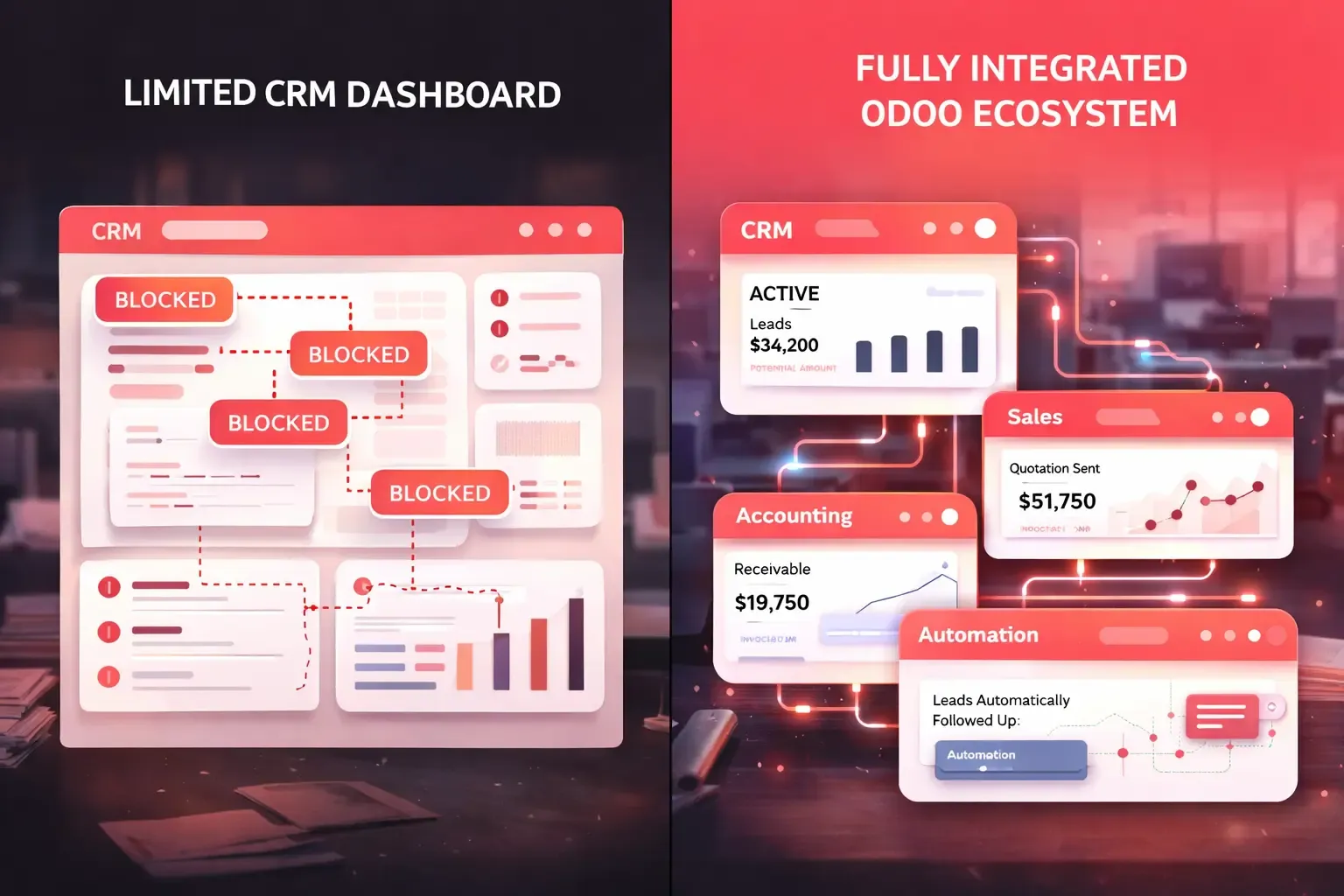
Odoo ERP replaces fragmented tools with a unified business platform. Instead of departments working in isolation, all modules operate from a single shared database.
That structure changes everything.
Unified Data Flow
When a salesperson confirms an order, Odoo automatically:
- Creates the invoice in accounting
- Updates inventory levels
- Triggers procurement if stock runs low
- Updates CRM records
- Reflects revenue in dashboards
No retyping. No file transfers. No reconciliation exercises.
Real-Time Visibility
Managers view live dashboards across finance, sales, logistics, and HR. Reporting shifts from weekly manual tasks to instant insights.
Built-In Automation Rules
Odoo allows companies to automate:
- Invoice generation
- Payment reminders
- Stock reordering
- Payroll calculations
- Approval workflows
- Customer communications
- Project billing
These rules remove repetitive admin work entirely.
Business Process Automation in Dubai: Why ERP Matters
Across Dubai’s logistics hubs, retail districts, trading companies, and service firms, process automation has become a competitive necessity.
ERP automation helps organizations:
- Reduce operational overhead
- Increase employee efficiency
- Improve data accuracy
- Support regulatory compliance
- Scale without adding admin staff
- Deliver faster customer service
Instead of hiring more people to manage complexity, businesses simplify systems and let software handle routine operations.
That shift directly attacks the root of manual data entry problems.
Comparing Manual Workflows vs Automated ERP Systems
Manual Environment
- Multiple databases
- Spreadsheet-based reporting
- Delayed financial closing
- Frequent reconciliation
- High error rates
- Disconnected departments
- Limited scalability
Odoo-Powered Environment
- Single source of truth
- Real-time dashboards
- Automated transactions
- Consistent records
- Faster month-end closing
- Integrated departments
- Growth-ready infrastructure
The contrast explains why ERP adoption continues to accelerate across UAE SMEs.
Real-World Scenarios Where Odoo Replaces Data Entry
Finance Teams
Instead of entering invoices manually, finance departments rely on sales orders flowing directly into accounting. VAT calculations, payment tracking, and reconciliation happen automatically.
Inventory and Warehousing
Stock updates sync instantly with purchases, sales, and deliveries. Barcode scanning reduces manual counts and spreadsheet dependency.
Sales Operations
Leads convert into quotations, orders, and contracts inside one platform. Customer history stays centralized, improving follow-ups and forecasting.
Marketing Departments
Campaign performance links directly to CRM records. Teams stop exporting lists and uploading contact files across systems.
HR and Payroll
Attendance, expenses, and salary calculations integrate into accounting without double entry.
How Automation Supports UAE Growth Strategies
The UAE’s business ecosystem rewards speed, accuracy, and scalability. Companies expanding across emirates or into international markets need systems that grow with them.
ERP automation allows organizations to:
- Open new branches without rebuilding processes
- Onboard staff faster
- Handle higher transaction volumes
- Maintain financial transparency
- Prepare for audits and investor due diligence
- Integrate new subsidiaries into existing operations
Instead of piling administrative work onto teams, businesses build lean digital foundations.
Is Manual Data Entry Holding Your Company Back?
If your organization still relies on spreadsheets and copy-paste workflows, ask yourself:
- How many systems require the same information?
- How long does monthly closing take?
- How often do teams reconcile numbers?
- How many staff hours go into reporting?
- How frequently do data errors surface?
- Could those employees focus on higher-value work?
These questions reveal whether manual processes quietly consume budget and momentum.
Final Thoughts: Replace Tasks, Not People
Manual data entry remains one of the most underestimated expenses in UAE operations. It slows growth, increases risk, and frustrates teams. Automation does not eliminate jobs. It eliminates wasteful tasks so employees can focus on strategy, service, and innovation.
Businesses planning to modernize operations often start by reviewing professional Odoo implementation services in Dubai from Milaaj Brandset when mapping how to replace repetitive workflows with a fully integrated ERP system.
If spreadsheets dominate your daily operations and staff spend hours moving data between platforms, it may be time to rethink your digital foundation and let automation handle the work humans were never meant to do.


Ready to Elevate Your Brand?
Start Your Project Today