February 13, 2026
Odoo Migration Without Downtime Dubai: How to Move Your Entire Business Without Disruption
Milaaj Editorial / Research Insights
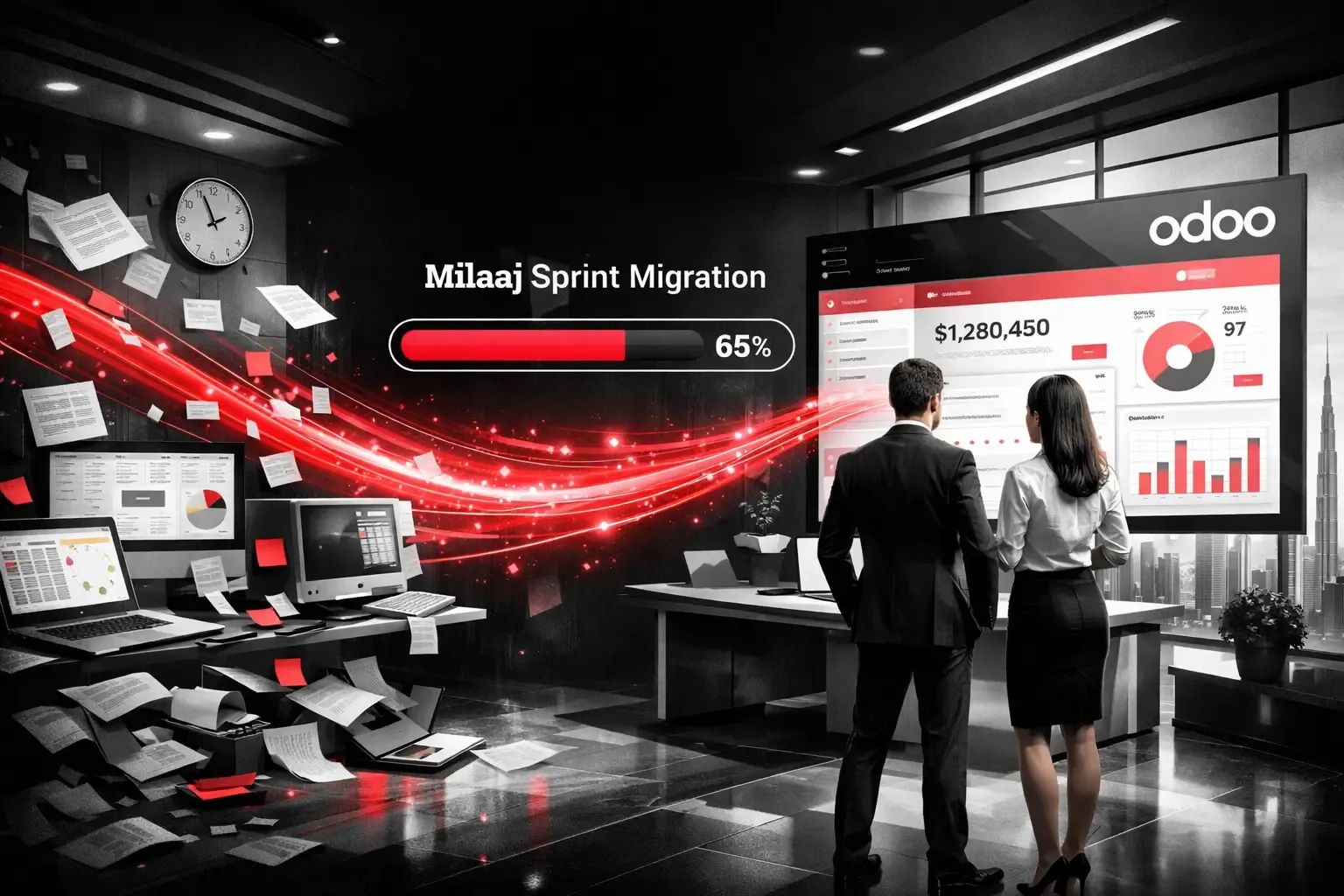
ERP migration has a reputation for disruption.
Many Dubai companies delay upgrading their systems because they fear billing interruptions, payroll delays, warehouse confusion, and reporting errors. When your ERP system controls accounting, sales, inventory, HR, and management dashboards, even one day of downtime feels risky.
However, modern ERP migration does not need to stop operations.
With a structured framework, businesses can complete an Odoo migration without downtime in Dubai while maintaining revenue flow, customer service, and compliance accuracy.
This guide explains how zero disruption ERP migration works and what makes it successful.
Why Traditional ERP Migration Causes Downtime
Most ERP failures happen because companies attempt to replace everything at once.
Common mistakes include:
- Turning off the old system before validating the new one
- Migrating unclean historical data
- Skipping workflow mapping
- Ignoring VAT compliance testing
- Training teams too late
- Customizing excessively before stabilization
Dubai businesses operate in fast cycles. Trading, retail, logistics, and services cannot pause operations for weeks.
Downtime usually comes from poor planning, not from the ERP system itself.
What Does “Odoo Migration Without Downtime Dubai” Really Mean?
Zero downtime does not mean instant transformation.
It means:
- Running old and new systems in parallel
- Migrating only essential operational data
- Validating financial and inventory reports before cutover
- Switching during low-risk business windows
- Providing real-time support during launch
The goal is continuity. Customers should not feel any system transition.
Step 1: Map Core Business Workflows
Every successful ERP migration begins with clarity.
Before configuring Odoo, it is essential to document:
- Sales processes and quotation flows
- VAT accounting procedures
- Inventory movement rules
- Procurement approvals
- HR payroll structures
- Management reporting requirements
- External integrations
This prevents blindly copying inefficiencies from a legacy ERP into a modern system.
Process optimization should happen during migration, not after it.
Step 2: Clean Data Before Migration
Data is often the biggest migration risk.
Businesses frequently store:
- Duplicate customer records
- Inconsistent supplier data
- Outdated inventory lists
- Spreadsheet-based tracking
- Redundant archived entries
A structured ERP migration focuses only on live operational data.
Typical migration scope includes:
- Active customers and vendors
- Product SKUs and stock balances
- Open invoices and payables
- Chart of accounts
- Employee records
- Current CRM pipelines
Historical records can remain archived separately.
Clean data ensures accurate reporting from day one.
Step 3: Configure Odoo in Parallel
Instead of shutting down your existing ERP, configure Odoo alongside it.
Core modules usually activated first:
- CRM
- Sales
- Accounting with UAE VAT compliance
- Inventory and warehouse
- Procurement
- Dashboards
Automation rules are configured early to eliminate manual tasks.
Because configuration runs parallel to operations, revenue continues uninterrupted.
Step 4: Validate Through Dual-System Testing
Parallel testing removes uncertainty.
During this stage, both systems run simultaneously while teams compare:
- Profit and loss statements
- VAT reports
- Inventory balances
- Customer statements
- Sales figures
- Aging reports
If discrepancies appear, they are resolved before final switchover.
This approach prevents post-launch financial surprises.
Step 5: Controlled Cutover During Low-Risk Window
The final switch to Odoo happens strategically.
Depending on business type, optimal timing may include:
- After month-end closing
- Over a weekend
- Between payroll cycles
- During a low-volume trading day
Because the system has already been validated, the transition feels smooth rather than risky.
Employees log in and continue their workflows normally.
Why Odoo Supports Zero Downtime Migration
Odoo’s architecture makes phased ERP migration practical.
Key advantages include:
- Modular structure
- Unified database
- Cloud-based deployment
- Real-time reporting
- Flexible API integrations
- Built-in automation tools
- UAE VAT compliance support
Instead of forcing a full system rebuild, Odoo allows gradual activation.
This flexibility is critical for companies seeking Odoo migration without downtime in Dubai.
Industries That Benefit Most
Retail and E-Commerce
Inventory and sales channels remain synchronized during transition. Stock accuracy prevents lost revenue.
Trading and Distribution
Procurement cycles and warehouse operations continue without shipment delays.
Professional Services
Timesheets, billing, and CRM activities stay operational during migration.
Manufacturing
Production planning and bill of materials migrate in structured phases.
Logistics
Shipment tracking, invoicing, and reporting stay active while systems transition.
Reducing Manual Work During ERP Migration
A well-executed ERP migration should reduce administrative effort immediately.
Automation can replace:
- Manual invoice creation
- Payment reminder follow-ups
- Stock reordering calculations
- Spreadsheet reporting
- Sales pipeline tracking
Instead of replicating inefficiencies, migration becomes an opportunity to modernize operations.
Risk Mitigation Strategies That Prevent Downtime
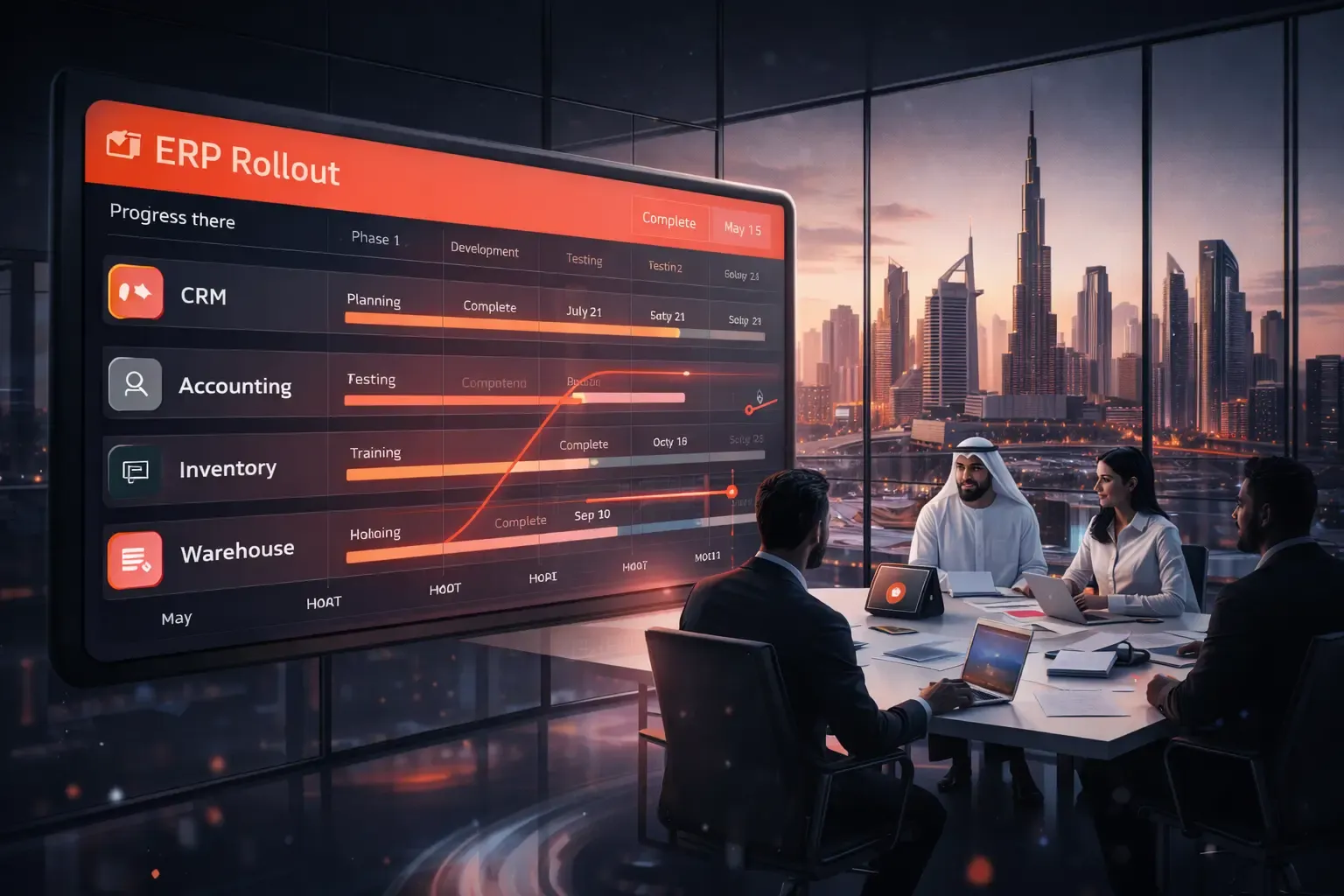
A structured Odoo migration without downtime in Dubai includes:
- Phased rollout
- Parallel testing
- Data validation checkpoints
- Rollback safety plans
- Role-based training
- Post-launch monitoring
- Continuous optimization
Each stage builds confidence before advancing to the next.
Risk decreases as visibility increases.
Signs Your Business Needs a Structured ERP Migration
You may need migration if:
- Teams rely heavily on spreadsheets
- Reports require manual consolidation
- Month-end closing takes too long
- SaaS subscriptions are increasing
- Data duplication causes confusion
- Growth is outpacing system capability
- Leadership lacks real-time dashboards
Delaying modernization increases operational cost over time.
What Happens After Migration?
Once stabilized, businesses can expand Odoo capabilities by adding:
- HR and payroll modules
- Marketing automation
- E-commerce integrations
- Helpdesk systems
- Manufacturing planning
- Advanced BI dashboards
- Custom workflows
Because the foundation is clean, scaling becomes seamless.
Final Thoughts: Upgrade Without Interruption
ERP transformation should strengthen operations, not interrupt them.
A structured approach makes Odoo migration without downtime Dubai a practical reality for growing companies. By prioritizing workflow clarity, clean data, parallel validation, and strategic cutover timing, businesses modernize systems without pausing momentum.
Companies exploring professional Odoo implementation services in Dubai often begin by evaluating how a phased migration strategy protects revenue while accelerating digital transformation.
If your current ERP system limits visibility, increases manual work, or slows reporting, upgrading without disruption is entirely achievable with the right framework.
Ready to Elevate
Your Brand?
Start Your Project Today