February 6, 2026
From Shopify & Mailchimp to Odoo: Consolidate Your Dubai E-Commerce Stack
Milaaj Editorial / Research Insights
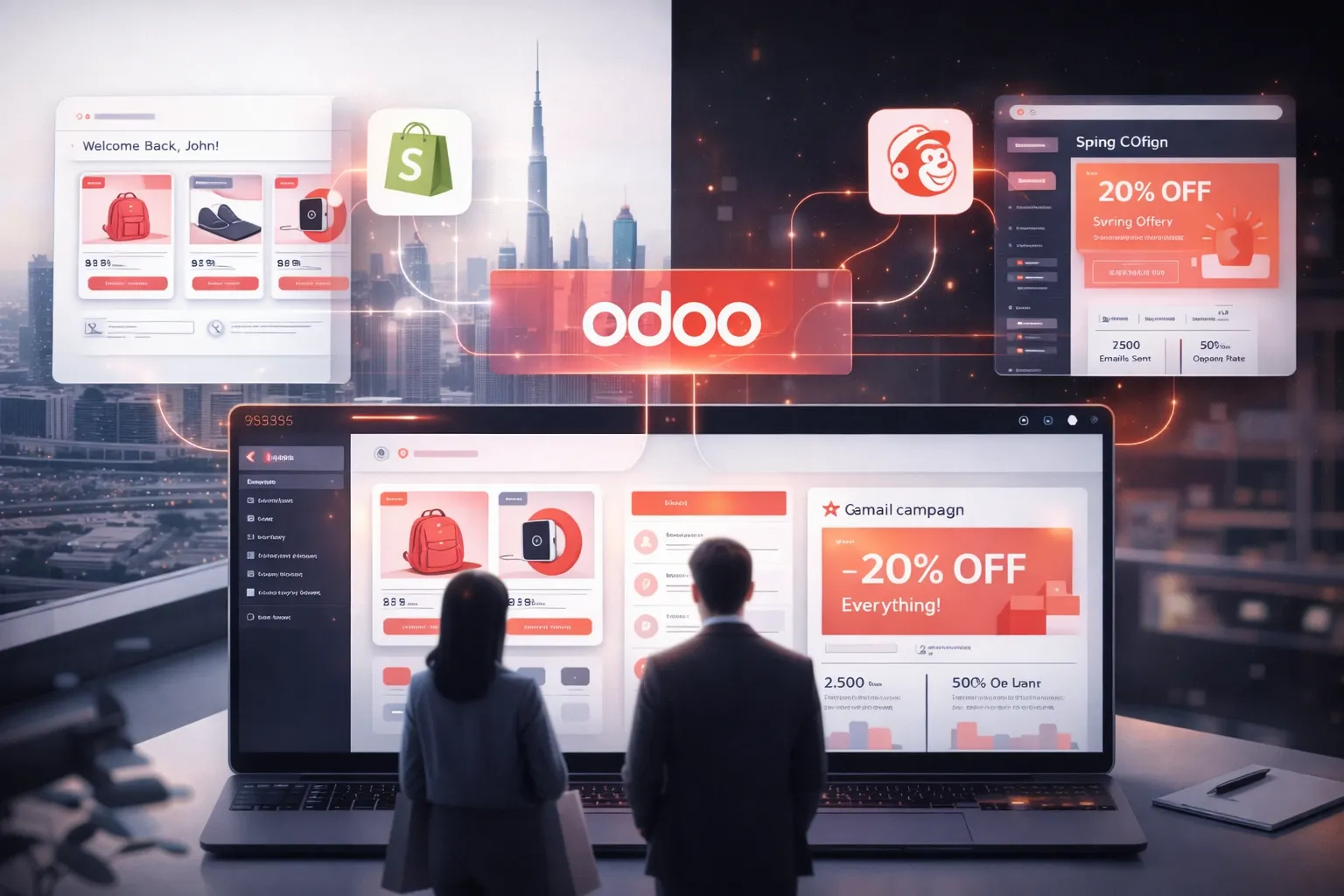
Dubai’s e-commerce market moves fast. Online retailers launch new stores, expand into marketplaces, open warehouses, and scale marketing campaigns almost overnight. To keep up, many businesses adopt popular SaaS tools like Shopify for storefronts and Mailchimp for email marketing. Add accounting software, inventory systems, CRM platforms, shipping tools, and analytics dashboards, and the stack quickly becomes complex.
At first, this setup works. Each tool solves a specific problem. Over time, however, disconnected systems begin to slow growth, inflate subscription costs, and create reporting blind spots.
That is why more retailers now explore the move from Shopify & Mailchimp to Odoo Dubai companies increasingly consider when they want one integrated platform instead of multiple subscriptions.
This guide explains how e-commerce businesses in the UAE can consolidate operations with Odoo ERP, eliminate SaaS sprawl, improve customer visibility, and prepare for long-term growth.
Why Dubai E-Commerce Businesses End Up with Fragmented Software
Most online retailers never plan to build a complicated technology stack. It grows organically.
A store launches on Shopify.
Marketing adds Mailchimp for campaigns.
Finance adopts accounting software.
Operations installs inventory management.
Logistics uses shipping tools.
Customer support deploys ticketing systems.
Each department chooses what works best in the moment. Months later, leadership manages five or six platforms that barely communicate.
This fragmentation causes:
- Duplicate customer records
- Manual exports between systems
- Inventory mismatches
- Delayed financial reporting
- Rising SaaS subscriptions
- Heavy reliance on spreadsheets
In competitive UAE markets, these inefficiencies become costly.
What Does It Mean to Consolidate Your E-Commerce Stack
Consolidation does not mean sacrificing functionality. It means running your storefront, marketing, CRM, accounting, warehouse operations, and reporting inside one ERP ecosystem.
When companies shift from Shopify & Mailchimp to Odoo Dubai retailers typically aim to achieve:
- Unified customer data
- Real-time inventory visibility
- Automated invoicing
- Campaign-to-revenue tracking
- VAT-ready accounting
- Centralized dashboards
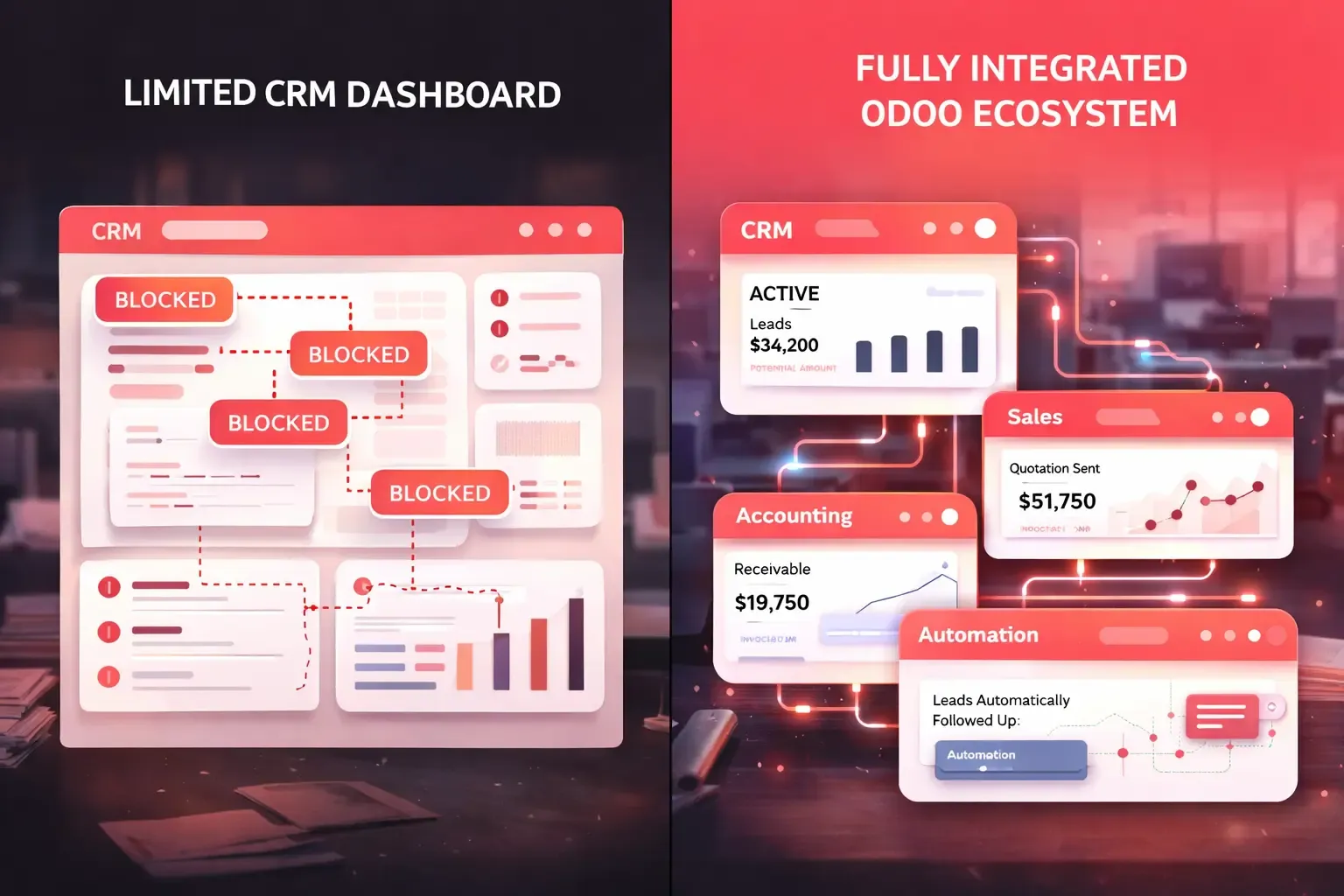
Instead of syncing five tools, teams work inside one environment where information flows automatically.
What Is Odoo and Why UAE Retailers Are Adopting It
Odoo is a modular Enterprise Resource Planning platform used globally across retail, manufacturing, logistics, and services. Businesses deploy only the modules they need today and expand later.
Core Odoo Modules for E-Commerce
Odoo supports:
- E-commerce storefronts
- CRM and sales pipelines
- Email marketing and automation
- Accounting and VAT compliance
- Inventory and warehouse management
- Purchasing and vendor control
- Shipping integrations
- POS systems
- Customer portals
- Business intelligence dashboards
All modules share one database. A sale updates stock, triggers an invoice, logs the customer journey, and feeds analytics automatically.
This unified architecture explains why UAE retailers evaluate Shopify Mailchimp to Odoo Dubai transitions as part of long-term digital transformation strategies.
The Hidden Cost of Running Shopify, Mailchimp, and Multiple Add-Ons
Shopify and Mailchimp are powerful tools on their own, but they rarely operate alone. E-commerce stores usually add:
- Accounting integrations
- Inventory connectors
- Shipping plugins
- Analytics tools
- CRM platforms
- Subscription management systems
Each add-on brings:
- Extra monthly fees
- Setup costs
- API limitations
- Maintenance work
- Data sync delays
Over a year, these hidden costs can rival or exceed ERP licensing.
Beyond money, staff lose hours reconciling mismatched data. Marketing teams struggle to connect campaigns with real profitability. Operations face stock issues during promotions. Finance waits for reports.
These problems push leadership to reconsider fragmented architectures.
How Odoo Replaces Shopify and Mailchimp in One Platform
Odoo does not simply replicate features. It integrates them into a broader business system.
Odoo E-Commerce vs Shopify
Odoo provides built-in storefronts, product catalogs, pricing rules, promotions, payment gateways, and customer accounts. Unlike standalone platforms, it connects directly to accounting, inventory, and CRM without third-party connectors.
Odoo Marketing Automation vs Mailchimp
Email campaigns, segmentation, newsletters, lead nurturing, and event marketing live inside the same system that stores customer orders and lifetime value.
Unified CRM and Customer Journey
Every interaction from first email click to repeat purchase stays attached to one customer profile.
This is the strategic advantage of moving from Shopify & Mailchimp to Odoo Dubai retailers increasingly seek.
Why This Matters for Dubai and UAE E-Commerce
Local businesses face regulatory, operational, and expansion pressures that fragmented stacks handle poorly.
Odoo supports:
- VAT-compliant accounting
- Arabic and English interfaces
- Multi-currency transactions
- Multi-warehouse operations
- Branch-level reporting
- Cross-border sales
- Marketplace integrations
For retailers scaling across emirates or exporting internationally, ERP consolidation becomes essential.
Signs Your E-Commerce Stack Needs Consolidation
You may be ready to move if:
- Inventory numbers differ across systems
- Finance cannot link marketing spend to profit
- Reports take days to compile
- Customer data appears in multiple tools
- SaaS bills increase every quarter
- Teams rely heavily on spreadsheets
- Integrations break after updates
These are classic indicators of SaaS sprawl.
Step-by-Step: Transitioning from Shopify & Mailchimp to Odoo
Switching platforms does not have to disrupt operations. Successful UAE retailers usually follow a phased approach.
1. Audit Your Current Tools
List every subscription, plugin, connector, and support contract.
2. Map Business Processes
Document how orders flow, how returns work, and how invoices close.
3. Select Odoo Modules
Start with e-commerce, CRM, marketing automation, accounting, and inventory.
4. Clean and Migrate Data
Move customers, products, orders, suppliers, and financial history carefully.
5. Configure VAT and Compliance
Set up tax rules and reporting aligned with UAE regulations.
6. Train Teams
Department-specific sessions accelerate adoption and reduce resistance.
7. Optimize After Launch
Add automation rules, dashboards, and forecasting once live.
This roadmap ensures retailers gain full value from consolidation.
Industry Scenarios Across Dubai
Fashion and Lifestyle Brands
Unified storefronts, POS systems, inventory across warehouses, and email campaigns under one ERP.
Electronics Retailers
Serialized inventory tracking, warranty management, online stores, and accounting integrated.
Grocery and FMCG Sellers
Demand forecasting tied to promotions and real-time stock replenishment.
Marketplace Sellers
Orders from multiple channels routed into one system for fulfillment and finance.
Each scenario shows how consolidation improves speed and control.
The Financial Upside of ERP-Driven E-Commerce
Savings come from multiple directions.
Direct Cost Reductions
- Cancelled SaaS subscriptions
- Fewer plugins and connectors
- Reduced middleware tools
- Lower IT maintenance
Operational Gains
- Faster order processing
- Improved stock accuracy
- Clear campaign ROI
- Reduced reconciliation work
- Faster month-end closing
Over time, these benefits often outweigh the cost of ERP deployment.
Why ERP Consolidation Supports Long-Term Growth
Unified data enables:
- Accurate demand forecasting
- Smarter procurement
- Better pricing strategies
- Customer lifetime value analysis
- Expansion planning
- Investor reporting
- Regulatory compliance
Instead of reacting to problems, leadership makes decisions from real-time insights.
Final Thoughts: Build a Smarter E-Commerce Stack in Dubai
Running Shopify, Mailchimp, accounting software, inventory platforms, and shipping tools separately may work in early stages, yet fragmentation eventually slows momentum.
Moving from Shopify & Mailchimp to Odoo Dubai retailers increasingly evaluate offers a path toward operational clarity, lower overhead, and scalable growth.
For businesses exploring unified platforms in the UAE, Milaaj Brandset quietly supports this transition through its Odoo implementation services in Dubai, helping retailers align storefronts, marketing, finance, and warehouses inside one future-ready ERP ecosystem.
Simplifying your technology today often becomes the foundation for sustainable e-commerce success tomorrow.

Ready to Elevate Your Brand?
Start Your Project Today