August 15, 2026
AI Search Optimization Strategies for Businesses
Milaaj Editorial / Research Insights
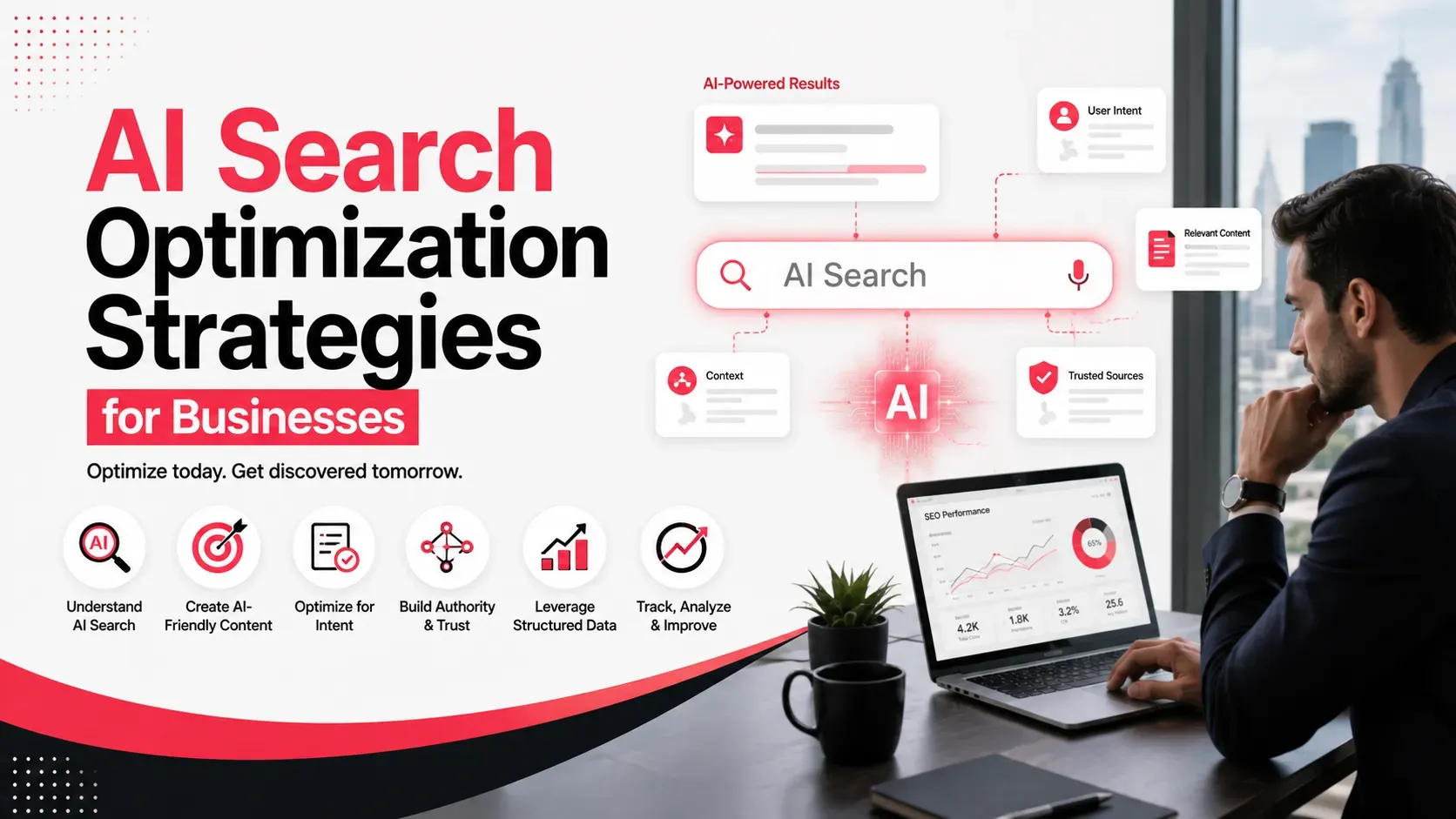
AI is changing how people discover businesses, products, and services online. Instead of typing a short keyword into a search engine and scanning several blue links, users can now ask detailed questions and receive synthesized answers from AI-powered search experiences.
Google's AI Overviews and AI Mode are designed to handle more complex and conversational searches while still connecting users to relevant websites. Google's current guidance makes an important point: the fundamentals of SEO remain the foundation for visibility in AI search. There is no special "AI ranking trick" or separate markup that guarantees inclusion.
For businesses, this changes the optimization goal. It is no longer enough to ask, "How do I rank this page?"
A better question is:
"How can I make my business and its expertise easy for search systems to understand, trust, retrieve, and recommend?"
Quick Answer
AI search optimization is the process of improving a business's website, content, brand signals, and technical foundations so that its information can be discovered and understood across AI-powered search experiences.
The most effective strategies include:
- Create genuinely useful, original content.
- Answer specific customer questions clearly.
- Build topical authority around important subjects.
- Make the business entity and expertise easy to understand.
- Demonstrate first-hand experience and credibility.
- Strengthen technical SEO and crawlability.
- Use appropriate structured data without relying on it as an AI shortcut.
- Build relevant brand mentions and third-party authority.
- Optimize for conversational, local, visual, and shopping searches.
- Measure business outcomes rather than focusing only on rankings.
What Is AI Search Optimization?
AI search optimization is often discussed alongside terms such as Answer Engine Optimization (AEO) and Generative Engine Optimization (GEO).
The terminology can make these strategies sound completely separate from SEO. Google's own documentation takes a simpler view: optimizing for generative AI search is fundamentally part of optimizing for search itself.
The difference is primarily in how information is discovered and presented.
Traditional search may return:
An AI search experience may instead interpret several related queries, retrieve information from multiple sources, and generate a response with supporting links.
That means businesses need content that works at both levels:
Search-friendly + useful to people + clear enough for AI systems to interpret.
How AI Search Understands Business Information
Modern AI search systems can retrieve information from search indexes and use multiple related queries to build a more complete response.
Google describes this process using concepts such as retrieval-augmented generation and query fan-out, where an initial question can lead to multiple related searches to gather additional information.
For example, someone might ask:
"What is the best digital marketing agency for a Dubai e-commerce company?"
The underlying research could involve questions about:
- Digital marketing services
- E-commerce expertise
- Dubai market experience
- SEO capabilities
- Paid advertising
- Client experience
- Brand credibility
This is why optimizing one page for one keyword is becoming a weaker strategy.
Businesses should instead build a connected body of useful information.
1. Create Content That Directly Answers Customer Questions
One of the simplest ways to prepare for AI search is to understand what customers actually want to know.
Instead of creating content around only broad keywords, build resources around questions such as:
- What does this service cost?
- Which option is better for my business?
- How long does implementation take?
- What problems does this product solve?
- What should I check before buying?
- What are the risks?
- Which solution works for a small business?
A strong article should answer the main question quickly and then provide enough depth for someone who wants to investigate further.
This approach also makes content useful outside search engines.
If a visitor arrives directly from an AI recommendation, they should find the answer they expected.
2. Build Topical Authority
A business should not rely on one article to establish expertise.
Instead, create a connected topic ecosystem.
For example, a digital marketing company could develop content around:
Digital Marketing
→ SEO
→ AI search
→ Paid advertising
→ Social media
→ Content marketing
→ Analytics
→ Lead generation
Each major subject can then contain supporting articles that answer increasingly specific questions.
Internal links connect these resources and help users navigate from broad concepts to detailed information.
The objective isn't to publish hundreds of pages.
It is to build depth around the subjects that matter to the business.
3. Make Your Business Entity Clear
AI systems need to understand what a business actually is.
Your website should clearly communicate:
- Business name
- Primary services
- Products
- Locations
- Target customers
- Industries served
- Areas of expertise
- Team information
- Contact details
- Relevant credentials
Avoid making search systems infer important information from scattered pages.
For example, if a company provides SEO services in Dubai, that information should be clear through its service pages, company information, relevant content, and consistent external references.
The stronger the information architecture, the easier it becomes to establish relationships between the company, its services, location, and expertise.
4. Demonstrate First-Hand Experience
AI makes it easy to produce generic explanations.
That makes genuine experience more valuable.
A business can differentiate its content through:
- Case studies
- Original research
- Customer examples
- Before-and-after comparisons
- Screenshots
- Expert opinions
- Industry observations
- Implementation lessons
- Original statistics
Consider two articles discussing website redesign.
One simply summarizes common recommendations.
The other explains how a company approached a redesign, what problems were discovered, what changed, and what happened afterward.
The second provides information that is much harder to replicate.
Google continues to emphasize original, helpful, people-first content rather than content created primarily to manipulate search rankings.
5. Structure Content for Easy Retrieval
Good content structure helps both readers and search systems.
Use:
- Clear H2 and H3 headings
- Short paragraphs
- Descriptive subheadings
- Bullet lists
- Tables where genuinely useful
- Direct answers
- Relevant examples
- Logical transitions
For example, instead of burying a definition inside a 500-word introduction, start with a concise explanation and then expand.
This creates a better experience for someone scanning the article and makes important information easier to identify.
However, don't turn every paragraph into a two-line answer simply because you are targeting AI.
Depth still matters when the topic requires it.
6. Strengthen Technical SEO Foundations
AI search does not eliminate technical SEO.
Google specifically states that pages need to meet its normal Search technical requirements to be eligible as supporting links in AI Overviews and AI Mode.
Businesses should therefore maintain:
- Crawlable pages
- Proper indexing
- Logical internal links
- Mobile-friendly layouts
- Good page experience
- Accessible important content
- Clean URL structures
- Appropriate canonicalization
- Fast and reliable websites
JavaScript-heavy websites also need to ensure important content isn't inaccessible to search systems.
Technical SEO is essentially the infrastructure that allows your content to participate in search in the first place.
7. Use Structured Data Correctly
Structured data can help search engines understand specific types of information.
Depending on the website, relevant implementations may include:
- Organization
- LocalBusiness
- Product
- Article
- Breadcrumb
- Other supported schema types
But businesses should avoid treating schema as an AI-search shortcut.
Google explicitly says there is no special schema.org markup required for AI Overviews or AI Mode. Structured data should also accurately represent the visible content on the page.
In other words:
Use structured data to describe real information—not to manufacture signals.
8. Build Relevant Brand Mentions
Your website is not the only place where your business exists online.
Search systems can encounter information through many sources, including reputable publications, industry websites, reviews, business profiles, and other relevant platforms.
Businesses can strengthen their broader digital presence through:
- Industry publications
- Digital PR
- Expert interviews
- Business directories
- Professional associations
- Customer reviews
- Partnerships
- Original research
The goal isn't to obtain thousands of mentions.
A handful of relevant, credible references can be more meaningful than a large collection of low-quality links.
This is particularly important for competitive markets where several businesses may offer similar services.
9. Optimize for Local and UAE Search
For UAE businesses, AI search optimization should include local context.
Make sure your online presence clearly communicates:
- City or emirate
- Service areas
- Business location
- Contact information
- Local expertise
- Products or services available locally
- Relevant customer experience
Keep information consistent across your website and important business profiles.
For local businesses, Google's current guidance also recommends keeping Business Profile information up to date.
A company targeting Dubai customers should not rely entirely on a generic "best service provider" article.
Its content should demonstrate why its offering is relevant to Dubai customers and their specific needs.
10. Optimize for Conversational and Multimodal Search
Search queries are becoming more natural.
Users may ask:
rather than:
Your content should accommodate both.
Cover the underlying question, related considerations, comparisons, and practical decisions.
Multimodal search adds another dimension.
Users can increasingly combine text, images, and other inputs during search. Google has highlighted the growth of more complex and multimodal queries in its AI Search development.
Businesses should therefore support important written information with:
- High-quality images
- Demonstration videos
- Descriptive image text
- Product information
- Useful visual explanations
11. Connect Your Content With Internal Links
Internal linking becomes especially useful when a website contains several related resources.
Instead of creating isolated blog posts, connect them logically.
For example:
AI Search Optimization
→ Future of SEO
→ GEO
→ AI Overviews
→ E-E-A-T
→ SEO services
This gives readers a clear path through the subject.
It can also help search engines discover and understand relationships between pages.
The important point is relevance.
Don't add a link simply because another page exists.
Ask:
Would this link help the reader understand or act on the subject?
12. Measure AI Search Visibility
AI search introduces new measurement challenges.
A business shouldn't assume there is one universal "AI ranking" that can be tracked like a traditional keyword position.
Instead, monitor a combination of:
- Organic impressions
- Organic conversions
- Branded searches
- Referral traffic
- Relevant search queries
- Brand mentions
- AI citations where measurable
- Qualified leads
- Revenue influenced by organic discovery
Google introduced dedicated Search Console reporting for visibility from generative AI features such as AI Overviews and AI Mode in June 2026, initially rolling the reports out to a subset of websites.
As measurement tools develop, businesses should focus on visibility and commercial outcomes, not just whether a particular prompt produces a mention.
Common AI Search Optimization Mistakes
Publishing Large Volumes of Generic AI Content
AI can accelerate production, but publishing pages without meaningful value can create a weaker website.
Google warns that generating many pages with AI without adding value can fall under its scaled content abuse policies.
Optimizing Only for Keywords
Modern search is increasingly conversational and contextual. Keyword research remains useful, but it should inform a broader understanding of customer intent.
Creating Fake Expertise
Adding superficial claims of expertise doesn't replace actual experience.
Use real examples, evidence, authorship, and useful insights.
Ignoring Technical SEO
A brilliant article cannot perform properly if important pages cannot be crawled, indexed, or accessed.
Chasing AI-Specific Tricks
There is no guaranteed prompt, markup, or hidden file that forces a business into AI search results.
Google explicitly states that existing SEO fundamentals remain the foundation for AI features.
Measuring Only Traffic
A smaller number of highly qualified visitors can be more commercially valuable than a large volume of low-intent traffic.
AI Search Optimization Checklist
Before considering a page or website ready for AI search, ask:
- Is the business clearly identified?
- Is the target audience obvious?
- Does the content answer genuine customer questions?
- Is there original information or experience?
- Are important pages crawlable and indexable?
- Are internal links logical?
- Is the information consistent across the website?
- Is structured data accurate where used?
- Are local business details current?
- Does the website demonstrate expertise?
- Are relevant external brand signals being built?
- Are meaningful business outcomes being measured?
If most answers are yes, the website is already moving in the right direction.
Key Takeaways
- AI search optimization is an extension of strong SEO rather than a replacement for it.
- There is no guaranteed AI-search shortcut or special schema that forces visibility.
- Original, useful, people-first content remains central.
- Businesses should answer specific customer questions instead of targeting keywords in isolation.
- Clear entity information helps search systems understand what a business does.
- First-hand experience can make content substantially more valuable.
- Technical SEO remains essential for AI search eligibility.
- Local businesses should strengthen location and Business Profile information.
- Relevant third-party mentions can support broader brand authority.
- AI search measurement should focus increasingly on qualified visibility and business outcomes.
Conclusion
AI search is changing the way customers discover information, but the fundamentals of successful digital visibility are surprisingly familiar.
Businesses still need useful content, strong websites, credible expertise, clear information, and a positive customer experience.
The difference is that these assets now need to work across a wider discovery environment where people may interact with traditional search results, AI-generated answers, conversational interfaces, and multimodal search during the same journey.
The best AI search optimization strategy is therefore not to write specifically for machines. It is to make your business genuinely useful, clearly understood, technically accessible, and easy to trust.
For businesses that need to turn these principles into a broader organic growth strategy, SEO services in Dubai can help connect technical optimization, content, authority, and search visibility. Milaaj Brandset brings these capabilities together to help businesses build stronger long-term digital visibility.
AI search will continue to evolve. Businesses that build strong digital foundations now will be better positioned to adapt as the interfaces and the way customers search continue to change.
Frequently Asked Questions
What is AI search optimization?
AI search optimization is the practice of improving a website's content, technical foundations, business information, and authority so that it can be effectively discovered and understood within AI-powered search experiences as well as traditional search.
How can a business appear in AI-generated answers?
There is no guaranteed method. Google recommends following normal SEO fundamentals, creating helpful and unique content, ensuring pages are crawlable and indexed, and providing information that genuinely satisfies users.
Is AI search optimization different from SEO?
It is better viewed as an evolution of SEO. Google's current guidance says SEO best practices remain relevant because its generative AI search features rely on core Search systems.
Does ChatGPT SEO guarantee visibility in ChatGPT?
No. No legitimate optimization strategy can guarantee that an AI system will mention a particular business. The practical approach is to build authoritative, accurate, discoverable information across the web.
How long does AI search optimization take?
There is no universal timeframe. Technical improvements can sometimes be implemented quickly, while building topical authority, brand recognition, and external credibility generally requires sustained effort.
How should businesses measure AI search optimization?
Track a combination of organic visibility, qualified traffic, conversions, branded demand, relevant mentions, AI citations where measurable, and revenue-related outcomes rather than relying on a single AI visibility score.
Ready to Elevate Your Brand?
Start Your Project Today