August 13, 2026
AI Trends Changing Business Marketing in UAE
Milaaj Editorial / Research Insights
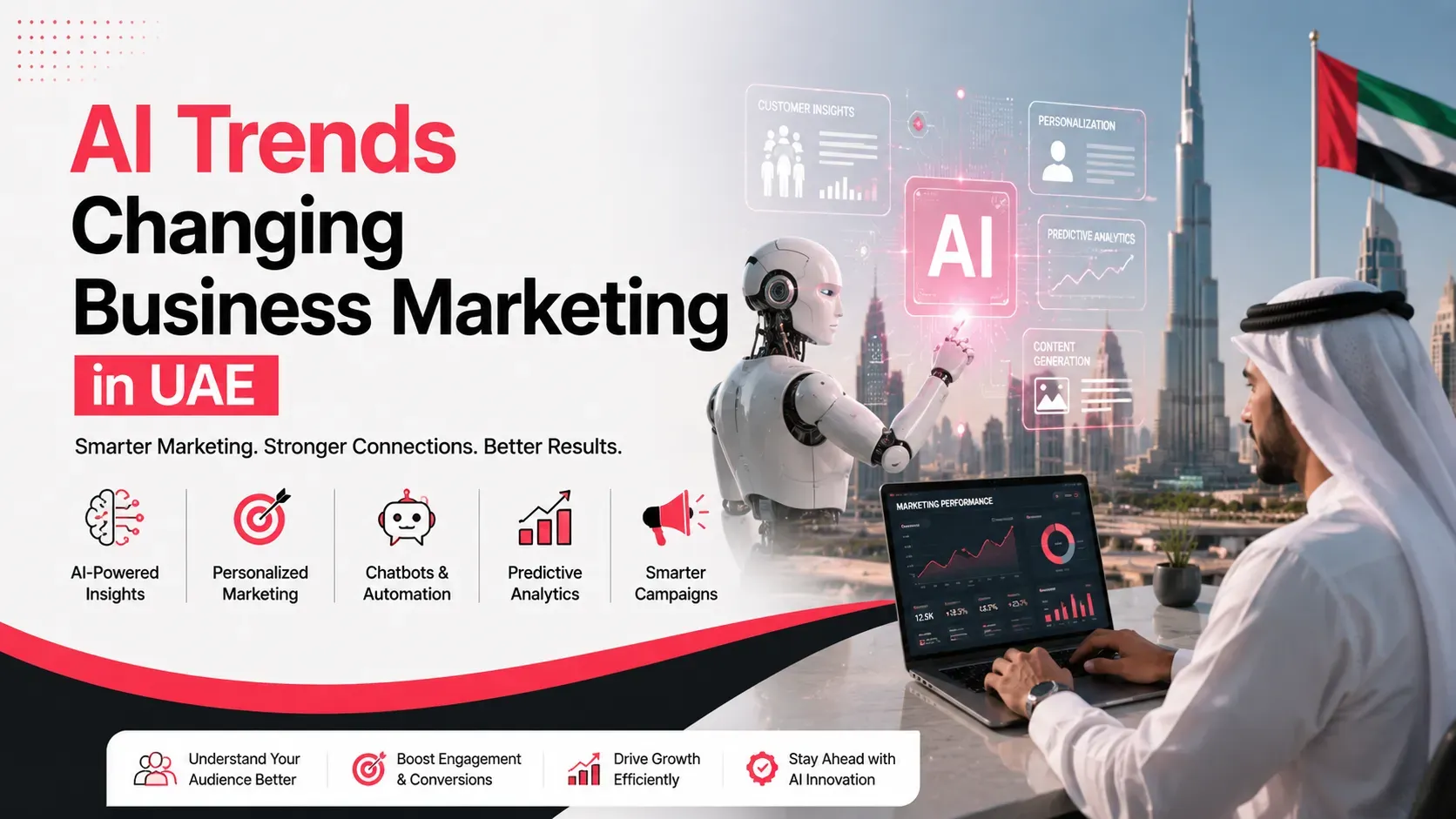
Artificial intelligence is moving from an experimental technology to a practical part of how businesses in the UAE attract, understand, convert, and retain customers. Marketing teams are increasingly using AI for personalization, content production, customer interactions, analytics, advertising, and automation.
This shift is particularly relevant in the UAE, where government-led AI initiatives and strong digital adoption are accelerating the move toward AI-enabled business operations. The UAE's National AI Strategy 2031 continues to support the country's ambition to become a global leader in artificial intelligence. In 2026, the shift is increasingly moving from isolated AI tools toward AI being integrated into broader business processes.
For marketers, the important question is no longer simply whether to use AI. It is where AI can create measurable value without weakening creativity, trust, or the customer relationship.
Quick Answer
The major AI trends changing business marketing in the UAE include hyper-personalization, AI-powered content creation, predictive analytics, conversational AI, automated lead qualification, AI-driven advertising, visual and voice search, AI search visibility, and increasingly autonomous marketing workflows.
However, successful adoption is not about automating every marketing task. UAE businesses need to combine AI's speed and analytical capabilities with human strategy, local market knowledge, creativity, and responsible data practices.
Why AI Marketing Matters in the UAE
The UAE is a particularly interesting market for AI-driven marketing because its customer base is highly diverse and digitally connected.
Businesses may need to communicate with customers from different nationalities, languages, cultures, and purchasing backgrounds. Traditional audience segmentation can struggle to capture that complexity.
Research from INSEAD highlights how generative AI can enable more individualized marketing experiences in the UAE's unusually diverse consumer environment.
At the same time, businesses are under increasing pressure to use AI strategically rather than simply experiment with individual tools. UAE companies are moving toward larger-scale AI adoption, including agentic systems and AI-enabled business processes.
1. Hyper-Personalized Marketing at Scale
Personalization has been part of digital marketing for years, but AI is making it possible to move beyond basic audience segmentation.
Instead of showing the same message to an entire customer segment, AI can analyze signals such as:
- Browsing behavior
- Previous purchases
- Content engagement
- Location
- Product interests
- Customer interactions
- Purchase patterns
This allows businesses to adjust messaging and recommendations to individual users.
For UAE businesses serving diverse audiences, this can be particularly useful.
An e-commerce company, for example, could personalize product recommendations based on browsing and purchase behavior rather than relying solely on broad demographic categories.
The goal is not to make every interaction different for the sake of personalization. It is to make marketing more relevant.
2. AI-Powered Content Creation
Generative AI is changing how marketing teams produce content.
It can help marketers create initial versions of:
- Blog outlines
- Social media posts
- Email campaigns
- Ad variations
- Product descriptions
- Video scripts
- Research summaries
This can significantly reduce production time.
But faster production does not automatically mean better marketing.
Businesses still need human oversight to maintain:
- Brand voice
- Accuracy
- Originality
- Cultural relevance
- Strategic direction
The growing volume of AI-generated content also makes originality more important. Recent industry discussion has highlighted concerns about generic AI-generated material and its potential impact on professional credibility.
The competitive advantage will therefore come less from simply using AI and more from using AI while producing content that still feels informed and distinctive.
3. AI-Powered Customer Conversations
Conversational AI is becoming more useful for businesses that receive large numbers of customer enquiries.
AI assistants can help answer common questions about:
- Products
- Services
- Pricing
- Availability
- Appointments
- Delivery
- Policies
- Basic troubleshooting
For businesses operating outside traditional working hours, this can reduce response delays.
More advanced systems can also qualify leads before passing them to sales teams.
For example, an AI assistant could identify:
What does the customer need? → How urgently do they need it? → What service are they interested in? → Are they ready to speak with sales?
This allows sales teams to spend more time on qualified opportunities.
4. Predictive Analytics for Better Marketing Decisions
Traditional analytics explains what happened.
AI can help businesses estimate what may happen next.
Predictive models can identify patterns related to:
- Customer churn
- Purchase probability
- Lead quality
- Product demand
- Customer lifetime value
- Campaign performance
For example, instead of treating every lead equally, a business could use behavioral signals to identify which prospects are more likely to convert.
Marketing teams can then prioritize resources accordingly.
This turns analytics from a reporting function into a more proactive decision-making system.
5. AI-Driven Advertising Optimization
Paid advertising platforms already use machine learning extensively for targeting, bidding, delivery, and campaign optimization.
The next step is broader AI-assisted campaign management.
AI can help marketers test combinations of:
- Headlines
- Images
- Videos
- Audiences
- Offers
- Landing pages
- Calls to action
This creates a much larger testing environment than a small marketing team could manage manually.
However, businesses still need to establish the strategic parameters.
AI can optimize toward the goal it is given. It cannot independently determine whether the goal itself is commercially meaningful.
6. AI Lead Scoring and Qualification
Not every enquiry deserves the same sales effort.
AI-powered lead scoring can analyze customer information and behavior to identify prospects that show stronger buying signals.
A system might consider:
- Pages visited
- Forms completed
- Previous interactions
- Company information
- Requested service
- Engagement frequency
- Purchase history
High-intent prospects can then be routed to sales faster.
This can be particularly useful for UAE businesses handling high volumes of enquiries through websites, social platforms, advertising campaigns, and messaging channels.
7. AI Search Is Changing Brand Discovery
One of the biggest emerging changes in digital marketing is the growth of AI-assisted search and recommendation.
Customers increasingly use conversational AI tools to research:
- Products
- Services
- Companies
- Destinations
- Software
- Restaurants
- Business providers
This creates a new visibility question:
Does an AI system understand and recognize your brand when customers ask relevant questions?
Traditional SEO remains important, but businesses also need clear information about who they serve, what they offer, where they operate, and what makes them credible.
This is contributing to the growth of strategies around AI search optimization and generative engine optimization.
The objective is not simply to rank a webpage. It is to make a business sufficiently clear, authoritative, and discoverable across modern search environments.
8. Voice and Visual Search Will Become More Relevant
Search is becoming increasingly multimodal.
Customers can use:
- Voice queries
- Images
- Screenshots
- Visual product searches
- Conversational questions
For businesses, this means product and service information needs to be structured clearly.
E-commerce brands should pay particular attention to:
- Product descriptions
- Images
- Structured information
- FAQs
- Attributes
- Reviews
Local businesses should ensure their location, services, contact information, and business identity are consistently represented online.
9. AI-Powered Marketing Automation
Automation is moving beyond simple scheduled workflows.
AI can increasingly help determine:
- Which customer should receive a message
- What information they may need
- When to contact them
- Which content to recommend
- When a lead should be escalated
- Which follow-up action makes sense
This creates more responsive marketing journeys.
For example:
Ad interaction → website visit → AI lead qualification → CRM update → personalized follow-up → sales notification
Instead of managing each stage manually, businesses can connect them into a coordinated system.
10. Agentic AI Will Change Marketing Workflows
One of the more important developments in 2026 is the move from AI that simply generates outputs toward AI systems that can perform multi-step tasks.
UAE institutions are already exploring and implementing agentic AI at an organizational level, with the federal government establishing a framework for agentic AI deployment across ministries and entities.
For marketing, agentic systems could eventually coordinate workflows such as:
Identify opportunity → research audience → create campaign assets → launch workflow → monitor performance → recommend adjustments
Human approval will remain important, especially for brand-sensitive and high-impact decisions.
But the role of marketers may increasingly shift from manually executing every task to designing, supervising, and improving AI-enabled systems.
11. AI Will Make Data Quality More Important
AI is only as useful as the information available to it.
Poor customer data can lead to:
- Incorrect personalization
- Bad recommendations
- Weak lead scoring
- Inaccurate predictions
- Conflicting customer information
Businesses therefore need to improve their underlying data infrastructure.
That includes:
- Clean CRM records
- Consistent customer identifiers
- Accurate analytics
- Clear consent practices
- Proper data governance
- Connected marketing systems
AI adoption should therefore be treated as a data and process project, not simply a software purchase.
12. Human Creativity Will Become More Valuable
AI can produce content quickly.
That may actually make genuinely creative thinking more valuable.
When thousands of brands can generate similar:
- Blog posts
- Images
- Ad copy
- Social captions
- Email messages
generic content becomes easier to ignore.
Human marketers still provide:
- Brand perspective
- Cultural understanding
- Original ideas
- Emotional intelligence
- Strategic judgment
- Storytelling
Current industry thinking increasingly emphasizes using AI to enhance human creativity rather than replacing it.
The strongest approach is therefore AI-enabled, human-led marketing.
How UAE Businesses Should Prepare for AI Marketing
Businesses don't need to implement every new AI technology immediately.
A more practical approach is to start with a measurable business problem.
Step 1: Identify a Bottleneck
For example:
- Slow lead response
- High customer support volume
- Low conversion rate
- Poor personalization
- Excessive content production time
Step 2: Select the Appropriate AI Use Case
Choose technology based on the problem rather than buying tools because AI is fashionable.
Step 3: Connect the Data
Make sure the relevant customer and marketing information is accurate and accessible.
Step 4: Start Small
Run a controlled implementation and measure its impact.
Step 5: Keep Human Oversight
Review outputs, particularly where brand reputation, customer trust, privacy, or financial decisions are involved.
Step 6: Scale What Works
If the system improves a meaningful business metric, expand it gradually.
Key Takeaways
- AI is becoming an important part of UAE business marketing.
- Hyper-personalization can help brands serve diverse audiences more effectively.
- Generative AI can accelerate content production but requires human oversight.
- Conversational AI can improve customer response and lead qualification.
- Predictive analytics can help marketers make more proactive decisions.
- AI search is creating new opportunities for brand visibility.
- Agentic AI is moving marketing toward increasingly automated workflows.
- Good data and governance are essential for reliable AI implementation.
- Human creativity and strategic judgment remain critical.
- Businesses should adopt AI around measurable problems rather than chasing every new tool.
Conclusion
AI is changing business marketing in the UAE, but the biggest opportunity isn't simply automation.
It is the ability to make marketing more relevant, responsive, measurable, and useful.
Businesses that combine customer understanding with AI-powered personalization, analytics, automation, and search visibility can create stronger experiences without relying entirely on larger teams.
At the same time, AI should not become a substitute for strategy. The brands that stand out will be those that use technology to improve human creativity and customer relationships rather than flooding the market with more generic content.
For businesses looking to bring these capabilities together through a broader growth strategy, Milaaj Brandset can help connect branding, digital marketing, technology, and customer experience into a more coordinated approach.
The future of marketing in the UAE is unlikely to be purely human or purely automated. It will increasingly be human strategy
amplified by intelligent technology.
Frequently Asked Questions
What are the biggest AI marketing trends in the UAE?
Key trends include hyper-personalization, generative content, conversational AI, predictive analytics, automated lead qualification, AI advertising, AI search visibility, and agentic marketing workflows.
How can AI help UAE businesses with marketing?
AI can help businesses analyze customer behavior, personalize campaigns, automate repetitive tasks, qualify leads, improve advertising, generate content, and provide faster customer interactions.
Will AI replace marketing teams?
AI is more likely to change marketing roles than eliminate marketing teams entirely. Human strategy, creativity, judgment, relationship-building, and brand understanding remain important.
Is AI search important for UAE businesses?
Yes. As customers increasingly use conversational AI for recommendations and research, businesses need to ensure their websites and online presence clearly communicate their expertise, services, location, and credibility.
Should every UAE business adopt AI?
Not necessarily. Businesses should identify specific problems where AI can create measurable value rather than adopting technology simply because it is trending.
What is the biggest challenge with AI marketing?
One major challenge is balancing automation with accuracy, privacy, brand consistency, and human oversight. Poor data or poorly designed automation can create bad customer experiences instead of improving them.
Ready to Elevate Your Brand?
Start Your Project Today