August 17, 2026
ChatGPT & AI Tools for Business Marketing
Milaaj Editorial / Research Insights
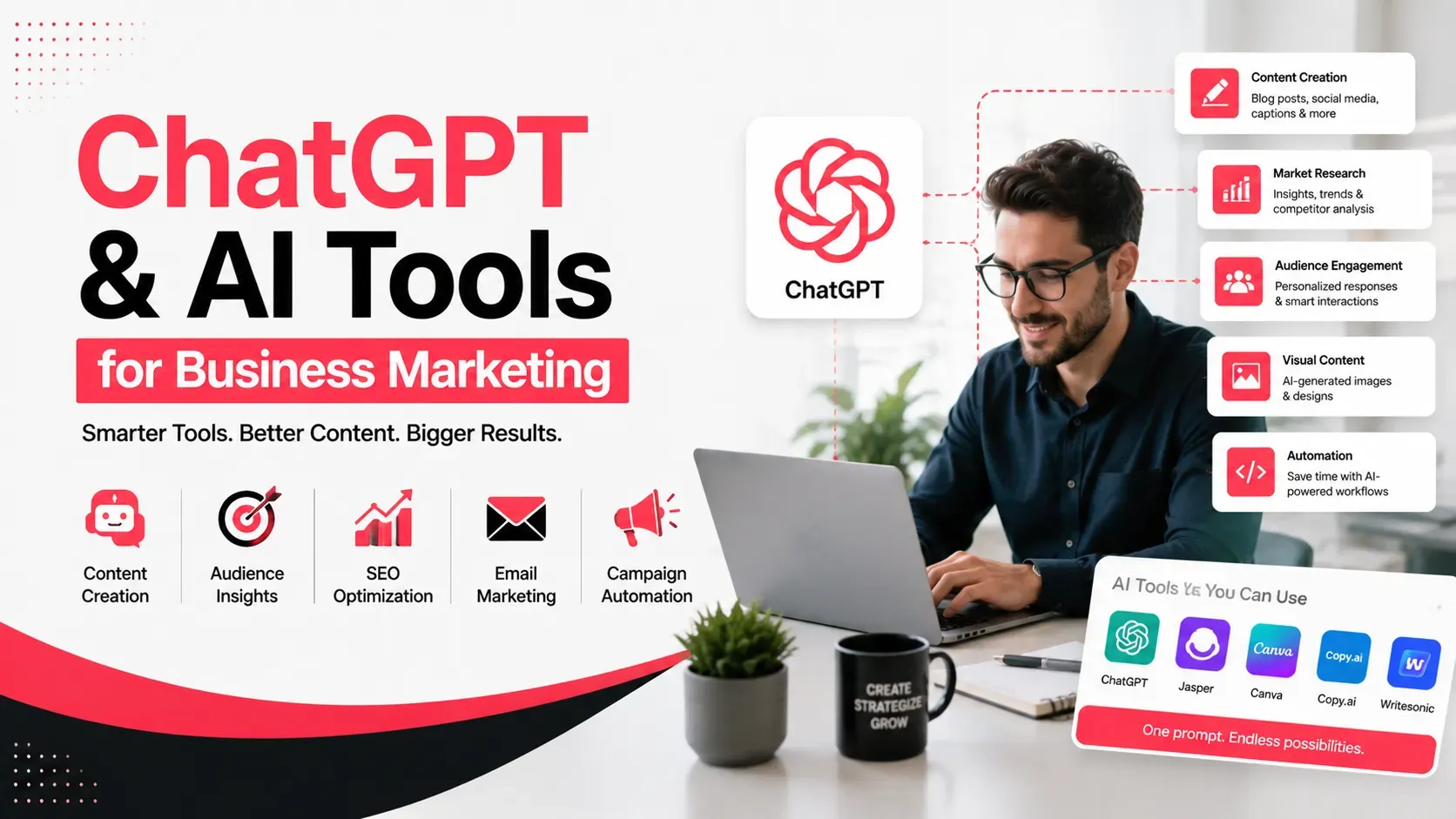
Artificial intelligence has moved from an experimental technology to a practical part of everyday marketing. Businesses now use ChatGPT and other AI tools to research audiences, generate content ideas, analyze data, create campaign concepts, automate repetitive tasks, and improve customer communication.
But using AI effectively is not simply about generating more content.
The real opportunity is to use AI to make marketing faster, more relevant, more consistent, and easier to measure while keeping human judgment at the center.
For businesses in competitive markets such as the UAE, the right combination of AI tools and marketing expertise can help smaller teams compete with organizations that have significantly larger resources.
Quick Answer
ChatGPT and AI marketing tools can support almost every stage of the marketing process, from research and content creation to advertising, customer engagement, analytics, and personalization.
The most valuable applications include:
- Market and audience research
- Content ideation
- SEO content planning
- Social media creation
- Email marketing
- Ad copy development
- Customer support
- Lead qualification
- Data analysis
- Marketing automation
- Personalization
- Campaign optimization
However, businesses should treat AI as a marketing assistant rather than an autonomous marketing department. Human expertise, brand positioning, fact-checking, creativity, and strategic decision-making remain essential.
What Can ChatGPT Do for Business Marketing?
ChatGPT can assist marketers with a wide range of tasks.
For example, a marketing team can use it to:
- Brainstorm campaign concepts
- Develop buyer personas
- Generate content briefs
- Rewrite copy for different audiences
- Create social media variations
- Develop email sequences
- Summarize research
- Analyze customer feedback
- Create FAQ ideas
- Develop ad variations
- Turn long-form content into short-form posts
The value comes from reducing repetitive work.
Instead of spending an hour creating the first draft of a campaign email, a marketer can use AI to produce several starting points and spend more time refining the message, checking accuracy, and aligning it with the campaign strategy.
AI Tools Are Changing the Marketing Workflow
Traditional marketing workflows often involve multiple manual steps:
Research → Planning → Writing → Editing → Publishing → Analysis
AI can accelerate several of these stages.
A modern workflow might look more like:
Research → AI-assisted analysis → Strategic planning → AI-assisted production → Human review → Publishing → Automated analysis
The important difference is that the strategy remains human-led.
AI can help identify patterns and produce options, but businesses still need people who understand customers, markets, positioning, and commercial objectives.
1. Use AI for Market and Customer Research
Before creating campaigns, marketers need to understand what customers care about.
AI can help organize research around:
- Customer pain points
- Frequently asked questions
- Buying objections
- Product comparisons
- Customer motivations
- Search behavior
- Competitor positioning
- Common service expectations
For example, a UAE e-commerce business could ask an AI tool to organize customer concerns around delivery, payment methods, returns, product quality, and trust.
The output should then be compared with real customer data.
Useful sources include:
- Reviews
- Customer-service conversations
- Website analytics
- Search data
- Sales-team feedback
- Surveys
- CRM records
AI becomes much more useful when it works with real business information rather than assumptions.
2. Generate Better Content Ideas
Coming up with new content topics can consume significant time.
AI can help marketing teams turn one broad subject into multiple content opportunities.
For example:
Digital Marketing
can become:
- SEO strategy
- Paid advertising
- Social media marketing
- Content marketing
- Lead generation
- Conversion optimization
- Marketing analytics
- Customer retention
From there, marketers can identify questions for different stages of the customer journey.
The goal isn't to publish every idea.
Instead, use AI to create a larger pool of possibilities, then select topics based on search intent, business relevance, expertise, and commercial value.
3. Improve SEO Content Planning
AI can be useful during SEO research and planning.
Marketers can use it to identify:
- Related questions
- Search-intent variations
- Topic clusters
- Content gaps
- Subtopics
- FAQ opportunities
- Internal-linking opportunities
However, AI-generated keyword suggestions should not replace actual keyword research.
Search volume, competition, SERP behavior, customer intent, and business relevance still need to be evaluated using appropriate SEO tools and real search data.
For businesses that want to turn this research into a broader organic visibility strategy, SEO services in Dubai can connect technical SEO, content planning, and long-term search growth.
4. Create Social Media Content Faster
Social media teams often need multiple versions of similar content.
AI can help transform one idea into different formats:
Blog article → LinkedIn post → Instagram caption → Short video script → Email → Story concept
It can also generate variations for different audiences.
For example, a company launching a new service could create:
- Educational content
- Promotional content
- Customer-focused content
- Behind-the-scenes content
- FAQ content
- Short-form video concepts
Human review is still essential because social media depends heavily on tone, cultural context, timing, and authenticity.
5. Develop Better Advertising Copy
AI can generate multiple advertising concepts quickly.
A marketer could request variations based on:
- Different customer pain points
- Benefits
- Offers
- Emotional triggers
- Different awareness stages
- Different platforms
For example, an e-commerce campaign might require separate messaging for:
First-time visitors
Returning visitors
Existing customers
AI makes producing these variations faster.
But performance should determine which messages survive.
The winning copy should come from testing, not from assuming that an AI-generated headline is automatically effective.
6. Personalize Email Marketing
AI can help businesses create more relevant email communication.
Instead of sending one generic message to every customer, marketers can develop different messaging based on:
- Customer lifecycle
- Previous purchases
- Website behavior
- Interests
- Location
- Engagement
- Lead stage
Possible campaigns include:
- Welcome sequences
- Product recommendations
- Abandoned-cart emails
- Re-engagement campaigns
- Post-purchase communication
- Cross-selling
- Customer retention
AI can help draft and personalize these campaigns, while marketing automation platforms can handle the delivery logic.
7. Use AI for Customer Support and Lead Qualification
AI chatbots can handle repetitive customer questions at any time.
They can help answer questions about:
- Pricing
- Opening hours
- Services
- Product specifications
- Delivery
- Booking
- Availability
- Frequently asked questions
AI can also help qualify leads by asking basic questions before transferring promising prospects to a sales representative.
This allows sales teams to spend more time on conversations that require human involvement.
The best approach is usually AI for initial interaction + human support for complex situations.
8. Analyze Marketing Data With AI
Marketing teams often have more data than they can comfortably interpret.
AI can help summarize and analyze information from:
- Campaign reports
- Customer feedback
- Website performance
- Advertising results
- Sales data
- Survey responses
- CRM records
A marketer could ask:
Or:
AI can identify patterns and summarize large datasets quickly.
But businesses should verify important conclusions against the original data before making significant decisions.
9. Automate Repetitive Marketing Tasks
One of AI's biggest benefits is reducing repetitive work.
Depending on the tools involved, businesses can automate tasks such as:
- Lead routing
- Email responses
- Content repurposing
- Meeting summaries
- Customer follow-ups
- Report generation
- Data classification
- Social content preparation
The objective isn't automation for its own sake.
A good automation should either save time, reduce errors, improve response speed, or create a better customer experience.
10. Combine AI With CRM and Marketing Automation
AI becomes significantly more useful when connected to customer data.
A CRM can contain information about:
- Leads
- Customers
- Previous interactions
- Sales stages
- Purchases
- Follow-ups
- Customer preferences
AI can help marketers interpret this information and identify opportunities.
For example, a business could identify leads that have shown strong engagement but haven't yet converted.
The marketing team could then create a targeted follow-up sequence instead of sending the same message to the entire database.
This creates a connection between data, automation, and personalization.
11. Use AI for Marketing Personalization
Personalization doesn't have to mean adding someone's first name to an email.
AI can help businesses personalize:
- Product recommendations
- Website experiences
- Content suggestions
- Offers
- Email campaigns
- Advertising messages
- Customer journeys
For example, a visitor researching premium products may receive different content from someone primarily interested in budget options.
The more useful the personalization, the more important quality customer data becomes.
Businesses should also respect privacy expectations and applicable data-protection requirements.
12. Keep Humans in Control
One of the biggest mistakes businesses can make is treating AI output as automatically correct.
AI-generated material can contain:
- Incorrect facts
- Outdated information
- Unsupported claims
- Repetitive language
- Generic recommendations
- Brand-inappropriate wording
Human review should therefore remain part of the workflow.
A practical model is:
AI generates → Expert reviews → Brand refines → Data validates → Customer responds
This maintains efficiency without sacrificing quality.
AI Marketing Mistakes Businesses Should Avoid
Publishing Unedited AI Content
Generating hundreds of articles without adding original value can create a weak content library.
Replacing Strategy With Prompts
AI can execute instructions, but it doesn't automatically understand your complete commercial strategy.
Ignoring Brand Voice
If every AI-generated message sounds generic, customers may struggle to recognize the brand.
Feeding Sensitive Information Into Unapproved Tools
Businesses should establish clear rules around confidential customer, financial, employee, and business information.
Automating Every Customer Interaction
Some conversations require empathy, negotiation, judgment, or specialist knowledge.
Measuring AI Activity Instead of Business Results
Producing 100 pieces of AI-assisted content means little if none of it generates meaningful engagement, leads, or revenue.
How to Build an AI-Powered Marketing Workflow
A practical implementation can follow five steps.
Step 1: Identify Repetitive Tasks
Find activities that consume time without requiring significant strategic judgment.
Step 2: Select Appropriate AI Tools
Choose tools according to the task rather than adopting AI simply because it is popular.
Step 3: Create Brand and Quality Guidelines
Define tone, terminology, approval processes, fact-checking standards, and acceptable AI usage.
Step 4: Connect AI With Real Data
Where appropriate, use reliable customer, campaign, and performance information to improve relevance.
Step 5: Measure Results
Track:
- Time saved
- Cost reduction
- Engagement
- Leads
- Conversion rate
- Customer satisfaction
- Revenue
If an AI workflow doesn't improve an important business outcome, reconsider it.
Best AI Marketing Strategy for UAE Businesses
AI adoption should also account for the market being served.
UAE businesses often market to multilingual, multicultural, and geographically diverse audiences.
Marketing teams should consider:
- English and Arabic content requirements
- Local search behavior
- UAE-specific customer expectations
- Cultural context
- Emirate-specific targeting
- Local purchasing behavior
- Regional advertising platforms
AI can assist with localization, but native-level human review remains valuable when cultural nuance matters.
Key Takeaways
- ChatGPT can support research, content, advertising, analytics, and customer communication.
- AI should accelerate marketing rather than replace marketing strategy.
- Real customer data makes AI outputs more useful.
- Human review is essential for accuracy, originality, and brand consistency.
- AI can help personalize campaigns at scale.
- Automation is most valuable when it removes repetitive work.
- CRM and AI integration can improve lead management and customer journeys.
- Businesses should establish rules for privacy and sensitive information.
- AI-generated content still needs expert input and quality control.
- The best measure of AI adoption is business impact—not the number of tasks automated.
Conclusion
ChatGPT and AI tools can give marketing teams a significant productivity advantage, but the technology itself isn't the strategy.
Businesses get the greatest value when AI handles repetitive work while marketers focus on positioning, creativity, customer understanding, and decision-making.
The winning model is not AI instead of marketers.
It is AI helping marketers do better work, faster.
For businesses looking to combine AI with a broader digital growth strategy, Milaaj Brandset brings together marketing, technology, and brand-focused capabilities to help businesses build stronger digital presence and customer journeys.
As AI tools continue to evolve, businesses that establish practical workflows now will be better positioned to scale their marketing without sacrificing quality or authenticity.
Frequently Asked Questions
How can ChatGPT help with business marketing?
ChatGPT can assist with research, content ideas, copywriting, email campaigns, social media content, customer-service responses, data analysis, and marketing planning.
Can AI replace marketing teams?
AI can automate or accelerate many repetitive tasks, but it does not replace strategic judgment, creativity, customer understanding, relationship building, or accountability.
Is AI-generated content good for SEO?
AI-generated content can be useful when it is accurate, original, and genuinely helpful. Simply producing large quantities of unedited AI content does not create SEO value.
Which marketing tasks should businesses automate first?
Start with repetitive, predictable activities such as reporting, content repurposing, basic customer questions, lead routing, and routine follow-ups.
How can UAE businesses use AI marketing effectively?
UAE businesses can use AI for content localization, audience research, campaign personalization, lead generation, customer support, advertising, and analytics while maintaining human oversight for cultural and market-specific context.
Ready to Elevate Your Brand?
Start Your Project Today