March 31, 2026
Is Your CRM Holding You Back? Moving from Basic Tools to a Full Odoo Ecosystem
Milaaj Editorial / Research Insights
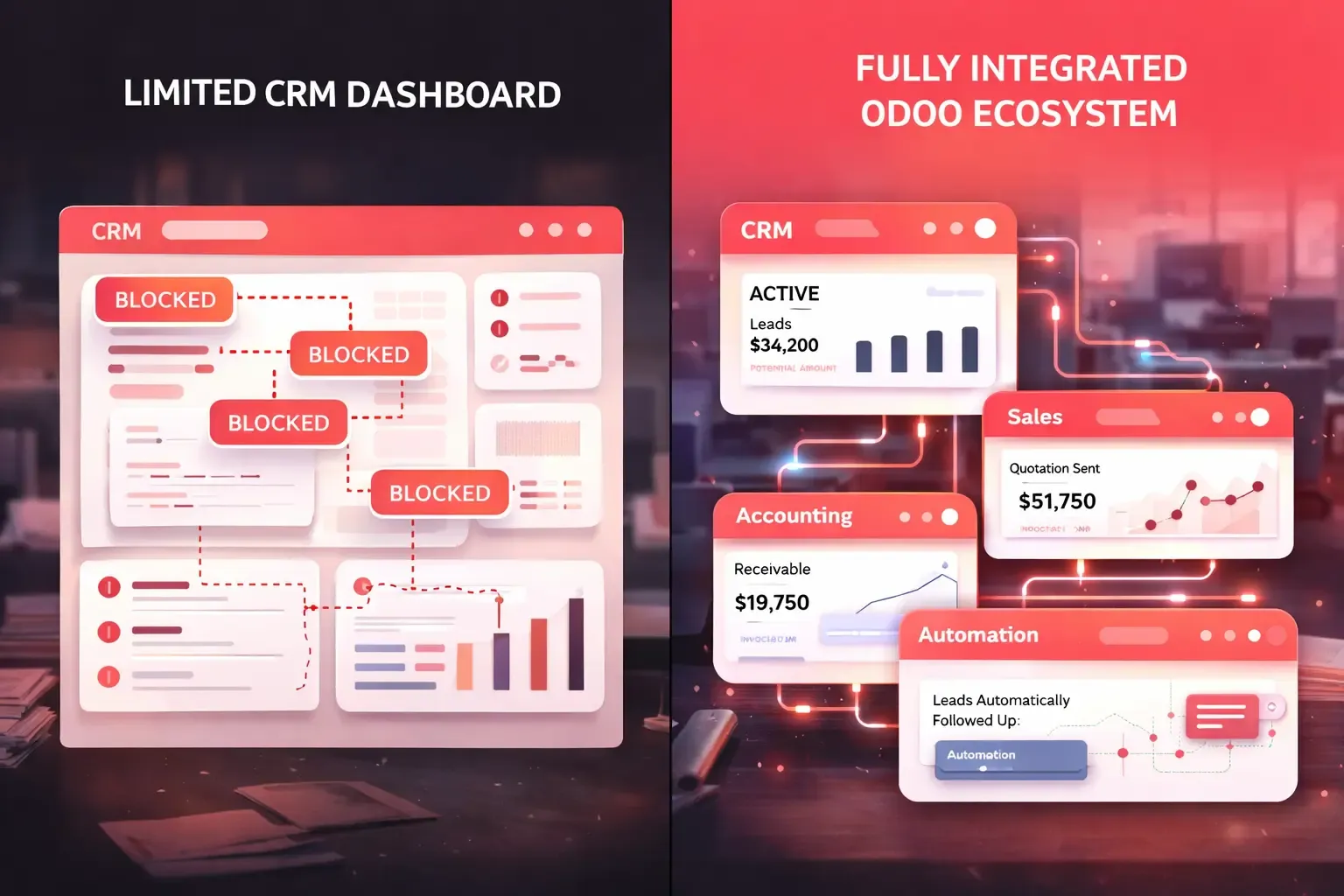
Customer Relationship Management tools are essential for managing leads, tracking interactions, and improving sales processes. However, many businesses outgrow their CRM systems faster than expected.
What once worked as a simple lead tracker can quickly become a bottleneck when your operations expand.
If your CRM is slowing down your team, limiting visibility, or forcing you to rely on multiple tools, it may be time to upgrade to a full Odoo ecosystem.
This guide explains how to identify CRM limitations and why moving to Odoo can transform your entire business workflow.
What a Basic CRM Can (and Cannot) Do
Basic CRM tools are designed for simple use cases.
They typically allow businesses to:
- store customer data
- track leads and deals
- manage sales pipelines
- log communication history
While these features are useful, they come with limitations.
Signs Your CRM is Holding You Back
1. You’re Using Multiple Tools for Different Functions
If your business uses separate tools for:
- email marketing
- accounting
- inventory
- project management
then your CRM is not enough.
Disconnected systems create data silos and inefficiencies.
2. No Integration with Business Operations
A standalone CRM cannot connect sales with:
- invoicing
- order management
- inventory tracking
This results in manual processes and duplicated work.
3. Limited Automation Capabilities
Basic CRMs often lack advanced automation features.
This means:
- manual follow-ups
- delayed responses
- inconsistent customer experiences
4. Poor Reporting and Insights
Without integrated data, reporting becomes fragmented.
Businesses struggle to answer questions like:
- Which campaigns generate revenue?
- What is the real sales performance?
- Where are the bottlenecks?
5. Scalability Issues
As your business grows, your CRM may not keep up.
You may experience:
- slower performance
- limited customization
- inability to handle complex workflows
What is an Odoo Ecosystem?
An Odoo ecosystem goes beyond CRM.
It is a fully integrated ERP platform that connects all business functions in one place.
Core modules include:
- CRM and sales
- accounting and invoicing
- inventory and operations
- marketing automation
- customer support
This unified approach eliminates the need for multiple tools.
CRM vs Odoo Ecosystem: The Key Difference
The biggest difference is integration.
A basic CRM focuses only on sales, while Odoo connects the entire business.
With Odoo:
- leads convert directly into sales orders
- sales trigger invoices automatically
- inventory updates in real time
- reports combine data from all departments
This creates a seamless workflow from lead to revenue.
Benefits of Moving to a Full Odoo Ecosystem
1. End-to-End Business Visibility
Odoo provides a complete view of your operations.
You can track:
- customer journeys
- sales performance
- financial data
- operational metrics
All in one dashboard.
2. Advanced Automation
Odoo automates repetitive tasks such as:
- lead nurturing
- follow-ups
- invoicing
- inventory updates
This improves efficiency and reduces manual work.
3. Improved Collaboration Across Teams
All departments work within the same system.
This ensures:
- better communication
- faster processes
- fewer errors
4. Real-Time Data and Insights
Odoo eliminates delays in reporting.
Decision-makers get access to real-time data for faster and smarter decisions.
5. Scalability for Growth
Odoo grows with your business.
You can:
- add new modules
- customize workflows
- expand operations without switching systems
When Should You Move from CRM to Odoo?
You should consider upgrading when:
- your CRM no longer supports your processes
- you rely on multiple disconnected tools
- manual work is increasing
- reporting is inaccurate or delayed
- business growth is limited by system capabilities
How to Transition Smoothly to Odoo
Audit Your Current CRM Usage
Understand how your team uses the CRM and identify gaps.
Define Your Requirements
List the features and integrations you need.
Migrate Data Carefully
Ensure that customer data is clean and accurate before migration.
Implement in Phases
Start with CRM and sales, then expand to other modules.
Businesses planning this transition often collaborate with experts providing Odoo Migration Services In Dubai to ensure smooth data transfer and system setup.
Real Business Impact of Upgrading to Odoo
Companies that move from basic CRM tools to Odoo typically experience:
- higher sales efficiency
- improved customer experience
- faster operations
- reduced operational costs
- better decision-making
This transformation enables businesses to operate with greater control and agility.
Conclusion
A basic CRM may be enough in the early stages of your business, but it can quickly become a limitation as you grow.
Moving to a full Odoo ecosystem allows you to unify your operations, automate workflows, and gain real-time visibility across your entire business.
Instead of managing multiple disconnected tools, you can run everything from a single, scalable platform.
Businesses looking to streamline operations and improve efficiency often work with experts offering Odoo ERP Solutions In Dubai to build fully integrated systems tailored to their needs. Milaaj Brandset helps companies transition from limited CRM tools to powerful Odoo ecosystems that drive growth, automation, and long-term success.
FAQs
What is the difference between CRM and Odoo?
CRM focuses on managing customer relationships, while Odoo is a full ERP system that integrates CRM with accounting, inventory, and operations.
Can Odoo replace my existing CRM?
Yes. Odoo includes a powerful CRM module along with additional features that go beyond traditional CRM capabilities.
Is migrating from CRM to Odoo difficult?
With proper planning and expert support, the migration process can be smooth and efficient.
How long does it take to implement Odoo?
It depends on business size and requirements, but many implementations are completed within a few weeks.
Is Odoo suitable for small businesses?
Yes. Odoo is highly scalable and works well for both small and growing businesses.
Does Odoo improve sales performance?
Yes. Automation, real-time data, and integrated workflows help improve sales efficiency and conversion rates.
Ready to Elevate Your Brand?
Start Your Project Today