October 19, 2026
Do You Actually Own Your Website? Domain, Hosting and Code Explained
Milaaj Editorial / Research Insights
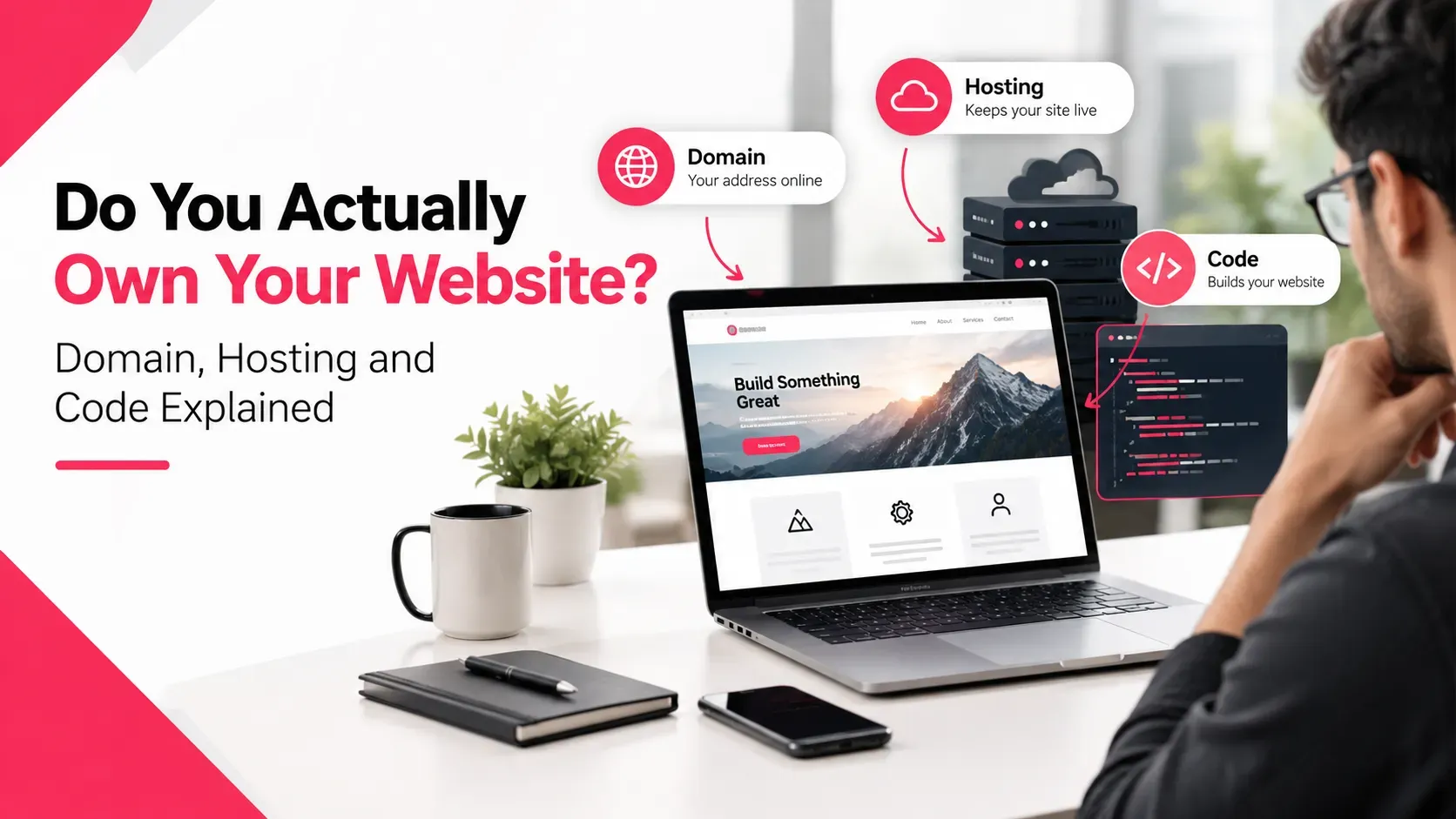
You paid for your website. The invoice says so. But when you try to move to a new agency, the old freelancer is slow to reply, the domain login is in someone else's name and nobody can find the files.
So, do you own your website? The honest answer is: it depends which part you mean.
A website is not one thing. It is a domain, a hosting account, your content, the code and design, and a handful of other accounts. Each can have a different owner. This guide explains who normally holds what, how to check and what to ask for in writing.
Quick Answer
Do you own your website? Not automatically. A website is several separate assets: the domain name, the hosting account, your content, the code and design, and linked accounts. Whether you own each one depends on whose name it is registered in and what your contract says. Check each asset, and get ownership terms in writing before you hire anyone.
Key Takeaways
- "Your website" is really five or six separate assets, and each can have a different owner.
- The domain belongs to whoever is listed as the registrant, so make sure that is you.
- Hosting belongs to whoever holds the account, so check the login and billing details.
- Ownership of code and design depends on your contract, so do not assume it.
- Themes, plugins and platforms come with licences, which are not the same as ownership.
- A short handover checklist protects you if the relationship ends.
What Does Owning a Website Actually Include?
Think of your website like a shop. The address, the building, the fittings and the keys can all belong to different people.
Asset | What it is | Who should hold it | How to check |
|---|---|---|---|
Domain name | Your web address | You or your company | Look at the registrant details with your registrar |
Hosting | The server that stores your site | You or your company | Check who owns the hosting account and pays the bill |
Content | Your text, photos, logo, videos | Usually you, but check your contract | Check licences for stock images and fonts |
Code and design | The pages, layout and custom features | Depends on your contract | Read the contract or ask in writing |
Accounts | Analytics, Search Console, ad accounts | You or your company | Check who is listed as owner |
Licences | Themes, plugins, software subscriptions | The vendor owns it; you hold a licence | Check licence terms and renewal dates |
The rest of this guide takes these one at a time.
Do You Own Your Website's Domain Name?
The domain is often the most important asset, and one of the easiest to get wrong.
When someone registers a domain, a registrar handles the paperwork. The person or company named as the registrant is the one responsible for it. ICANN's guidance for registrants says the registrant assumes sole responsibility for the registration and use of the domain name.
That matters because:
- The registrant details should be yours. If your agency registered the domain under its own name, you may need its help to move or renew it.
- Contact details must stay accurate. ICANN says registrants must keep their details up to date and respond to registrar inquiries within 15 days.
- Renewals need attention. If the domain renews automatically, the payment details on file must stay current.
Some extensions, including .ae, have their own eligibility rules, so ask your registrar who is allowed to register the one you want.
The safest setup: the domain sits in a registrar account that you own, with your email address, and your agency is added as a user if it needs access.
Who Owns Your Website Hosting?
Hosting is where your website files live. Whoever holds the hosting account controls the site.
Ask yourself:
- Whose email address is the account registered under?
- Whose card or invoice pays for it?
- Who has the admin login?
- Can you add or remove users?
If the answer to all four is "the agency" or "the freelancer", you depend on them to keep the site online and to hand it over. If you use a platform that hosts your site for you, such as an online store builder, read its terms on exporting your data and moving away.
Do You Own Your Website? The Code and Design Question
Here is where it gets less clear, and where honesty matters more than a confident answer.
Not always. It depends on your contract. UAE copyright law protects the author of an original work, and official UAE guidance does not spell out who owns work made for a client. So get a written clause saying whether you own the code or only have a licence to use it.
According to the UAE government's page on intellectual property, authors of original works are protected under Federal Law No. 38 of 2021. The page does not say how rights pass from a developer to a client, or who owns commissioned work.
So there is no safe default to assume. Possible arrangements include:
- Full transfer. The developer assigns the rights in the custom work to you.
- Licence to use. You may use the site, but the developer keeps the rights.
- Mixed. Custom parts are yours, while templates, plugins and software remain licensed.
Many websites are built on themes, plugins and platforms that other people own. You cannot own those, only license them, and the terms vary. Our comparison of custom and template websites explains how that choice changes what you end up holding.
This is general information, not legal advice. For anything important, ask a qualified UAE lawyer to review your contract.
What Should a Website Contract Say About Ownership?
Put it in writing before work starts. A good contract answers these questions plainly.
- Who owns the custom code and design once the final payment is made?
- When does ownership pass? On payment, on delivery or on some other date?
- Which parts are licensed, such as themes, plugins, fonts, stock images and software?
- Who owns the domain and hosting accounts, and in whose name are they registered?
- What will be handed over at the end: source files, database, admin logins, documentation?
- How long will handover take if you change provider?
- What happens to ongoing costs such as hosting, licences and maintenance?
Our guide to freelancers versus agencies for a Dubai business website raises the ownership question as one to ask before you hire. This section gives you the answer list to bring with you.
Who Owns Your Analytics and Search Console Accounts?
Analytics, Google Search Console, tag managers and ad accounts hold years of data. If they are tied to an agency email address, you can lose access when the relationship ends.
Check that:
- You are an owner or admin on each account, not just a viewer.
- Your company email is the account owner.
- Any agency access is added as a user that you can remove.
Setting this up correctly from the start is part of good tracking. A team offering GA4 and GTM services in Dubai can audit who has access and move accounts into your name.
How Do You Check What You Own Today?
Run this check once, even if everything seems fine.
- List every asset from the table above.
- Find the domain registrar and confirm the registrant details.
- Log into your hosting account, or confirm you can.
- Find your contract and read the ownership and handover terms.
- Check your analytics and Search Console owners.
- List the licences, with renewal dates and who pays.
- Ask for missing logins in writing, so there is a record.
If you are unsure where to start, Milaaj Brandset recommends asking any provider for a written list of what they hold on your behalf, and storing a copy somewhere safe.
What If an Agency or Freelancer Won't Hand Things Over?
Stay calm and work in order.
- Ask in writing, listing exactly what you need.
- Point to your contract, if it covers handover.
- Offer a reasonable timeline and, if it applies, pay any outstanding invoice.
- Contact your registrar about transferring the domain, if you are the registrant.
- Get legal advice if the provider refuses and the contract is unclear.
Keep every message. Do not delete or change anything on the live site until you know what you hold.
How Do You Avoid Lock-In on Your Next Website?
Set these up at the start of the project:
- Register the domain and hosting in your own name from day one.
- Put ownership and handover terms in the contract.
- Choose a platform you can export from.
- Keep a record of logins and licences, stored securely.
- Use a content management system your team can run without the developer.
The choice of CMS shapes how easily you can switch providers later. CMS development services in Dubai can build a site your own team can edit and take elsewhere if needed.
Frequently Asked Questions About Website Ownership
Do I own my website if an agency built it?
Not automatically. Ownership depends on your contract and on what the agency built. The domain belongs to whoever is listed as registrant, hosting to whoever holds the account, and the code depends on the agreement. Ask for it in writing.
Who owns my domain name?
The registrant listed with your registrar. ICANN says the registrant takes sole responsibility for the registration and use of the domain. Make sure your own name or company is listed, with a working email address.
Do I own my website's code?
It depends. UAE copyright law protects the author of an original work, and official guidance does not state who owns commissioned work. Your contract should say whether the code is transferred to you or licensed to you.
What should a website contract say about ownership?
It should state who owns the custom code and design, when ownership passes, which parts are licensed, who holds the domain and hosting, and what will be handed over if you leave. Ask a lawyer to review it.
How do I check who owns my domain and hosting?
Find your registrar and check the registrant details, then confirm which email and payment method are on the hosting account. If you cannot log in to either, ask whoever set them up for access in writing.
Final Thoughts
So, do you own your website? In practice, you can count on what is registered in your name or assigned to you in writing. Finding that out takes a few minutes of checking, not a crisis.
Start with the domain, then hosting, then your contract. Fix anything that sits in someone else's name, and write ownership into every future agreement. If you are planning a new site and want the setup done cleanly, our web development services in Dubai can build it with your accounts and handover in your name from the start.
Knowing what you own gives you something better than a website. It gives you options.
Ready to Elevate Your Brand?
Start Your Project Today