September 2, 2026
Featured Snippet Optimization Guide: How to Win Position Zero
Milaaj Editorial / Research Insights
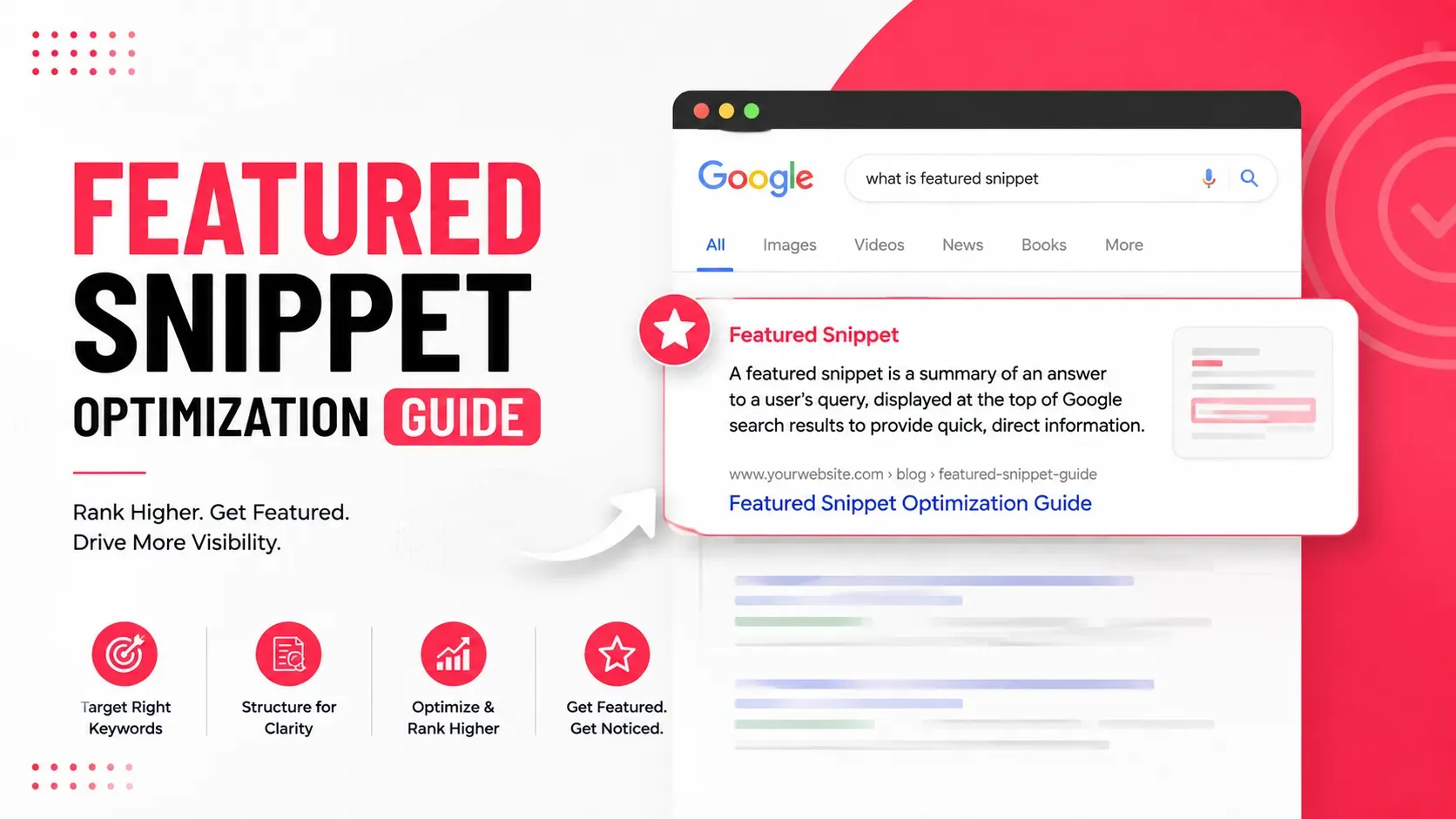
Google search results are no longer limited to a list of ten blue links. Depending on the query, users may see maps, videos, shopping results, People Also Ask, AI features, and featured snippets before reaching traditional organic listings.
A featured snippet is one of the most prominent search-result formats because Google can display an extracted answer from a webpage above many standard organic results. This makes featured snippet optimization an important part of content strategy for websites targeting informational and question-based searches.
But there is an important misconception: you cannot simply mark a page as a featured snippet. Google automatically determines when a page provides a useful answer for a particular query.
The real objective is therefore to make your content relevant, easy to understand, easy to extract, and genuinely useful to the searcher.
Quick Answer
Featured snippet optimization is the process of structuring useful content so Google can more easily identify sections that directly answer search queries.
There is no guaranteed formula for winning a featured snippet. The strongest approach is to:
- Match the search intent
- Answer important questions directly
- Use descriptive question-based headings where appropriate
- Keep direct answers concise and complete
- Structure lists, steps, and comparisons clearly
- Build topical depth around the primary question
- Maintain strong overall SEO and page quality
The goal should be to create the best answer for the searcher, rather than simply trying to occupy a particular position in Google's results.
What Is a Google Featured Snippet and Why Does It Matter?
A featured snippet is a highlighted search result that presents an answer or passage from a webpage directly within Google Search.
Featured snippets can appear for searches such as:
- What is technical SEO?
- How does keyword research work?
- What is the difference between SEO and PPC?
- How long does SEO take?
- How do I optimize a website for search?
Instead of requiring the searcher to open several pages, Google may display a concise answer directly in the results.
That creates an opportunity for publishers and businesses to gain greater visibility.
A page does not necessarily have to be the traditional number-one result to be considered for a featured snippet. Google's systems automatically determine whether a page is a suitable answer for a particular query.
Why featured snippets are valuable
Winning a featured snippet can potentially provide:
- Greater search visibility
- Increased exposure for informational queries
- Additional organic traffic opportunities
- Stronger perceived authority
- More visibility for long-tail searches
- Better exposure for question-based content
However, a featured snippet does not automatically guarantee more clicks.
Some searches can be answered directly within Google, meaning the user may have no reason to visit the source page.
For that reason, featured snippet optimization should be part of a broader organic search strategy rather than the only objective.
How Google Chooses Content for Featured Snippets
Google does not provide a special formula that guarantees featured snippet placement.
Instead, its automated systems determine whether a page provides a useful and relevant answer to a particular search.
This makes relevance the starting point.
For example, imagine an article about technical SEO containing a section titled:
What Is Technical SEO?
If the section immediately provides a clear explanation, Google has a relatively straightforward piece of content to evaluate for a query such as "what is technical SEO?"
The rest of the article can then provide examples, applications, benefits, and related information.
This creates an important principle:
Your whole page should be useful, but individual sections should also be capable of answering specific questions.
Relevance still comes first
Formatting alone cannot make irrelevant content suitable for a featured snippet.
A page targeting "what is SEO?" needs to provide an understandable explanation of SEO.
A page targeting "how much does SEO cost in Dubai?" needs to address pricing considerations, service scope, business factors, and the intent behind that commercial query.
The keyword may be similar, but the information required is completely different.
That is why search intent should come before formatting decisions.
Which Types of Content Can Win Featured Snippets?
Featured snippets can appear in different formats depending on the query and the information Google considers useful.
Paragraph snippets
Paragraph snippets are useful for questions that can be answered through a short explanation or definition.
For example:
What is search intent?
A strong page could provide a concise definition immediately below the relevant heading and then expand on the topic.
The important principle is:
Give the direct answer first, then provide the detail.
List snippets
Lists can work particularly well for searches involving:
- Steps
- Methods
- Types
- Benefits
- Examples
- Processes
- Rankings
For example:
How to optimize a website for SEO
could naturally be presented as a sequence of steps.
If the information follows a process, use an ordered list.
If the items are categories or examples, an unordered list may be more appropriate.
Table snippets
Tables can help with comparison-based searches.
For example:
SEO | PPC |
|---|---|
Organic visibility | Paid visibility |
Builds over time | Can generate immediate exposure |
No direct payment per click | Advertisers pay for clicks or impressions |
The table should exist because it makes the comparison easier to understand—not simply because you want to trigger a particular SERP feature.
How to Optimize Content for Featured Snippets
Featured snippet optimization works best when it is incorporated into normal on-page SEO rather than treated as a separate trick.
Answer the search query immediately
If a heading asks a question, provide the answer directly underneath it.
Don't make the reader navigate through several paragraphs of background information before reaching the answer.
For example:
What is a featured snippet?
The paragraph immediately following this heading should provide a clear definition.
You can then explain how featured snippets work, why they matter, and how businesses can optimize for them.
This structure helps readers whether or not Google eventually selects the passage.
Use question-based headings strategically
Question-based headings can make the relationship between a query and its answer clearer.
Useful examples include:
- What is SEO?
- How does technical SEO work?
- Why does search intent matter?
- What are the benefits of internal linking?
- How long does SEO take?
However, don't turn every heading into a question.
Use question-based headings where they genuinely reflect the information users are seeking.
Keep direct answers concise
There is no universal "perfect" featured snippet word count.
The amount of information Google displays can vary depending on the query and other circumstances. Therefore, outdated recommendations such as "always write exactly 40–50 words" should not become a rigid content rule.
Instead, aim for:
Direct + complete + concise.
Answer the question clearly first and then add supporting information.
Structure processes as steps
When someone searches how to accomplish something, a clearly structured process can improve usability.
For example:
- Identify the target search query.
- Analyze its search intent.
- Provide a direct answer.
- Expand the topic with relevant supporting information.
- Organize the content using descriptive headings.
- Monitor search performance and update the content when necessary.
This makes the information easier to scan and understand.
Build topical depth around the answer
A featured snippet should not exist as an isolated sentence.
Suppose the target question is:
What is semantic SEO?
A useful article could also discuss:
- Entities
- Related concepts
- Search intent
- Topic clusters
- Internal linking
- Context
- Natural language
This gives Google additional context while making the page more useful to readers.
For a broader explanation, readers can explore our guide to semantic SEO strategies.
Match the searcher's intent
Featured snippet optimization cannot compensate for search-intent mismatch.
A page explaining "what is SEO?" is unlikely to satisfy someone searching for "SEO company Dubai prices."
The first search requires education.
The second may involve commercial investigation.
Understanding this difference helps determine whether your content should be informational, commercial, transactional, local, or navigational.
How Featured Snippets and People Also Ask Work Together
Featured snippets and People Also Ask can both create opportunities for question-focused content.
When users expand related questions in Google, they may encounter additional featured snippets answering those questions.
This creates an interesting content strategy:
Don't target only one question. Understand the question ecosystem surrounding the topic.
For example, an article about local SEO might address:
- What is local SEO?
- How does local SEO work?
- Does Google Business Profile affect local SEO?
- How do local citations work?
- How can businesses improve local visibility?
Each question can become a useful section within a comprehensive resource.
This approach can also prevent another SEO problem: creating multiple thin pages targeting slightly different versions of essentially the same question.
Featured Snippets, AEO, and AI Search: What Has Changed?
Featured snippets are often discussed alongside Answer Engine Optimization (AEO) because both emphasize clear answers to user questions.
However, AEO should not be treated as a replacement for SEO.
The broader principle remains the same: create information that search systems can understand and users can trust.
That means maintaining:
- Crawlable content
- Clear page structure
- Strong topical relevance
- Useful internal links
- Accurate information
- Clear answers
- Helpful supporting content
For a broader look at answer-focused search, read our guide to Answer Engine Optimization (AEO).
Featured snippets are not the same as AI Overviews
A featured snippet generally presents a highlighted passage from a webpage.
AI-powered search experiences can synthesize information from multiple sources.
These are different search features, so optimizing for one does not guarantee visibility in another.
The better long-term strategy is to create content that is useful enough to be understood, selected, and referenced, rather than attempting to exploit a particular SERP format.
Why Your Page May Not Win a Featured Snippet
Even a well-optimized page may never receive a featured snippet.
The query does not trigger one
Not every search produces a featured snippet.
Another page provides a better answer
Google may determine that another webpage is more relevant or useful for the query.
The answer is buried
If the direct answer appears deep inside a long section surrounded by unnecessary text, it may be less clearly associated with the question.
Search intent is misunderstood
A page can target the correct keyword while answering the wrong question.
The content is too similar to existing results
Simply rewriting what competitors have already published does not necessarily create a better result.
Original explanations, useful examples, first-hand experience, accurate information, and genuinely helpful perspectives can make a page more valuable.
The broader SEO foundation is weak
Featured snippets are not a substitute for technical SEO, crawlability, internal linking, useful content, and a well-structured website.
For businesses that need to strengthen these foundations, SEO strategy and optimization services can connect technical improvements, content strategy, search intent, and website structure into a broader organic search approach.
Featured Snippet Optimization Checklist
Before publishing content designed to answer question-based searches, check the following:
- Does the page satisfy the primary search intent?
- Does the introduction establish the topic quickly?
- Are important questions covered with descriptive headings?
- Is the direct answer placed immediately below the relevant heading?
- Are definitions concise and easy to understand?
- Are processes presented as logical steps?
- Are comparisons easy to scan?
- Does the article cover important related concepts?
- Are internal links genuinely relevant?
- Is the content original rather than a rewritten competitor template?
- Is the page technically accessible to Google?
- Are important answers visible in the actual page content?
- Does the article remain useful even if it never wins a featured snippet?
That final question matters.
The best featured-snippet strategy is to create content that is valuable even without the featured snippet.
Key Takeaways
- Featured snippet optimization focuses on making useful answers easy for Google to identify.
- Google automatically determines which content appears in featured snippets.
- Question-based headings can create a clearer connection between searches and answers.
- Paragraph, list, and table formats should be selected according to the information being presented.
- There is no universal ideal word count for featured snippet answers.
- Search intent is more important than simply repeating keywords.
- Topical depth gives individual answers stronger context.
- People Also Ask can reveal related questions worth addressing within a broader resource.
- AEO and featured snippet optimization complement traditional SEO rather than replacing it.
- Creating genuinely useful content is more sustainable than chasing a specific SERP feature.
Conclusion
Featured snippet optimization is ultimately less about manipulating Google's search results and more about making information exceptionally easy to understand.
Start with the question. Understand why the person is asking it. Give a clear answer, then provide the context needed to make that answer useful.
When content is original, logically structured, relevant to search intent, and genuinely helpful, it can compete for featured snippets while also supporting traditional organic search and newer answer-focused search experiences.
That approach is much more sustainable than building every article around a fixed snippet formula. Milaaj Brandset helps businesses strengthen their digital visibility through SEO and digital marketing solutions designed around content, search strategy, technology, and user experience.
FAQ: Featured Snippet Optimization
What is featured snippet optimization?
Featured snippet optimization is the process of structuring useful, relevant content so Google can more easily identify sections that directly answer specific search queries.
Can I guarantee a Google featured snippet?
No. Google automatically determines which pages and passages appear as featured snippets. There is no special tag or button that guarantees placement.
What is the best length for a featured snippet answer?
There is no fixed ideal length. The amount of text Google displays can vary according to the query and other factors. Focus on providing a direct and complete answer rather than targeting an arbitrary word count.
Do question-based headings help with featured snippets?
They can make the relationship between a user's question and the corresponding answer clearer, particularly when a concise answer follows the heading. However, headings alone do not guarantee a featured snippet.
Does schema markup guarantee a featured snippet?
No. There is no special schema markup that allows a website to claim a featured snippet. Structured data can support certain search features, but featured snippets are selected automatically.
Are featured snippets still relevant with AI search?
Yes. Featured snippets remain a distinct Google Search feature, while AI-powered search experiences represent a different way of presenting information. Content should therefore be optimized around usefulness, relevance, clarity, and strong SEO fundamentals rather than one particular search feature.
Ready to Elevate Your Brand?
Start Your Project Today