July 2, 2026
How to Build Topical Authority for SEO in Dubai: A Complete Guide for Higher Google Rankings
Milaaj Editorial / Research Insights
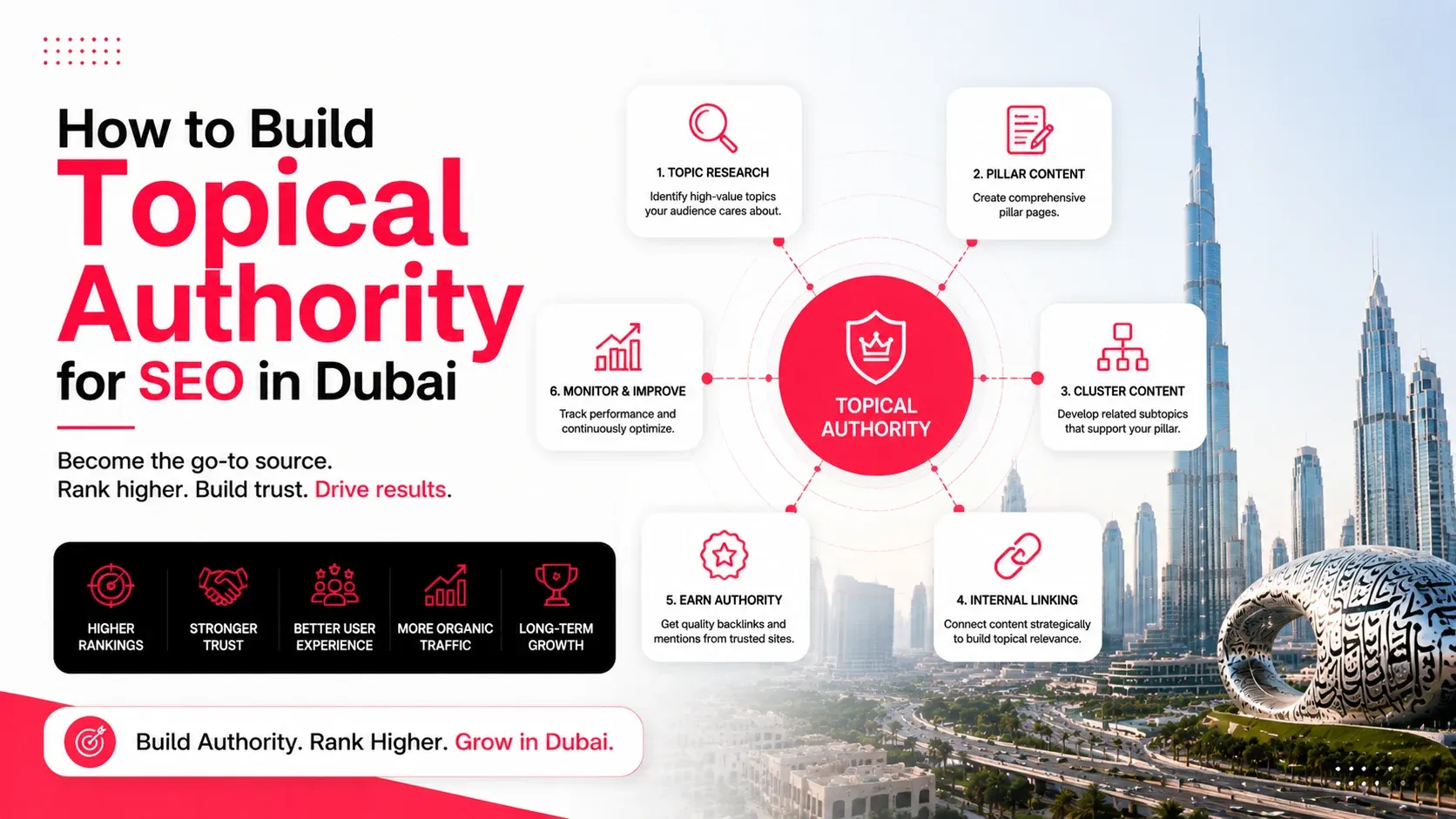
Ranking on Google has changed dramatically over the past few years. Businesses can no longer expect to rank consistently by publishing a few keyword-focused blog posts or optimizing individual pages in isolation. Modern search engines evaluate how comprehensively a website covers an entire subject, not just whether it targets a specific keyword.
This shift has made topical authority one of the most important SEO concepts for businesses aiming to achieve sustainable organic growth.
For companies in Dubai, where digital competition continues to increase across industries such as real estate, healthcare, ecommerce, legal services, hospitality, education, and professional services, building topical authority has become a competitive necessity rather than an optional SEO tactic.
Businesses that demonstrate expertise across complete subject areas are more likely to rank for competitive keywords, appear in AI-powered search experiences, earn backlinks naturally, and become trusted industry resources.
In this guide, you'll learn exactly what topical authority is, why it matters for SEO, and how businesses in Dubai can build a content ecosystem that strengthens rankings and long-term organic visibility.
Quick Answer
Topical authority is Google's assessment of how comprehensively and consistently a website covers a particular subject. Instead of publishing isolated articles, businesses build topical authority by creating interconnected content clusters, answering customer questions, demonstrating expertise, and maintaining a logical internal linking structure.
Building topical authority helps businesses:
- Improve keyword rankings
- Increase organic traffic
- Strengthen website credibility
- Support AI-powered search visibility
- Build long-term SEO performance
- Reduce dependence on paid advertising
What Is Topical Authority?
Topical authority refers to the level of expertise and trust a website demonstrates within a particular subject area.
Rather than evaluating individual pages independently, Google increasingly looks at how well an entire website covers a topic.
For example, if a business wants to rank for SEO Services Dubai, publishing a single service page is rarely enough.
Instead, Google expects supporting content covering related subjects such as:
- Technical SEO
- Local SEO
- Ecommerce SEO
- AI SEO
- Website audits
- Core Web Vitals
- Structured data
- Keyword research
- Content strategy
- Internal linking
- Google Business Profile optimization
- Search intent
The more complete your coverage, the more likely Google is to recognize your website as an authoritative resource.
Why Topical Authority Matters More Than Ever
Google's algorithms have evolved beyond simple keyword matching.
Today, search engines attempt to understand:
- Topics
- Entities
- Relationships
- User intent
- Context
- Experience
- Expertise
Instead of asking:
Google increasingly asks:
That distinction is why topical authority has become central to modern SEO.
How Google Evaluates Topical Authority
Although Google doesn't publish a specific "topical authority score," several signals contribute to its understanding of expertise.
These include:
- Depth of content
- Breadth of topic coverage
- Internal linking
- Semantic relevance
- Search intent satisfaction
- Freshness
- User engagement
- High-quality backlinks
- Consistent publishing
Rather than optimizing one article, businesses should focus on strengthening their entire knowledge base.
Topical Authority vs Domain Authority
These concepts are often confused but serve different purposes.
Topical Authority | Domain Authority |
|---|---|
Measures expertise within specific subjects | Estimates overall website authority |
Built through comprehensive content | Influenced largely by backlinks |
Topic-specific | Website-wide |
Improves semantic relevance | Improves general ranking potential |
Controlled primarily by content strategy | Strongly influenced by external links |
A website can have moderate domain authority while still dominating search results for a niche if it demonstrates exceptional topical authority.
Why Topical Authority Is Especially Important in Dubai
Dubai's digital marketplace is highly competitive.
Businesses compete not only with local companies but also with regional and international brands targeting UAE audiences.
Customers increasingly search for detailed information before making purchasing decisions.
Examples include:
- Best SEO agency in Dubai
- Local SEO strategies
- Website redesign tips
- AI marketing solutions
- Digital branding advice
Businesses that publish comprehensive educational content are more likely to become trusted resources for both customers and search engines.
Build Topic Clusters Instead of Publishing Random Articles
One of the biggest mistakes businesses make is publishing disconnected blog posts.
Instead, successful websites organize content into topic clusters.
A typical SEO cluster might include:
Pillar Page
- SEO Services Dubai
Supporting Articles
- Technical SEO Guide
- Local SEO Strategies
- Core Web Vitals
- Website Navigation and SEO
- Structured Data
- SEO Audit Checklist
- AI SEO Strategies
- Voice Search Optimization
- SEO Content Strategy
- Google Maps Ranking
- Topical Authority
- Semantic SEO
- Internal Linking
Each supporting article strengthens the pillar page while reinforcing the overall subject.
This interconnected structure makes it easier for Google to understand your expertise.
Understand Search Intent Before Creating Content
Publishing content without understanding search intent often leads to poor rankings.
Every article should satisfy a specific customer need.
Common search intents include:
Search Intent | Example |
Informational | What is topical authority? |
Navigational | SEO company Dubai |
Commercial | Best SEO services Dubai |
Transactional | Hire SEO agency Dubai |
Matching content to user intent increases both rankings and engagement.
Cover Every Stage of the Customer Journey
Topical authority isn't built solely through beginner-level educational articles.
Businesses should create content that supports every stage of the buyer's journey.
Journey Stage | Recommended Content |
Awareness | Educational blogs |
Consideration | Comparisons, guides |
Decision | Service pages, case studies |
Retention | Tutorials, updates |
Advocacy | Success stories, industry insights |
Comprehensive coverage signals expertise while helping users throughout their decision-making process.
Create Content Around Entities, Not Just Keywords
Modern SEO increasingly focuses on entities rather than individual keywords.
An entity represents a clearly identifiable concept, business, person, location, or topic.
Instead of targeting only:
- SEO Dubai
A stronger content ecosystem naturally includes related entities such as:
- Google Search Console
- Google Analytics
- Structured Data
- Core Web Vitals
- Search Intent
- Local SEO
- Technical SEO
- Google Business Profile
- AI Search
- Content Clusters
These relationships help search engines understand the overall context of your website.
Strengthen Internal Linking
Internal linking is one of the strongest signals supporting topical authority.
Every relevant article should naturally connect to related pages.
For example, this article would naturally reference your primary SEO service page for businesses seeking professional optimization.
Businesses looking to improve organic visibility can explore SEO services in Dubai to understand how comprehensive SEO strategies support long-term rankings.
Similarly, readers interested in building credibility alongside search visibility can continue with your guide on Building brand authority in local markets, which complements topical authority by focusing on long-term brand trust.
Rather than forcing links, every internal link should genuinely help readers explore the subject in greater depth.
Publish Comprehensive Content Instead of Thin Articles
Google increasingly rewards comprehensive resources that answer multiple related questions within a single article.
High-quality content typically:
- Explains concepts clearly
- Includes practical examples
- Answers follow-up questions
- Covers related subtopics
- Uses logical heading structures
- Demonstrates expertise
Comprehensive content reduces the need for users to return to search results, which often improves engagement signals.
Prioritize Content Quality Over Publishing Frequency
Many businesses believe publishing daily automatically improves SEO.
In reality, one authoritative article often outperforms multiple low-value posts.
Focus on creating content that is:
- Accurate
- Original
- Helpful
- Well-researched
- Easy to understand
- Updated regularly
Publishing fewer high-quality articles generally builds stronger topical authority than producing large volumes of repetitive content.
Build a Logical Content Publishing Framework
One of the biggest misconceptions about topical authority is that simply publishing more articles leads to better rankings.
In reality, Google rewards websites that demonstrate organized expertise rather than random publishing activity.
A structured content framework typically looks like this:
- Core service pages targeting commercial keywords.
- Pillar pages covering broad industry topics.
- Supporting cluster articles answering related questions.
- Case studies and success stories.
- Industry news and trend analysis.
- Frequently updated evergreen resources.
This structure helps search engines understand how each piece of content contributes to the overall expertise of your website.
Keep Existing Content Updated
Topical authority isn't built only by publishing new content.
Refreshing existing content is equally important.
Regular updates may include:
- New statistics
- Current SEO best practices
- Updated screenshots
- Additional FAQs
- Emerging industry trends
- New internal links
- Improved examples
- Updated search intent
Google prefers content that remains accurate and relevant over time.
Demonstrate Experience and Expertise
Google's quality systems increasingly reward websites that demonstrate genuine expertise.
Instead of writing generic articles, include:
- Practical recommendations
- Real-world examples
- Industry insights
- Step-by-step explanations
- Common mistakes
- Actionable checklists
Content should answer the question:
"Would someone trust this article enough to make a business decision?"
If the answer is yes, you're moving closer to building topical authority.
Use Semantic SEO Throughout Your Content
Semantic SEO helps search engines understand relationships between topics.
Instead of repeating the same keyword excessively, naturally include related concepts.
For example, an article about topical authority may also discuss:
- Search intent
- Topic clusters
- Pillar pages
- Internal linking
- Content hubs
- Entity SEO
- Technical SEO
- E-E-A-T
- AI search
- Structured data
- Content optimization
This broader context allows search engines to understand the complete subject rather than isolated keywords.
Optimize for AI Search and Google AI Overviews
Search is no longer limited to traditional blue links.
AI-powered search experiences increasingly summarize information from authoritative sources.
To improve visibility in AI-generated answers:
- Answer important questions early.
- Use descriptive headings.
- Include concise summaries.
- Cover related subtopics thoroughly.
- Structure content logically.
- Add FAQ sections.
- Maintain factual accuracy.
- Demonstrate genuine expertise.
Businesses that create comprehensive resources are more likely to appear in AI-powered search experiences.
Earn High-Quality Backlinks Naturally
Although topical authority focuses primarily on content, backlinks still strengthen credibility.
Authoritative backlinks often come from:
- Industry publications
- Local business organizations
- Professional associations
- Research reports
- Guest articles
- Case studies
- Digital PR campaigns
Rather than purchasing links, businesses should create content valuable enough to earn references naturally.
Monitor the Right SEO Metrics
Building topical authority is a long-term strategy.
Instead of tracking only rankings, monitor broader performance indicators.
Metric | Why It Matters |
|---|---|
Organic Traffic | Indicates overall visibility |
Keyword Rankings | Measures topical growth |
Indexed Pages | Shows search coverage |
Internal Link Distribution | Strengthens topic relationships |
Average Engagement Time | Indicates content quality |
Returning Visitors | Reflects trust and usefulness |
Backlinks Earned | Supports authority |
Conversion Rate | Connects SEO with business outcomes |
Reviewing these metrics regularly helps identify opportunities for improvement.
Common Mistakes That Prevent Topical Authority
Many businesses struggle because they focus on short-term SEO tactics instead of long-term expertise.
Avoid these common mistakes:
- Publishing random blog topics with no clear strategy
- Creating multiple articles targeting the same keyword
- Ignoring internal linking
- Writing thin content with little value
- Copying competitor articles
- Overusing keywords unnaturally
- Neglecting existing content updates
- Publishing without understanding search intent
- Focusing only on search engines instead of users
- Building isolated pages instead of connected topic clusters
Avoiding these issues allows your website to develop stronger authority over time.
A Practical Roadmap for Building Topical Authority
Businesses can approach topical authority systematically.
Phase | Primary Goal | Actions |
|---|---|---|
Foundation | Define core topics | Identify primary services and customer problems |
Content Planning | Create topic clusters | Build pillar pages and supporting articles |
Optimization | Improve existing content | Add semantic coverage, FAQs, internal links, and updated information |
Expansion | Increase topic depth | Publish advanced guides, case studies, and industry insights |
Maintenance | Preserve authority | Refresh content regularly and monitor performance |
This roadmap creates sustainable SEO growth rather than short-term ranking improvements.
How Long Does It Take to Build Topical Authority?
There is no fixed timeline because results depend on:
- Website age
- Competition
- Content quality
- Publishing consistency
- Internal linking
- Technical SEO
- Backlink profile
For most businesses, noticeable improvements typically begin within several months of consistently publishing high-quality, interconnected content.
Topical authority is an ongoing investment rather than a one-time project.
Key Takeaways
- Topical authority measures how comprehensively your website covers a subject.
- Modern SEO rewards expertise across complete topics rather than isolated keywords.
- Topic clusters are more effective than publishing unrelated articles.
- Search intent should guide every piece of content.
- Internal linking strengthens semantic relationships between pages.
- Semantic SEO helps search engines understand broader context.
- High-quality, comprehensive content consistently outperforms thin articles.
- Regular content updates preserve authority over time.
- AI-powered search increasingly favors trustworthy, well-structured resources.
- Topical authority supports sustainable rankings, organic traffic, and long-term business growth.
Building Long-Term SEO Authority That Google Trusts
Topical authority has become one of the strongest competitive advantages in modern SEO. Businesses that consistently publish comprehensive, interconnected, and genuinely helpful content are far more likely to achieve stable rankings than those relying on outdated keyword-focused tactics.
Instead of chasing every algorithm update, focus on becoming the most trusted resource within your industry. Build content around customer needs, strengthen internal connections between related topics, and continually improve existing resources. Over time, this approach creates a website that search engines—and potential customers—recognize as a reliable source of expertise.
For businesses looking to develop a complete organic growth strategy, our guide on SEO Content Strategy for Dubai Businesses provides additional insights into planning content that supports long-term search visibility and lead generation.
Milaaj Brandset helps businesses build sustainable SEO growth through strategic content planning, semantic SEO, technical optimization, and data-driven digital marketing that strengthens topical authority over time.
FAQs
What is topical authority in SEO?
Topical authority is the level of expertise and trust a website demonstrates by comprehensively covering a subject through interconnected, high-quality content.
How does topical authority improve Google rankings?
When Google recognizes that your website consistently provides valuable information across an entire topic, it is more likely to rank your pages for a wider range of relevant search queries.
Is topical authority more important than backlinks?
Both are important. Topical authority strengthens content relevance and expertise, while backlinks reinforce credibility. The strongest SEO strategies combine both.
What is a topic cluster?
A topic cluster consists of a pillar page supported by multiple related articles that cover different aspects of the same subject and are connected through internal links.
How many articles are needed to build topical authority?
There is no fixed number. The goal is to comprehensively cover your subject area rather than reach a specific article count.
How often should content be updated?
Review important articles every 6–12 months or whenever significant industry changes occur. Updating existing content helps maintain accuracy and rankings.
Does topical authority help AI search?
Yes. Comprehensive, well-structured, authoritative content is more likely to be referenced by AI-powered search experiences and answer engines.
Can small businesses build topical authority?
Absolutely. By focusing on a specific niche and consistently publishing high-quality content, even smaller businesses can establish strong topical authority and compete effectively with larger websites.
Ready to Elevate Your Brand?
Start Your Project Today