May 30, 2026
Marketing Funnels Explained for Service Businesses (2026 Guide)
Milaaj Editorial / Research Insights
Many service businesses struggle with digital marketing because they focus only on getting traffic.
But traffic alone does not generate business growth.
What actually drives sustainable results is a well-structured marketing funnel.
A marketing funnel helps businesses guide potential customers through different stages of the buying journey, from first discovery to final conversion.
For service businesses in Dubai and the UAE, marketing funnels are becoming increasingly important because customer decisions are now more research-driven and competitive.
Users rarely convert immediately.
They usually:
- search online
- compare providers
- read reviews
- visit websites multiple times
- engage with social content
- revisit through retargeting
Businesses without a structured funnel often lose potential customers during this journey.
This guide explains how marketing funnels work for service businesses and how to build conversion-focused funnel systems in 2026.
What is a Marketing Funnel?
A marketing funnel is the step-by-step process businesses use to move users from awareness to conversion.
It represents the customer journey from:
- discovering your business
- building interest
- developing trust
- taking action
Funnels help businesses understand how potential customers behave before becoming leads or paying clients.
Why Marketing Funnels Matter for Service Businesses
Service businesses often have longer decision-making cycles than ecommerce stores.
Customers usually need trust before making inquiries or bookings.
This is especially true for industries like:
- digital marketing
- healthcare
- legal services
- consulting
- web development
- real estate
- B2B services
Funnels help businesses nurture users instead of expecting instant conversions.
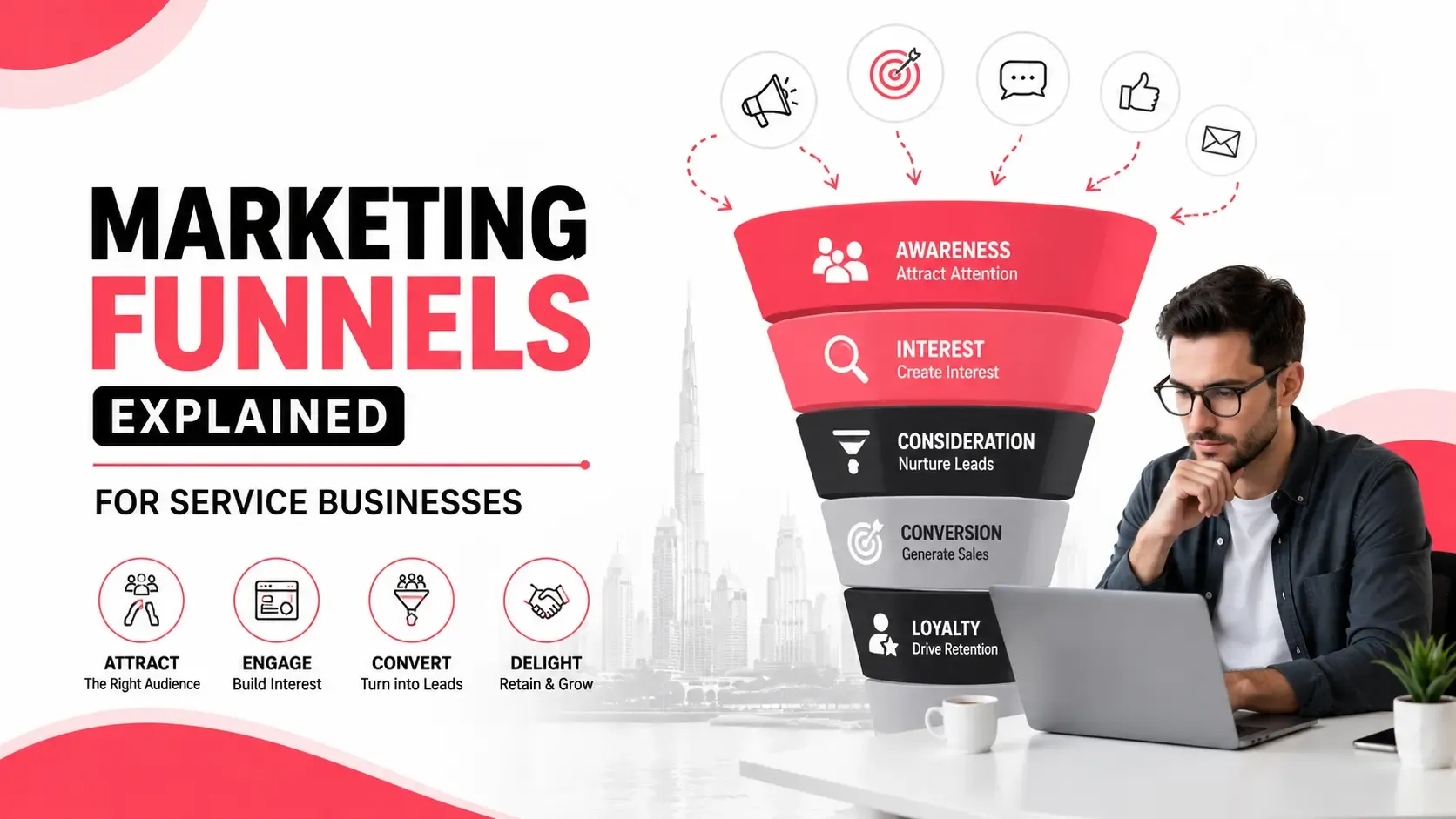
The 4 Main Funnel Stages
Modern marketing funnels usually include four core stages:
- Awareness
- Interest
- Consideration
- Conversion
Each stage requires different marketing strategies.
1. Awareness Stage
At the top of the funnel, users are discovering your business for the first time.
They may not even be ready to buy yet.
Awareness Stage Channels Include
- SEO
- Google search
- social media
- blog content
- YouTube videos
- paid advertising
The goal here is visibility and attention.
Example User Intent
- “best SEO agency Dubai”
- “how to improve website traffic”
- “website development company UAE”
At this stage, educational and informative content performs best.
2. Interest Stage
Once users discover your business, they begin evaluating whether you are relevant to their needs.
This stage focuses on engagement and credibility.
Effective Interest Stage Strategies
- case studies
- educational blogs
- testimonials
- social proof
- service explainers
- email marketing
Users are trying to determine whether they trust your expertise.
3. Consideration Stage
At this stage, users are actively comparing options.
They are closer to becoming leads but still evaluating alternatives.
Users Often Look For
- pricing information
- reviews
- portfolio examples
- consultation offers
- guarantees
- business credibility
Landing pages, service pages, and retargeting campaigns become extremely important here.
4. Conversion Stage
This is where users finally take action.
Conversion Actions Include
- submitting forms
- booking consultations
- making calls
- requesting quotes
- purchasing services
The easier and more trustworthy the process feels, the higher the conversion rate.
Why Most Service Business Funnels Fail
Many businesses only focus on traffic generation.
But without a proper funnel, users leave before converting.
Common Funnel Problems
- weak landing pages
- poor follow-up systems
- unclear messaging
- lack of retargeting
- weak trust signals
- poor mobile UX
Funnels fail when businesses do not guide users properly through the decision-making process.
How SEO Supports Funnel Growth
SEO plays a major role in funnel visibility.
Different keywords support different funnel stages.
Top Funnel SEO Keywords
- informational searches
- educational blog topics
- beginner guides
Middle Funnel Keywords
- comparison searches
- service-specific searches
- industry solutions
Bottom Funnel Keywords
- “hire SEO agency Dubai”
- “best web development company UAE”
- “book marketing consultation”
SEO helps businesses attract users throughout the entire customer journey.
Why Landing Pages Matter in Funnels
Landing pages are often where conversions happen.
A strong funnel depends heavily on:
- clear messaging
- fast load speed
- trust-building UX
- conversion-focused design
Weak landing pages reduce funnel efficiency dramatically.
You can also read our Landing Page Optimization Guide to understand how UX and CRO improve funnel conversions.
Retargeting is Essential for Modern Funnels
Most users do not convert immediately.
Retargeting helps businesses reconnect with users who already interacted with their brand.
Retargeting Helps
- increase trust
- improve brand recall
- recover lost visitors
- reduce acquisition costs
Modern funnels rely heavily on retargeting for lead nurturing.
Why Content Marketing Strengthens Funnels
Educational content builds authority and trust.
High-Performing Funnel Content Includes
- blogs
- guides
- case studies
- FAQs
- comparison articles
- tutorials
Helpful content keeps users engaged during the consideration process.
Lead Magnets Improve Funnel Performance
Lead magnets encourage users to exchange contact information.
Examples
- free audits
- downloadable guides
- consultations
- webinars
- free strategy sessions
Lead magnets help businesses convert traffic into qualified leads.
Why Funnel Psychology Matters
Funnels are not only technical systems.
They are built around human behavior and decision-making psychology.
Users need:
- clarity
- trust
- relevance
- simplicity
- confidence
Funnels work best when they reduce uncertainty naturally.
Multi-Channel Funnels Perform Better
Modern users interact across multiple platforms before converting.
A customer may:
- discover your brand through SEO
- revisit through Instagram
- click retargeting ads later
- finally convert through Google Ads
Businesses with integrated marketing funnels usually achieve stronger results.
Funnel Metrics Businesses Should Track
Funnels should be optimized continuously using data.
Important Funnel Metrics
- click-through rate
- conversion rate
- cost per lead
- bounce rate
- landing page engagement
- lead quality
Tracking helps businesses improve weak funnel stages.
What Actually Works in 2026
The highest-performing service business funnels today focus on:
- educational content
- mobile-first UX
- retargeting systems
- conversion-focused landing pages
- audience segmentation
- trust-building strategy
Funnels perform best when businesses focus on customer experience instead of aggressive selling.
Why Funnels and Lead Generation Work Together
Marketing funnels directly support lead generation.
Instead of chasing random traffic, funnels help businesses attract, nurture, and convert qualified users systematically.
Businesses looking to improve inquiry quality and scalable customer acquisition can also explore our Lead Generation Services in Dubai to learn how conversion-focused funnels, PPC campaigns, landing pages, and retargeting strategies work together for sustainable business growth.
Bringing It All Together
Marketing funnels for service businesses are no longer optional in competitive digital markets.
The businesses generating consistent growth today focus on:
- customer journey optimization
- conversion-focused UX
- educational content
- retargeting systems
- lead nurturing
- trust-building strategies
From SEO and PPC campaigns to landing page optimization and lead generation systems, successful funnels guide users naturally through every stage of the buying journey.
If you want a broader understanding of how funnel strategy fits into digital growth, read our Performance Marketing & Lead Generation in Dubai Guide to learn how PPC, CRO, lead nurturing, and customer acquisition strategies work together for scalable business growth.
Businesses investing in marketing funnels often achieve stronger long-term ROI when SEO, UX, paid advertising, and conversion strategy are aligned together.
Milaaj Brandset helps businesses build marketing funnels focused on lead generation, conversions, customer engagement, and scalable growth.
FAQs
What is a marketing funnel?
A marketing funnel is the process businesses use to guide users from awareness to conversion.
Why are funnels important for service businesses?
Service businesses often have longer customer decision cycles that require trust-building and nurturing.
What are the stages of a marketing funnel?
The main stages are awareness, interest, consideration, and conversion.
How does SEO support marketing funnels?
SEO attracts users at different stages of the buying journey through targeted search intent.
Why is retargeting important in funnels?
Retargeting helps businesses reconnect with users who did not convert initially.
What is funnel optimization?
Funnel optimization improves each stage of the customer journey to increase conversions and lead quality.
Why do landing pages matter in funnels?
Landing pages influence whether users take action after clicking ads or search results.
Should funnels connect with lead generation strategy?
Yes. Funnels and lead generation work together to improve customer acquisition and conversion efficiency.
Ready to Elevate Your Brand?
Start Your Project Today