February 23, 2026
Odoo vs SAP in Dubai: Why Mid-Market Businesses Prefer Flexibility Over Legacy ERP
Milaaj Editorial / Research Insights
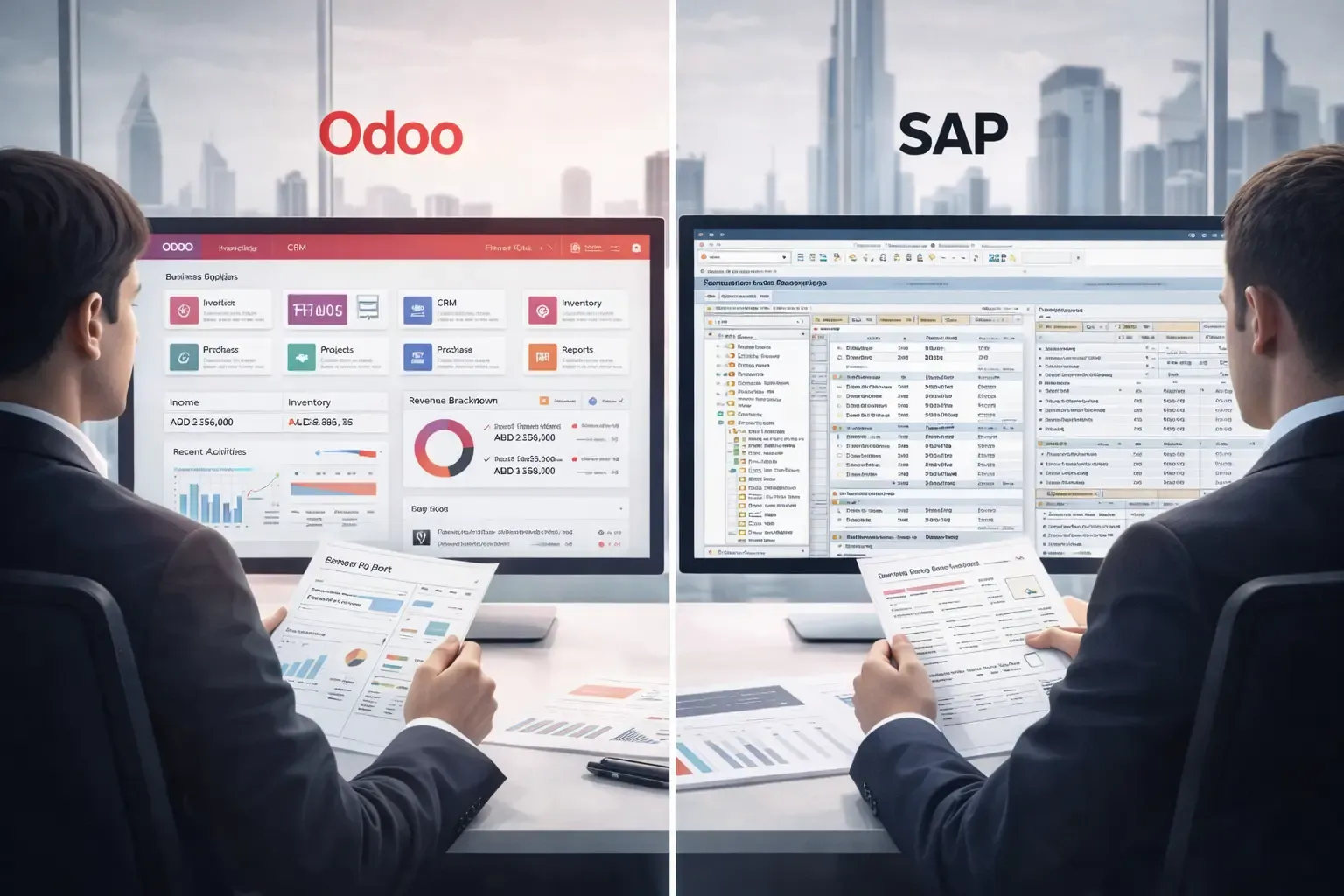
Enterprise Resource Planning systems have become essential for scaling operations in Dubai’s fast-growing commercial landscape. From trading companies in Deira to e-commerce retailers in Business Bay, mid-market businesses now rely on ERP platforms to manage accounting, inventory, CRM, procurement, HR, and reporting.
Yet many organizations face a difficult choice between traditional legacy platforms and newer modular ERP solutions.
When comparing Odoo vs SAP Dubai, one clear trend is emerging across the UAE mid-market segment. Companies are prioritizing flexibility, scalability, and speed over rigid enterprise architecture.
This article explores why modern ERP adoption patterns in Dubai are shifting and how flexible systems are replacing legacy frameworks.
Understanding the ERP Needs of Dubai’s Mid-Market
Mid-sized companies in Dubai operate under very different constraints compared to global enterprises.
They must:
- Scale quickly
- Maintain lean operational teams
- Manage VAT compliance
- Control IT expenditure
- Launch new services rapidly
- Integrate online and offline channels
- Handle regional expansion
ERP systems that require lengthy deployments or expensive custom development often struggle to meet these demands.
As a result, decision makers evaluating Odoo vs SAP Dubai increasingly consider deployment speed, licensing flexibility, and integration capability alongside feature depth.
Legacy ERP vs Flexible ERP Systems
Traditional ERP platforms were designed for large multinational organizations with extensive budgets and implementation timelines.
Legacy ERP systems often involve:
- Long deployment cycles
- High upfront licensing fees
- Complex customization processes
- Limited modularity
- Separate third-party integrations
- Ongoing consultancy costs
In contrast, modern modular ERP solutions provide:
- Cloud-based deployment
- App-driven architecture
- Unified databases
- Real-time dashboards
- Native integrations
- Continuous scalability
For UAE companies pursuing digital transformation, these advantages translate into faster ROI and lower operational risk.
Odoo vs SAP Dubai: Key Comparison Factors
1. Implementation Timeline
Implementation speed is a major differentiator.
SAP deployments often require:
- Extensive process documentation
- Custom development
- Third-party integrations
- Long testing cycles
This can extend ERP rollout timelines significantly.
Odoo implementations typically involve:
- Configurable modules
- Built-in integrations
- Faster data migration
- Minimal custom coding
Mid-market businesses benefit from shorter go-live timelines, allowing them to modernize operations without delaying growth plans.
2. ERP Licensing Costs
Budget considerations play a major role in ERP selection.
Legacy ERP systems usually include:
- High licensing costs
- Additional customization fees
- Ongoing upgrade charges
- Separate maintenance agreements
Flexible ERP platforms provide:
- Modular pricing
- Pay-as-you-grow licensing
- Reduced integration expenses
- Lower total cost of ownership
Companies comparing Odoo vs SAP Dubai frequently find that modular licensing aligns better with evolving operational needs.
3. Customization and Scalability
Dubai’s commercial ecosystem spans multiple industries including retail, logistics, trading, and manufacturing.
ERP platforms must adapt to:
- VAT requirements
- Inventory workflows
- Multi-warehouse operations
- Sales channel integration
- Project-based billing
- Procurement automation
Legacy ERP customization often requires developer involvement and extended timelines.
Flexible ERP platforms allow:
- Workflow configuration
- Automation rules
- Custom reporting
- App installation
- Industry-specific modules
This enables mid-market companies to scale without replacing systems every few years.
4. Integration Capabilities
Modern organizations rely on multiple digital tools for:
- E-commerce
- CRM
- Marketing automation
- Accounting
- Inventory tracking
- Customer support
Legacy ERP systems frequently depend on third-party middleware for integrations.
Flexible ERP solutions integrate these applications within a unified platform, improving:
- Data accuracy
- Reporting consistency
- Decision-making speed
- Operational efficiency
Unified databases eliminate silos and reduce manual data entry errors.
Digital Transformation in the UAE Mid-Market
Dubai’s SME sector continues to pursue cloud-based digital transformation initiatives.
Key priorities include:
- Automating workflows
- Consolidating SaaS tools
- Improving financial visibility
- Enhancing customer experience
- Supporting remote teams
- Launching new business models
ERP systems designed for agility help companies:
- Reduce administrative overhead
- Optimize procurement cycles
- Improve stock management
- Generate real-time reports
- Maintain compliance
Organizations evaluating Odoo vs SAP Dubai often favor platforms that support continuous innovation.
Industry Use Cases for Flexible ERP in Dubai
Retail and E-Commerce
ERP integration supports:
- Omnichannel inventory
- Automated invoicing
- CRM synchronization
- Order fulfillment
- Financial reporting
Trading and Distribution
Flexible ERP platforms assist with:
- Supplier management
- Procurement automation
- Logistics tracking
- Credit control
- VAT reporting
Manufacturing
Modern ERP solutions enable:
- Production planning
- BOM management
- Quality control
- Warehouse integration
Professional Services
ERP deployment improves:
- Project tracking
- Resource planning
- Client billing
- Timesheet automation
These capabilities are critical for growth-oriented mid-market firms.
Why Flexibility Matters More Than Legacy Stability
Legacy ERP systems provide extensive functionality but often lack adaptability.
In fast-paced markets like Dubai, businesses require systems that evolve with:
- Market conditions
- Customer expectations
- Regulatory changes
- Product lines
- Revenue channels
Flexible ERP platforms allow organizations to:
- Add modules as needed
- Automate new workflows
- Integrate emerging technologies
- Scale operations across regions
This adaptability reduces long-term technology risk.
Signs It’s Time to Replace a Legacy ERP System
Mid-market companies should reassess ERP solutions if they experience:
- Rising SaaS subscription costs
- Manual data entry
- Reporting delays
- Integration challenges
- Limited scalability
- High customization expenses
- Slow deployment timelines
Modern ERP migration helps businesses improve agility and competitiveness.
Final Thoughts: Choosing ERP for the Future
Dubai’s mid-market sector continues to grow rapidly, demanding technology platforms that support innovation rather than restrict it.
While legacy ERP systems remain powerful, flexibility, modularity, and deployment speed are becoming decisive factors in ERP selection.
Businesses comparing platforms often begin by reviewing professional Odoo implementation services in Dubai from Milaaj Brandset when considering how flexible ERP systems can replace rigid legacy frameworks.
Selecting the right ERP solution today ensures that organizations remain scalable, efficient, and competitive in the evolving UAE market.
Ready to Elevate Your Brand?
Start Your Project Today