July 3, 2026
SEO Mistakes That Hurt Dubai Business Rankings (And How to Fix Them)
Milaaj Editorial / Research Insights
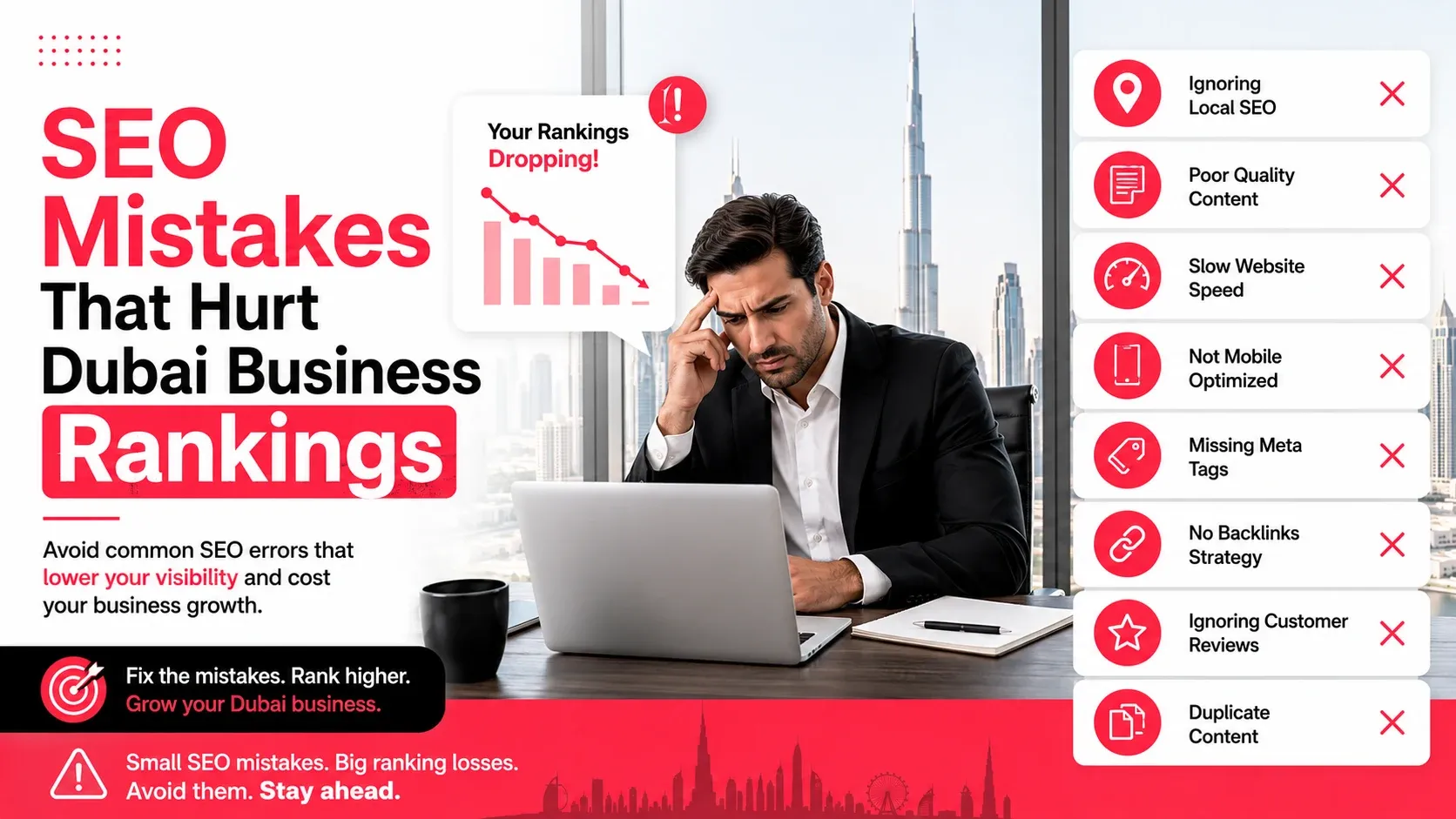
Search engine optimization has become one of the most valuable long-term investments for businesses in Dubai. Whether you're targeting local customers, expanding across the UAE, or competing internationally, strong SEO helps generate qualified traffic, improve brand visibility, and reduce dependence on paid advertising.
However, many businesses struggle to achieve consistent rankings—not because SEO doesn't work, but because avoidable mistakes limit their performance. Some issues are technical, such as slow-loading websites or broken internal links. Others involve poor content planning, weak keyword targeting, or outdated optimization techniques that no longer align with how Google evaluates websites.
Google's algorithms have evolved significantly over the past few years. Today, search engines prioritize user experience, helpful content, topical authority, technical performance, and trustworthiness. Businesses that continue relying on outdated SEO tactics often find themselves losing visibility to competitors with stronger, more comprehensive digital strategies.
In this guide, you'll discover the most common SEO mistakes that hurt business rankings in Dubai, why they matter, and practical ways to fix them for sustainable organic growth.
Quick Answer
The most common SEO mistakes include targeting the wrong keywords, publishing thin content, ignoring technical SEO, neglecting local optimization, poor website speed, duplicate content, weak internal linking, and failing to satisfy search intent.
Avoiding these mistakes helps businesses:
- Improve Google rankings
- Increase organic traffic
- Generate more qualified leads
- Strengthen topical authority
- Enhance user experience
- Improve conversion rates
- Achieve long-term SEO growth
Why SEO Mistakes Cost Businesses Valuable Traffic
SEO isn't simply about ranking for keywords.
Every ranking improvement increases opportunities to:
- Attract new customers
- Build trust
- Generate leads
- Increase sales
- Reduce advertising costs
Likewise, every SEO mistake creates barriers that prevent search engines from understanding, indexing, and recommending your website.
Even small issues can compound over time, leading to declining visibility and lost business opportunities.
How Google Evaluates Modern Websites
Google now considers hundreds of ranking signals.
Some of the most influential include:
- Content quality
- Search intent satisfaction
- Website speed
- Mobile usability
- Internal linking
- Topical authority
- User experience
- Structured data
- Local relevance
- Backlink quality
Businesses that optimize across all these areas generally outperform websites relying on isolated SEO tactics.
Mistake 1: Targeting the Wrong Keywords
Many businesses focus on keywords with the highest search volume while ignoring whether those searches match their products or services.
For example, targeting a broad keyword like:
may attract visitors from around the world.
However:
is far more relevant for a business serving clients in the UAE.
Successful keyword research balances:
- Search volume
- User intent
- Competition
- Commercial value
- Local relevance
Choosing keywords based solely on popularity often leads to lower conversions.
Mistake 2: Ignoring Search Intent
Google increasingly ranks pages that satisfy user intent rather than simply repeating keywords.
Every search falls into one of several intent categories.
Search Intent | Example Query | Recommended Content |
|---|---|---|
Informational | What is Local SEO? | Educational guide |
Commercial | Best SEO Agency Dubai | Comparison article |
Transactional | Hire SEO Company Dubai | Service page |
Navigational | Google Search Console | Specific destination page |
A mismatch between search intent and content often results in poor rankings, even if the page is technically optimized.
Mistake 3: Publishing Thin or Generic Content
Many websites publish articles simply to increase the number of indexed pages.
Unfortunately, thin content rarely performs well.
Low-quality content often:
- Repeats information already available elsewhere
- Lacks practical insights
- Provides little depth
- Fails to answer follow-up questions
- Doesn't demonstrate expertise
Instead, businesses should focus on creating comprehensive resources that genuinely help readers solve problems.
Mistake 4: Creating Duplicate Content
Duplicate content is especially common among:
- Ecommerce websites
- Multi-location businesses
- Service pages
- Product descriptions
Examples include:
- Copying service pages across different cities
- Reusing manufacturer descriptions
- Publishing identical blog articles
- Creating multiple URLs with the same content
Duplicate content makes it difficult for search engines to determine which page deserves to rank.
Every important page should provide unique value.
Mistake 5: Neglecting Technical SEO
Excellent content cannot compensate for a website with serious technical issues.
Common technical SEO problems include:
- Broken links
- Crawl errors
- Missing XML sitemaps
- Poor URL structures
- Redirect chains
- Indexing problems
- Missing canonical tags
Regular technical audits help identify these issues before they affect rankings.
Businesses wanting to identify technical weaknesses can explore SEO services in Dubai for comprehensive SEO strategies that improve website performance and long-term organic visibility.
Mistake 6: Slow Website Speed
Page speed directly affects both rankings and user experience.
Visitors expect websites to load quickly.
Common causes of slow websites include:
- Large images
- Excessive JavaScript
- Unoptimized CSS
- Poor hosting
- Too many plugins
- Render-blocking resources
Improving loading speed often increases:
- Organic traffic
- User engagement
- Conversion rates
- Search rankings
Mistake 7: Ignoring Core Web Vitals
Google introduced Core Web Vitals to measure real user experience.
The three primary metrics are:
Metric | Measures |
|---|---|
Largest Contentful Paint (LCP) | Loading performance |
Interaction to Next Paint (INP) | Responsiveness |
Cumulative Layout Shift (CLS) | Visual stability |
Poor scores can negatively impact both usability and rankings.
Improving these metrics benefits visitors while supporting SEO performance.
Mistake 8: Poor Mobile Optimization
Most searches now happen on mobile devices.
A website that performs well on desktop but poorly on smartphones loses valuable ranking opportunities.
Mobile optimization should include:
- Responsive layouts
- Readable typography
- Fast loading speeds
- Clickable buttons
- Easy navigation
- Mobile-friendly forms
Google primarily evaluates the mobile version of your website, making mobile optimization essential.
Mistake 9: Weak Internal Linking
Internal links help both users and search engines discover related content.
Common internal linking mistakes include:
- Orphan pages
- Broken links
- Generic anchor text
- Linking only to the homepage
- Missing contextual links
Instead, articles should naturally connect readers to relevant resources.
A strong internal linking strategy also strengthens topical authority by showing how different pieces of content relate to one another.
Mistake 10: Overlooking Local SEO
Many Dubai businesses compete primarily for local customers but fail to optimize for local search.
Common local SEO mistakes include:
- Incomplete Google Business Profile
- Inconsistent NAP (Name, Address, Phone Number)
- Missing local keywords
- No location-specific landing pages
- Few customer reviews
- Poor Google Maps optimization
Local SEO remains one of the highest-return investments for businesses serving customers within specific geographic areas.
Mistake 11: Ignoring Structured Data
Structured data helps search engines understand website content more accurately.
Schema markup can provide additional context for:
- Businesses
- Services
- Articles
- FAQs
- Reviews
- Products
- Events
Although schema alone won't guarantee higher rankings, it improves content understanding and may enhance search result appearance, increasing click-through rates.
Mistake 12: Using Outdated SEO Techniques
Some SEO practices that worked years ago are now ineffective—or even harmful.
Avoid tactics such as:
- Keyword stuffing
- Hidden text
- Buying low-quality backlinks
- Automatically generated spam content
- Doorway pages
- Excessive exact-match anchor text
Modern SEO focuses on providing value, improving user experience, and demonstrating expertise rather than manipulating search algorithms.
Mistake 13: Focusing Only on Rankings Instead of Business Results
Many businesses judge SEO success solely by keyword rankings.
While rankings are important, they don't always translate into business growth.
Instead, monitor metrics that directly impact your business:
- Qualified organic traffic
- Conversion rate
- Lead generation
- Phone calls
- Contact form submissions
- Revenue from organic search
- Customer acquisition cost
- Return on SEO investment
A keyword ranking #1 for an irrelevant query is far less valuable than ranking #5 for a keyword that consistently generates qualified leads.
Mistake 14: Publishing Content Without a Strategy
Random blogging rarely builds long-term SEO success.
Many businesses publish articles based on ideas rather than customer demand.
A stronger approach is to build content around topic clusters.
For example, an SEO content hub might include:
- SEO Strategy
- Technical SEO
- Local SEO
- AI SEO
- Core Web Vitals
- Structured Data
- Website UX
- Topical Authority
- Internal Linking
- Google Business Profile
- Content Marketing
Each article reinforces the others, helping Google recognize your website as an authoritative resource.
Mistake 15: Ignoring Content Updates
SEO isn't a "publish once and forget" activity.
Outdated content gradually loses relevance as:
- Search intent evolves
- Algorithms change
- Statistics become outdated
- Competitors publish newer content
- Best practices improve
Review high-performing articles regularly by:
- Updating statistics
- Adding new examples
- Expanding FAQs
- Improving internal links
- Refreshing screenshots
- Including emerging trends
Fresh, relevant content is more likely to maintain strong rankings over time.
Mistake 16: Poor User Experience (UX)
Google increasingly rewards websites that provide positive user experiences.
Common UX issues include:
- Confusing navigation
- Intrusive pop-ups
- Difficult-to-read text
- Poor contrast
- Broken layouts
- Slow interactions
- Excessive advertisements
Good SEO and good UX work together.
If users struggle to navigate your website, search engines are less likely to view it as a high-quality result.
Businesses looking to improve website usability alongside SEO can explore web design services in Dubai to create user-focused websites that support both rankings and conversions.
Mistake 17: Poor Image Optimization
Images contribute significantly to both SEO and page performance.
Common mistakes include:
- Uploading oversized files
- Missing alt text
- Generic filenames
- Uncompressed images
- Using stock images exclusively
- Ignoring WebP or modern formats
Optimized images improve:
- Loading speed
- Accessibility
- Image search visibility
- User experience
Mistake 18: Neglecting E-E-A-T Signals
Google places increasing emphasis on Experience, Expertise, Authoritativeness, and Trustworthiness (E-E-A-T).
Businesses should demonstrate credibility through:
- Well-researched content
- Accurate information
- Author expertise where appropriate
- Customer testimonials
- Case studies
- Transparent contact information
- Secure HTTPS websites
- Updated content
Trust is becoming one of the strongest long-term ranking advantages.
Mistake 19: Measuring the Wrong SEO KPIs
Not every SEO metric reflects business success.
Focus on meaningful performance indicators.
KPI | Why It Matters |
|---|---|
Organic Traffic | Measures search visibility |
Qualified Leads | Connects SEO with revenue |
Conversion Rate | Shows content effectiveness |
Keyword Rankings | Tracks search performance |
Click-Through Rate | Measures search result appeal |
Core Web Vitals | Indicates user experience |
Indexed Pages | Shows search engine coverage |
Backlinks Earned | Strengthens website authority |
A balanced set of KPIs provides a more accurate picture of SEO performance than rankings alone.
Mistake 20: Expecting Instant SEO Results
SEO is a long-term investment.
Businesses often become discouraged after only a few weeks.
In reality, sustainable SEO growth requires:
- Consistent publishing
- Technical improvements
- Content optimization
- Internal linking
- Link acquisition
- Regular monitoring
Websites that commit to continuous improvement generally outperform competitors looking for quick wins.
Quick SEO Health Checklist
Use this checklist to identify common issues affecting your website.
SEO Area | Status |
|---|---|
Target the right keywords | ☐ |
Match search intent | ☐ |
Publish comprehensive content | ☐ |
Avoid duplicate content | ☐ |
Fix technical SEO issues | ☐ |
Improve website speed | ☐ |
Optimize Core Web Vitals | ☐ |
Ensure mobile responsiveness | ☐ |
Strengthen internal linking | ☐ |
Optimize for local SEO | ☐ |
Implement structured data | ☐ |
Update older content | ☐ |
Improve user experience | ☐ |
Optimize images | ☐ |
Monitor SEO KPIs | ☐ |
This checklist can serve as a regular review process to maintain and improve your website's SEO health.
How to Recover from SEO Mistakes
Recovering from SEO issues starts with identifying the highest-impact problems first.
A practical recovery process looks like this:
Phase | Priority | Recommended Actions |
|---|---|---|
Audit | High | Identify technical, on-page, and content issues |
Technical Fixes | High | Resolve crawl errors, speed issues, redirects, and indexing problems |
Content Optimization | High | Improve quality, search intent, semantic coverage, and internal linking |
Authority Building | Medium | Earn quality backlinks and strengthen topical authority |
Monitoring | Ongoing | Track rankings, traffic, conversions, and user engagement |
SEO improvements rarely happen overnight, but consistent optimization produces compounding long-term results.
Key Takeaways
- SEO mistakes often prevent businesses from reaching their full organic potential.
- Keyword targeting should align with customer intent and business goals.
- Comprehensive, high-quality content consistently outperforms thin articles.
- Technical SEO remains essential for crawling, indexing, and rankings.
- Website speed and Core Web Vitals directly affect user experience.
- Mobile optimization is critical for modern search performance.
- Strong internal linking improves topical authority.
- Local SEO is essential for businesses targeting customers in Dubai and across the UAE.
- E-E-A-T and trust signals are becoming increasingly important.
- SEO success should be measured through business outcomes—not rankings alone.
Building a Stronger SEO Foundation for Sustainable Growth
Successful SEO isn't about avoiding one or two mistakes—it's about creating a website that consistently delivers value to both users and search engines. Businesses that invest in technical excellence, helpful content, strong internal linking, local optimization, and continuous improvement are better positioned to earn long-term visibility and qualified traffic.
Rather than chasing algorithm updates or relying on outdated tactics, focus on building a comprehensive SEO strategy that aligns with user intent, demonstrates expertise, and supports your business objectives. Over time, this approach creates a stronger digital presence that continues to generate results even as search evolves.
If you're looking to systematically identify and resolve SEO issues, our SEO Audit Checklist for Dubai Websites provides a practical framework for evaluating technical, on-page, and content performance.
Milaaj Brandset helps businesses improve organic visibility through strategic SEO, technical optimization, high-quality content, and data-driven digital marketing solutions that deliver sustainable growth.
FAQs
What are the biggest SEO mistakes businesses make?
The most common mistakes include targeting the wrong keywords, ignoring search intent, publishing thin content, neglecting technical SEO, poor website speed, weak internal linking, duplicate content, and overlooking local SEO.
Can technical SEO affect Google rankings?
Yes. Technical issues such as crawl errors, broken links, slow loading speeds, and indexing problems can prevent search engines from properly understanding and ranking your website.
How often should I update SEO content?
Review important pages every 6–12 months or sooner if there are major algorithm updates, industry changes, or new customer search trends.
Why is search intent important?
Google aims to provide results that best satisfy a user's goal. Content that matches search intent is more likely to rank well and keep visitors engaged.
Does website speed affect SEO?
Yes. Faster websites improve user experience, reduce bounce rates, and contribute positively to search rankings through better Core Web Vitals performance.
Is local SEO necessary for businesses in Dubai?
Absolutely. Businesses serving local customers should optimize their Google Business Profile, location pages, reviews, and local keywords to improve visibility in Google Search and Maps.
How can internal linking improve SEO?
Internal links help search engines understand the relationship between pages, distribute authority across your website, and guide users to relevant content.
How long does it take to fix SEO mistakes?
Some technical improvements may show results within weeks, while broader SEO improvements involving content, authority, and rankings typically require several months of consistent optimization.
Ready to Elevate Your Brand?
Start Your Project Today