September 3, 2026
White Hat SEO Strategies for Long-Term Growth: A Practical Guide
Milaaj Editorial / Research Insights
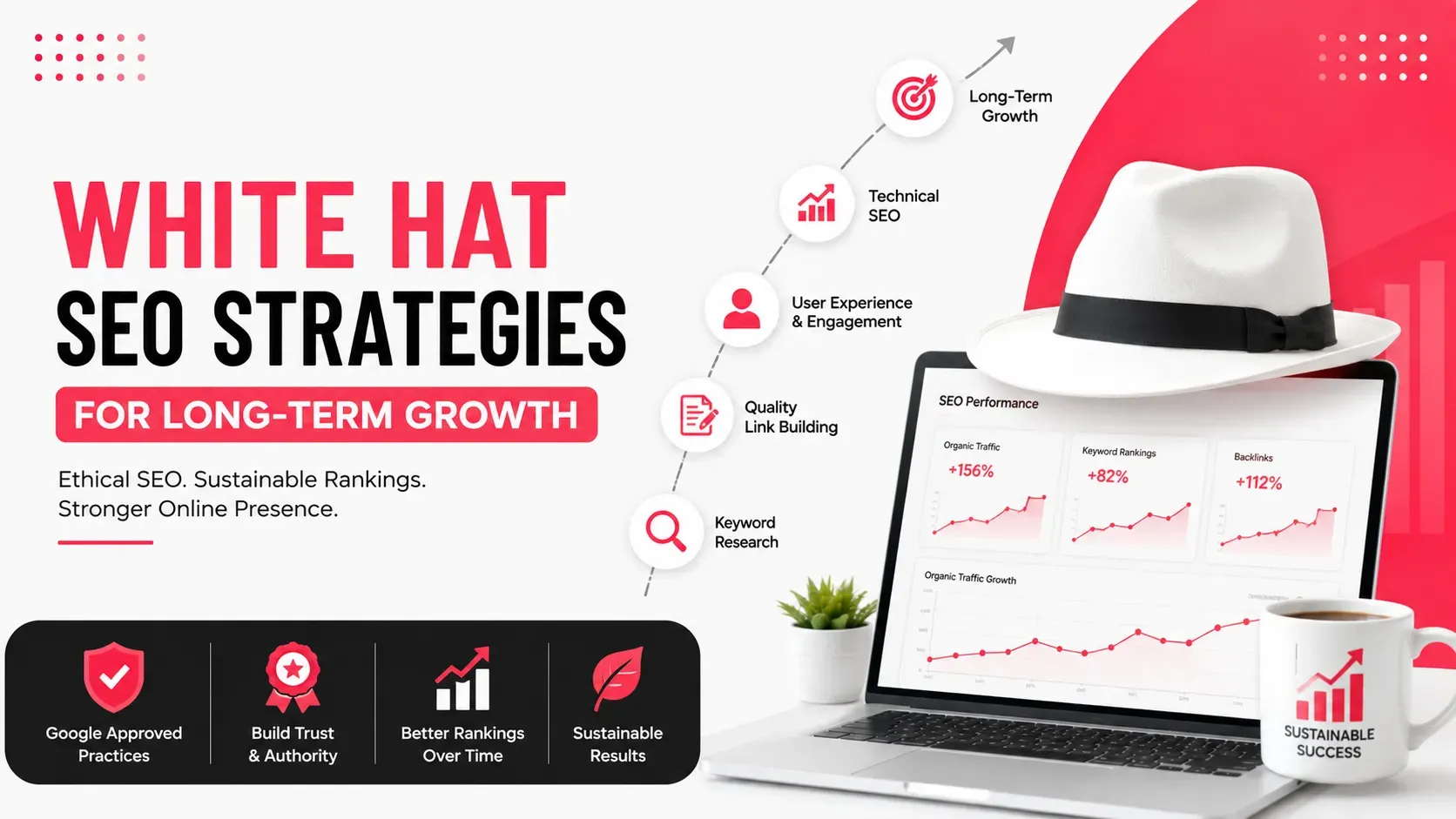
Search rankings can change quickly, but sustainable SEO growth rarely happens overnight. Businesses that want consistent organic visibility need strategies that improve their websites for users while staying aligned with how search engines are designed to work.
This is where white hat SEO strategies become important.
White hat SEO focuses on legitimate optimization practices such as creating useful content, understanding search intent, improving website accessibility, building logical site structures, and earning authority through genuine value. It takes a longer-term view instead of trying to exploit temporary weaknesses in search algorithms.
For businesses competing in crowded markets, that difference matters. A short-term ranking increase is useful only if it can survive algorithm changes, competitor improvements, and changing search behavior.
Quick Answer: What Is White Hat SEO?
White hat SEO is the practice of improving a website's organic search visibility through ethical, sustainable optimization methods that prioritize users and follow search engine guidelines.
The strongest white hat SEO strategies typically include:
- Creating helpful, original content
- Matching content to search intent
- Improving technical SEO
- Building logical internal links
- Developing topical authority
- Earning relevant backlinks naturally
- Improving website experience
- Monitoring performance and updating content
Unlike manipulative SEO, the objective isn't to trick search engines into ranking a page. It is to build a website that deserves visibility because it provides useful information and a good experience.
Why White Hat SEO Is Better for Long-Term Growth
SEO is not simply a competition to reach the first position today.
A website that gains visibility through manipulative tactics may experience short-term improvements, but those gains can become fragile when search systems change or spam patterns are detected.
Google's Search Essentials identify helpful, reliable, people-first content as a core SEO best practice and separately document spam practices that can result in lower rankings or removal from search results.
White hat SEO takes a different approach.
Instead of asking:
“What can I do to make Google rank this page?”
the better question is:
“What would make this page genuinely useful for someone searching this topic?”
That shift influences everything from keyword research to content creation and website architecture.
Sustainable SEO is built in layers
Long-term organic growth usually develops through several connected layers:
Technical foundation → Relevant content → Topical depth → Authority → Search visibility → Business results
Weakness in one layer can limit the others.
For example, excellent content may struggle if Google cannot properly crawl or index the website. Likewise, a technically strong site may attract little organic traffic if its content does not satisfy search intent.
Start With Search Intent, Not Just Keywords
One of the most important white hat SEO strategies is understanding what the searcher actually wants.
A keyword is only a representation of a search.
Consider these three queries:
- What is SEO?
- How to improve SEO rankings
- SEO company Dubai
They all relate to SEO, but the intent is different.
The first is informational.
The second is instructional.
The third has strong commercial and local intent.
Creating the same type of page for all three would be a mistake.
Let the query determine the page
Before creating content, examine the search results for the target query.
Look at:
- The type of pages ranking
- Common topics covered
- Search-result features
- Questions appearing in the results
- Commercial versus informational content
- Local relevance
- Content depth
- Potential information gaps
The goal isn't to copy the current results.
It is to understand what Google appears to consider relevant and then create something that provides additional value.
Create People-First Content That Deserves to Rank
Content is at the center of sustainable SEO.
But publishing more articles does not automatically produce more organic growth.
Google's current guidance asks whether content provides original information, substantial value, insightful analysis, and a satisfying experience for readers. It also warns against producing content primarily to attract search traffic or rewriting existing sources without adding meaningful value.
That makes content quality more important than publishing volume.
Give readers something competitors don't
Suppose the top-ranking pages all explain:
- What SEO is
- Why SEO matters
- Basic SEO techniques
Publishing another article that says exactly the same things is unlikely to create a meaningful advantage.
Instead, improve the resource with:
- Original examples
- Practical workflows
- Industry-specific observations
- Clear comparisons
- Real problems and solutions
- Better explanations
- Updated information
- Useful data or research
The goal is not simply to be longer.
It is to be more useful.
Avoid writing to an arbitrary word count
A 1,500-word article can outperform a 3,000-word article when the shorter page answers the search more effectively.
Google explicitly says there is no preferred word count for ranking.
Use as many words as the topic genuinely requires.
Build Topical Authority Instead of Chasing Isolated Keywords
A website becomes stronger when its pages demonstrate knowledge across a connected subject area.
Imagine a business targeting the broad topic of SEO.
Instead of publishing unrelated articles around random keywords, it could build a connected content ecosystem covering:
- Keyword research
- Search intent
- Semantic SEO
- Technical SEO
- Internal linking
- Local SEO
- Content optimization
- SEO measurement
- Search features
- AI and answer-focused search
Each page serves a different purpose while contributing to the site's broader topical coverage.
Use topic clusters intelligently
A central commercial page can act as the main destination, while supporting articles answer specific informational questions.
For example:
Main service page
SEO services
Supporting resources
Keyword research
Search intent
Technical SEO
Semantic SEO
Internal linking
Content relevance
The relationship between these pages should be natural rather than artificially forced.
Our guide on SEO silo structure explains how related content can be organized into a clearer website architecture without creating isolated sections.
Make Technical SEO Part of the Strategy
White hat SEO isn't only about content.
A website also needs to be accessible to search engines.
Google's Search Essentials describe technical requirements as the basic conditions that allow web content to be eligible to appear in Search.
Important areas include:
Crawlability and indexability
Search engines need to be able to discover and process important pages.
Check for:
- Blocked resources
- Incorrect robots directives
- Unwanted noindex tags
- Crawl problems
- Broken internal links
Website structure
Important pages should be easy to discover through logical navigation and internal links.
Mobile usability
A page should work properly across the devices people actually use.
Page experience
Loading performance, visual stability, responsiveness, and usability all contribute to the overall experience.
However, technical SEO should not become a checklist exercise where every other aspect of the website is ignored.
A technically excellent website with poor content is still unlikely to become a strong organic resource.
Use Internal Linking to Connect Your Best Content
Internal links are one of the simplest white hat SEO techniques to overlook.
A strong internal-linking system helps users move between related pages and gives search engines additional paths for discovering content.
Imagine an article about keyword research mentioning search intent.
A contextual link to a detailed search-intent article makes sense because the reader may want to explore that concept.
Similarly, an article about technical SEO might naturally connect to content about website structure or page experience.
Think in relationships, not link counts
There is no benefit in adding dozens of internal links simply to hit a target number.
Instead, ask:
Would this link help someone understand the topic better?
If the answer is yes, the link probably belongs there.
If the answer is no, adding it merely for SEO can make the page harder to read.
Earn Backlinks Through Value, Not Manipulation
Backlinks remain an important part of how websites build authority, particularly in competitive industries.
But white hat link building is fundamentally different from buying or manipulating links.
Google identifies link spam as a practice intended to manipulate rankings and recommends creating unique, compelling content that can naturally earn references.
Create reasons for people to reference your website
Useful link-worthy assets can include:
- Original research
- Industry statistics
- Detailed guides
- Case studies
- Surveys
- Original tools
- Calculators
- Expert analysis
- Data visualizations
- Unique local insights
For example, a Dubai-focused business could publish original research about digital marketing trends among UAE businesses.
That gives journalists, bloggers, industry publications, and other websites something useful to reference.
Relevance matters more than raw quantity
One relevant industry reference can be more meaningful than dozens of unrelated links.
The objective should be to build real authority within your subject area, not simply increase a backlink counter.
Optimize for Search Without Making the Content Sound Optimized
White hat SEO still requires keywords.
The difference is how they are used.
Google recommends using words people would use to search for your content and placing them in prominent locations such as titles and main headings.
That does not mean repeating the same phrase in every paragraph.
Use natural keyword variations
Suppose the primary keyword is:
white hat SEO strategies
Related language might naturally include:
- ethical SEO
- sustainable SEO
- organic search growth
- SEO best practices
- people-first content
- technical optimization
- search visibility
- organic traffic
These phrases can help communicate the subject while keeping the writing natural.
The best test is simple:
Would a knowledgeable human naturally write this sentence this way?
If not, rewrite it.
Improve Existing Content Instead of Constantly Publishing New Pages
One of the most overlooked long-term SEO strategies is improving pages you already have.
An existing article may already have:
- Search impressions
- Backlinks
- Organic traffic
- Historical authority
- Existing internal links
Throwing it away and starting again may not always be the best approach.
Look for improvement opportunities
Review important pages periodically and ask:
- Has the search intent changed?
- Is the information still accurate?
- Are competitors providing better answers?
- Are there important questions missing?
- Are internal links still relevant?
- Are there outdated examples?
- Could the introduction be clearer?
- Are there pages now competing for the same keyword?
Updating content should be driven by genuine improvements rather than changing dates simply to make a page appear fresh.
Google specifically warns against changing content dates without substantial changes merely to make pages seem fresh.
Make SEO Useful Beyond Traditional Google Rankings
Search behavior continues to expand beyond conventional blue-link results.
Users increasingly interact with search through featured answers, conversational queries, AI-powered experiences, voice interfaces, and other formats.
This makes clear, structured, answer-focused content increasingly useful.
Our guide to Answer Engine Optimization (AEO) explains how direct answers, conversational queries, and structured information can complement traditional SEO.
The underlying principle remains the same:
Make your information easy to understand and useful wherever the searcher encounters it.
That does not mean creating a completely separate “AI SEO” system.
It means continuing to produce content that demonstrates relevance, clarity, usefulness, and genuine expertise.
Measure SEO Growth by Business Value
Rankings matter, but they are not the final objective.
A sustainable SEO campaign should connect search visibility with meaningful business outcomes.
Monitor metrics such as:
- Organic impressions
- Organic clicks
- Click-through rate
- Ranking trends
- Non-branded search traffic
- Qualified leads
- Conversions
- Revenue where measurable
- Engagement with important landing pages
A keyword moving from position 70 to position 25 represents progress, even though it isn't yet on the first page.
Likewise, ranking first for an irrelevant keyword may provide very little commercial value.
Measure the right audience
The most valuable organic visitor isn't necessarily the one who generates the highest traffic number.
It is the visitor who:
- Has a genuine need
- Finds the page relevant
- Engages with the website
- Moves toward a useful next step
- Has the potential to become a customer
For businesses investing in sustainable organic growth, SEO services in Dubai can bring together technical optimization, content strategy, keyword research, internal linking, and authority building within one broader SEO approach.
What White Hat SEO Should Never Become
Ethical SEO does not mean avoiding optimization.
It means avoiding manipulation.
Be cautious of strategies built around:
Keyword stuffing
Repeating keywords unnaturally can make content difficult to read and is explicitly identified by Google as spam.
Manipulative link schemes
Buying or creating links primarily to manipulate rankings can violate Google's spam policies.
Mass-produced low-value content
Publishing large volumes of generic pages simply to capture search traffic can create a weak content ecosystem.
Fake expertise
Content should not make unsupported claims about experience, results, or expertise.
Doorway pages
Creating multiple highly similar pages primarily to capture different search queries or locations can produce poor user experiences and create SEO risks.
The common thread is simple:
If the primary purpose of the tactic is to manipulate rankings rather than improve the user's experience, reconsider it.
A Practical White Hat SEO Roadmap
For businesses starting or rebuilding an SEO campaign, the process can be simplified into several stages.
1. Understand the market
Identify your audience, competitors, products, services, and commercial priorities.
2. Research search demand
Find keywords and questions that reflect genuine customer needs.
3. Map search intent
Determine what type of content each important query requires.
4. Fix the technical foundation
Make important pages crawlable, indexable, accessible, and usable.
5. Build useful content
Create pages that provide original information and meaningfully satisfy search intent.
6. Connect the website
Use logical navigation and contextual internal links to connect related resources.
7. Build authority
Earn relevant references through useful content, expertise, research, partnerships, and genuine promotion.
8. Measure and improve
Use search performance and business data to identify what is working and where the website needs improvement.
This creates a cycle rather than a one-time SEO project:
Research → Build → Measure → Improve → Expand
That is the foundation of sustainable organic growth.
Key Takeaways
- White hat SEO focuses on sustainable optimization rather than manipulating search rankings.
- Search intent should guide keyword targeting and content creation.
- Helpful, original content is more valuable than content created simply to attract search traffic.
- Technical SEO provides the foundation for organic visibility.
- Topical authority is stronger than chasing disconnected keywords.
- Internal links should connect genuinely related content rather than exist for link-count targets.
- Ethical link building focuses on earning relevant references through valuable content.
- Keyword optimization should remain natural and readable.
- Updating existing content can be more valuable than constantly publishing new pages.
- SEO should increasingly consider answer-focused and AI-powered search experiences.
- Rankings are useful metrics, but qualified traffic and business results are ultimately more important.
- Long-term SEO growth comes from continuously improving the website rather than searching for shortcuts.
Conclusion
White hat SEO is not about doing less to avoid penalties. It is about doing the right things for the right reasons.
Instead of trying to exploit temporary weaknesses in search algorithms, businesses can build a stronger foundation through useful content, technical accessibility, clear site architecture, relevant internal links, genuine authority, and a deep understanding of what their customers are searching for.
That approach may not produce overnight results. But it creates something more valuable: a website capable of continuing to attract relevant organic visibility as search systems, competitors, and user behavior evolve.
The most sustainable SEO strategy is therefore not the one that finds the fastest shortcut.
It is the one that keeps making the website more useful, more relevant, and more trustworthy over time.
Milaaj Brandset helps businesses build sustainable online visibility through SEO and digital marketing strategies that connect content, technical optimization, search intent, and long-term growth.
FAQ: White Hat SEO Strategies
What is white hat SEO?
White hat SEO refers to ethical search engine optimization practices that focus on improving a website for users while following search engine guidelines. Common examples include useful content creation, technical SEO, internal linking, search-intent optimization, and earning relevant backlinks.
Is white hat SEO better than black hat SEO?
For long-term business growth, white hat SEO is the safer and more sustainable approach. Black hat techniques attempt to manipulate search systems and can create ranking or visibility risks.
Does white hat SEO take longer to produce results?
It can. Sustainable SEO often requires time to build content quality, topical authority, technical improvements, and external recognition. The advantage is that the strategy is designed for durable growth rather than short-term ranking manipulation.
Is keyword research part of white hat SEO?
Yes. Keyword research helps identify the language and questions people use when searching. The important part is using that information to create genuinely useful content rather than stuffing keywords into pages.
Can white hat SEO work for competitive industries?
Yes, although highly competitive markets generally require a more comprehensive strategy. Strong content, technical SEO, topical authority, local relevance where applicable, internal linking, and earned authority can all contribute to competing for difficult searches.
Are backlinks considered white hat SEO?
Earning relevant backlinks through valuable content and genuine relationships is consistent with white hat SEO. Manipulating links primarily to influence rankings can violate search engine spam policies.
How often should SEO content be updated?
There is no universal update schedule. Content should be reviewed when information changes, search intent evolves, competitors provide substantially better resources, or performance data reveals an opportunity to improve the page.
Does white hat SEO work with AI search?
Yes. The fundamentals remain relevant. Clear, useful, well-structured, trustworthy content can support visibility across traditional search and newer answer-focused search experiences. The focus should remain on satisfying users rather than optimizing for a supposed shortcut.
Ready to Elevate Your Brand?
Start Your Project Today