September 7, 2026
What Is an AI Agent and How Can It Automate Your Business in Dubai?
Milaaj Editorial / Research Insights
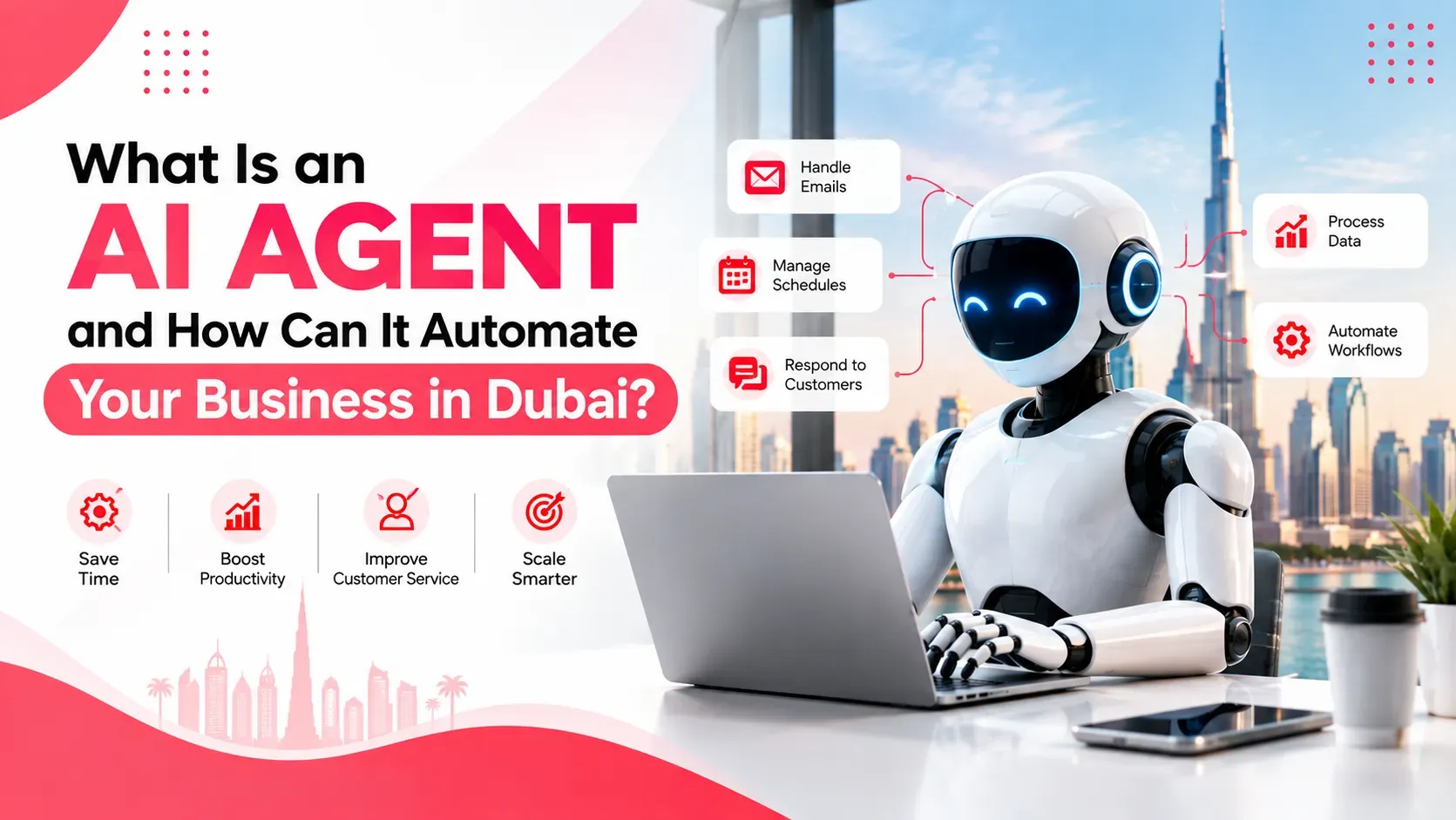
Someone in your industry mentions "AI agents" at a networking event, your competitor's LinkedIn post claims they "automated their whole sales pipeline with an AI agent," and you nod along, but privately you're wondering if this is a real tool or just the next buzzword after "chatbot" and "the cloud."
You're not alone in that confusion. The term gets used so loosely right now that it covers everything from a simple customer support bot to a fully autonomous system running parts of a company without human input.
This guide gives you a clear, honest definition of what an AI agent actually is, how it's different from the chatbot you might already be using, and what it could realistically automate inside a Dubai business like yours.
Quick Answer
An AI agent is a software system that can understand a goal, make decisions, and take action on its own, using tools like databases, APIs, or other software, rather than just responding to a single message. Unlike a chatbot, which mainly answers questions, an AI agent can complete multi-step tasks such as qualifying a lead, updating a record, and sending a follow-up, all without a human directing each step.
Key Takeaways
- An AI agent perceives information, decides what to do, and takes action, closer to a digital employee than a search box.
- The key difference from a chatbot is autonomy: a chatbot responds, an agent completes tasks.
- Common business uses in Dubai include customer support, lead qualification, appointment scheduling, and internal reporting.
- AI agents still need human oversight, especially for anything involving customer data, payments, or legal commitments.
- Costs vary widely based on complexity, from a few thousand dirhams for a simple task-specific agent to significantly more for a fully custom, multi-system agent.
What Is an AI Agent, Exactly?
Think of an AI agent as a digital assistant that doesn't just talk, it acts. IBM describes an AI agent as a system that works through tasks on its own by building out a workflow and calling on whatever tools it needs along the way, using large language models to understand what's being asked and decide which tools to use to get it done.
Here's a simple way to picture it. If you ask a chatbot "what's my order status," it looks up an answer and tells you. An AI agent, given the goal "make sure this customer's order arrives on time," can check inventory, contact the courier's system, flag a delay, and message the customer proactively, all as one connected chain of decisions.
That chain of perceiving information, deciding what matters, and acting on it is what separates an agent from a simple tool.
AI Agent vs Chatbot vs Traditional Automation: What's the Difference?
This is where most of the confusion comes from, so let's untangle it properly.
How AI Agents Differ from Chatbots
A chatbot is reactive. It waits for a message, matches it to a response or a script, and replies. Even AI-powered chatbots built on large language models are usually still answering one question at a time.
An AI agent is goal-driven. You give it an outcome to reach, like "qualify this lead and book a call if they're a fit," and it figures out the steps needed to get there, adjusting along the way if something changes.
If your business already uses a support bot, a well-built AI chatbot is often the right tool for straightforward, single-turn questions, while an agent is better suited to anything that requires multiple steps or decisions.
How AI Agents Differ from Rule-Based Automation
Traditional automation (think "if this, then that" workflows) is powerful but rigid. It only works exactly as programmed and breaks the moment something unexpected happens.
AI agents can handle ambiguity. If a customer's message doesn't fit a predefined rule, an agent can reason through it, pull in outside information, and still complete the task, rather than stalling out and waiting for a human to step in.
How Do AI Agents Actually Work?
Most AI agents follow a simple loop: perceive, decide, act. They take in information (a message, a data update, a trigger), use an AI model to decide what needs to happen next, then carry out that action using connected tools like a CRM, an email system, or an internal database, before checking the result and repeating the cycle if needed. Agents that are properly connected to your own data through LLM integration tend to make far better decisions than generic, off-the-shelf tools, simply because they understand your specific business context rather than guessing from general knowledge.
What Business Tasks Can AI Agents Automate in Dubai?
Once you see the pattern, the practical applications become obvious for almost any UAE business.
Customer Support and Query Handling
Beyond basic FAQs, an agent can look up an actual order or account record, resolve straightforward issues on its own, and only escalate the genuinely complex cases to a human team member.
Sales Lead Qualification and Follow-Up
An agent can review an incoming lead, check it against your ideal customer criteria, send a tailored follow-up message, and update your CRM automatically, all before a salesperson even sees the notification.
Inventory, Ordering, and Supplier Coordination
For retail and e-commerce businesses, agents can monitor stock levels, flag low inventory, and even trigger a reorder with a supplier's system when thresholds are hit.
Appointment Scheduling and Bookings
Clinics, salons, and service businesses can use agents to handle the entire booking conversation: checking availability, confirming a slot, and sending reminders, without a staff member managing a calendar manually.
Internal Reporting and Data Entry
Agents can pull data from multiple internal systems, compile it into a report format your team actually uses, and deliver it on a schedule, cutting out hours of manual copy-paste work every week.
What Are the Real Benefits of Using AI Agents?
The appeal isn't just "saving time," although that's real. It's what saved time actually unlocks for a growing business.
- Consistency: an agent follows the same quality standard on the hundredth task as it did on the first, no fatigue, no bad days
- Scalability without headcount growth: handling double the customer volume doesn't automatically mean hiring double the staff
- Faster response times: agents can act within seconds, which matters a lot when a lead's interest fades quickly
- Freed-up human time: your team spends less time on repetitive tasks and more time on judgment calls, relationships, and strategy
If repetitive manual work is slowing your team down across more than one department, it's often worth looking at business process automation more broadly rather than tackling each task in isolation.
What Are the Risks and Limitations of AI Agents?
It would be dishonest to sell you on AI agents as a flawless solution, so let's be direct about the tradeoffs.
Agents can still make mistakes, especially when a situation falls outside what they were designed to handle. Anything involving sensitive customer data, financial transactions, or legally binding commitments should include a human review step, not full autonomy from day one.
There's also an integration reality check: an agent is only as useful as the systems it's connected to. A poorly planned setup can create more confusion than it solves, which is exactly why Google Cloud notes that agent architecture needs proper orchestration and clear boundaries around what the agent is allowed to do.
The businesses that get the most value treat AI agents as a capable junior team member that still needs oversight, not a fully hands-off replacement for a human role.
How Much Does It Cost to Build an AI Agent for Your Business?
Pricing depends heavily on scope. A narrow, single-task agent (say, one that only handles appointment booking) costs far less than a multi-system agent coordinating sales, inventory, and support together.
As a rough guide, simple task-specific agents tend to start in the low thousands of dirhams, while more complex agents integrated across several business systems can run considerably higher, similar in structure to how custom software projects are priced based on complexity rather than a flat rate.
The safest approach is to start with one clearly defined task, prove the value, then expand from there rather than trying to automate everything at once. This kind of honest, scope-first conversation about cost and complexity is exactly what Milaaj Brandset walks UAE businesses through before recommending anything.
How to Get Started with AI Agents in Your Business
You don't need to overhaul your entire operation to benefit from this. A practical starting point looks like this:
- Pick one repetitive, time-consuming task that follows a somewhat predictable pattern
- Map out exactly what a human currently does for that task, step by step
- Identify which systems (CRM, inventory, calendar, email) the task touches
- Build and test the agent on that single task before expanding further
- Keep a human checkpoint in place until the agent has a proven track record
If you're also exploring broader AI tooling for your marketing efforts, it's worth reading up on how AI tools are already reshaping business marketing more generally, since agents often work alongside those tools rather than replacing them.
Frequently Asked Questions
What is an AI agent in simple terms?
An AI agent is software that can understand a goal, decide what steps are needed to reach it, and carry out those steps on its own using connected tools, rather than just answering a single question.
How is an AI agent different from a chatbot?
A chatbot responds to individual questions, while an AI agent can complete multi-step tasks toward a goal, making decisions and taking actions across systems without needing a human to direct every step.
What business tasks can AI agents automate?
Common examples include customer support resolution, sales lead qualification, appointment scheduling, inventory monitoring, and internal reporting, though almost any repetitive, multi-step task is a candidate.
How much does it cost to build an AI agent for a business?
Costs depend on complexity. A single-task agent is far more affordable than a multi-system agent connected across sales, support, and inventory platforms, similar to how custom software pricing scales with scope.
Are AI agents safe and reliable for handling company data?
They can be, provided they're built with proper access controls and human review checkpoints for sensitive actions. Treating an agent like a capable but supervised team member, rather than a fully autonomous system, is the safest approach.
Ready to See What an AI Agent Could Actually Do for Your Business?
You don't need to understand every technical detail to benefit from this technology. What matters is identifying the one repetitive task in your business that's quietly costing you the most time, and starting there.
If you want to explore what a custom-built agent could realistically automate for your specific operations, our AI agent development team can walk you through what's actually feasible before you commit to anything.
Ready to Elevate Your Brand?
Start Your Project Today