August 8, 2026
Best Payment Gateway Options for UAE Ecommerce
Milaaj Editorial / Research Insights
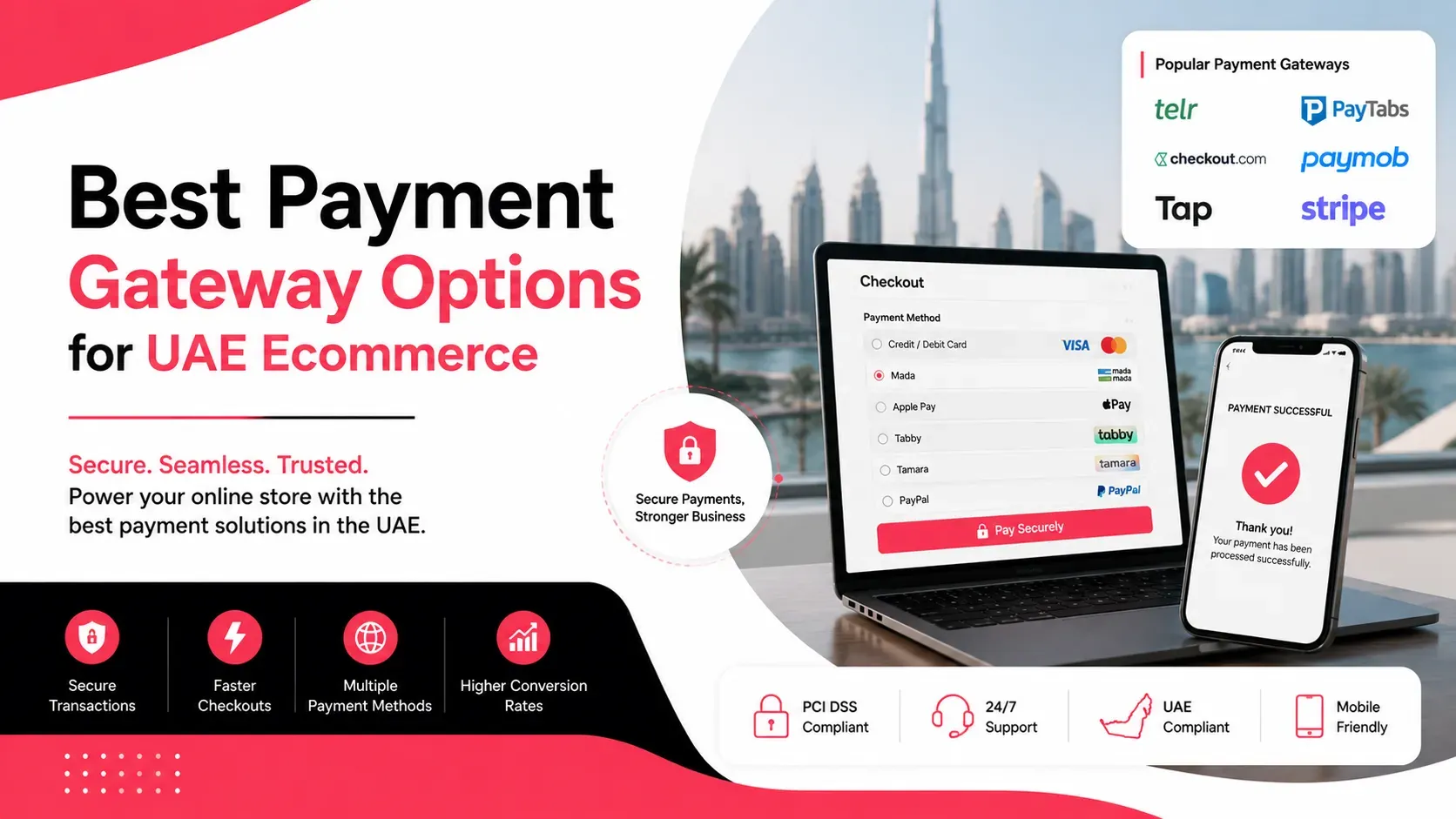
Choosing a payment gateway is one of the most important decisions when launching or upgrading an ecommerce store in the UAE. A gateway does more than process card payments. It influences checkout speed, customer trust, payment success rates, settlement processes, integrations, and ultimately how easily customers can complete an order.
The UAE has a mature digital payments ecosystem, with businesses able to choose from local and international providers serving different merchant requirements. Current market coverage includes providers such as Network International, Telr, Stripe, Checkout.com, PayTabs, Tap Payments, and Mamo, although their suitability varies considerably depending on business size, transaction volume, target customers, and required payment methods.
For ecommerce businesses, there is no single gateway that is automatically the best. A startup processing a small number of domestic transactions may have very different requirements from an established retailer selling across the GCC and accepting multiple currencies.
This guide explains the main payment gateway options available to UAE ecommerce businesses and the factors you should evaluate before choosing one.
Quick Answer
Some of the leading payment gateway options for UAE ecommerce businesses include Network International, Telr, Stripe, Checkout.com, PayTabs, and Tap Payments. The best choice depends on your transaction volume, local and international payment requirements, ecommerce platform, settlement needs, integration capabilities, and pricing structure.
Before choosing a provider, businesses should compare the total cost of acceptance, supported payment methods, settlement arrangements, fraud controls, integration options, and customer checkout experience rather than selecting a gateway based only on advertised transaction rates.
What Is a Payment Gateway?
A payment gateway connects an ecommerce website with the financial infrastructure required to authorize and process online payments.
When a customer checks out, the gateway helps transmit payment information securely, communicate with the relevant payment infrastructure, and return an approval or decline response to the merchant.
A typical ecommerce payment flow involves:
- Customer selects a payment method.
- Payment information is submitted securely.
- The transaction is routed for authorization.
- The payment provider and relevant financial institutions process the request.
- The merchant receives confirmation of success or failure.
- Funds are settled according to the provider's agreed settlement cycle.
The exact architecture differs between providers and integrations, but the objective remains the same: make online payments secure, reliable, and convenient.
The Central Bank of the UAE regulates payment services through its applicable regulatory framework, including categories such as merchant acquiring and payment aggregation. Businesses should therefore verify the regulatory and contractual status of the providers they use rather than relying solely on marketing claims.
Why Payment Gateway Selection Matters for UAE Ecommerce
A customer may spend several minutes comparing products before reaching checkout. If the payment experience suddenly becomes confusing, slow, or restrictive, all the marketing and website optimization that brought the customer there can be wasted.
A suitable gateway can support:
- Faster checkout
- Multiple payment methods
- Secure transaction processing
- Mobile-friendly payments
- International customers
- Local currency transactions
- Recurring payments where supported
- Ecommerce platform integrations
- Fraud monitoring
- Reliable settlement
Milaaj Brandset's existing guide on payment gateway integration for UAE websites also highlights how payment infrastructure affects conversion rates, customer trust, mobile usability, and cart abandonment.
Leading Payment Gateway Options in the UAE
The right provider depends heavily on the type of ecommerce business you operate. Rather than ranking every gateway from "best" to "worst," it is more useful to understand what each type of provider is generally suited for.
Network International
Network International is one of the major payment infrastructure and acquiring companies serving merchants across the UAE and wider Middle East.
It can be particularly relevant for established businesses that require extensive payment acceptance and acquiring capabilities.
Potential considerations include:
- Local market presence
- Merchant acquiring
- Multiple payment methods
- Enterprise-oriented payment infrastructure
- Integration capabilities
For larger ecommerce operations, the relationship between the gateway, acquiring bank, settlement process, and existing financial infrastructure can be just as important as the storefront integration.
Telr
Telr is a UAE-founded payment gateway that focuses heavily on merchants in the region.
It can be suitable for businesses looking for a payment provider with regional ecommerce experience and support for local merchant requirements.
Common considerations when evaluating Telr include:
- Ecommerce integration
- Regional payment acceptance
- Currency support
- Merchant onboarding
- Security features
- Available payment methods
Current UAE payment-provider comparisons continue to list Telr among the country's major ecommerce payment options.
Stripe
Stripe is particularly attractive to technology-focused businesses that need developer-friendly payment infrastructure.
Its strengths can include:
- Extensive APIs
- Developer tools
- International payment capabilities
- Subscription functionality
- Strong integration ecosystem
- Support for customized checkout experiences
This can make Stripe appealing to SaaS companies, digitally native businesses, marketplaces, and ecommerce brands with technical teams.
However, merchants should still review current UAE-specific availability, pricing, supported payment methods, settlement terms, and account requirements before making a decision.
Checkout.com
Checkout.com is another major international payment provider with a significant Middle East presence.
It is generally more relevant to businesses with sophisticated payment requirements and substantial transaction volumes.
Potential advantages include:
- Enterprise payment infrastructure
- Global payment acceptance
- Advanced payment processing capabilities
- Developer APIs
- Data and optimization tools
For a large ecommerce operation, the ability to optimize authorization rates and manage payments across different markets can become more important than simply finding the lowest headline transaction fee.
PayTabs
PayTabs is another established regional payment provider used by businesses across the Middle East.
It can be worth considering for ecommerce companies looking for:
- Regional payment acceptance
- Online payment processing
- Ecommerce integrations
- Multiple payment options
- Merchant-focused tools
Its regional positioning makes it particularly relevant for businesses whose customer base is concentrated in the GCC.
Tap Payments
Tap Payments operates across the Middle East and provides payment solutions aimed at online businesses and merchants.
It can be relevant for businesses that want:
- Online payment acceptance
- Regional payment methods
- API integrations
- Ecommerce platform connectivity
- Payment links and related merchant tools
Recent UAE payment-provider comparisons identify Tap among the notable options available to local merchants.
Which Gateway Should You Choose?
The "best" payment gateway depends on your specific ecommerce model.
For example:
- Small UAE store: Prioritize easy onboarding, predictable costs, and straightforward integration.
- Growing ecommerce brand: Look for multiple payment methods, strong integrations, and scalable processing.
- Enterprise retailer: Focus on authorization rates, reporting, fraud controls, multi-market capabilities, and negotiated commercial terms.
- International seller: Prioritize currency support, international card acceptance, and cross-border settlement.
- Subscription business: Verify recurring billing and tokenization capabilities before signing up.
A gateway should fit your business architecture rather than forcing your business to adapt to its limitations.
Compare Payment Gateway Costs Carefully
Transaction fees are important, but they should not be the only financial consideration.
Depending on the provider and merchant agreement, you may encounter costs related to:
- Transaction processing
- Monthly or annual fees
- Setup or onboarding
- Refunds
- Chargebacks
- International transactions
- Currency conversion
- Payment links
- Additional payment methods
A gateway with a slightly higher transaction rate can sometimes be more economical if it provides better authorization rates, fewer failed payments, or lower fixed costs.
Always request a complete pricing schedule before making a decision.
Look Beyond Credit Cards
UAE ecommerce customers use more than traditional credit and debit cards. Your gateway should support the payment methods that matter to your target audience.
Depending on your provider and merchant eligibility, these may include:
- Visa
- Mastercard
- Apple Pay
- Google Pay
- Local debit card payments
- Buy Now, Pay Later options
- International cards
- Alternative payment methods
The exact availability varies between providers, so confirm supported methods directly with the payment company before implementation.
For mobile-heavy ecommerce businesses, wallet support can be particularly valuable because customers can complete purchases without manually entering lengthy card details.
Check Ecommerce Platform Compatibility
Your payment gateway needs to work reliably with the technology powering your online store.
Before selecting a provider, check whether it supports your platform, such as:
- Shopify
- WooCommerce
- Magento
- Custom ecommerce platforms
- Headless ecommerce architectures
For custom stores, investigate the quality of the provider's API and developer documentation.
For businesses building or upgrading their E-commerce infrastructure, payment compatibility should be considered during the architecture stage rather than treated as an afterthought.
Prioritize Security and Fraud Protection
Online payments require strong security controls.
Look for features such as:
- 3-D Secure authentication
- Tokenization
- Fraud detection
- Risk monitoring
- Encryption
- Secure API practices
- Chargeback management
The UAE's payment ecosystem operates within a regulated framework, and merchants should ensure their payment setup complies with applicable requirements and the terms established by their payment provider and acquiring partners.
Security should never be sacrificed in exchange for a slightly cheaper processing fee.
Consider Settlement Times
Cash flow matters, particularly for smaller ecommerce businesses.
Two payment providers may process transactions similarly but offer different settlement arrangements.
Before signing an agreement, ask:
- When will funds reach the business bank account?
- Are weekends and public holidays treated differently?
- Are there settlement limits?
- How are refunds handled?
- What happens when a transaction is disputed?
- Are there currency conversion charges?
Understanding settlement procedures helps businesses plan inventory purchases, advertising budgets, salaries, and other operating expenses.
Test the Checkout Experience
Never evaluate a payment gateway solely from the merchant dashboard.
Test the customer journey yourself.
Check how it performs on:
- Desktop
- Android phones
- iPhones
- Different browsers
- Slow connections
- Different payment methods
Look for unnecessary redirects, confusing error messages, slow loading screens, and failed payment attempts.
A technically secure payment system can still hurt sales if customers find the checkout experience difficult.
Payment Gateway Comparison
Payment Gateway | Generally Best Suited For | Key Consideration |
|---|---|---|
Network International | Established and larger UAE merchants | Strong regional payment infrastructure |
Telr | UAE and regional ecommerce businesses | Regional focus and ecommerce capabilities |
Stripe | Technology-driven and international businesses | APIs and developer flexibility |
Checkout.com | High-volume and enterprise businesses | Global payment infrastructure |
PayTabs | GCC-focused online businesses | Regional payment capabilities |
Tap Payments | Regional ecommerce and digital businesses | GCC payment ecosystem |
This comparison is a starting point rather than a definitive ranking. Pricing, eligibility, supported payment methods, settlement terms, and product availability can change, so merchants should verify current commercial terms directly with each provider.
How to Choose the Right Payment Gateway
A simple evaluation framework can make the decision easier.
Step 1: Understand Your Customers
Determine where your customers are located and how they prefer to pay.
A UAE-only retailer may have different requirements from a business selling throughout Saudi Arabia, Kuwait, Europe, and Asia.
Step 2: Calculate Your Transaction Profile
Estimate:
- Monthly transaction value
- Average order value
- Number of transactions
- Expected international transactions
- Refund frequency
This gives you a realistic basis for comparing pricing.
Step 3: Check Technical Requirements
Confirm compatibility with your ecommerce platform and any existing CRM, ERP, accounting, or fulfillment systems.
Step 4: Evaluate Security
Compare fraud controls, authentication options, tokenization, and dispute management.
Step 5: Test the Checkout
A smooth customer experience should be one of the final deciding factors.
Don't Choose Based on Price Alone
The cheapest gateway isn't necessarily the most profitable.
Suppose one provider offers a lower processing fee but experiences more payment failures. Another charges slightly more but successfully authorizes a greater percentage of legitimate transactions.
The second provider could potentially generate more revenue despite having a higher headline rate.
This is why ecommerce businesses should evaluate total payment performance, not just transaction cost.
Metrics worth monitoring include:
- Payment success rate
- Checkout conversion rate
- Failed transaction rate
- Refund rate
- Chargeback rate
- Average transaction cost
- Payment-related customer complaints
Key Takeaways
- There is no single best payment gateway for every UAE ecommerce business.
- Network International, Telr, Stripe, Checkout.com, PayTabs, and Tap Payments are among the providers worth evaluating.
- Compare complete costs rather than focusing only on transaction fees.
- Check support for the payment methods your customers actually use.
- Confirm compatibility with your ecommerce platform and existing business systems.
- Security, settlement speed, authorization rates, and checkout experience can have a major impact on profitability.
- Always verify current pricing, availability, eligibility, and contractual terms directly with the provider.
Make Payments Part of Your Ecommerce Strategy
A payment gateway should be treated as a core component of your ecommerce infrastructure rather than a simple checkout add-on. The right solution can make purchasing easier, support multiple payment methods, reduce friction, and give your business the infrastructure needed to expand.
For UAE ecommerce businesses, the best choice will depend on customer demographics, transaction volume, technology stack, geographic expansion plans, and financial requirements. Comparing these factors before implementation can prevent expensive changes later.
A well-designed ecommerce store should connect the entire customer journey, from product discovery to checkout and post-purchase communication. Milaaj Brandset helps businesses build and optimize digital commerce experiences with a focus on usability, performance, technology integration, and sustainable growth.
Businesses looking to build a scalable online store can explore ecommerce website development services that integrate secure payments with a smooth customer experience.
FAQs
What is the best payment gateway for ecommerce in the UAE?
There is no universal best option. Network International, Telr, Stripe, Checkout.com, PayTabs, and Tap Payments can all be relevant depending on business requirements, transaction volume, target markets, payment methods, and technical infrastructure.
Is Stripe available for UAE businesses?
Stripe supports businesses in the UAE, subject to its current eligibility and account requirements. Businesses should verify current availability, supported payment methods, pricing, and settlement conditions directly with Stripe before implementation.
Should UAE ecommerce stores accept Apple Pay?
If it is supported by your chosen gateway and appropriate for your customer base, offering digital wallets such as Apple Pay can reduce checkout friction, particularly for mobile shoppers.
How much does a UAE payment gateway cost?
Costs vary by provider and merchant agreement. Transaction fees, setup charges, monthly fees, refunds, chargebacks, international transactions, and currency conversion can all affect the total cost.
Can WooCommerce use UAE payment gateways?
Yes. Many payment providers offer WooCommerce integrations or APIs that can be connected through extensions or custom development. Always confirm that the specific gateway supports your WooCommerce setup before implementation.
What should I check before choosing a payment gateway?
Compare pricing, payment methods, security features, settlement times, ecommerce platform compatibility, international support, fraud controls, customer service, and checkout performance.
Ready to Elevate Your Brand?
Start Your Project Today