September 22, 2026
React.js for Business Websites: Benefits Beyond the Hype
Milaaj Editorial / Research Insights
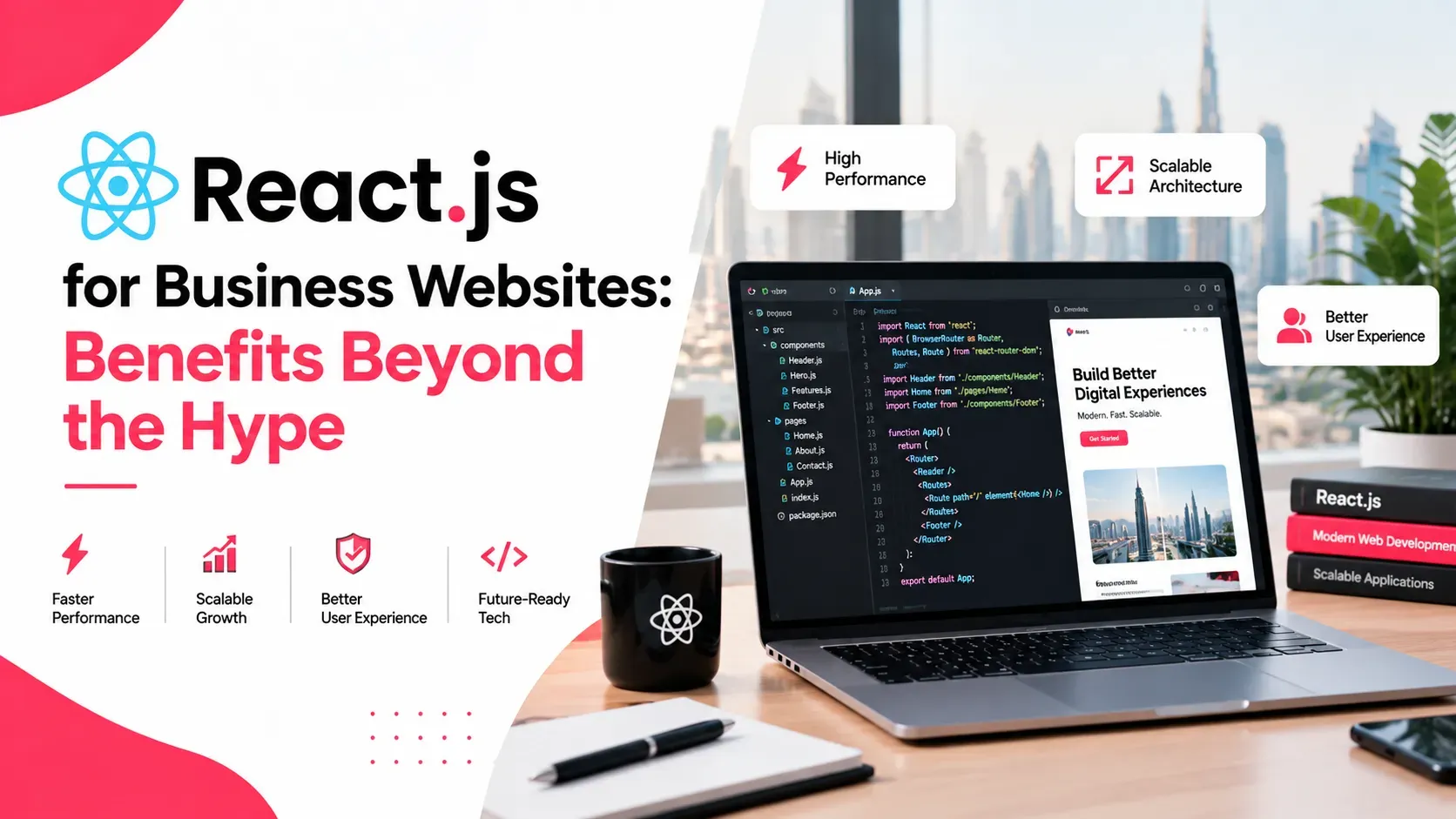
Choosing a frontend technology is not simply a developer decision. For a business website, it can affect how quickly pages evolve, how interactive the experience feels, how easily the site connects with other systems, and how much effort future changes require.
That is why React.js for business websites deserves a closer look. React is widely used for modern web experiences, but that does not mean every company needs it. The real question is whether its strengths match your website's goals, complexity, and growth plans.
Quick Answer: Is React.js Good for Business Websites?
React.js can be a strong choice for business websites that need interactive interfaces, reusable components, API integrations, or a frontend that may grow into a more complex digital product. However, React is not automatically better than a traditional CMS. The right choice depends on functionality, SEO requirements, content management needs, performance goals, and long-term maintenance.
Key Takeaways
- React.js is a JavaScript library for building interactive user interfaces.
- Its component-based approach can make complex websites easier to develop and maintain.
- React works particularly well when a website needs dynamic features or integrations with external systems.
- React does not automatically make a website faster or better for SEO.
- Rendering, performance, technical SEO, content structure, and implementation quality still matter.
- A traditional CMS can be more practical for simple content-focused websites.
- Businesses should choose React based on requirements rather than technology trends.
What Is React.js Used for in Business Websites?
React.js is an open-source JavaScript library designed for building user interfaces. Its component-based architecture allows developers to create reusable interface elements and combine them into larger experiences.
The official React documentation describes React around components, which are reusable pieces of UI that can have their own logic and appearance.
For businesses, this can be useful when a website goes beyond static pages.
Common examples include:
- Interactive product configurators
- Customer dashboards
- Booking and quotation systems
- Account portals
- Advanced search interfaces
- Real-time data displays
- E-commerce interfaces
- SaaS-style web applications
- Websites connected to CRM or ERP systems
- Interactive calculators and business tools
A company with a simple five-page website may not need React. A business building a customer-facing platform with several interactive workflows may benefit considerably from it.
The important distinction is website complexity, not whether React is considered a modern technology.
7 Real Business Benefits of React.js
React's technical features become valuable when they solve actual business problems. Here are some of the most relevant benefits.
1. Reusable Interface Components
One of React's biggest strengths is component reusability.
Instead of treating every page element as an isolated piece, developers can create reusable components for elements such as:
- Navigation
- Forms
- Product cards
- Filters
- Buttons
- Pricing sections
- Account panels
- Search interfaces
When the same component appears across multiple parts of a website, changes can be easier to manage.
For a growing website, this can reduce unnecessary duplication and create a more consistent user experience.
2. Better Support for Interactive Experiences
Traditional websites are often designed around pages and content. React becomes more useful when users need to interact with information without constantly navigating between separate pages.
For example, imagine a property platform where users can:
- Select a location.
- Filter properties by price.
- Change the number of bedrooms.
- Compare selected properties.
- Open detailed information.
- Submit an enquiry.
React can support these interactions within a responsive interface.
The benefit is not simply that the website "looks modern." The underlying interaction model can make complicated workflows easier for users to complete.
3. Useful for Complex Digital Products
Some business websites eventually become more like applications.
A simple company website may contain:
- Home
- About
- Services
- Blog
- Contact
A more complex platform might include:
- User accounts
- Personalized dashboards
- Search and filtering
- Payments
- Notifications
- Data visualization
- Third-party integrations
- Multiple user roles
React is particularly relevant when the frontend needs to handle this type of complexity.
For businesses developing applications alongside their websites, React development for complex business websites can provide a frontend foundation that supports richer interfaces.
4. Easier Frontend Consistency
Large websites can develop inconsistencies over time.
One button may look different from another. Forms may behave differently across pages. Developers may repeatedly recreate similar interface elements.
A component-based approach can help establish reusable patterns.
This does not guarantee perfect consistency, but it gives development teams a structured way to create and maintain shared interface elements.
5. Integration With Business Systems
Modern business websites rarely operate in isolation.
A website might need information from:
- CRM software
- ERP platforms
- Inventory systems
- Payment gateways
- Marketing platforms
- Analytics tools
- Internal databases
- External APIs
React can work as the frontend layer while communicating with backend services through APIs.
That makes it useful for businesses where the website needs to become a connected part of a wider digital ecosystem.
6. Flexible Frontend Experiences
React does not force every business into one particular visual structure.
Developers can create highly customized interfaces rather than relying entirely on predefined themes or templates.
That flexibility can matter when a company wants a distinctive user experience or has business workflows that do not fit neatly into an off-the-shelf website structure.
7. A Strong Foundation for Future Expansion
A website may start with a limited number of features and become more sophisticated later.
For example, an online retailer could eventually add:
- Personalized recommendations
- Customer accounts
- Advanced product filtering
- Loyalty functionality
- Subscription options
- Custom checkout experiences
React can provide a frontend architecture capable of supporting more sophisticated interfaces as requirements evolve.
However, future scalability should not be confused with building everything upfront. Businesses should avoid paying for complexity they do not currently need.
Is React.js Good for SEO?
React.js itself is neither an automatic SEO advantage nor an automatic SEO problem.
Search visibility depends on how the website is implemented.
Important factors include:
- Crawlability
- Indexability
- Page rendering
- Page speed
- Metadata
- Internal linking
- Structured data
- Content quality
- Mobile usability
- Canonical URLs
- Server and client rendering decisions
Google explains that JavaScript-powered websites can be crawled and rendered, but developers still need to follow JavaScript SEO fundamentals and ensure important content and links are accessible to search engines. See Google's JavaScript SEO basics.
This is especially important for businesses relying on organic search.
A React website can perform well in search, but simply choosing React does not make it SEO-friendly.
The implementation needs to support both users and search engines.
React.js vs a Traditional CMS: Which Approach Fits?
React and a traditional CMS solve somewhat different problems.
Factor | React-based frontend | Traditional CMS |
|---|---|---|
Interactive interfaces | Strong | Depends on plugins and implementation |
Content editing | Usually requires CMS integration | Often straightforward |
Custom user experiences | Highly flexible | Depends on theme and development |
Complex web applications | Well suited | Can require additional architecture |
Simple business websites | May be unnecessary | Often practical |
API integrations | Strong | Possible with development |
Long-term frontend customization | High flexibility | Depends on platform |
Development complexity | Generally higher | Often lower for basic sites |
For a content-heavy company website where marketers regularly publish pages and blog posts, a traditional CMS can be very practical.
For a platform with sophisticated interactions, customized workflows, and multiple external integrations, React may make more sense.
There is also a middle ground. A business can combine React with a headless CMS, allowing editors to manage content while developers build a customized frontend.
React.js vs Next.js: Are They the Same?
React and Next.js are related, but they are not interchangeable terms.
React is a JavaScript library for building user interfaces. Next.js is a React framework that provides additional capabilities for building web applications and websites.
Depending on the project, Next.js can provide features related to routing, rendering, optimization, and application structure.
This distinction matters when evaluating technology options.
A business should not ask only, "Should we use React?"
A more useful question is:
What frontend architecture best supports our website, content, performance, SEO, integrations, and future development requirements?
For projects that need a broader React-based application framework, Next.js development for modern web applications may also be worth evaluating.
When Is React.js Overkill?
React is not automatically the right technology for every website.
It may be unnecessary when a business needs a relatively simple website consisting primarily of:
- Company information
- Service pages
- Blog content
- Contact forms
- Basic landing pages
- Simple lead-generation functionality
If the main requirement is publishing content efficiently, a conventional CMS may offer a simpler development and management experience.
Using a sophisticated frontend architecture for a website that does not require it can introduce additional development and maintenance work without producing a meaningful business benefit.
The goal should not be to use the most advanced technology available.
The goal should be to use the technology that solves the actual problem.
When Should a UAE Business Consider React.js?
React can become more relevant when a UAE business has requirements such as:
A highly interactive customer experience
For example, property search, travel booking, financial tools, product customization, or advanced service quotation systems.
Multiple third-party integrations
Businesses connecting websites with CRMs, ERPs, payment platforms, inventory systems, or other APIs may require a more customized frontend architecture.
A website that is becoming a digital product
If customers are logging in, managing accounts, viewing data, submitting complex requests, or interacting with personalized dashboards, the project is moving beyond a conventional marketing website.
A strong need for customized user flows
Some businesses have workflows that cannot be efficiently represented by standard themes and plugins.
Plans for continued product development
If the website is expected to evolve into a larger platform, the initial architecture deserves careful consideration.
For these situations, custom frontend development can provide a more tailored approach to the user interface and technical requirements.
What Should You Ask Before Choosing React.js?
Before committing to React, businesses should answer several practical questions.
What does the website actually need to do?
List the required features before selecting the technology.
How much interaction will users have with the website?
A mostly informational site may have different requirements from a customer portal or SaaS platform.
Who will manage the content?
If marketing teams need to publish content frequently, CMS architecture should be considered from the beginning.
How important is organic search?
SEO requirements should influence rendering, content architecture, performance, metadata, and technical implementation.
What systems need to connect to the website?
Identify CRM, ERP, payment, inventory, analytics, authentication, and other integrations early.
What is the expected lifespan of the project?
A website expected to evolve for years may require different architectural decisions from a temporary campaign site.
Who will maintain it?
The technology should match the skills and resources available for future development.
These questions help move the discussion away from technology hype and toward business requirements.
Key Takeaways
React.js can be a powerful choice for business websites, particularly when the project requires interactive interfaces, reusable components, external integrations, or application-like functionality.
Its value comes from solving these requirements, not from simply being a popular JavaScript technology.
For a straightforward content-driven website, React may add unnecessary complexity. For a sophisticated digital platform, it can provide the flexibility needed to create and evolve a customized frontend.
The best decision comes from evaluating the website's functionality, content management model, SEO requirements, integrations, performance goals, budget, and future plans together.
FAQs
Is React.js good for small business websites?
React can work for a small business website, but it is not always necessary. If the site mainly contains service pages, company information, a blog, and contact forms, a conventional CMS may be simpler and more cost-effective.
Does React.js improve website speed?
React does not automatically make a website faster. Performance depends on factors such as rendering strategy, JavaScript usage, code splitting, image optimization, hosting, caching, and overall implementation.
Is React.js SEO-friendly?
React websites can be SEO-friendly when properly implemented. Developers need to consider rendering, crawlability, indexability, metadata, internal links, structured data, and page performance.
What is the difference between React and Next.js?
React is a JavaScript library used to build user interfaces. Next.js is a framework built around React that provides additional tools and capabilities for developing websites and web applications.
Should every business website use React?
No. React is most useful when its capabilities solve a genuine business or technical requirement. A simple content-focused website may not need it, while a complex interactive platform may benefit significantly from a React-based frontend.
Final Thoughts
The most important question is not whether React.js is popular. It is whether React makes sense for the experience your business needs to deliver.
Start with the customer journey, required functionality, content workflow, SEO goals, integrations, and future plans. Then choose the technology that supports those requirements without creating unnecessary complexity.
If you are evaluating different approaches for a new or existing digital presence, Milaaj Brandset can help translate the business requirements into a suitable web development strategy.
Ready to Elevate Your Brand?
Start Your Project Today