October 26, 2026
Google Algorithm Updates 2026: Timeline and What UAE Websites Should Check
Milaaj Editorial / Research Insights
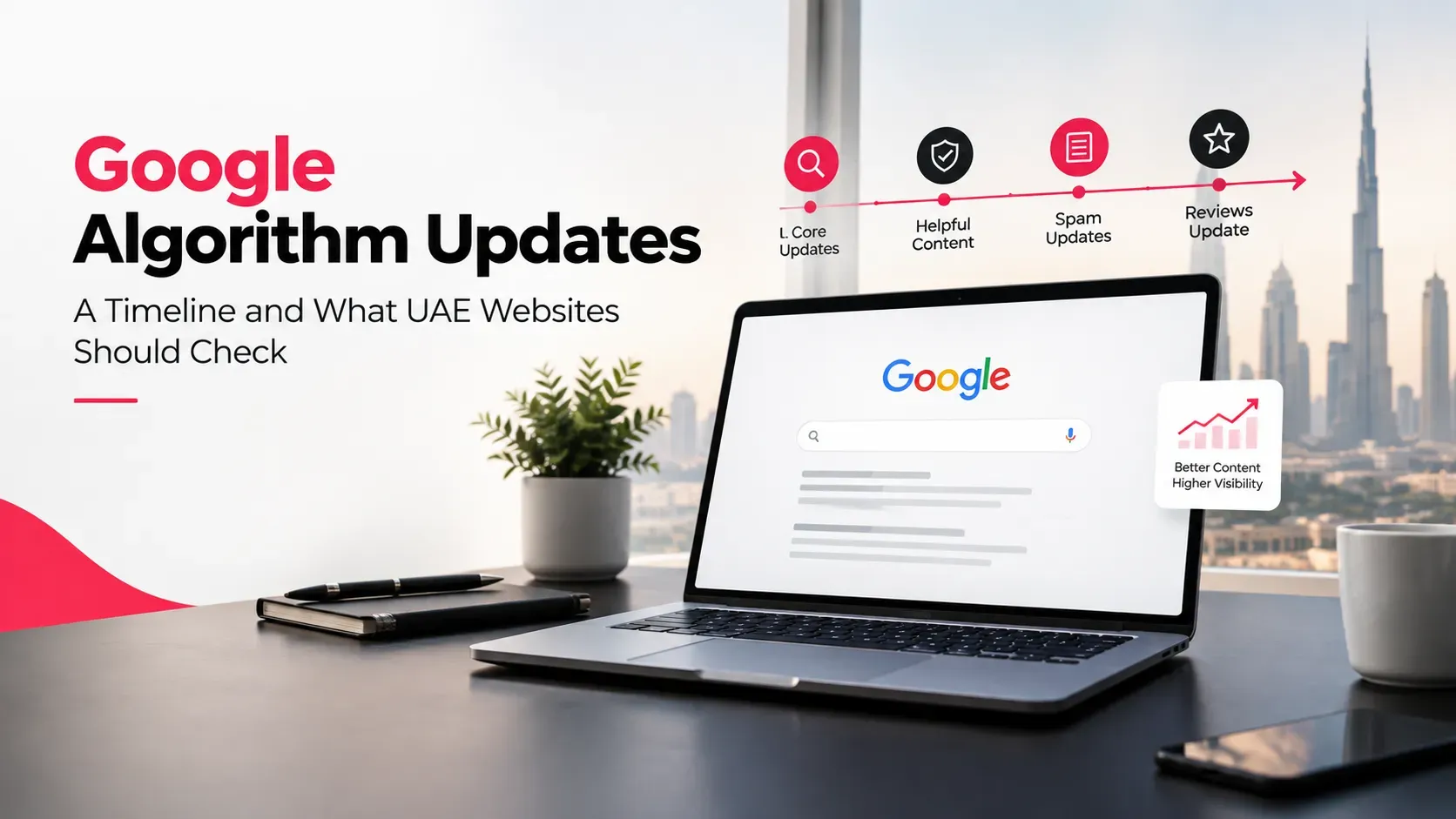
Last updated: 26 October 2026. Google adds new updates throughout the year, so check the dashboard linked below before you act on anything here.
It is Monday morning, and your enquiries are down by a fifth. Your agency swears nothing changed. Your developer says the site is fine. Then someone on LinkedIn mentions "the Google update," and now you are wondering whether you did something wrong.
Most of the time, you did not. Google changes how it ranks pages constantly, and a handful of those changes are big enough to move whole sites up or down. The trick is knowing which one you are dealing with, and what to check first.
This guide gives you the confirmed 2025 to 2026 timeline, a simple way to tell whether an update touched your site, and a checklist built for UAE websites.
Quick Answer
Google algorithm updates are changes to how Google ranks pages. The big ones are named core updates and spam updates, and Google logs their start and end dates on its Search Status Dashboard. In 2026 so far there have been two broad core updates (March and May) and four spam updates. If your traffic moved, compare matched date ranges in Search Console before changing anything.
Key Takeaways
- Core updates reassess overall content quality and take about two weeks to roll out. Spam updates are shorter and target policy violations.
- A ranking drop after a core update does not mean your site broke a rule.
- Wait at least a full week after an update finishes before you analyse Search Console data.
- Rule out your own changes first, such as a redesign, a migration or broken tracking.
- UAE sites with near-identical location pages or weak Arabic versions have the most to check.
What Are Google Algorithm Updates?
A Google algorithm update is a change to the systems Google uses to decide which pages appear for a search, and in what order. Some changes are tiny and constant. Others are named, announced and logged with start and end dates because they can shift rankings across millions of sites.
Core updates vs spam updates
These are the two types you will hear about most:
- Core updates: broad reassessments of how Google judges content quality and relevance. They do not target specific sites. Pages can move down simply because other pages now serve searchers better.
- Spam updates: improvements to the systems that detect policy violations, such as link schemes, scaled low-quality content and hacked sites. They usually finish in days.
There are also smaller named updates, such as the Discover update in February 2026, which only affects the Discover feed.
Why most changes are never announced
Google makes changes every day, and it only names the ones it expects to be noticeable. So a dip that matches no date on the dashboard can still be an algorithm effect, but it is far more likely to be something on your own site. That is why the order of checks matters, and we cover it below.
Google Algorithm Updates Timeline: 2025 to 2026
Here are the named updates Google has logged since early 2025, with dates checked against Google's Search Status Dashboard and trade press reports of each completion. The dashboard is where Google posts its own dates, and you can follow it on Google's Search Status Dashboard.
Update | Type | Started | Finished |
|---|---|---|---|
March 2025 core update | Core | 13 Mar 2025 | 26 Mar 2025 |
June 2025 core update | Core | 30 Jun 2025 | 16 Jul 2025 |
August 2025 spam update | Spam | 26 Aug 2025 | About 21 Sep 2025 |
December 2025 core update | Core | 11 Dec 2025 | 29 Dec 2025 |
Discover core update | Discover only | 5 Feb 2026 | Not confirmed |
March 2026 spam update | Spam | 24 Mar 2026 | 25 Mar 2026 |
March 2026 core update | Core | 27 Mar 2026 | 8 Apr 2026 |
May 2026 core update | Core | 21 May 2026 | 2 Jun 2026 |
June 2026 spam update | Spam | 24 Jun 2026 | 26 Jun 2026 |
August 2026 spam update | Spam | 18 Aug 2026 | 20 to 21 Aug 2026 |
September 2026 spam update | Spam | 24 Sep 2026 | Check the dashboard |
End dates for 2025 updates come from the durations Google lists. Sources differ by a day on the August 2026 spam update, and the Discover and September updates had no confirmed end date when we checked.
What the 2026 pattern tells you
- Core updates run about two weeks. The March 2026 update took 12 days, and so did the May 2026 update.
- Spam updates are short. Most finish within two or three days, and the March one was done in a day.
- Updates overlap. The March 2026 spam update ended on 25 March, and the core update began on 27 March. A drop between 24 and 27 March could come from either one.
- Google rarely explains the details. For the March and May core updates, Google called them regular updates designed to surface relevant, satisfying content, and offered little more.
How Can You Tell If an Update Hit Your Site?
Do not judge your traffic by a single bad day. Use this sequence instead:
- Check the dates. Find the update on the dashboard and confirm it has finished rolling out.
- Wait a week. Google advises waiting at least a full week after a core update completes before analysing Search Console.
- Compare matched periods. Look at the week after the update finished against the week before it started. Use the same weekdays so weekends do not distort the result.
- Split clicks from impressions. Falling impressions suggest lower rankings, while falling clicks with steady impressions point to something else, such as a changed search result layout.
- Find which pages moved. Sort by pages and queries to see whether the loss is spread across the site or concentrated in a few URLs.
If the drop is small, Google says no drastic action is needed. For a large and sustained drop, its advice is to assess the whole site against its helpful content guidance, then review the pages that fell furthest. You can read the details in Google's core update guidance.
What Should UAE Websites Check After an Update?
Most UAE business sites share a few weak spots. Work through these in order.
Near-duplicate location pages
Many Dubai sites publish one service page, then clone it for Sharjah, Abu Dhabi, Ajman and a dozen neighbourhoods with only the place name changed. That is thin, repetitive content, and it is the first thing worth auditing after any update. Each location page should have something real: local projects, addresses, reviews, team details and answers specific to that area. If you run several locations, our local SEO support for multi-location businesses shows what a stronger structure looks like.
Arabic and English versions
Check that both languages are indexed and linked to each other correctly, and that the Arabic pages are not machine-translated copies with no unique value. A weak Arabic version can drag down how the whole site is read.
Scaled or AI-generated content
Pages produced at volume with no review, no experience and no clear purpose are exactly what quality and spam systems are designed to catch. Keep the pages that answer a real question, and rewrite or merge the rest.
Links and old tactics
Look for bought links, link exchanges and expired-domain redirects, whether from a past agency or from a freelancer you no longer work with. Spam updates are aimed at these patterns.
Search intent match
Check whether the pages that fell still match what searchers want. A service page that now ranks below guides and comparison pages may be missing the information people are comparing.
Is It the Update, or Something on Your Own Site?
Before you blame Google, rule out changes you made yourself. The usual culprits are:
- A redesign or migration that changed URLs, templates or redirects.
- A broken tracking tag. If analytics stopped counting, the drop may be fake. A proper GA4 and tag manager setup will tell you quickly whether the traffic fell or only the reporting did.
- Noindex tags or robots.txt changes left over from a staging site.
- Slower pages or server problems after a hosting change.
- Seasonality. In the UAE, Ramadan, summer travel and the year-end shopping season move demand in ways that look like penalties.
If none of these explain it and the timing matches an update, then it is likely a ranking reassessment.
What Should You Avoid Doing After a Ranking Drop?
Panic causes more damage than most updates. Avoid these:
- Rewriting the whole site in a week. Google's own advice is to avoid quick fixes and to treat deleting content as a last resort.
- Buying links or traffic to push the numbers back up.
- Changing everything at once. If you edit titles, content and structure together, you will never know what helped.
- Blaming a penalty without evidence. Manual actions appear in Search Console. A core update drop does not.
If you are still unsure what happened, our guide to diagnosing a sudden traffic drop walks through the causes in order.
How Do You Build a Site That Survives Updates?
You cannot predict the next update, but you can make your site a safer bet. Core updates reward content that is helpful, original and clearly produced by people who know the subject.
- Write for a real question. Each page should have one clear job.
- Show your experience. Include real projects, photos, numbers and names.
- Fix the basics. Fast pages, clean mobile layouts, working internal links.
- Prune with care. Merge thin pages into stronger ones instead of leaving them to dilute the site.
- Audit regularly. A calm, scheduled review catches problems long before an update exposes them.
A good starting point is our SEO audit checklist for Dubai websites.
When Should You Get a Professional SEO Audit?
Do it yourself if the drop is small and the cause is clear. Bring in help if:
- Traffic fell more than a few weeks ago and is not recovering.
- You have hundreds of location or service pages and cannot tell which ones are weak.
- You inherited a site with an unknown link history.
- You need to explain the drop and the plan to a boss or a board.
An outside review gives you a ranked list of what to fix first, so you are not guessing. Our SEO team in Dubai can run that audit and map the fixes to your pages.
Frequently Asked Questions
What is a Google core update?
A core update is a broad change to Google's ranking systems that reassesses how it judges content quality and relevance. It does not target specific sites. Some pages rise and others fall because Google now thinks other pages answer the search better.
How often does Google update its algorithm?
Google changes its systems constantly, but it only names the bigger ones. Since early 2025 it has logged about two or three core updates a year, plus several spam updates. The 2026 list so far includes two core updates and four spam updates.
How do I know if a core update affected my website?
Wait until the update has finished, then wait another week. Compare Search Console clicks and impressions for the week after with the week before it started. If the change lines up with the dates and you made no major site changes, the update is the likely cause.
How long does it take to recover from a core update?
There is no fixed timeline. Google says improvements can take effect in a few days, but confirming a site's long-term quality can take several months. Recovery often happens at the next core update, not right after you fix things.
Do Google updates affect UAE and Arabic websites differently?
Core updates are global and apply to all regions and languages. The effect depends on the quality of your content, not your location. UAE sites with near-duplicate location pages or weak Arabic versions tend to have more to fix.
Final Thoughts
Google algorithm updates feel personal when your enquiries drop, but they rarely are. The calm approach works best: check the date, wait a week, compare properly, rule out your own changes, and fix the real problems in order.
Keep this timeline handy and bookmark the dashboard, so the next time a Monday goes wrong you will know where to look first. If you want a second pair of eyes on your site, that is exactly the kind of problem Milaaj Brandset helps UAE businesses solve every day.
Ready to Elevate Your Brand?
Start Your Project Today