August 7, 2026
Headless Ecommerce Explained for UAE Businesses
Milaaj Editorial / Research Insights
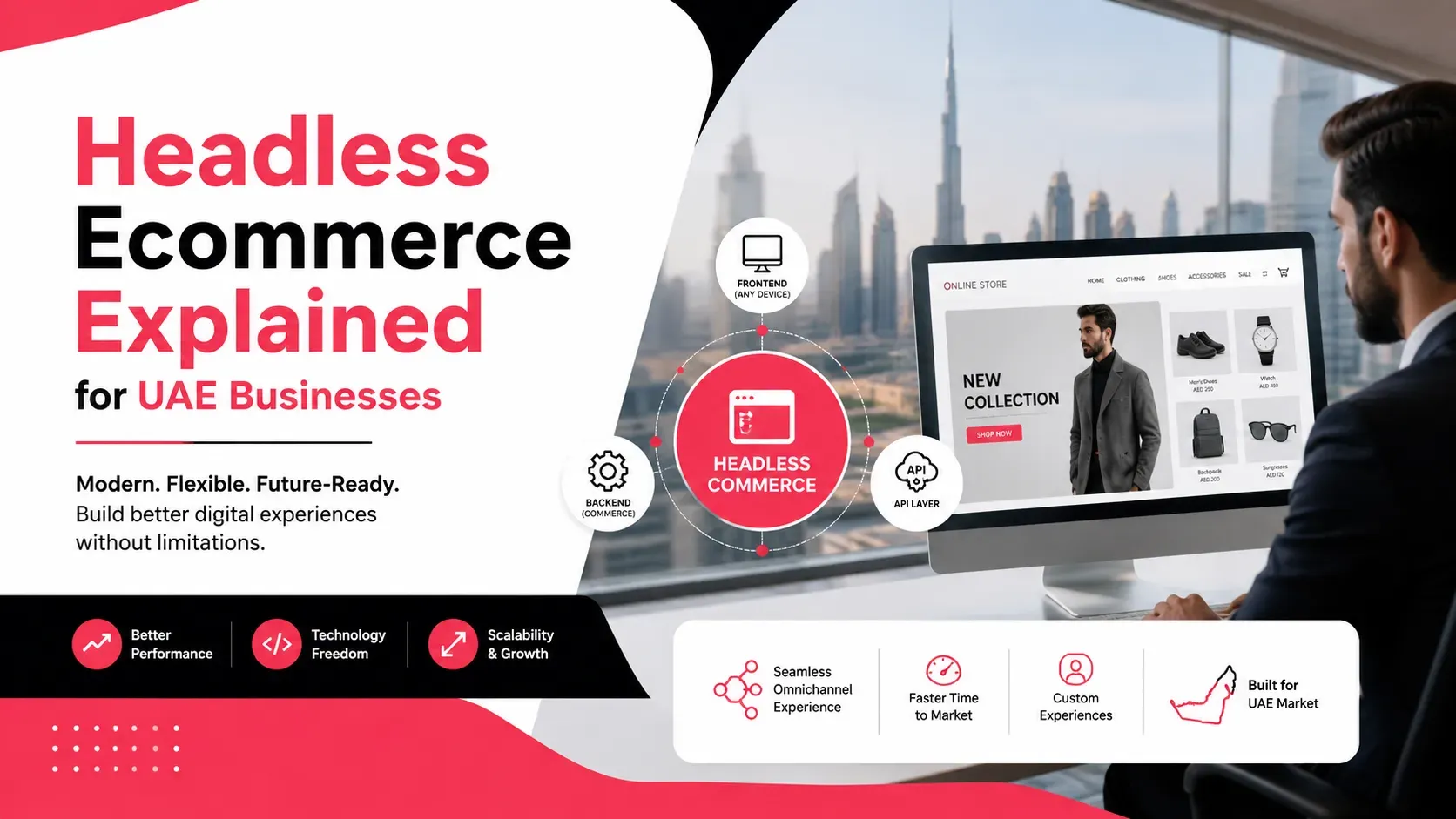
Ecommerce has evolved far beyond simply launching an online store. Today's customers expect lightning-fast websites, personalized shopping experiences, seamless mobile browsing, and consistent interactions across websites, mobile apps, marketplaces, and social commerce channels. Meeting these expectations has encouraged many growing businesses to rethink the technology powering their online stores.
This is where headless ecommerce comes into the conversation.
Rather than relying on a traditional all-in-one ecommerce platform where the storefront and backend are tightly connected, headless ecommerce separates the customer-facing experience from the commerce engine. This architecture allows businesses to design highly customized digital experiences while continuing to use the same backend for products, inventory, payments, and order management.
For UAE businesses, this flexibility is becoming increasingly valuable. The country's ecommerce market continues to expand as mobile shopping, cross-border commerce, and customer expectations for premium digital experiences grow. Businesses that can adapt quickly across multiple digital channels are often better positioned to compete in this fast-moving environment.
This guide explains what headless ecommerce is, how it works, its advantages and challenges, and when UAE businesses should consider adopting it.
Quick Answer
Headless ecommerce is an architecture that separates the frontend storefront from the backend ecommerce system using APIs. This allows businesses to create faster, highly customized shopping experiences across websites, mobile apps, kiosks, and other digital channels without changing the underlying commerce engine. While it offers greater flexibility and scalability, it is generally best suited for growing or enterprise businesses with more complex digital requirements.
What Is Headless Ecommerce?
Traditional ecommerce platforms combine everything into one system.
The storefront customers interact with and the backend that manages products, orders, inventory, pricing, and payments are tightly connected.
Headless ecommerce changes this model.
Instead of one tightly coupled application, it separates:
- The frontend, where customers browse and shop.
- The backend, where business operations are managed.
These two layers communicate through APIs, allowing each to evolve independently. Marketing teams can redesign the shopping experience without rebuilding the commerce engine, while developers can improve backend functionality without disrupting the storefront.
How Headless Commerce Works
Think of the backend as the operational center of your ecommerce business.
It manages:
- Products
- Inventory
- Pricing
- Orders
- Customer accounts
- Promotions
- Payment processing
The frontend becomes an independent presentation layer.
It can be:
- A website
- Mobile application
- Progressive Web App (PWA)
- Smart kiosk
- Digital marketplace
- In-store touchscreen
- Future digital channels
Whenever a customer interacts with the storefront, APIs retrieve the necessary information from the backend and display it in real time.
This architecture gives businesses far greater flexibility when creating customer experiences.
Traditional Ecommerce vs Headless Ecommerce
Traditional Ecommerce | Headless Ecommerce |
|---|---|
Frontend and backend are tightly connected | Frontend and backend operate independently |
Design flexibility depends on the platform | Nearly unlimited frontend customization |
Updates may affect the entire website | Frontend and backend can be updated separately |
Best for standard online stores | Ideal for complex, multi-channel experiences |
Faster initial setup | Higher implementation complexity |
Neither approach is universally better—the right choice depends on your business goals, technical resources, and growth plans.
Why UAE Businesses Are Exploring Headless Commerce
The UAE has one of the region's most digitally connected consumer markets.
Customers increasingly expect:
- Fast-loading websites
- Mobile-first experiences
- Arabic and English content
- Consistent shopping across channels
- Personalized recommendations
- Smooth checkout experiences
At the same time, businesses often need to integrate ecommerce with:
- ERP systems
- CRM platforms
- Inventory software
- Loyalty programs
- Marketing automation
- Analytics platforms
A headless architecture makes these integrations easier to manage while allowing brands to deliver consistent customer experiences across multiple touchpoints.
Businesses investing in Custom Web Development often choose headless architecture because it provides the flexibility to create unique digital experiences without being constrained by standard ecommerce templates.
Key Benefits of Headless Ecommerce
Greater Design Freedom
Traditional ecommerce platforms often limit how much you can customize the customer experience.
With headless commerce, businesses have complete control over:
- Homepage layouts
- Product pages
- Navigation
- Search functionality
- Interactive experiences
- Checkout interfaces
This freedom allows brands to create distinctive online experiences that better reflect their identity.
Faster Website Performance
Modern headless storefronts often use lightweight frontend frameworks that load content more efficiently than traditional themes.
Benefits include:
- Faster page loads
- Better Core Web Vitals
- Improved mobile performance
- Higher customer engagement
- Lower bounce rates
Performance improvements not only enhance user experience but also support better organic search visibility.
Better Omnichannel Experiences
Customers no longer interact with brands through a single channel.
A single purchase journey may involve:
- Mobile browsing
- Desktop research
- Social media discovery
- Marketplace comparisons
- Physical store visits
Headless ecommerce allows businesses to serve all these channels using one centralized commerce backend while delivering tailored frontend experiences for each platform.
Easier Integration With Business Systems
Growing businesses rarely operate with ecommerce software alone.
They often rely on:
- CRM platforms
- ERP solutions
- Warehouse management systems
- Marketing automation tools
- AI recommendation engines
- Customer support platforms
Because headless commerce is API-driven, integrating these systems becomes more flexible and scalable than with many traditional architectures.
Future-Proof Scalability
Technology changes quickly.
New customer touchpoints, AI-powered shopping assistants, wearable devices, voice commerce, and emerging digital channels continue to reshape ecommerce.
Because the frontend is independent, businesses can adopt new technologies without replacing the entire commerce platform.
This flexibility helps protect long-term technology investments while making innovation significantly easier.
Businesses implementing scalable E-commerce solutions increasingly evaluate headless architecture when planning long-term digital growth, especially if they anticipate expanding across multiple channels, regions, or customer experiences.
When Headless Ecommerce Makes Sense
Headless commerce is a strategic investment, not simply a technology trend. It delivers the greatest value when a business has outgrown the limitations of a traditional ecommerce platform.
It may be the right choice if your business:
- Sells through multiple digital channels
- Requires highly customized customer experiences
- Plans to launch mobile apps alongside a website
- Operates across multiple countries or languages
- Integrates with several business systems
- Handles large product catalogues
- Expects significant long-term growth
For businesses with these requirements, headless architecture provides greater flexibility without limiting future expansion.
When Traditional Ecommerce Is the Better Choice
Headless ecommerce is not automatically the best solution for every business.
Small businesses and startups often achieve better results with traditional ecommerce platforms because they offer:
- Faster deployment
- Lower development costs
- Simpler maintenance
- Built-in themes and templates
- Easier content management
- Lower technical complexity
If your store has a relatively small catalogue, limited customization needs, and straightforward business processes, a traditional platform may deliver a stronger return on investment while remaining easier to manage.
Choosing the right architecture should be based on business goals rather than technology trends.
Common Misconceptions About Headless Commerce
Several misconceptions often influence business decisions.
Myth | Reality |
|---|---|
Headless ecommerce automatically improves SEO. | SEO depends on implementation, content quality, technical optimization, and user experience—not architecture alone. |
Only enterprise companies can use headless commerce. | Mid-sized businesses with complex requirements can also benefit. |
Headless commerce replaces your ecommerce platform. | It separates the frontend while continuing to use an ecommerce backend. |
It's impossible to manage without developers. | Many modern headless solutions include user-friendly content management tools alongside developer flexibility. |
Every ecommerce business needs headless architecture. | Many businesses perform exceptionally well using traditional ecommerce platforms. |
Understanding these differences helps businesses make informed technology decisions.
Challenges to Consider
While headless commerce offers significant flexibility, it also introduces additional complexity.
Potential considerations include:
- Higher initial development investment
- Greater reliance on experienced developers
- More complex deployment workflows
- Ongoing maintenance across multiple systems
- Additional planning for integrations
- Longer implementation timelines
These challenges should be evaluated alongside the expected long-term benefits.
Measure Success After Moving to Headless
Businesses adopting headless ecommerce should monitor measurable outcomes rather than focusing only on technical improvements.
Key performance indicators include:
Metric | Why It Matters |
|---|---|
Page Load Speed | Faster storefronts improve customer experience and engagement. |
Core Web Vitals | Measures loading performance, responsiveness, and visual stability. |
Conversion Rate | Indicates whether the improved experience leads to more completed purchases. |
Mobile Conversion Rate | Evaluates shopping performance across smartphones and tablets. |
Average Order Value | Shows whether personalization and improved UX encourage larger purchases. |
Customer Retention | Measures repeat purchases and long-term customer loyalty. |
Monitoring these metrics helps determine whether the investment is delivering meaningful business value.
The Future of Headless Commerce
Headless commerce continues to evolve alongside broader digital commerce trends.
Increasingly, businesses are combining headless architecture with:
- AI-powered product recommendations
- Personalized shopping experiences
- Progressive Web Apps (PWAs)
- Voice commerce
- Visual search
- Composable commerce
- Real-time inventory synchronization
- Omnichannel customer journeys
As customer expectations continue to rise, flexible commerce architectures are likely to become increasingly important for businesses seeking to innovate without replacing their entire ecommerce infrastructure.
Key Takeaways
- Headless ecommerce separates the storefront from the backend using APIs.
- It offers greater flexibility, faster frontend innovation, and stronger omnichannel capabilities.
- Growing businesses with complex digital requirements often benefit most from this architecture.
- Traditional ecommerce platforms remain an excellent choice for many smaller businesses.
- Technology decisions should be driven by business objectives rather than industry trends.
- Success depends on careful planning, scalable implementation, and continuous performance measurement.
Choosing the Right Commerce Architecture for Long-Term Growth
Headless ecommerce isn't about following the latest technology trend—it's about building an architecture that supports your business as customer expectations and digital channels evolve. For organizations requiring greater flexibility, deeper integrations, and highly customized customer experiences, separating the frontend from the backend can provide a strong foundation for future growth.
At the same time, not every ecommerce business needs headless architecture. The best solution is the one that aligns with your current operations, available resources, and long-term strategy. Evaluating your business needs before investing ensures that technology becomes an enabler of growth rather than unnecessary complexity.
Milaaj Brandset helps businesses design scalable ecommerce solutions, modern digital experiences, and future-ready commerce strategies that align technology with measurable business outcomes.
FAQs
What is headless ecommerce?
Headless ecommerce is an architecture where the customer-facing storefront is separated from the backend commerce system. The two communicate through APIs, allowing each to be developed and updated independently.
Is headless ecommerce better than traditional ecommerce?
Not necessarily. Headless ecommerce offers greater flexibility and customization, but traditional ecommerce platforms are often simpler and more cost-effective for businesses with straightforward requirements.
Why are UAE businesses adopting headless commerce?
Many UAE businesses are expanding across multiple digital channels and require faster websites, personalized experiences, multilingual capabilities, and integrations with ERP, CRM, and marketing platforms.
Does headless ecommerce improve SEO?
Headless architecture can improve website performance and Core Web Vitals, but SEO still depends on factors such as high-quality content, technical optimization, structured data, and user experience.
Is headless ecommerce suitable for small businesses?
It can be, but many small businesses achieve excellent results with traditional ecommerce platforms. Headless commerce is generally more beneficial for businesses with advanced customization, integration, or scalability requirements.
What's the difference between headless and composable commerce?
Headless commerce separates the frontend from the backend, while composable commerce extends modularity across multiple business systems, allowing organizations to assemble specialized technologies into a unified commerce ecosystem.
Ready to Elevate Your Brand?
Start Your Project Today