September 2, 2026
How Google Understands Content Relevance: What Makes a Page Truly Relevant?
Milaaj Editorial / Research Insights
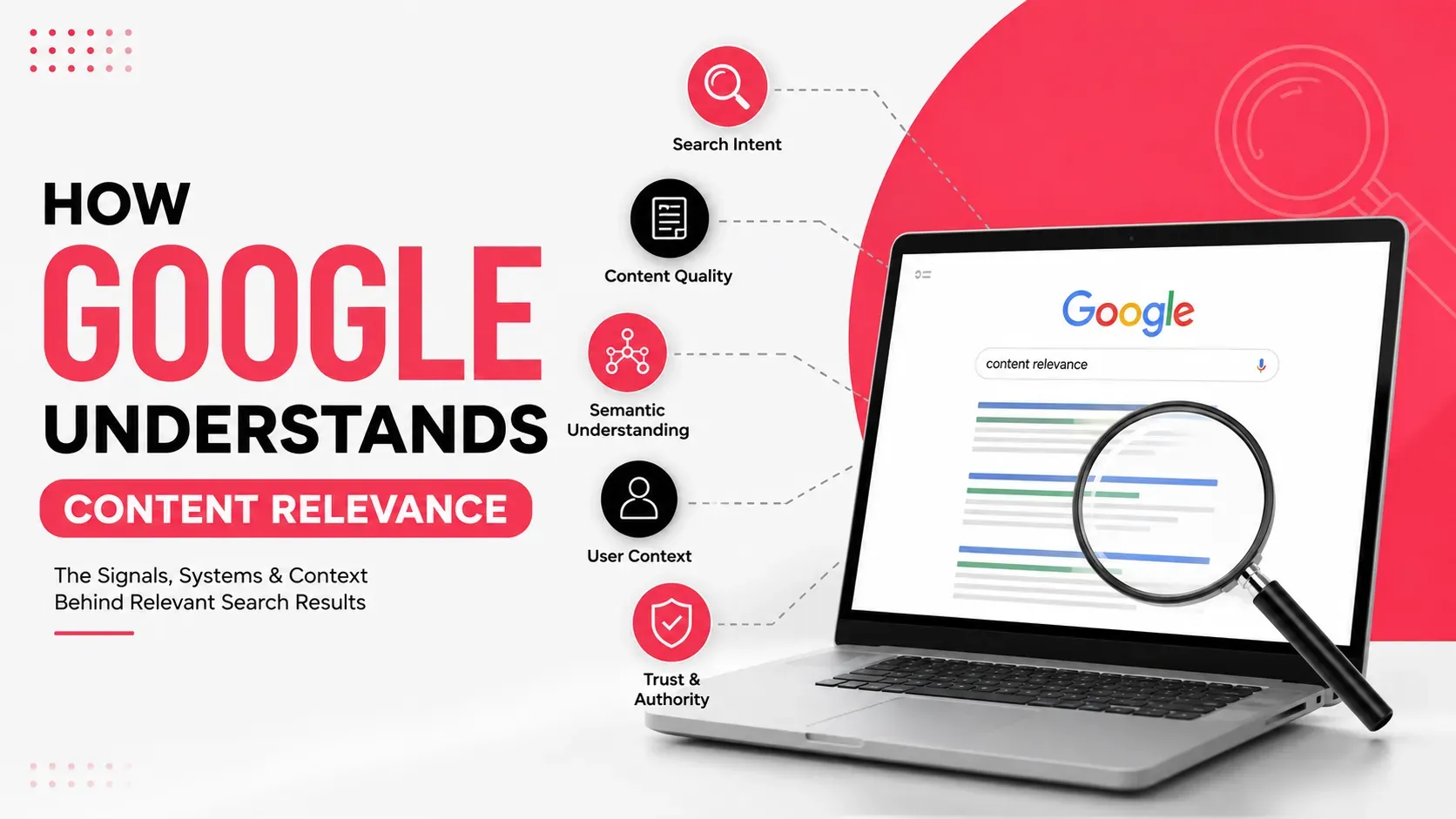
When someone searches Google, relevance is about far more than finding the page that contains the exact words they typed. Google has to determine what the searcher means, what information they need, and which pages provide the most useful answer.
That is why two websites can target the same keyword yet perform very differently. One may repeat the keyword dozens of times, while the other explains the subject clearly, covers related concepts, matches search intent, and provides useful context.
Understanding how Google evaluates content relevance can help you create pages that are easier for both search engines and people to understand.
Quick Answer
Google understands content relevance by examining the meaning, context, intent, topics, entities, relationships, and overall usefulness of a page, rather than relying only on exact keyword matches.
A relevant page generally does four things well:
- Addresses the reason behind the search
- Demonstrates clear topical understanding
- Connects related concepts naturally
- Provides useful, accessible, and trustworthy information
Keywords still matter, but they are only part of a much larger picture.
Relevance Starts With the Searcher, Not the Keyword
Consider two searches:
“best CRM for a small business”
and
“how does CRM software work?”
Both searches involve CRM software, but the information required is different.
The first search has a strong commercial investigation element. The user may want comparisons, features, pricing considerations, and recommendations.
The second is primarily informational. The searcher needs an explanation of how CRM systems operate.
A page that gives a detailed definition of CRM could be topically related to both searches, but it may not satisfy the first one particularly well.
This is an important distinction:
Google has to understand the relationship between the words in a query and the information contained on a page. It also needs to determine whether that information actually satisfies the likely purpose of the search.
Why exact keyword matching is not enough
Imagine a page targeting “SEO for ecommerce websites.”
If the page only repeats that phrase while offering little practical information about product pages, category pages, technical issues, search intent, internal linking, and ecommerce-specific optimization, the keyword itself tells Google very little about the page's actual usefulness.
A stronger page might naturally discuss:
- Product and category page optimization
- Search intent
- Structured product information
- Internal links
- Faceted navigation
- Duplicate content
- Page experience
- Ecommerce conversion paths
The page becomes relevant because the ideas connect, not because one phrase appears repeatedly.
Google Looks at Meaning and Context
Search engines have become much better at understanding language in context.
For example, a page about “apple” could discuss:
- Fruit and nutrition
- Apple products
- Apple stock
- Apple farming
The individual word does not provide enough information. The surrounding content helps establish what the page actually means.
This is why context matters so much in modern SEO.
A page about Apple products might naturally contain concepts such as iPhone, Mac, iPad, iOS, Apple Watch, and the App Store. A page about the fruit might instead discuss orchards, varieties, harvesting, nutrition, and recipes.
Google can use these relationships to build a better understanding of the subject.
Words work together
Search engines don't necessarily treat every word on a page as an isolated signal.
A sentence, paragraph, heading, image description, internal link, and surrounding sections can collectively establish meaning.
For content creators, this means you should focus on explaining a subject thoroughly and naturally rather than trying to identify every possible keyword variation and insert it into the copy.
The Hidden Structure Behind a Relevant Page
A useful way to think about relevance is to imagine several layers working together.
Query → Intent → Topic → Concepts → Relationships → Answer
Suppose someone searches:
“How much does it cost to build an ecommerce website in Dubai?”
The topic is ecommerce website development.
But the search also implies several related concepts:
- Website development
- Ecommerce functionality
- Platform selection
- Design
- Payment integration
- Hosting
- Maintenance
- UAE market considerations
- Potential development costs
A page that understands these relationships can provide a much stronger answer than one that simply repeats “ecommerce website development Dubai.”
This is where semantic SEO becomes useful. Instead of treating keywords as isolated targets, semantic optimization considers the broader concepts and relationships surrounding a subject.
For a deeper look at this approach, readers can explore our guide to semantic SEO strategies.
Entities help establish meaning
Entities are another important part of how information can be understood.
An entity could be a person, company, product, location, organization, technology, or other identifiable concept.
For example, a page about digital marketing in Dubai might naturally reference:
- Google
- Search Engine Optimization
- Google Ads
- Social Media
- Dubai
- UAE businesses
- Ecommerce
- Lead generation
These concepts are not interchangeable, but their relationships help establish what the page is about.
The goal isn't to insert entities artificially. It is to mention relevant concepts because they genuinely belong in the discussion.
Search Intent Changes What “Relevant” Means
One of the biggest reasons pages fail to rank for seemingly appropriate keywords is intent mismatch.
A search can be broadly classified as informational, commercial, transactional, navigational, or local, although real searches often contain overlapping intentions.
Informational intent
The user wants to understand something.
Examples include:
- What is semantic SEO?
- How does Google indexing work?
- What is an ERP system?
The best content usually explains the subject clearly and answers related questions without making the reader work unnecessarily hard.
Commercial investigation
The user is evaluating possible solutions.
Examples:
- Best ecommerce platforms for UAE businesses
- SEO agencies in Dubai
- Shopify vs WooCommerce
Useful content here may include comparisons, selection criteria, advantages, limitations, costs, and practical considerations.
Transactional intent
The user is closer to taking action.
Examples:
- Buy accounting software
- Book SEO consultation
- Ecommerce development company Dubai
A purely educational article may not be the best result for such a query.
Local intent
Location becomes an important part of relevance.
For example:
“SEO services in Dubai”
isn't simply asking what SEO is. The searcher is looking for a service connected to a specific market.
This is why creating content around search intent is more effective than treating every keyword as a standalone target.
Our guide on search intent optimization explores this relationship in greater depth.
Relevance Is Also About Coverage, Not Just Length
A common misconception is that longer content automatically becomes more relevant.
It doesn't.
A 1,200-word article can be more useful than a 3,000-word article if it answers the user's question more directly.
What matters is whether the page covers the important dimensions of the topic.
For example, an article about website accessibility might need to address:
- What accessibility means
- Common accessibility barriers
- Navigation
- Images and alternative text
- Forms
- Keyboard usability
- Mobile experiences
- Testing
Adding unrelated paragraphs simply to increase word count does not strengthen topical relevance.
Topical depth versus filler
There is a major difference between:
“Write more about the topic.”
and:
“Explain the topic more completely.”
Good content achieves the second.
It introduces useful supporting concepts, answers likely follow-up questions, provides examples, explains limitations, and connects related ideas.
That creates depth without unnecessary repetition.
Internal Links Give Google More Context
Internal linking is often treated primarily as a way to distribute authority between pages.
It does more than that.
A well-connected website can help search engines understand how its pages relate to one another.
Imagine a website containing separate articles about:
- Keyword research
- Search intent
- Semantic SEO
- Internal linking
- Content relevance
When these pages are connected naturally, the site communicates a clearer topical relationship.
An article about content relevance can point readers toward a relevant SEO resource, while a semantic SEO article can connect back to broader content strategy.
Internal links therefore contribute to both navigation and contextual understanding.
They should, however, be used because the destination genuinely helps the reader, not simply because another URL needs a link.
What Makes Content Relevant to AI Search?
The growth of AI-powered search makes clear, well-connected information even more valuable.
Google's AI search experiences can draw information from multiple sources when generating responses. That means content may need to work not only as a page that ranks for a traditional query, but also as a useful source of information that can be understood and referenced within broader search experiences.
This does not mean creating a completely separate form of “AI SEO.”
The fundamentals remain familiar:
- Make important information accessible
- Answer questions clearly
- Demonstrate genuine subject knowledge
- Organize information logically
- Maintain accurate and useful content
- Build strong internal relationships between pages
Clear answers also make content easier to extract and understand in conversational search.
Write for questions, not just keywords
Instead of asking:
“Where can I insert my target keyword?”
a better question is:
“What would someone searching this topic want to know next?”
That shift naturally produces stronger content.
If the primary question is “How does Google understand content relevance?”, likely follow-up questions include:
- Does Google still use keywords?
- Does search intent affect relevance?
- What are semantic relationships?
- Do internal links help Google understand topics?
- Does longer content rank better?
- How does AI search interpret website content?
Answering these questions naturally creates a more complete resource.
Where SEO Fits Into Content Relevance
SEO remains important because search engines still need to discover, crawl, index, and understand websites.
Technical accessibility, page structure, internal links, descriptive titles, useful headings, and other foundational practices can make content easier for search systems to process.
But optimization should support relevance rather than replace it.
For businesses competing in search results, professional SEO solutions for Dubai businesses can help connect technical optimization, content strategy, site structure, and search intent into a broader organic search strategy.
The important distinction is that SEO should make good content easier to discover and understand, not attempt to manufacture relevance through keyword repetition.
The Relevance Problems That Keyword Research Cannot Fix
Some content problems cannot be solved simply by adding more keywords.
The page answers the wrong question
A page may target the right phrase but provide information intended for a different type of searcher.
The topic is too narrow
A page might define a concept without addressing the practical questions users have about it.
Related concepts are missing
The content mentions the main topic but ignores important concepts that naturally belong to the subject.
The page is repetitive
Repeating the same idea in different wording adds length but little meaning.
The information lacks useful context
A page may provide a generic explanation while ignoring the audience, industry, location, use case, or decision the reader is trying to make.
These issues require better content strategy, not simply more optimization.
A Better Way to Create Relevant Content
Before publishing a page, ask five questions:
1. What is the searcher actually trying to accomplish?
Identify the underlying intent rather than relying only on the keyword.
2. What does the reader need to know to feel their question has been answered?
Think beyond the first question and anticipate useful follow-ups.
3. What concepts naturally belong to this topic?
Identify related entities, processes, problems, comparisons, and terminology.
4. What evidence or experience can make the information more trustworthy?
Use accurate facts, practical examples, original observations, and clear explanations.
5. Does every section earn its place?
Remove paragraphs that exist only to increase word count or repeat keywords.
This approach creates content that is easier to understand because it follows the logic of the subject itself.
Key Takeaways
- Google relevance is about meaning and usefulness, not simply keyword frequency.
- Search intent determines what kind of information is relevant to a particular query.
- Context helps Google understand how words and concepts relate to one another.
- Entities and semantic relationships can strengthen a page's topical clarity.
- Comprehensive content is not necessarily long content; depth matters more than word count.
- Internal links can help establish relationships between related pages on a website.
- AI-powered search reinforces the importance of clear, useful, accessible information.
- Strong SEO should support genuine relevance rather than attempt to manufacture it.
Conclusion
The most important shift in modern SEO is moving from “What keyword should this page rank for?” to “What does this search mean, and what information would genuinely satisfy it?”
When content answers the right question, covers the subject naturally, connects related concepts, and provides genuine value, its relevance becomes much clearer to both search engines and users.
That is the foundation of sustainable search visibility. Milaaj Brandset helps businesses build stronger digital visibility through its digital marketing and SEO solutions, combining content, search strategy, technology, and user-focused digital experiences.
FAQ
Does Google still use keywords to understand content?
Yes. Keywords remain useful for helping search engines understand the language and subject of a page. However, relevance is not determined by keyword frequency alone. Context, intent, relationships between concepts, and overall usefulness also matter.
Is keyword density still important for SEO?
There is no ideal keyword-density percentage that guarantees rankings. Using a keyword naturally where it makes sense is generally more useful than deliberately repeating it.
Does longer content rank better?
Not automatically. Longer content can be useful when a topic requires detailed coverage, but unnecessary length does not make a page more relevant. The goal should be complete and useful coverage rather than a specific word count.
How does search intent affect content relevance?
Search intent determines what the user expects from the result. A definition may satisfy an informational search, while a comparison, service page, or product page may be more appropriate for commercial or transactional intent.
Do internal links help Google understand content?
Yes. Internal links can help search engines discover pages and understand relationships between different sections of a website. They also help users move between closely related information.
Is semantic SEO different from traditional SEO?
Semantic SEO places greater emphasis on meaning, context, related concepts, entities, and relationships between topics. It complements traditional SEO rather than replacing its fundamentals.
Ready to Elevate Your Brand?
Start Your Project Today