August 31, 2026
Search Intent Optimization for Better Rankings: A Practical SEO Guide
Milaaj Editorial / Research Insights
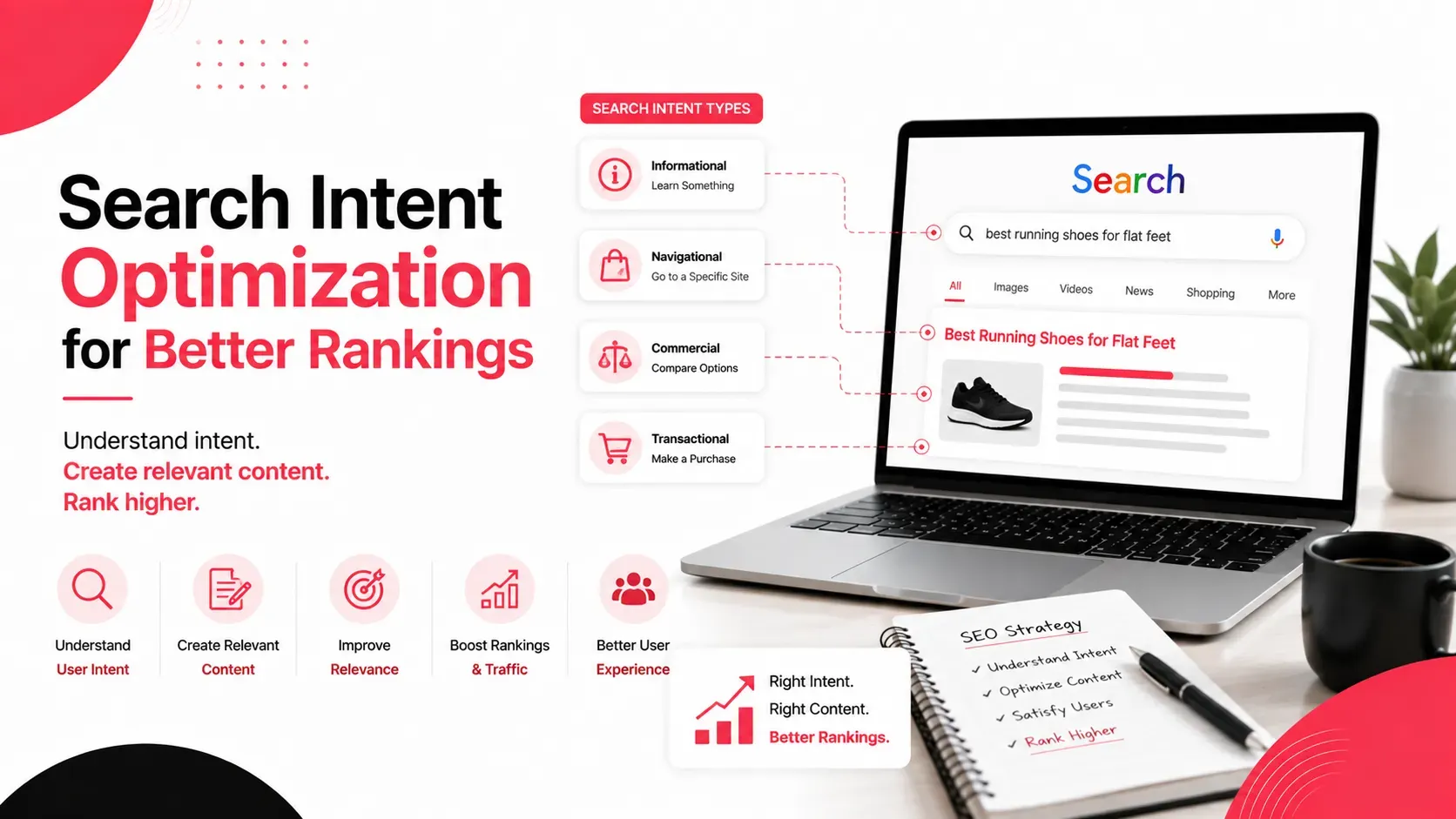
Ranking for a keyword isn't enough. A page can target the right phrase, include relevant keywords, and still struggle in search results if it doesn't provide what the searcher actually wants.
This is where search intent optimization becomes important.
Search intent refers to the underlying goal behind a search query. Someone searching for "what is SEO" wants an explanation, while someone searching for "SEO services in Dubai" is much closer to making a purchasing decision.
Understanding this difference helps businesses create the right page, choose the right content format, answer questions more effectively, and build a better path from search discovery to conversion.
For modern SEO, search intent also matters beyond traditional rankings. Clear answers, structured information, topical relationships, and trustworthy content can make pages more useful for answer engines and AI-powered search experiences.
Quick Answer
Search intent optimization means creating and optimizing a webpage to satisfy the underlying goal of a user's search.
The main types of search intent are:
- Informational: The user wants to learn something.
- Navigational: The user wants to find a particular website or page.
- Commercial investigation: The user is researching options before making a decision.
- Transactional: The user is ready to take an action, such as purchasing or requesting a service.
To optimize for search intent:
- Analyze the current search results.
- Identify what users expect from the query.
- Choose the appropriate content format.
- Answer the main question clearly.
- Cover relevant subtopics and related questions.
- Match keywords and entities to the topic naturally.
- Provide useful internal links and next steps.
- Review intent periodically as search results change.
The goal isn't to manipulate rankings.
It's to create the result that best satisfies the searcher's actual need.
What Is Search Intent in SEO?
Search intent is the reason behind a user's search.
Consider these three queries:
"What is content marketing?"
The searcher wants information.
"Best content marketing agencies in Dubai"
The searcher is comparing potential providers.
"Content marketing agency Dubai"
The searcher may be ready to contact or hire a provider.
Although all three searches relate to content marketing, they require different content.
Why Search Intent Matters
Search engines aim to provide results that are useful for the query.
If a person searches for a definition and the results are mostly product pages, those results are unlikely to satisfy the user.
Similarly, someone looking for a service may not want to read a basic introductory article before finding a provider.
This is why keyword targeting alone isn't enough.
A strong SEO strategy considers:
- The keyword
- The meaning behind the keyword
- The user's stage in the journey
- The expected content format
- The questions users need answered
- The action they may want to take
Search intent therefore connects keyword research with content strategy.
How Search Engines Interpret User Intent
Search engines use many signals to understand queries and determine which results are useful.
The results themselves provide an important clue.
If most results for a query are:
- Guides
- Tutorials
- Definitions
- Product pages
- Category pages
- Comparison articles
- Local business pages
that pattern can help reveal what searchers generally expect.
This is why SERP analysis should be part of content planning.
The Four Types of Search Intent
Search intent is often grouped into four broad categories. Some searches can overlap, but these categories provide a useful framework.
Informational Intent
The user wants to learn something or find an answer.
Examples include:
- What is technical SEO?
- How does content marketing work?
- How to improve website speed
- What are SEO silos?
The appropriate format is often:
- Blog articles
- Guides
- Tutorials
- Definitions
- How-to content
- Educational resources
The priority should be answering the question thoroughly and clearly.
Navigational Intent
The user is trying to reach a particular website, brand, product, or page.
Examples:
- Google Search Console
- Milaaj Brandset
- Facebook login
- Amazon
For these searches, users generally already know where they want to go.
The best result is usually the relevant official page rather than a lengthy educational article.
Commercial Investigation Intent
The user is researching options before making a decision.
Examples include:
- Best SEO agencies in Dubai
- SEO vs PPC
- Best website development companies
- SEO agency pricing
- WordPress vs Shopify
These searches often require content that helps users compare alternatives and evaluate solutions.
Useful formats include:
- Comparison guides
- Reviews
- Buying guides
- Case studies
- Service explainers
- Detailed evaluations
The content should provide useful decision-making information without turning into an aggressive sales pitch.
Transactional Intent
The user is ready to take action.
Examples include:
- Buy running shoes online
- Hire an SEO agency
- Book a hotel
- Order a laptop
For service businesses, transactional queries may include terms such as:
- Hire
- Get a quote
- Book
- Pricing
- Services
- Agency
- Consultant
Landing pages, service pages, product pages, and conversion-focused pages are often more appropriate than general blog articles.
How to Identify Search Intent for a Keyword
Keyword tools can show search volume and competition, but they don't always tell you exactly what content users expect.
SERP analysis can provide additional context.
Analyze the SERPs
Search the target keyword and examine the pages currently ranking.
Look for patterns.
Are the results primarily:
- Blog posts?
- Service pages?
- Product pages?
- Videos?
- Lists?
- Comparison guides?
- Local businesses?
If most high-ranking results are detailed guides, creating a short service page may not satisfy the same intent.
Likewise, if search results are dominated by product or service pages, a purely informational blog post may struggle to compete.
The existing SERP doesn't mean you must copy competitors.
It helps you understand the format and purpose that search engines appear to consider relevant.
Study the Search Results Format
Look beyond the blue links.
Search results can include:
- Featured snippets
- People Also Ask
- Image results
- Video results
- Local results
- Product information
- Related searches
These features can reveal additional questions and content formats associated with the topic.
For example, if a query produces several question-based results, your article may benefit from answering those questions directly.
Examine Related Searches and Questions
Related searches can reveal variations in user intent.
Suppose the main query is:
"How to improve SEO."
Related questions might include:
- How long does SEO take?
- How can I improve website rankings?
- What are the most important SEO techniques?
- How do I optimize website content?
These aren't necessarily separate keywords that all need their own pages.
Instead, they can help you understand what the audience expects from a comprehensive resource.
Identify the User's Actual Goal
Ask:
What does the user want to accomplish after this search?
Do they want to:
- Learn?
- Compare?
- Find?
- Buy?
- Contact a provider?
- Solve a problem?
Once that goal is clear, choosing the right content becomes much easier.
How to Optimize Content for Search Intent
After identifying the intent, your content needs to satisfy it.
Match Content Type to Intent
Content format matters.
For informational queries, use educational resources.
For commercial queries, provide comparisons, evaluations, and decision-making information.
For transactional searches, provide clear service or product information and an obvious action.
Trying to force every keyword into a blog post can lead to poor alignment.
Sometimes the correct SEO decision is to create a service page rather than another article.
Answer the Main Query Quickly
Don't make users search through several paragraphs before finding the answer.
Start with a concise explanation.
This is particularly important for informational searches.
A strong introduction can:
- Confirm the topic
- Answer the main question
- Explain what the article covers
- Set expectations for the reader
You can then provide deeper information further down the page.
This approach improves usability and also makes important information easier for answer engines and AI-powered search systems to interpret.
Cover Related Questions Naturally
Once the main question has been answered, address the questions that logically follow.
For example, an article about search intent might also explain:
- Why search intent matters
- How to identify intent
- Different intent types
- How to optimize content
- Common mistakes
- How to measure results
Don't add questions simply because they contain related keywords.
Include them when they genuinely help the reader.
Align Keywords With User Intent
Use the primary keyword naturally throughout the page.
Also incorporate relevant terminology and entities where appropriate.
For example, an article about search intent may naturally discuss:
- SERPs
- Search queries
- Keyword research
- User journey
- Content format
- Organic rankings
- Informational intent
- Commercial investigation
- Transactional intent
This helps establish topical context without repeating the same phrase excessively.
Search Intent and the Customer Journey
Search intent often changes as a person moves closer to a purchasing decision.
Top-of-Funnel Informational Searches
A potential customer may initially search for information about a problem.
For example:
"How does SEO improve website visibility?"
The person may not yet be looking for a provider.
Educational content can introduce the subject and establish expertise.
Mid-Funnel Commercial Searches
Later, the same person may compare solutions.
For example:
"SEO agency vs in-house SEO."
This type of content can help them understand the advantages, limitations, costs, and considerations involved.
Bottom-Funnel Transactional Searches
Eventually, the user may be ready to take action:
"SEO services in Dubai."
At this stage, a dedicated service page is generally more appropriate.
The content can explain:
- Services provided
- Process
- Areas served
- Expertise
- Benefits
- Expectations
- How to get started
This creates a natural relationship between informational content and commercial pages.
How Search Intent Optimization Supports AEO and AI Search
Search behavior is increasingly extending beyond traditional blue-link results.
People may receive answers through search features, voice assistants, AI-generated summaries, and other answer-focused interfaces.
This makes clear, structured, and trustworthy information increasingly important.
Write Clear Answers for Answer Engines
Answer-focused content should make important information easy to identify.
Use:
- Direct answers
- Descriptive headings
- Short explanatory paragraphs
- Lists
- Definitions
- Step-by-step instructions
- Clearly separated questions and answers
Avoid burying the answer under unnecessary introductions.
Structure Content for Extractable Information
Well-structured content is easier for both people and machines to interpret.
For example, instead of writing a dense paragraph explaining four types of search intent, separate them into clearly labeled sections.
This creates stronger semantic organization.
However, optimizing for AI search doesn't mean writing unnatural content specifically for machines.
The same principles that improve clarity for readers often improve machine understanding too.
Build Topic and Entity Relationships
AI-powered search systems need context.
A page discussing search intent can naturally connect concepts such as:
Search intent → keywords → SERPs → content format → search journey → conversion
This gives the content a clear semantic relationship.
Topic clusters and internal linking can further strengthen those connections.
Demonstrate First-Hand Expertise
AI-search visibility shouldn't come at the expense of content quality.
Useful content should provide genuine expertise, practical examples, original observations, and accurate information.
Avoid producing generic pages that simply summarize what already exists online.
The goal is to create content that provides real value beyond keyword coverage.
Common Search Intent Optimization Mistakes
Targeting Keywords Without Checking Intent
A keyword may look valuable in a keyword tool but still be a poor target for your chosen page.
Always examine the search results before deciding what to create.
Ranking for the Wrong Content Format
If users expect a detailed guide but your page is a short sales pitch, the content may not satisfy their expectations.
Likewise, if users want a service page, creating another generic blog post may not be the best strategy.
Over-Optimizing Keywords
Search intent optimization isn't keyword stuffing.
Don't repeat the same phrase in every heading and paragraph.
Use natural language and cover the topic comprehensively.
Ignoring Changes in Search Intent
Search results can change.
A query that previously produced mostly blog articles might eventually become dominated by product, service, or other page types.
Review important keywords periodically.
If the SERP changes significantly, your content strategy may need to change with it.
How to Measure Search Intent Optimization
Search intent optimization should be evaluated using both SEO and business metrics.
Track:
- Organic impressions
- Organic clicks
- Keyword rankings
- Click-through rate
- Organic traffic
- Engagement
- Internal link clicks
- Leads
- Conversions
Don't judge success only by ranking position.
A page that moves from position 8 to position 3 but attracts irrelevant traffic may not produce meaningful business results.
Likewise, a page with moderate traffic can be highly valuable if it consistently generates qualified enquiries.
Compare the traffic with the intended audience and conversion goal.
Key Takeaways
- Search intent describes the goal behind a user's search.
- The four common categories are informational, navigational, commercial investigation, and transactional.
- Search intent should influence the type of page you create.
- Analyze current SERPs before targeting an important keyword.
- Answer the primary query clearly and early.
- Cover related questions when they genuinely support the topic.
- Use keywords and entities naturally rather than stuffing them.
- Match content to the user's stage in the buying journey.
- Clear structure can support both traditional search and AI-powered answer experiences.
- Keep content useful, accurate, and written for people.
- Monitor changes in SERPs because search intent can evolve.
- Measure qualified traffic and conversions alongside rankings.
Conclusion
Search intent optimization is about understanding why someone searches before deciding what content to create.
Instead of choosing a keyword and building a page around it mechanically, start with the user's goal.
Are they looking for an explanation? Trying to compare options? Searching for a particular website? Or ready to purchase a product or service?
Once you understand that intent, you can choose the right content format, structure the information appropriately, answer important questions, and create a natural path toward the next step.
This approach is also increasingly relevant to AEO and AI-powered search. Clear answers, logical structure, strong topical relationships, and genuinely useful information make content easier for both people and search systems to understand.
For businesses that want to align keyword research, content strategy, technical optimization, and search intent, SEO services can help build a more comprehensive organic search strategy. Milaaj Brandset helps businesses connect SEO and digital marketing with broader growth objectives.
The most effective SEO strategy isn't about creating a page that matches a keyword.
It's about creating the page that best matches the reason someone searched for that keyword.
Frequently Asked Questions
What is search intent optimization?
Search intent optimization is the process of aligning a webpage's content, format, structure, and purpose with the underlying goal of the person performing a search.
Why is search intent important for SEO?
Search intent helps determine whether your page actually satisfies what users are looking for. Strong intent alignment can improve content relevance, user experience, organic visibility, and the likelihood of attracting qualified traffic.
What are the four types of search intent?
The four commonly used categories are informational, navigational, commercial investigation, and transactional intent.
How can I identify search intent?
Analyze the current search results, examine the types of pages ranking, review related searches and questions, and determine what the user is ultimately trying to accomplish.
Does search intent affect keyword rankings?
Search intent is an important part of creating relevant content, but rankings depend on many factors. Matching intent does not guarantee a specific ranking position.
How does search intent relate to AEO?
Answer Engine Optimization focuses on making information useful and accessible in answer-focused search experiences. Understanding search intent helps you provide direct, structured answers that better address what users are asking.
Can one keyword have multiple search intents?
Yes. Some queries can have mixed intent. Search engines may show different content types because users searching for the same phrase can have different goals.
Should every keyword have a separate page?
No. Creating separate pages for every keyword variation can lead to overlapping or low-value content. Related keywords with the same search intent can often be addressed on one comprehensive page.
Ready to Elevate Your Brand?
Start Your Project Today