September 10, 2026
In-House Marketing Team vs Digital Marketing Agency: What's Right for Your Business?
Milaaj Editorial / Research Insights
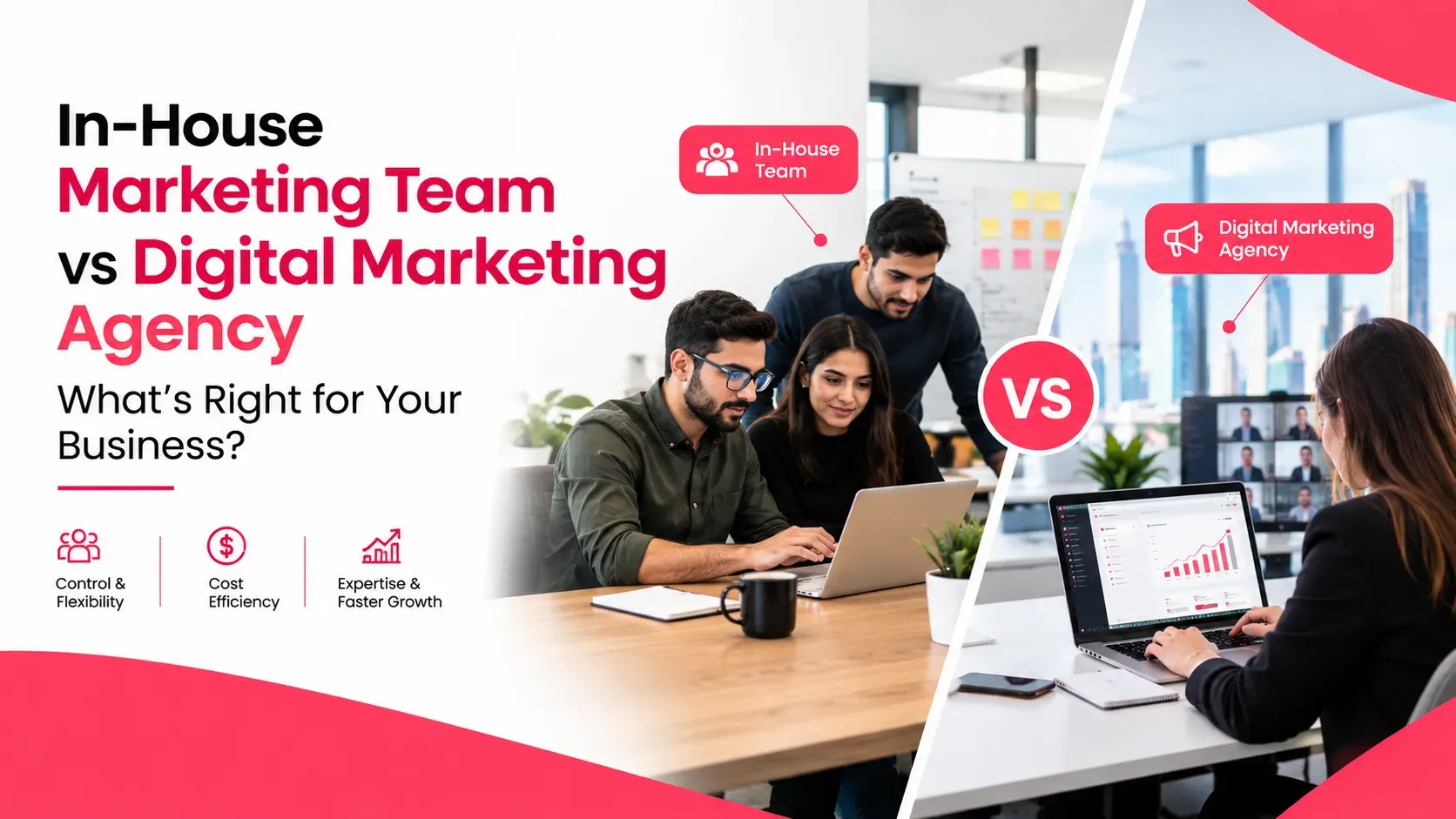
You've hit the point where marketing can't stay an afterthought anymore. Maybe leads have plateaued, maybe your founder is still writing social posts at midnight, or maybe the board just asked what your marketing strategy actually is and you didn't love your answer.
Now you're facing a real decision: build a team, or bring in an agency.
Both options work. Both options also fail, often for reasons nobody warns you about until you've already committed a year and a budget to the wrong one. Let's walk through this properly, without the sales pitch either way.
Quick Answer
There's no universally right answer between an in-house marketing team and a digital marketing agency. In-house suits businesses that need constant availability and deep brand knowledge, while agencies suit businesses that need broad expertise and faster scaling without the overhead of full-time hires. The right choice depends on your budget, growth stage, and how specialized your marketing needs actually are.
Key Takeaways
- In-house teams offer control and brand familiarity but come with hiring risk, skill gaps, and ongoing overhead beyond salary.
- Agencies offer broad expertise and faster scaling but require you to share attention and give up some day-to-day control.
- The real cost comparison isn't salary versus retainer, it's total cost of ownership on both sides.
- Many growing businesses eventually land on a hybrid model rather than an all-or-nothing choice.
- The right structure depends more on your growth stage and the specificity of your needs than on which option sounds more "professional."
What's the Real Difference Between In-House and Agency Marketing?
At its core, this decision comes down to one trade-off: control versus breadth.
An in-house team lives inside your business every day. They know your product, your customers, and your internal politics without needing a briefing. An agency, on the other hand, brings a wider bench of specialists, someone who's spent years exclusively on paid ads, someone else who's spent years exclusively on SEO, working across many clients rather than just yours.
Neither structure is inherently better. They're built for different jobs, and mismatching the structure to the job is where most businesses actually go wrong.
The True Cost of Each Option (It's Not Just Salary vs Retainer)
This is where most comparisons oversimplify things. The real cost isn't the headline number, it's everything sitting underneath it.
What an In-House Team Actually Costs
- Base salary, which is only the starting point
- Benefits, visa sponsorship, and UAE-specific employment costs
- Software and tool subscriptions for each function you hire for
- Training time and the ramp-up period before a new hire is actually productive
- Turnover risk, since losing a key marketing hire can stall momentum for months
Marketing talent gaps are a widespread problem right now, not just a hiring challenge unique to smaller businesses. In Gartner's 2026 CMO Spend Survey, more than half of marketing leaders reported their department lacked the talent needed to execute their strategy, which says a lot about how hard specialized marketing hiring has become even for well-resourced teams.
What an Agency Actually Costs
- Monthly retainer or project fee, usually scoped to specific deliverables
- Onboarding time while the agency learns your business and brand voice
- Potential scope creep if deliverables aren't defined clearly upfront
- Less predictable output if the agency is spread thin across too many clients
Cost only tells half the story here. What actually matters is what you're getting for it, and how that maps to the ROI you're chasing, which is exactly why we broke down the real ROI math behind digital marketing spend in a separate guide worth reading alongside this one.
What You Gain and Lose With an In-House Team
What you gain:
- Deep, constant familiarity with your brand, product, and customers
- Immediate availability for time-sensitive requests
- Full control over priorities and daily direction
- Institutional knowledge that compounds over time
What you lose:
- Breadth of specialized skill, since one or two hires rarely cover SEO, paid ads, content, design, and analytics equally well
- Flexibility, since scaling up or down means hiring or letting people go
- Access to outside perspective, since a team embedded in your business can develop blind spots
A lot of businesses learn these trade-offs the hard way, which is part of why we put together a breakdown of the most common digital marketing mistakes we see UAE businesses make, several of which come directly from stretching one generalist hire across too many specialties.
What You Gain and Lose With an Agency
What you gain:
- Access to a full bench of specialists without the overhead of hiring each one
- Faster scaling up or down as your needs change
- Exposure to strategies and benchmarks from working across multiple clients and industries
- No HR overhead, recruitment costs, or employment liability
What you lose:
- Shared attention, since you're one of several accounts an agency manages
- Slightly less day-to-day control over execution details
- A ramp-up period while the agency learns your brand from scratch
This is exactly the gap a full-service partner is built to close, and it's part of why businesses lean on structured content marketing support rather than trying to build that specialty in-house from day one.
Which One Is Right for You?
Direct answer: Choose in-house if your marketing needs are broad, ongoing, and deeply tied to daily operations, and you have the budget for a full team. Choose an agency if you need specialized expertise fast, your needs fluctuate, or you're not yet ready to carry full-time marketing salaries and overhead.
A rough decision framework by stage:
- Early-stage or lean team: an agency almost always makes more sense, since you need broad coverage without the fixed cost of multiple hires.
- Fast-growing with a clear core need: consider one in-house generalist paired with an agency for specialist gaps.
- Established with steady, complex needs: a larger in-house team starts to make financial sense, since the total cost per function drops at scale.
For context on just how common outsourcing has become even among growing businesses, independent research on marketing team structures found that outsourcing rates have nearly doubled over the past several years, even as most companies still keep the majority of their marketing work in-house.
Can You Use Both? The Hybrid Model
Yes, and for many growing businesses, this ends up being the actual answer rather than a compromise.
A hybrid model typically looks like one in-house marketing lead who owns strategy, brand voice, and day-to-day priorities, supported by an agency for specialized execution like SEO, paid ads, or content production. You get the control and brand knowledge of an internal hire, plus the breadth of an outside specialist team.
This is especially common for functions like lead generation, where businesses want an internal owner tracking results closely, while leaning on outside expertise to actually run and optimize the campaigns.
Signs It's Time to Switch
Sometimes the right structure changes as your business grows, and the signs are usually visible before you consciously notice them.
Signs it's time to move from agency to in-house:
- Your marketing needs have become constant rather than project-based
- You're spending more on retainers than a full-time hire would cost
- You need someone embedded daily in strategic decisions
Signs it's time to move from in-house to agency (or add one):
- Your team is stretched across too many specialties to do any of them well
- You need expertise your current team simply doesn't have
- Hiring for a niche skill isn't practical for your current size
There's no shame in either direction, and getting this decision right the first time is exactly the kind of strategic groundwork Milaaj Brandset helps businesses work through before committing budget either way.
Frequently Asked Questions
Is it better to have an in-house marketing team or hire an agency?
Neither is universally better. In-house suits businesses needing constant availability and deep brand familiarity, while agencies suit businesses needing broad expertise and flexible scaling. The right choice depends on your budget, growth stage, and how specialized your needs are.
How much does an in-house marketing team cost compared to an agency?
An in-house team's true cost includes salary, benefits, tools, training, and turnover risk, often exceeding the headline salary figure significantly. An agency's cost is typically a predictable monthly retainer or project fee, though scope creep can add unplanned costs if deliverables aren't clearly defined.
What are the disadvantages of an in-house marketing team?
The main disadvantages are limited specialized skill coverage, reduced flexibility when scaling up or down, hiring and turnover risk, and the tendency to develop blind spots without outside perspective.
Can a small business afford both an agency and in-house staff?
Many small businesses can afford a hybrid model by keeping one in-house lead for strategy and daily priorities, then using an agency for specialized execution, which is often more affordable than building a full in-house team from scratch.
When should a startup switch from an agency to an in-house team?
A startup should consider switching when marketing needs become constant rather than project-based, when retainer costs start exceeding what a full-time hire would cost, or when the business needs someone embedded daily in strategic decisions.
Making This Decision With Confidence
There's no single right answer here, and that's actually good news. It means you get to choose the structure that fits where your business is today, not where a generic guide assumes every business should be.
Start with your actual bottleneck. If it's breadth of expertise, lean toward an agency. If it's control and constant availability, lean toward in-house. And if you're not sure yet, a hybrid model lets you test the waters without betting everything on one structure.
If you want a second opinion on which setup actually fits your stage and goals, our digital marketing team in Dubai is happy to walk through it with you, no pressure either way.
Ready to Elevate Your Brand?
Start Your Project Today