September 3, 2026
How to Rank for Competitive Keywords in Dubai: A Practical SEO Guide
Milaaj Editorial / Research Insights
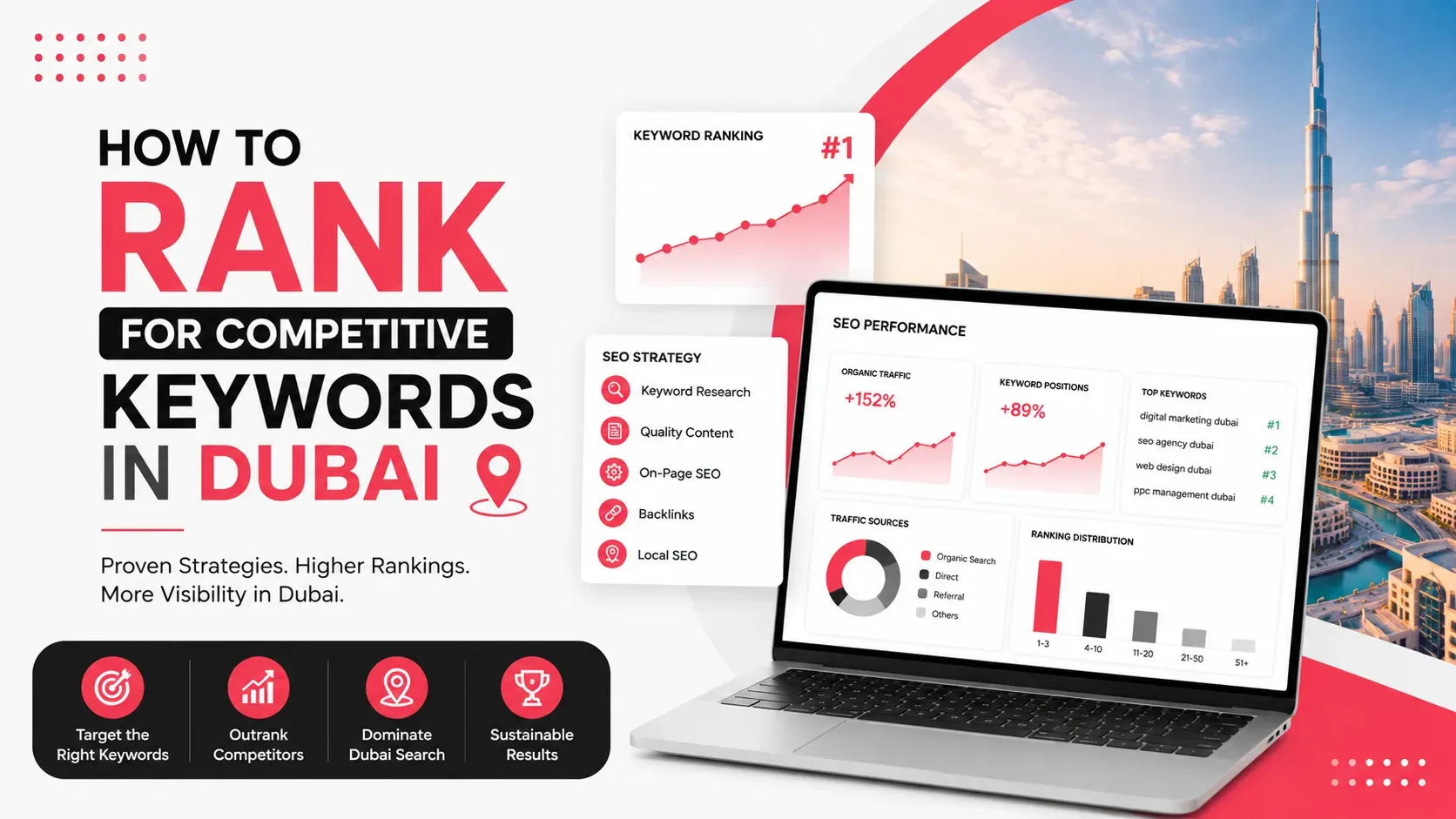
Ranking for competitive keywords in Dubai is rarely a matter of adding the location name to a page and publishing more content.
Searches such as “SEO company Dubai,” “digital marketing agency Dubai,” “real estate company Dubai,” or “web development company Dubai” can put your website against established businesses with strong domains, extensive content, local relevance, backlinks, and years of search visibility.
That does not mean smaller or newer businesses cannot compete.
It means the strategy has to be more precise.
Instead of trying to overpower established websites with more generic content, you need to identify where the competition is vulnerable, understand what Google expects from the query, and build stronger relevance around the subject.
Quick Answer: How Can You Rank for Competitive Keywords in Dubai?
To rank for highly competitive Dubai keywords, build your strategy around search intent, local relevance, topical authority, high-quality content, technical SEO, internal linking, and authoritative mentions or links.
Start by identifying realistic keyword opportunities instead of targeting only the highest-volume phrases. Analyze the current search results, understand why those pages rank, build content that addresses the same intent more effectively, strengthen your site's topical coverage, and establish genuine local relevance.
For extremely competitive terms, expect SEO to be a long-term process rather than a quick ranking campaign.
Why Competitive Keywords in Dubai Are Difficult to Rank For
Dubai has a highly competitive digital market.
Businesses often compete not only with local companies but also with international brands, agencies, marketplaces, directories, franchises, and businesses targeting the wider UAE market.
A keyword such as:
“digital marketing agency Dubai”
has significantly different competitive dynamics from:
“digital marketing for dental clinics Dubai.”
The first is broad and commercially valuable. The second is narrower and more specific.
This difference creates an important SEO opportunity.
Don't confuse search volume with opportunity
A high-volume keyword is not automatically the best keyword for your business.
A broader term may attract thousands of searches but generate relatively few qualified leads.
A more specific search can have lower volume while showing much stronger commercial intent.
For example:
- “web development Dubai”
- “Shopify development company Dubai”
- “Shopify development for fashion brands Dubai”
Each search represents a different level of specificity.
The more specific query may be easier to compete for and more closely connected to a particular service.
Start With Dubai-Specific Keyword Research
Competitive SEO begins with choosing the right battlefield.
Before creating content, investigate what people actually search for, how competitors structure their pages, and which keywords are realistically attainable.
Our existing guide on keyword research strategy for Dubai covers the broader process of identifying local, long-tail, commercial, and intent-based opportunities.
For a competitive campaign, however, keyword research needs to go one step further.
Build a keyword hierarchy
Instead of creating a list of hundreds of disconnected keywords, organize them into groups.
For example:
Core topic: SEO
Primary commercial keyword:
- SEO company Dubai
Related commercial searches:
- SEO agency Dubai
- SEO services Dubai
- SEO consultant Dubai
Specific service searches:
- local SEO Dubai
- technical SEO Dubai
- ecommerce SEO Dubai
Informational searches:
- how SEO works
- how long SEO takes
- how to improve Google rankings
This creates a structure where different pages have different purposes rather than competing against one another.
Look for the gap between broad and specific
A competitive keyword doesn't always have to be abandoned.
Instead, use it as the center of a broader topic ecosystem.
A website targeting “SEO company Dubai” might build supporting content around:
- Local SEO
- Technical SEO
- Ecommerce SEO
- Search intent
- Keyword research
- Content relevance
- Google Business Profile
- Link building
- SEO reporting
The objective is not to publish dozens of pages simply because they contain related phrases.
Each page should have a distinct reason to exist.
Analyze What Google Already Rewards in Dubai
Before attempting to outrank competitors, study the actual SERP.
Search the keyword from the relevant market and examine the pages appearing consistently.
Ask:
- Are they service pages or blog articles?
- Are directories dominating the results?
- Are local businesses appearing?
- What topics do the top pages cover?
- How specific are their services?
- Do they demonstrate local expertise?
- What questions do competing pages answer?
- Where is their content weak or outdated?
- Are there obvious content gaps?
This tells you what type of page Google considers relevant for the query.
Search intent can change the entire strategy
Suppose the target keyword is:
“best SEO company Dubai.”
A long educational article explaining what SEO means may be informative, but it does not necessarily satisfy someone comparing agencies.
The searcher may expect:
- Services
- Experience
- Industries served
- Case studies
- Approach
- Pricing information
- Reviews
- Local expertise
- Contact options
The page therefore needs to reflect the intent behind the search.
Google says its systems aim to return the most relevant and useful results and can consider factors such as location, language, and device.
Build Topical Authority Around the Keyword
One competitive page rarely creates a strong SEO presence by itself.
Google needs to understand what your website is about and how your pages relate to one another.
Imagine a website targeting:
“SEO services Dubai.”
A single service page provides limited context.
A stronger content ecosystem might include supporting resources covering:
- Keyword research
- Search intent
- Semantic SEO
- Technical SEO
- Local SEO
- Content optimization
- Internal linking
- SEO measurement
This gives the site broader topical coverage.
Your existing guide on content relevance can also support this approach because relevance extends beyond matching one exact keyword.
Create clusters instead of isolated articles
A topic cluster can look like this:
Main commercial page
→ SEO services in Dubai
Supporting content
→ Dubai keyword research
→ Local SEO for Dubai companies
→ Search intent optimization
→ Semantic SEO
→ Content relevance
→ Technical SEO
The pages should link to one another naturally where useful.
This helps users navigate the subject while giving search engines additional context about relationships between pages.
Make Local Relevance More Than a City Name
Adding “Dubai” to every heading does not automatically create local SEO relevance.
A genuinely Dubai-focused page should demonstrate why the subject matters in the local market.
Depending on the business, that could involve:
- Dubai customer behavior
- Local search patterns
- UAE business sectors
- Competition between local businesses
- Dubai neighborhoods or commercial areas where relevant
- UAE-specific regulations or market conditions
- Local examples
- Dubai-specific customer expectations
The details should be relevant to the business rather than inserted simply for SEO.
Local SEO has its own signals
For businesses serving customers in specific locations, local visibility can involve more than website content.
Google Business Profile, business information consistency, reviews, local references, and other signals can contribute to how a business is understood in local search.
Our guide to local SEO for Dubai companies goes deeper into these elements.
The important distinction is:
Local SEO supports local relevance; it does not replace strong website content.
Create Content That Is Better, Not Just Longer
When businesses discover that competitors have 2,000-word articles, a common reaction is to create a 3,000-word article.
That isn't necessarily an improvement.
Google's current guidance explicitly rejects writing to a predetermined word count. It encourages helpful, reliable, people-first content and asks whether the page provides substantial value compared with other search results.
A stronger approach is to identify what competitors fail to explain.
Look for information gaps
Suppose competing pages explain:
- What SEO is
- Why SEO matters
- Basic SEO techniques
You could improve the resource by adding:
- Dubai-specific search behavior
- Keyword selection by business type
- Commercial versus informational intent
- Local landing-page strategy
- Internal-link architecture
- Practical examples
- Conversion considerations
- Common mistakes
The advantage comes from useful differentiation, not arbitrary length.
Strengthen Your Internal Linking
Competitive pages often need support from the rest of the website.
Internal links can connect related content and help users discover deeper resources.
For example, a page targeting a competitive commercial keyword could naturally link to supporting articles about:
- Keyword research
- Local SEO
- Search intent
- Content relevance
The anchor text should describe the destination accurately.
Avoid creating a block of links simply for SEO purposes.
Instead, place each link where the reader would reasonably want additional information.
Google's Search Essentials also recommends making links crawlable so Google can discover other pages through them.
Build Authority Without Treating Backlinks as a Shortcut
Competitive keywords often require more than excellent on-page content.
Established competitors may already have backlinks from:
- Industry publications
- Business directories
- News websites
- Partner organizations
- Local publications
- Industry associations
- Relevant blogs
But acquiring links indiscriminately is not the answer.
Google specifically recommends creating unique, compelling content that others naturally want to reference and warns against unnatural link schemes.
Focus on link-worthy assets
Instead of asking:
“How many backlinks do I need?”
ask:
“What could I publish that a relevant website would genuinely want to reference?”
Depending on the industry, this could include:
- Original research
- Market data
- Detailed guides
- Local industry insights
- Case studies
- Useful calculators
- Original statistics
- Expert commentary
This creates a stronger foundation for sustainable authority.
Don't Ignore Technical SEO
Content cannot compensate indefinitely for serious technical problems.
Before pushing a competitive keyword campaign, check:
- Indexability
- Crawlability
- Canonicalization
- Mobile usability
- Page speed
- Core Web Vitals
- HTTPS
- Internal linking
- Duplicate pages
- Broken links
- XML sitemap
- Structured data where appropriate
Google's Search Essentials identifies technical requirements as the baseline for being eligible to appear in Search, while its page-experience guidance recommends looking at the overall experience rather than chasing one isolated metric.
Don't obsess over perfect scores
A perfect technical score does not guarantee a first-page ranking.
Technical SEO removes obstacles and strengthens the foundation.
It does not replace relevance, usefulness, authority, or search intent.
Use a Different Strategy for Extremely Difficult Keywords
Some keywords are so competitive that trying to rank a single page immediately can be inefficient.
Instead, create a progression.
Stage 1: Capture specific opportunities
Target relevant long-tail and lower-competition searches.
Stage 2: Build topical coverage
Create strong supporting content around the broader subject.
Stage 3: Strengthen authority
Earn relevant mentions, references, and backlinks.
Stage 4: Improve the main commercial page
Use the insights gained from supporting content and Search Console data to improve the primary page.
Stage 5: Move toward broader terms
Once the website has stronger relevance and authority, compete more aggressively for the broader keyword.
This is often more realistic than expecting a new page to immediately rank for the most valuable search in the market.
For businesses that want to coordinate technical SEO, content, keyword strategy, and organic growth, expert SEO strategy can bring these elements together as part of a broader campaign.
Measure Progress Beyond the Final Ranking
A competitive SEO campaign should not be judged only by whether a keyword reaches position one.
Monitor:
- Impressions
- Clicks
- Click-through rate
- Average position
- Indexed pages
- Organic traffic
- Ranking distribution
- Conversions
- Qualified leads
- Search queries
- Pages generating impressions
- New keyword opportunities
A page moving from position 80 to position 25 has made meaningful progress even though it isn't on page one yet.
Likewise, ranking first for a low-value keyword may matter less than ranking fifth for a search that generates qualified customers.
The ultimate objective is commercially valuable organic visibility, not a screenshot of a ranking position.
What to Avoid When Targeting Competitive Dubai Keywords
Keyword stuffing
Repeating “SEO company Dubai” throughout every paragraph does not create stronger relevance.
Use natural language and related terminology.
Creating a page for every tiny variation
Pages targeting “SEO agency Dubai,” “SEO company Dubai,” and “SEO services Dubai” may not always need to be separate.
Consider whether the search intent is genuinely different before creating another URL.
Copying the top-ranking pages
Competitor research should reveal opportunities—not provide a template to rewrite.
Google encourages original, useful content that adds value rather than simply rehashing what others have published.
Publishing hundreds of weak articles
More URLs do not automatically create more authority.
A smaller collection of genuinely useful resources can be more valuable than a large library of repetitive pages.
Buying or manipulating links
Unnatural link schemes can create SEO risks instead of sustainable authority.
Key Takeaways
- Ranking for competitive keywords in Dubai requires more than adding “Dubai” to a page.
- Start with realistic keyword opportunities and understand the local SERP.
- Search intent should determine the type and structure of the page.
- Build topical authority rather than relying on one isolated article.
- Use Dubai-specific insights where they genuinely improve relevance.
- Create content that provides something more useful than competing pages.
- Strengthen internal linking between commercially important pages and supporting resources.
- Earn relevant authority rather than relying on manipulative link-building tactics.
- Technical SEO provides the foundation but does not replace content quality or relevance.
- Track qualified traffic and conversions alongside rankings.
- For highly competitive terms, use a staged strategy instead of expecting immediate first-page results.
Conclusion
Ranking for competitive keywords in Dubai is a process of building relevance, authority, and local trust over time.
The strongest strategy isn't necessarily to publish more content than your competitors or repeat a target keyword more frequently. It is to understand what searchers actually want, identify gaps in the existing results, build a website that covers the subject comprehensively, and demonstrate why your business is relevant to the Dubai market.
Competitive SEO becomes much more achievable when the goal changes from “rank for this keyword” to “become one of the most useful and credible results for this topic.”
Milaaj Brandset helps businesses strengthen their online visibility through SEO and digital marketing strategies that connect keyword research, content, technical optimization, and broader business goals.
FAQ: Ranking for Competitive Keywords in Dubai
How long does it take to rank for competitive keywords in Dubai?
There is no universal timeframe. It depends on competition, website authority, content quality, technical condition, local relevance, backlinks, and the starting position of the website. Highly competitive commercial terms generally require a longer-term strategy.
What are the most competitive SEO keywords in Dubai?
Competition varies by industry, but broad commercial searches such as “SEO company Dubai,” “digital marketing agency Dubai,” “real estate Dubai,” “web development Dubai,” and similar service-focused terms can be highly competitive.
Should I target high-volume keywords first?
Not necessarily. High-volume keywords can be difficult and may not generate the most qualified traffic. A combination of commercially valuable long-tail keywords, specific service searches, and broader terms can create a more sustainable strategy.
Does adding Dubai to a keyword improve rankings?
Simply adding “Dubai” does not guarantee better rankings. Local relevance should be supported by useful location-specific information, appropriate business details, relevant content, and other signals that help Google understand the business's connection to the market.
Are backlinks necessary for competitive keywords?
Strong competition can make authoritative references and backlinks valuable, but quantity should not be the sole objective. Relevant, natural links earned because your content is genuinely useful are preferable to manipulative link schemes.
Can a new website rank for competitive Dubai keywords?
Yes, but it may take longer than for an established site with strong authority. A new website can improve its chances by targeting realistic opportunities first, building topical depth, producing genuinely useful content, and gradually establishing authority.
Should one page target multiple Dubai SEO keywords?
It can, when the keywords share the same search intent. For example, closely related variations such as “SEO company Dubai” and “SEO agency Dubai” may be addressed by one strong page rather than creating separate pages solely for keyword variations.
How do I know whether my SEO campaign is working?
Look beyond one keyword position. Monitor organic impressions, clicks, ranking growth, relevant search queries, traffic quality, leads, conversions, and the number of valuable keywords generating visibility. A successful SEO campaign should ultimately contribute to meaningful business outcomes.
Ready to Elevate Your Brand?
Start Your Project Today