August 25, 2026
SEO-Friendly URL Structure Best Practices for Better Rankings
Milaaj Editorial / Research Insights
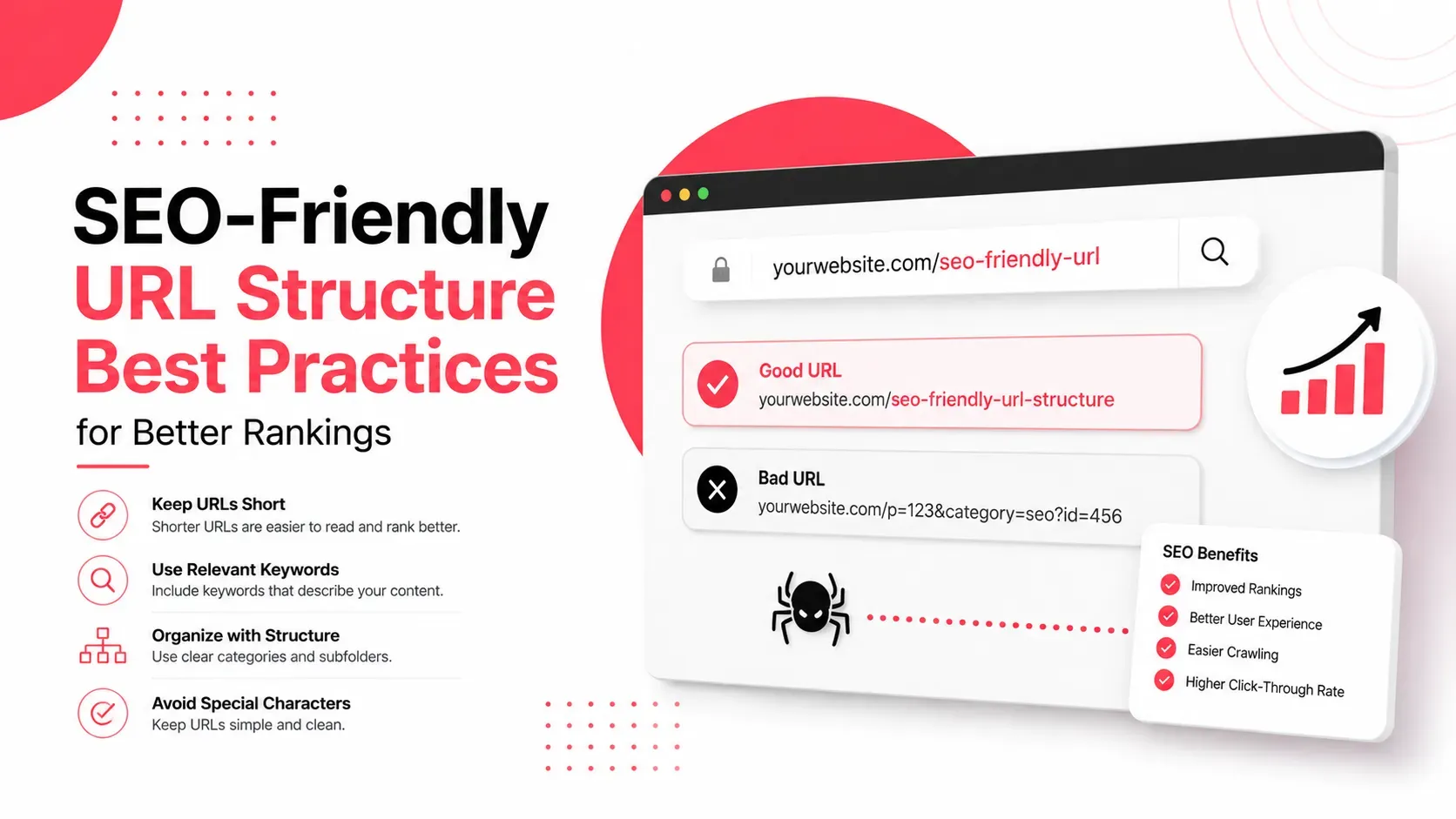
A website URL may look like a small technical detail, but it can influence how users understand a page and how efficiently search engines crawl and interpret a website.
Compare these two URLs:
example.com/page?id=8472
and
example.com/seo-friendly-url-structure/
The second URL immediately communicates what the page is about. It is easier to read, easier to share, and easier to understand when it appears in search results.
An SEO-friendly URL structure doesn't guarantee higher rankings by itself. However, clean, search engine friendly URLs support a well-organized website, improve usability, make pages easier to identify, and can help search engines understand the site's structure.
The goal is simple: create URLs that are short, descriptive, consistent, and useful to both people and search engines.
Quick Answer
The best practices for creating SEO-friendly URLs include keeping them concise and descriptive, using relevant keywords naturally, separating words with hyphens, and using lowercase characters consistently. A good URL should also sit inside a logical hierarchy, avoid unnecessary parameters, and manage duplicate versions with canonical tags. Above all, it should allow someone to understand the general subject of a page without opening it.
Key Takeaways
- Keep URLs short, descriptive, and free of filler words, dates, or tracking codes.
- Use one clear keyword per URL instead of repeating variations.
- Separate words with hyphens, never underscores or spaces.
- Serve every URL over HTTPS and keep the format lowercase and consistent.
- Build a logical folder hierarchy that reflects how the site is actually organized.
- Use 301 redirects and canonical tags to manage URL changes and duplicate versions.
What Is an SEO-Friendly URL Structure?
An SEO-friendly URL is a web address designed to be understandable, descriptive, and logically organized.
For example:
example.com/services/seo/
is easier to understand than:
example.com/services/service?id=4928
A useful URL can communicate the website section, the content category, the page topic, and the content hierarchy. A URL doesn't need to contain every detail about a page. In fact, trying to include too much information can make URLs unnecessarily long and difficult to maintain.
The ideal structure provides enough context without creating unnecessary complexity.
Why URL Structure Matters for SEO
URL structure for SEO is only one part of a much larger system. Google's search systems consider many signals when evaluating pages, including content relevance, technical accessibility, links, and other factors.
However, URLs still have practical SEO value. A logical URL structure can help with:
- Crawlability: Search engines can navigate a well-organized site more efficiently.
- Context: Descriptive URLs provide additional information about a page.
- Usability: People can understand where a link leads.
- Sharing: Clean URLs are easier to copy and share.
- Site management: Developers and SEO teams can more easily identify page types and sections.
A well-structured URL therefore supports the broader architecture of the website rather than functioning as an isolated ranking tactic.
Keep URLs Short and Descriptive
Shorter URLs are generally easier for people to read and remember.
Consider:
example.com/blog/seo-friendly-url-structure/
versus:
example.com/blog/2026/08/technical-seo-guide-for-businesses-and-marketers/
The second URL isn't necessarily harmful, but unnecessary information makes the address harder to manage. Avoid adding unnecessary dates, repeated keywords, filler words, internal IDs, tracking information, or excessive category levels.
However, don't remove useful words simply to make a URL extremely short. Clarity should come before an arbitrary character count.
Include Relevant Keywords Naturally
Including the main topic in a URL can help users and search engines understand the page.
For example:
example.com/blog/technical-seo-guide/
clearly indicates the subject. But keyword inclusion should remain natural. Avoid URLs such as:
example.com/seo/seo-services/seo-company-seo-expert-seo/
This adds little value and makes the URL look manipulative. A good URL generally contains the primary topic or a concise description of the page. Think about what a user would expect to see after clicking the link.
If you want a deeper reference on how to phrase and structure URLs for readability, Moz's guide to URLs breaks down how word choice and simplicity affect the way both people and search engines interpret a page address.
Use Hyphens Between Words
Use hyphens to separate words in URLs.
For example:
example.com/seo-friendly-url-structure/
is much easier to interpret than:
example.com/seofriendlyurlstructure/
Hyphens visually separate individual words and create a cleaner URL. Avoid using spaces, which aren't appropriate in standard URLs, and avoid unnecessarily complicated separators.
For most websites, a consistent lowercase, hyphen-separated structure is the simplest approach.
Create a Logical URL Hierarchy
A website's URL structure should reflect its information architecture where appropriate.
For example:
example.com/services/
example.com/services/seo/
example.com/services/social-media-marketing/
This creates an understandable relationship between the main service section and individual services. An ecommerce website might use:
example.com/men/shoes/running-shoes/
The exact structure will depend on the site's size and organization. Don't create folders simply because they appear in a hierarchy. A structure such as:
example.com/services/digital/marketing/seo/technical/
may be unnecessarily deep if the intermediate categories don't provide meaningful value. The URL should reflect the site's logical organization without becoming complicated.
Avoid Unnecessary URL Parameters
Parameters can be useful for legitimate technical purposes. For example, ecommerce websites may use parameters for filtering, sorting, tracking, session handling, or search functionality.
But excessive parameters can create multiple URLs representing essentially the same content. For example:
example.com/products/shoes?color=black&sort=price&utm_source=email
may contain useful functionality, but the business needs to understand how these parameterized URLs interact with crawling, indexing, canonicalization, and internal linking. Google's own documentation on crawling and URL structure goes into more depth on how parameter-heavy URLs can affect how efficiently a site gets crawled.
Don't automatically remove every parameter. Instead, determine whether it creates a meaningful page or simply generates another version of existing content.
Use HTTPS and Lowercase URLs Consistently
Every URL on the site should load over HTTPS rather than HTTP. Beyond the trust signal for visitors, HTTPS is a confirmed factor search engines take into account, and most hosting providers now issue SSL certificates at no extra cost.
A consistent URL format also reduces potential confusion. For example, choose:
example.com/services/seo/
rather than mixing:
example.com/Services/SEO/
example.com/services/SEO/
and
example.com/services/seo/
Depending on the server configuration, uppercase and lowercase versions may be treated differently. A consistent lowercase convention is therefore easier to manage, and it also makes URLs simpler to share and remember.
Avoid Excessive URL Folders
A URL doesn't need to reproduce every level of your website's internal organization.
For example:
example.com/blog/seo/technical/2026/august/url-structure-guide/
may be unnecessarily complicated. A cleaner alternative could be:
example.com/blog/seo-friendly-url-structure/
The right choice depends on the website's architecture. Large websites with thousands of pages may benefit from meaningful categories, while smaller websites often don't need deeply nested URLs. This is usually easier to control when the site runs on a CMS built with URL structure in mind rather than one that generates folder paths automatically based on how content happens to be organized behind the scenes.
The important thing is to create a structure that remains manageable as the site grows.
Handle URL Changes With Proper Redirects
Changing URLs can create problems if old addresses stop working.
For example, suppose a page changes from:
example.com/old-seo-guide/
to:
example.com/seo-guide/
If the old URL has existing links, search visibility, bookmarks, or traffic, simply deleting it can create a poor experience. When a page has permanently moved, a 301 redirect can usually be used to send visitors and search engines to the appropriate new URL.
Before changing URLs, consider existing backlinks, organic traffic, internal links, search visibility, bookmarks, and external references. URL changes should be planned rather than treated as routine edits, and this is exactly the kind of technical detail covered in our technical SEO guide for UAE websites if you want a broader checklist before making structural changes.
Manage Duplicate URLs and Canonicals
Sometimes multiple URLs can access the same or very similar content.
For example:
example.com/product/
and
example.com/product/?ref=homepage
may potentially lead to the same page. Search engines need to understand which version should be considered the primary URL. Canonicalization can help communicate the preferred version.
A canonical URL is particularly useful when a website's technical structure naturally produces multiple URL variations. This is especially important for larger ecommerce websites, where filters, sorting options, tracking parameters, and category combinations can generate many URLs. If your site is generating duplicate URLs faster than you can track them, it's usually a sign the underlying technical setup needs a proper audit, which is where our SEO services in Dubai come in.
Build URLs That Are Easy for Users to Understand
SEO-friendly URLs should not be designed exclusively for search engines. Users see URLs in search results, browser address bars, social media, emails, messaging apps, advertisements, and internal links.
A descriptive URL can provide useful context before someone clicks. For example:
example.com/blog/best-fonts-typography-websites/
immediately communicates the topic. That is more useful than:
example.com/blog/article-4582/
Think of the URL as a small piece of information architecture.
Keep URL Structures Consistent
Consistency becomes increasingly important as a website grows.
If one blog uses /blog/article-name/, another uses /articles/article-name/, and another uses /content/article-name/, the website can become harder to manage.
Choose a clear convention and document it. For example:
- Blog posts: /blog/post-name/
- Services: /services/service-name/
- Locations: /locations/city-name/
- Products: /products/product-name/
The exact system doesn't matter as much as having a logical and sustainable one, which is usually easiest to enforce from the start with the help of a web development team rather than trying to retrofit a convention onto an existing site later.
Connect URLs With Internal Linking
URL structure works together with internal linking and site architecture. If a website has logically organized pages but doesn't connect them appropriately, users and search engines may still have difficulty discovering important content.
For example, a service page could link to related services, relevant blog articles, supporting guides, and contact pages. This creates relationships between pages and helps users move naturally through the website. Our own piece on internal linking strategies for better SEO covers this side of the equation in more detail.
A strong URL system is therefore one part of a broader SEO architecture.
Common URL Structure Mistakes
- Keyword Stuffing. Repeating keywords doesn't make a URL more SEO-friendly.
- Using Long URLs. Unnecessary words and folders make URLs harder to manage.
- Changing URLs Frequently. Frequent changes create unnecessary redirects and can complicate SEO management.
- Using Random IDs. Technical IDs may be necessary in some systems, but descriptive slugs are generally more useful where possible.
- Inconsistent Capitalization. Mixed uppercase and lowercase structures can create unnecessary URL variations.
- Ignoring Redirects. Removing important URLs without proper redirects can lead to broken links and lost traffic.
- Creating Excessive Categories. Deep URL structures aren't automatically better.
- Forgetting User Experience. A URL should make sense to the person seeing it, not just to a crawler.
Final Thoughts
A clean URL structure may seem like a small part of SEO, but it contributes to a website that is easier to understand, navigate, maintain, and optimize.
The best URLs aren't created by filling them with keywords or following an arbitrary character limit. They are built around clarity, consistency, logical hierarchy, and long-term usability.
Before publishing a new page, ask: can someone understand what this page is about just by looking at the URL? If the answer is yes, you're likely moving in the right direction.
Businesses looking to improve their website's technical foundation can benefit from SEO strategies that address URL structure alongside site architecture, internal linking, crawlability, content optimization, and broader search visibility. Milaaj Brandset helps businesses connect these technical improvements with wider digital marketing objectives, so the URLs, the content, and the links around them all work toward the same goal.
Ultimately, an SEO-friendly URL should do one thing exceptionally well: make the destination clear before the visitor even clicks.
Frequently Asked Questions
What is an SEO-friendly URL?
An SEO-friendly URL is a clear, descriptive web address that helps users and search engines understand the subject and organization of a webpage.
Should keywords be included in URLs?
Relevant keywords can be useful when they naturally describe the page. They should not be repeated excessively or inserted solely to manipulate search rankings.
Are shorter URLs better for SEO?
Shorter URLs are often easier for users to read and share, but there is no need to remove useful descriptive words simply to make a URL as short as possible.
Should URLs use hyphens or underscores?
Hyphens are generally preferred for separating words in URLs because they make individual words easier to identify.
Should URLs be lowercase?
Using lowercase URLs consistently is a good practice because it reduces potential variations and makes URL management simpler.
Should I change old URLs to make them more SEO-friendly?
Not necessarily. If an existing URL is working well, changing it only for cosmetic SEO reasons may create unnecessary risk. If a URL genuinely needs to change, plan the migration carefully and use appropriate redirects.
How do I make my URLs SEO-friendly?
Keep the URL short and descriptive, use the page's main keyword once, separate words with hyphens, and use lowercase letters throughout. Avoid dates, tracking parameters, and unnecessary folders, and serve the page over HTTPS. If the URL is already live and performing well, leave it as is rather than changing it purely for cosmetic reasons.
Do URLs directly improve Google rankings?
URL structure is only one small part of SEO. A descriptive URL can help communicate page context and improve usability, but it cannot compensate for poor content, weak relevance, technical problems, or a lack of useful information.
Ready to Elevate Your Brand?
Start Your Project Today