September 26, 2026
What Is DevOps and Why Should Your Dubai Business Care?
Milaaj Editorial / Research Insights
It's 6pm on a Thursday. Your developer pushes a small update to your online store. By 7pm, customers can't check out, and nobody is quite sure how to undo the change. The one person who knows how the server works is on a flight to Kochi.
Stories like this are exactly why DevOps exists. But what is DevOps, really, and is it something only big tech companies need? This guide explains it in plain English, shows the business problems it solves, and helps you decide how much of it your Dubai business actually needs.
Quick Answer
DevOps is a way of building and running software where development and operations work as one team, using automation to test, release, and monitor changes. For a Dubai business, it means faster updates, fewer outages during busy periods, and problems fixed in minutes instead of days, without having to choose between speed and stability.
Key Takeaways
- DevOps is a way of working, supported by tools, not just a job title or a piece of software.
- Its core idea is automation: testing, releasing, and monitoring changes without manual guesswork.
- Research shows speed and stability improve together; you don't have to trade one for the other.
- For Dubai businesses, it protects revenue during peak periods like White Friday, DSF, and Ramadan evenings.
- Small businesses don't need a full DevOps team, just a few right-sized practices.
What Is DevOps?
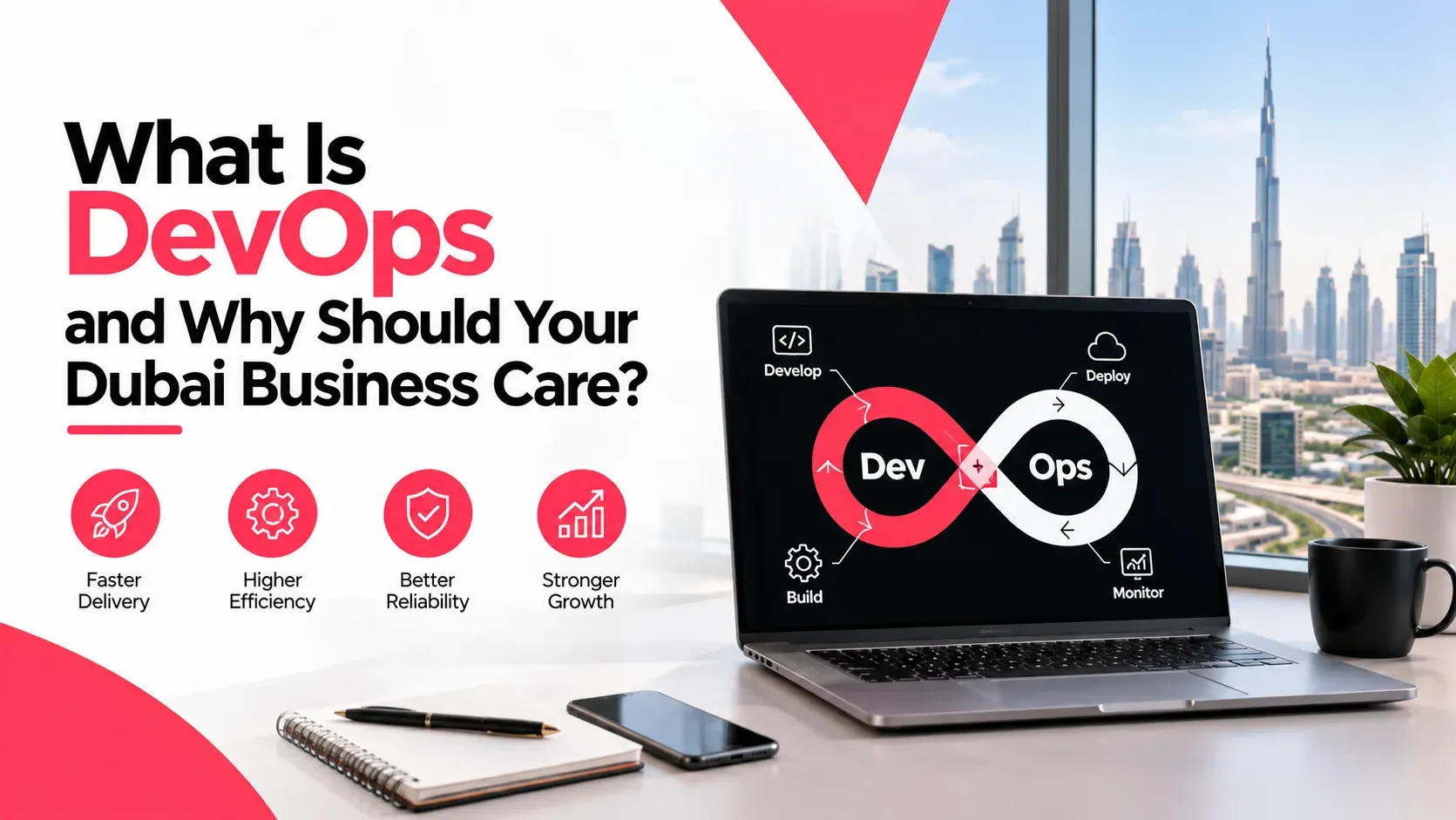
DevOps is a set of practices that brings software development (Dev) and IT operations (Ops) together, so the people who build your software and the people who run it work as one team. It relies on automation to test, release, and monitor changes, so updates reach customers faster and break things less often.
AWS describes DevOps as a combination of cultural philosophies, practices, and tools that helps organisations deliver applications and services at high speed. The culture part matters as much as the tools.
A Simple Way to Picture It
Think of a busy restaurant. In a badly run one, the kitchen cooks the food and throws it over the wall to the waiters, and when a customer complains, each side blames the other. In a well-run one, the kitchen and the floor work as one team, with a clear system for every order. DevOps turns your software team into the second restaurant.
How Does DevOps Work? The Core Practices in Plain English
Most DevOps setups are built on six practices:
- Version control. Every change to your software is saved and tracked, so you always know what changed, when, and by whom.
- Continuous integration (CI). Each change is automatically tested as soon as it's made, catching problems early.
- Continuous delivery or deployment (CD). Tested changes are released automatically or with a single click, instead of through a nervous manual process.
- Infrastructure as code. Your servers and settings are defined in files, so environments can be rebuilt identically in minutes.
- Monitoring and alerts. The system watches your app around the clock and warns the team the moment something looks wrong.
- A feedback loop. Every incident becomes a lesson that improves the process.
You'll often hear "CI/CD" used as shorthand. In simple terms, it means every change is automatically checked and then shipped safely, like a production line with quality control built into every step.
What Problems Does DevOps Solve?
You probably need better DevOps practices if any of these sound familiar:
- Releases are rare and scary. Updates happen every few months because everyone dreads them.
- Things break after updates. Fixing one feature quietly breaks another.
- Outages happen at the worst times. Your site goes down during a sale, and recovery takes hours.
- "It works on my machine." Code runs fine for the developer but fails on the live server.
- One person holds all the knowledge. If your deployment expert is sick or leaves, releases stop.
- Cloud bills are a mystery. Nobody can explain why hosting costs jumped this month.
Most of these trace back to manual, undocumented processes. Software built without these safeguards often looks cheaper at first, and our article on why cheap software ends up costing UAE SMEs more shows how those savings disappear over time.
What Are the Business Benefits of DevOps?
For a business owner, DevOps comes down to outcomes you can feel:
- Faster improvements: new features and fixes reach customers in days, not months.
- Fewer outages: automated testing catches problems before customers do.
- Quicker recovery: when something does fail, rolling back takes minutes.
- Lower risk: knowledge lives in documented systems, not one person's head.
- Better cost control: monitoring shows exactly what your infrastructure is doing and costing.
The most important finding for business owners comes from Google's DevOps research programme. DORA's research on software delivery metrics has repeatedly shown that speed and stability aren't trade-offs: the best-performing teams release faster and break less.
Security Built In, Not Bolted On
DevOps also makes security routine. Automated checks can scan for vulnerabilities with every change, and updates can be patched quickly instead of waiting for the next big release. It pairs naturally with the essential website security practices every business should follow.
Why DevOps Matters for Businesses in Dubai
A few things make reliable software especially valuable here:
- Peak moments can't fail. White Friday, Dubai Shopping Festival, and Ramadan evenings bring traffic spikes, and an outage during those hours costs far more than on a quiet Tuesday.
- Customers expect 24/7 service. Many businesses serve customers across time zones, and the UAE market has little patience for "we're down for maintenance."
- Apps often serve several markets. Businesses expanding across the GCC need to release updates safely to more users in more places.
- Local cloud infrastructure is available. Major cloud providers now run regions inside the UAE, making it easier to build reliable, automated systems close to your customers.
Getting that foundation right starts with how your cloud environment is set up. AWS cloud infrastructure services in Dubai can design environments that scale for peak seasons and recover quickly when something goes wrong.
DevOps vs Traditional IT: What's the Difference?
Factor | Traditional IT | DevOps |
|---|---|---|
How often you release | Every few months, in big batches | Small updates, often weekly or daily |
Who owns problems | Developers and operations blame each other | One shared team owns the outcome |
Testing | Mostly manual, near the end | Automated, with every change |
How releases happen | Manual steps, often late at night | Automated pipelines, any time |
Recovery from failure | Hours or days | Minutes, with quick rollbacks |
Knowledge | Held by a few individuals | Documented in code and systems |
The shift isn't only technical. It's a change from "hope nothing breaks" to "we'll know immediately, and we can fix it fast."
What Is DevOps Worth to a Small Business?
You don't need a dedicated DevOps team to benefit. Most small and mid-sized businesses only need a few right-sized practices:
- A staging environment: a private copy of your site or app where changes are tested before going live
- Automated backups: daily, stored separately, and tested to confirm they can be restored
- Automated deployments: releases that happen the same way every time, without manual steps
- Uptime monitoring: alerts the moment your site or app goes down
- A rollback plan: a simple way to undo a bad update in minutes
How much you need depends on your platform. A Shopify store handles most infrastructure for you, so your focus is on testing theme and app changes. A WordPress site benefits hugely from staging, backups, and update discipline. A custom app or platform needs the fuller set of practices.
If your software is built by an outside team, ask how they handle testing, releases, and rollbacks before the project starts. A software development company in Dubai that builds these practices in from day one saves you from retrofitting them later.
How to Get Started With DevOps
You can adopt DevOps gradually. Follow these five steps:
- Map your current release process. Write down exactly how a change goes from idea to live, and where it tends to go wrong.
- Add version control and a staging environment. These two basics prevent most self-inflicted outages.
- Automate testing and deployment. Start with the most common type of change and automate that first.
- Add monitoring and alerts. Make sure you hear about problems before your customers do.
- Track four simple measures. How often you release, how long changes take to go live, how often releases fail, and how quickly you recover.
Each step delivers value on its own, so there's no need to transform everything at once. If you'd like experienced help setting up pipelines, monitoring, and automated releases, DevOps automation services in Dubai can assess where you are today and build a practical roadmap.
Frequently Asked Questions
Is DevOps a job title or a way of working?
Both terms are used, but DevOps is primarily a way of working. Some companies hire "DevOps engineers" to build the automation, but the approach only succeeds when developers and operations share responsibility for the outcome.
What is CI/CD in simple terms?
CI/CD stands for continuous integration and continuous delivery. It means every change to your software is automatically tested and then released through a consistent, reliable process, rather than being checked and uploaded by hand.
Does a small business really need DevOps?
Not a full DevOps team, but most businesses that rely on software benefit from the basics: staging, automated backups, consistent deployments, monitoring, and a rollback plan. These prevent the outages that hurt small businesses most.
Do I need DevOps if my site runs on Shopify or WordPress?
Partly. Shopify manages the servers for you, so focus on testing theme and app changes before they go live. WordPress sites benefit from staging, backups, and careful update routines, since plugin updates are a common cause of breakages.
Is DevOps the same as automation?
No. Automation is a big part of DevOps, but DevOps also covers teamwork, shared responsibility, and continuous improvement. Automating a broken process just makes it break faster, so the process comes first.
Final Thoughts
So, what is DevOps in plain terms? It's the difference between software updates that feel like a gamble and updates that feel routine. For Dubai businesses, that reliability protects revenue in the moments that matter most, from White Friday checkouts to late-night Ramadan orders.
You don't have to overhaul everything overnight. Start with staging, backups, and monitoring, then build from there. If you'd like a partner who explains the technology in plain language and builds it properly, Milaaj Brandset helps UAE businesses ship software with confidence.
Ready to Elevate Your Brand?
Start Your Project Today