October 6, 2026
What Is RAG? A Plain-English Guide for Business Owners
Milaaj Editorial / Research Insights
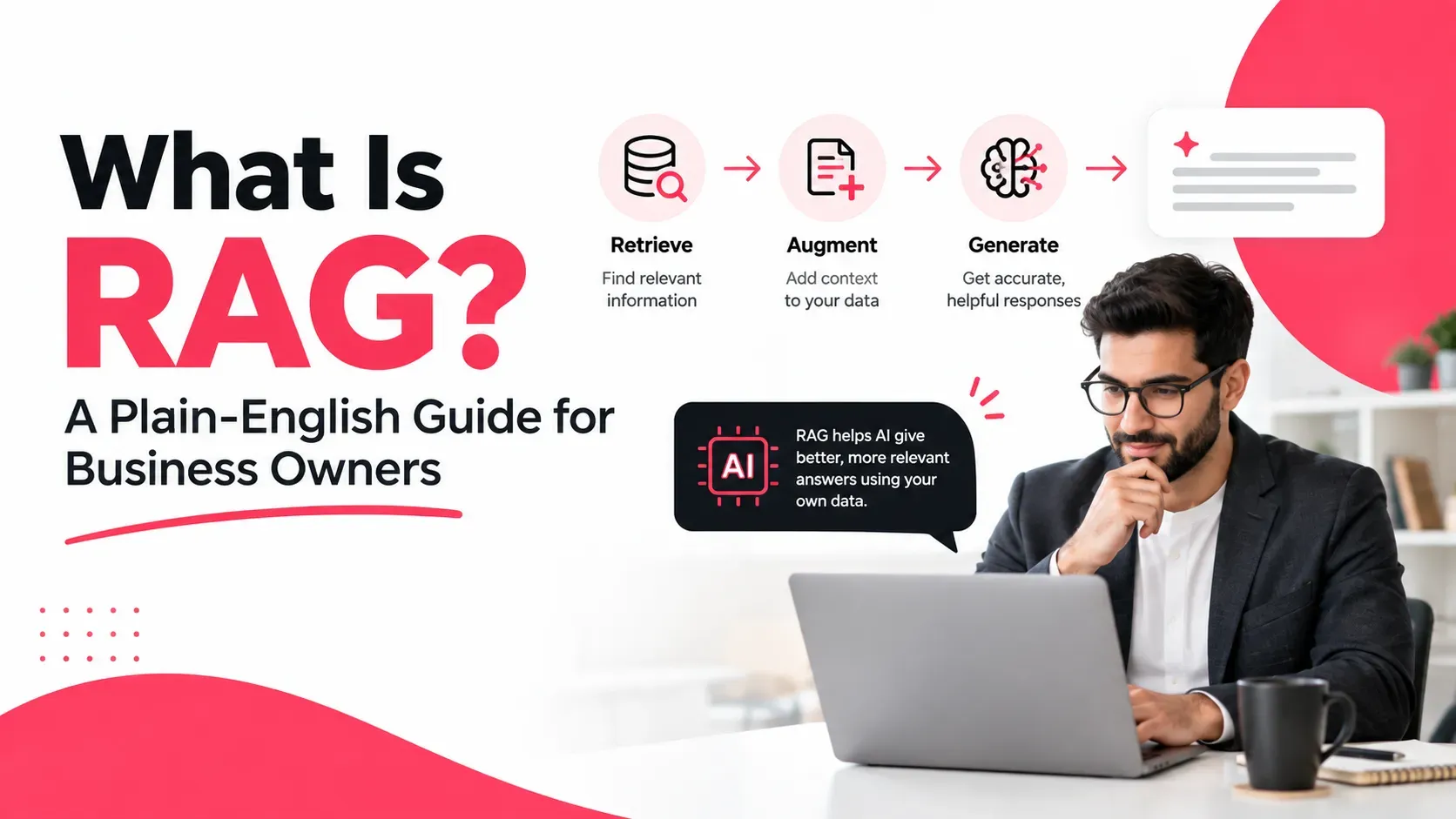
Ask a general AI tool about your company's return policy and it will answer with total confidence. The problem is that it has never seen your policy, so it may simply make one up.
If a vendor has told you "the fix is RAG" and you nodded politely, you are in good company. So, what is RAG, and does your business actually need it? Here is the plain-English answer, with no jargon you have to Google afterwards.
Quick Answer
RAG, short for retrieval-augmented generation, is a method where an AI looks up relevant information in your own documents first, then writes its answer using what it found. It helps AI tools give accurate, current answers about your business instead of guessing. Think of it as an open-book exam for AI.
Key Takeaways
- RAG connects an AI model to your own documents so it answers from facts, not memory.
- It reduces made-up answers, keeps information current, and lets AI use private company data.
- It is usually cheaper and faster to update than retraining an AI model.
- Results depend heavily on how clean, current and well organised your documents are.
- RAG fits repeat-question work like support, HR, property and catalog queries. It is overkill for a handful of static FAQs.
What Is RAG in Simple Terms?
RAG (retrieval-augmented generation) is a technique that connects an AI model to an outside source of information, such as your documents, so it can look facts up before it answers.
Picture two students sitting the same exam. One has to answer from memory. The other can open the textbook and check. The second student is not smarter, just better informed, and that is exactly what RAG does for AI.
Google Cloud describes RAG as combining traditional information retrieval, like search, with generative AI models, so the answers are grounded in real data.
What the name actually means
- Retrieval: the system finds the most relevant passages from your documents.
- Augmented: those passages are added to the question before the AI sees it.
- Generation: the AI writes a clear answer based on that material.
How Does RAG Work?
Behind the scenes, a RAG system follows four simple steps every time someone asks a question:
- The question comes in. A customer or employee types something like "What is your refund window for online orders?"
- The system searches your documents. It pulls out the few passages most likely to contain the answer.
- The passages are attached to the question. The AI now has your real policy in front of it.
- The AI writes the answer. It responds in plain language, ideally pointing to the source document.
What is a vector database, in plain English?
A vector database is a filing system that sorts information by meaning instead of exact words. Your documents are turned into numbers (called embeddings) that capture what each passage is about.
That is why a search for "money back" can find a paragraph titled "Refund policy." The two phrases mean the same thing, so they sit close together.
Why Use RAG Instead of Just Asking ChatGPT?
General AI tools are trained on public data up to a certain date. That creates three problems for a business:
- Made-up answers: when the AI does not know, it can still sound certain.
- Outdated knowledge: it cannot know about last month's price change.
- No access to private data: your contracts, listings and internal rules were never part of its training.
RAG tackles all three by handing the AI the right facts at the moment it answers.
RAG vs fine-tuning vs plain prompting
Business owners often hear these three terms mixed together. Here is how they differ:
Approach | What it does | Best for | Main limitation |
|---|---|---|---|
Plain prompting | You paste information into a chat | Quick one-off tasks | Does not scale across a company |
Fine-tuning | Trains the AI on your examples | Tone, format, specialised behaviour | Costly to update when facts change |
RAG | Looks up your documents at answer time | Policies, catalogs, FAQs, contracts | Needs clean, current documents |
IBM explains that RAG lets a model query an outside data source, while fine-tuning trains it on domain data. The two can also work together.
What Is RAG Used For in a UAE Business?
Imagine a Business Bay property firm with hundreds of brochures, payment plans and handover documents. Today, a buyer waits hours for an agent to dig through PDFs. With RAG, an assistant can answer "What is the post-handover payment plan for this tower?" in seconds, straight from the latest document.
Customer support from your own policies
A RAG assistant answers questions about delivery, returns, warranties and booking rules using your actual wording. When a policy changes, you update the document, not the AI.
Property, clinics and e-commerce
- Real estate: listings, payment plans and project FAQs.
- Clinics: opening hours, services, preparation instructions and insurance FAQs.
- E-commerce: product specifications, compatibility questions and shipping rules.
Internal HR and operations
New staff can ask "How many leave days do I have?" or "What is our expense approval process?" and get an answer from the handbook, instead of messaging three colleagues.
RAG is the "knowledge" part of an AI tool. Whether that tool only answers questions or also takes actions is a separate decision, which is covered in our post on the difference between AI agents and chatbots.
What Does a RAG System Need to Work Well?
RAG is only as good as what you feed it. Before you build anything, check these basics:
- Clean, current documents. Old versions sitting next to new ones will confuse the system.
- Clear structure. Headings, short sections and consistent naming help the search find the right passage.
- Access rules. HR files and customer data should only be visible to the right people.
- Real testing. Try it with genuine questions from your customers or staff, not tidy examples.
- A human fallback. When the AI is unsure, it should hand over to a person.
RAG reduces wrong answers, but it does not guarantee zero mistakes. That is why testing and a fallback matter. If you want one team to handle the retrieval setup, the chat interface and the testing together, custom AI chatbot development is usually the simplest route.
Is Your Company Data Safe With RAG?
Done properly, yes. In a RAG setup, your documents stay in your own storage, and the AI only sees the few passages retrieved for each question. That is often safer than pasting company files into a public chat tool.
Still, treat security as part of the design:
- Encrypt your vector database. If an unencrypted one is breached, the original text can be recovered from it.
- Use role-based access. Staff and customers should only retrieve what they are allowed to see.
- Know where it is hosted. Sector rules and company policy may limit where data can be stored or processed.
- Keep logs. You should be able to see what was asked and what was retrieved.
Hosting location is a big question for UAE companies, and our guide to AI sovereignty and local data hosting in the UAE walks through the trade-offs.
Is RAG Worth It for Your Business?
RAG is worth it when your business answers the same questions repeatedly from documents that change, such as policies, product catalogs or contracts. It is usually overkill when you have only a handful of static FAQs. Start with one narrow use case and measure whether answers are accurate and staff or customers save time.
RAG is probably a good fit if you can say yes to most of these:
- Do people ask you the same questions over and over?
- Do the answers live in documents, PDFs or a knowledge base?
- Do those documents change often?
- Would a wrong answer be costly enough that grounding in real sources matters?
If you answered no to most of them, a simple FAQ page or a basic chatbot may be enough for now. When RAG does fit, safely connecting a language model to your content is the core of LLM integration work.
How to Get Started With RAG
You do not need to digitise the entire company on day one. A sensible first project looks like this:
- Pick one use case. For example, customer support questions about delivery and returns.
- Gather the source documents. Collect the current policies, FAQs and guides.
- Clean them up. Remove outdated versions and fix contradictions.
- Build a small pilot. Connect those documents to an AI assistant for a limited group.
- Test with real questions. Check accuracy, source references and what happens when the answer is unknown.
- Decide what next. Improve, expand to a second use case, or stop if it is not paying off.
If you would like a partner to scope the pilot with you, a custom AI development team in Dubai can map your documents, pick the right setup and test it with your real questions.
Frequently Asked Questions About RAG
What does RAG stand for in AI?
RAG stands for retrieval-augmented generation. The system retrieves relevant information from a chosen source, adds it to the question, and then the AI generates an answer from that material.
Is RAG better than fine-tuning?
They solve different problems. RAG is better when facts change often, such as prices, policies or listings, because you update a document instead of retraining a model. Fine-tuning suits changes in tone or behaviour. Many projects use both.
Does RAG stop AI from making things up?
It reduces the problem a lot, but it does not remove it. The AI can still misread a passage, or the right document may be missing. Good testing, clear sources in every answer and a human fallback keep the risk low.
How much does a RAG system cost to build?
There is no fixed price, because it depends on how many documents you have, how clean they are, the security you need and the systems it connects to. A narrow pilot costs far less than a company-wide rollout, so start small and scope from there.
Can RAG work with Arabic and English content?
Yes, if the AI model and the search method you choose handle both languages well. Test it with real Arabic and English questions from your customers before you commit, since quality varies between tools.
Final Thoughts
So, what is RAG? It is simply a way to give AI an open book: your own, current, trusted documents, checked before every answer. That is what turns a clever but unreliable chatbot into something your customers and team can actually depend on.
You do not need to be technical to make a good decision here. Pick one repeat-question problem, clean up the documents behind it, and run a small pilot. That is the practical, step-by-step approach Milaaj Brandset takes with AI projects, and you are now well equipped to start the conversation.
You do not have to understand every detail of the technology. You just need to know the right questions to ask, and now you do.
Ready to Elevate Your Brand?
Start Your Project Today