September 16, 2026
AI Agents vs Traditional Chatbots: What's the Real Difference?
Milaaj Editorial / Research Insights
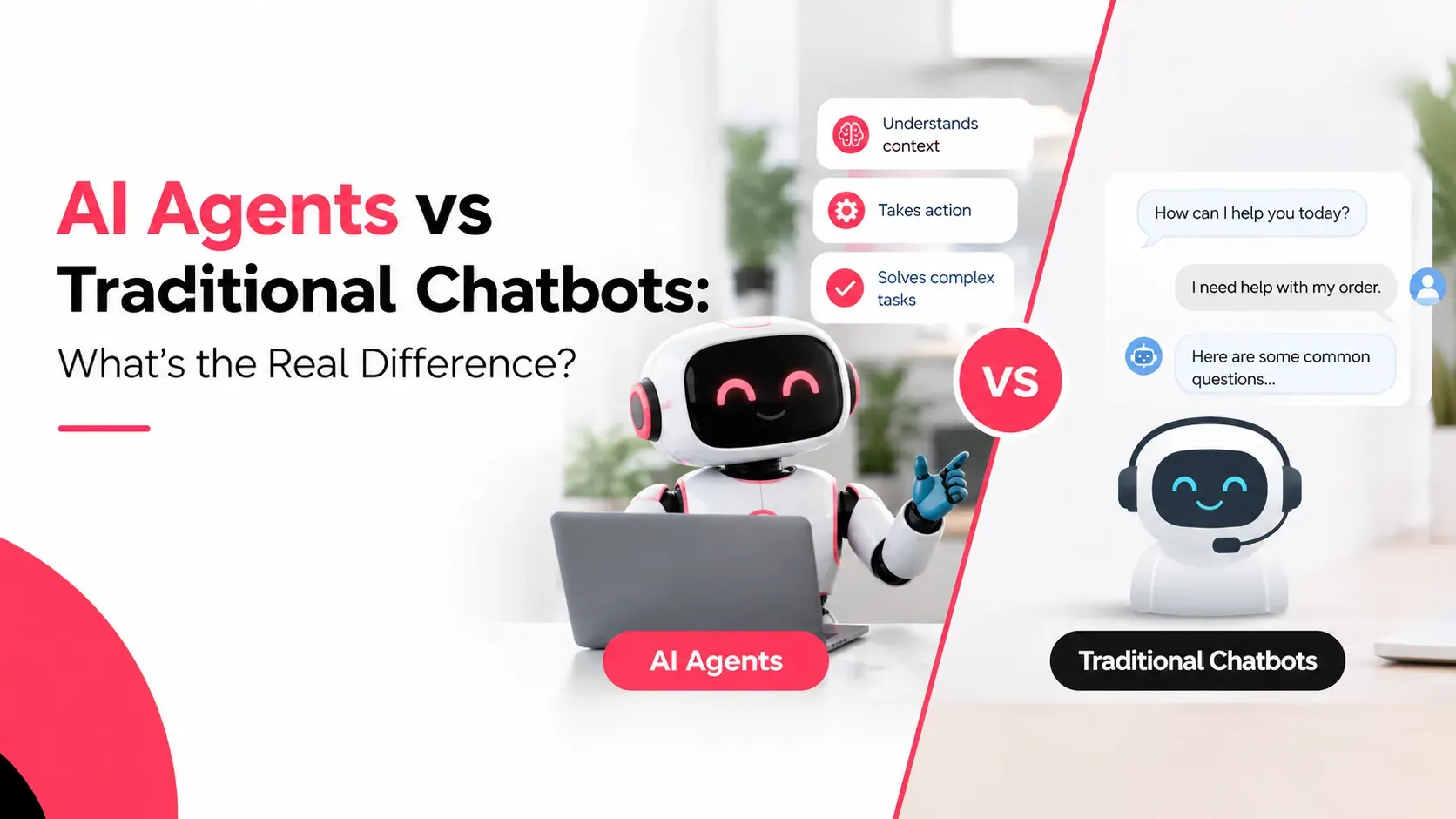
You've probably had this exact conversation with a vendor. They pitch you an "AI agent," you ask how it's different from the chatbot you already have, and the answer you get back is mostly buzzwords.
You're right to ask. "AI agent" has become one of those terms that gets slapped on anything with a chat window, which makes it genuinely hard to know if you're looking at real technology or a rebrand.
There is a real difference, and once you see it clearly, deciding which one your business actually needs gets a lot easier.
Quick Answer
A traditional chatbot follows pre-written scripts and answers questions from a fixed set of options. An AI agent understands natural language, makes decisions, and can complete multi-step tasks across different systems on its own. Chatbots are best for simple, repetitive queries, while AI agents suit businesses that need something to actually get work done, not just answer questions.
Key Takeaways
- Chatbots follow scripts; AI agents reason through problems and decide what to do next.
- AI agents can connect to multiple business systems and complete tasks, not just hold a conversation.
- Traditional chatbots are still the right, cost-effective choice for simple FAQ-style support.
- AI agents cost more upfront but can handle work that would otherwise need a human, or several tools stitched together.
- The right choice depends on how complex your customer or internal workflows actually are, not on which term sounds more advanced.
What Is a Traditional Chatbot?
A traditional chatbot is a program built to respond to specific inputs with pre-written outputs. Most work off a decision tree: you click a button or type a keyword, and the chatbot matches it to a scripted answer.
Some are rule-based, only recognizing exact phrases. Others use basic natural language processing to understand a bit more variation, but they still operate within a fixed set of possible responses. Step outside that script, and the chatbot either loops back to the same answer or hands you off to a human. If your business currently relies on this kind of setup, it's worth understanding what custom AI chatbot development looks like before assuming an upgrade means starting from scratch.
What Is an AI Agent?
An AI agent is a system that can understand a goal, reason through the steps needed to achieve it, and take action, often across multiple tools or systems, with limited human supervision.
Unlike a chatbot, an AI agent doesn't just answer a question. It can look something up, make a decision based on what it finds, and then act on that decision, whether that's updating a record, sending a follow-up, or triggering the next step in a workflow.
AI Agents vs Chatbots: What's the Real Difference?
The real difference comes down to autonomy. A chatbot responds within a script, while an AI agent reasons through a goal, decides what steps are needed, and takes action across systems on its own, without needing every possible scenario pre-programmed in advance.
Decision-Making Ability
Chatbots don't make decisions. They match input to output. AI agents evaluate a situation and choose the next step based on context, not a pre-set rule.
Task Complexity
A chatbot can answer "What are your business hours?" An AI agent can handle "Check if this customer's order qualifies for a refund, process it, and send a confirmation email," a task with multiple steps and conditions.
Integration with Other Business Systems
Chatbots typically live inside one interface, like a website widget. AI agents are usually built to connect across your CRM, inventory system, calendar, or internal databases, so they can act on real, current information.
Learning and Adaptability
A chatbot's responses stay fixed until someone manually updates the script. AI agents, built on large language models, can handle a wider range of phrasing and unexpected questions without needing every variation programmed in.
What Can AI Agents Actually Do That Chatbots Can't?
- Look up live order, inventory, or booking information and act on it, not just describe it.
- Complete multi-step processes, like qualifying a lead and scheduling a follow-up call automatically.
- Work across several business tools at once instead of staying siloed in one chat window.
- Handle genuinely open-ended requests instead of only pre-anticipated ones.
If you're already using AI in your marketing, this shift will feel familiar. Many UAE businesses have started experimenting with broader AI chatbot marketing strategies for lead generation, and AI agents are essentially the next step up from that same idea, capable of acting rather than just responding.
As IBM describes it, an AI agent autonomously performs tasks by designing workflows with available tools, going well beyond simply generating a response to a question.
When a Traditional Chatbot Is Still the Right Choice
AI agents aren't automatically the better option. For a lot of businesses, a well-built chatbot does exactly what's needed.
- Your customer questions are genuinely repetitive (hours, location, pricing, return policy).
- You don't need the chatbot to take action, only to inform.
- Your budget or timeline doesn't support a more complex build right now.
- You want something simple to maintain without ongoing technical oversight.
If this sounds like your business, it's worth reading through what makes AI chatbots genuinely useful for UAE businesses before assuming you need to jump straight to an agent-based system.
When an AI Agent Makes Sense for Your Business
An AI agent starts to make sense once your business needs something done, not just something answered.
- You want to automate multi-step processes like lead qualification, order processing, or appointment scheduling.
- Your team spends real time on repetitive tasks that involve checking information and then acting on it.
- You need the assistant to pull from and act across multiple systems, not just answer from a script.
- You're scaling and can't keep hiring to handle repetitive operational work.
As Google Cloud puts it, AI agents are software systems that use AI to pursue goals and complete tasks on behalf of users, which is precisely the capability worth paying for once your needs go beyond simple Q&A. If that matches where your business is headed, AI agent development for Dubai businesses is the kind of project worth scoping properly from the start, rather than bolting agentic features onto an old chatbot.
Cost Comparison: AI Agents vs Chatbots in Dubai
A basic rule-based chatbot in the UAE can cost relatively little to set up, sometimes just a few hundred dollars for a simple FAQ widget. AI agents cost significantly more, since they require integration with your existing systems, careful workflow design, and ongoing monitoring. The right way to think about it isn't which is cheaper, but which one actually saves you money by replacing manual work your team is doing right now.
Frequently Asked Questions
What is the difference between an AI agent and a chatbot?
A chatbot follows pre-written scripts and answers from a fixed set of responses. An AI agent understands natural language, reasons through a goal, and can take multi-step actions across different systems on its own.
Are AI agents more advanced than chatbots?
Yes, in terms of capability. AI agents can make decisions and complete tasks, while chatbots are limited to matching questions with pre-set answers. That said, "more advanced" doesn't always mean "necessary" for every business.
Can AI agents replace human customer service reps?
They can handle a significant share of repetitive and process-driven work, but most businesses still keep humans available for complex, sensitive, or high-stakes conversations that benefit from a personal touch.
Do small businesses need AI agents, or is a chatbot enough?
Many small businesses do fine with a well-built chatbot, especially if customer questions are simple and repetitive. AI agents make more sense once you need something to actually complete tasks, not just answer questions.
How much does an AI agent cost compared to a chatbot?
AI agents typically cost more than a basic chatbot because they require deeper integration with your business systems and more complex setup. The actual value depends on how much manual work the agent replaces.
Final Thoughts
Neither option is inherently better. A chatbot that answers common questions well is often exactly right for a small business, while an AI agent earns its cost once your operations genuinely need something to think through a problem and act on it.
The real question is what your business actually needs done, not which term sounds more impressive in a sales pitch. Working through that distinction properly is exactly the kind of groundwork Milaaj Brandset helps UAE businesses get right before they invest in either.
Once you know which problem you're actually solving, the choice between the two becomes a lot less confusing.
Ready to Elevate Your Brand?
Start Your Project Today