July 7, 2026
AI-Powered Marketing Automation for UAE Companies: A Complete Guide to Smarter Business Growth
Milaaj Editorial / Research Insights
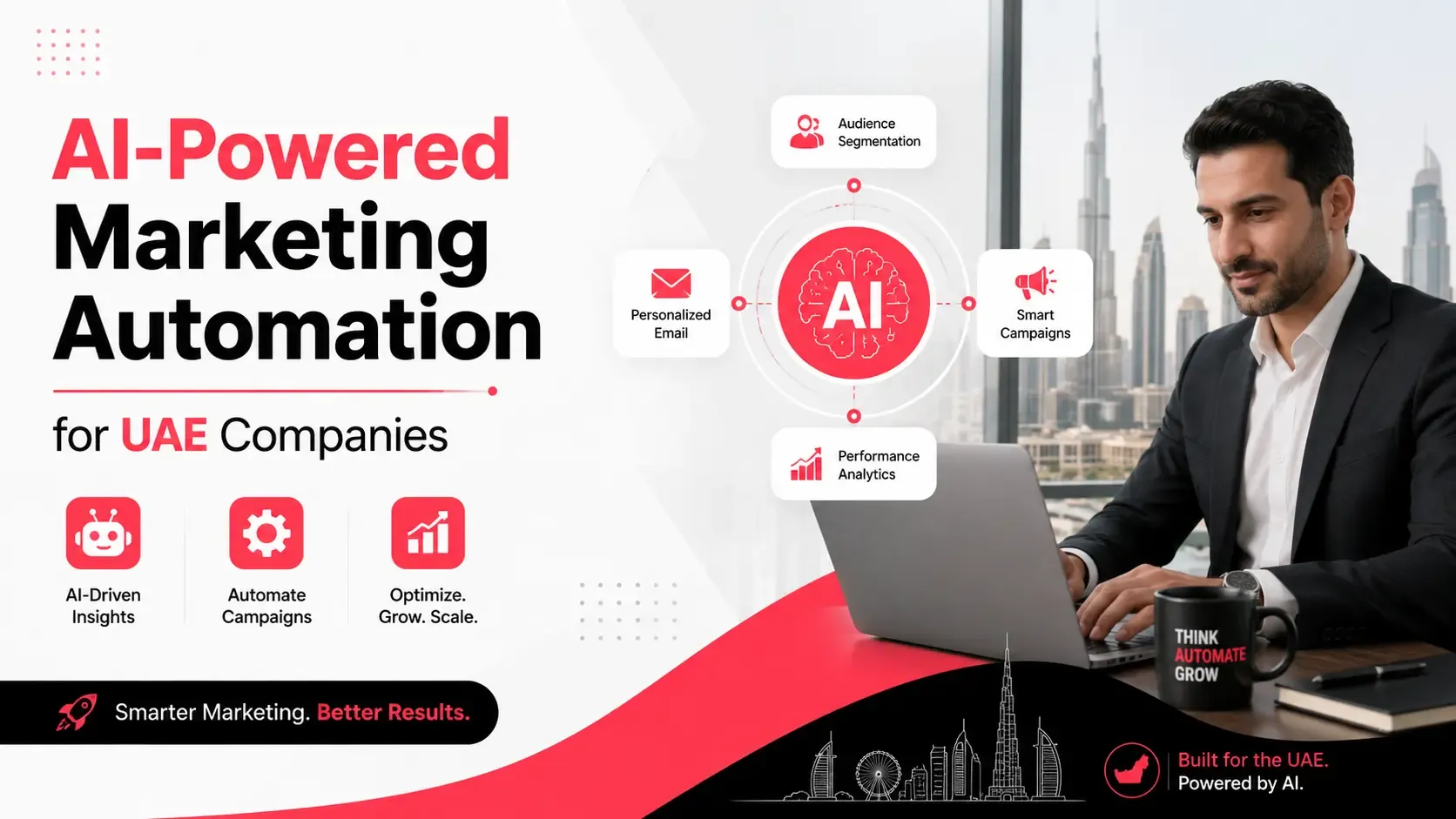
Marketing automation has been transforming businesses for years, but artificial intelligence has taken it to an entirely new level. Instead of simply automating repetitive tasks, AI can analyze customer behavior, predict buying intent, personalize communication, optimize campaigns, and help businesses make smarter marketing decisions in real time.
For companies across the UAE, where competition continues to grow across industries such as real estate, healthcare, ecommerce, education, hospitality, and professional services, AI-powered marketing automation offers a practical way to improve efficiency while delivering better customer experiences.
However, implementing AI successfully requires more than subscribing to an automation platform. Businesses need a strategy that combines quality data, well-designed customer journeys, meaningful personalization, and continuous optimization.
This guide explains how AI-powered marketing automation works, its benefits for UAE businesses, and the strategies that can help generate more leads, improve customer engagement, and increase marketing ROI.
Quick Answer
AI-powered marketing automation uses artificial intelligence to automate marketing tasks while making data-driven decisions based on customer behavior.
Businesses can use AI to:
- Capture and qualify leads
- Personalize email campaigns
- Automate customer journeys
- Improve lead scoring
- Optimize ad campaigns
- Power AI chatbots
- Predict customer behavior
- Improve conversion rates
- Save time through workflow automation
When implemented strategically, AI helps marketing teams focus more on growth and less on repetitive manual tasks.
Why AI Marketing Automation Matters in 2026
Modern customers expect fast responses, personalized experiences, and relevant communication across multiple channels.
Managing these expectations manually becomes increasingly difficult as businesses grow.
AI helps solve this challenge by processing large amounts of customer data and making intelligent decisions that improve marketing performance.
Key advantages include:
- Faster campaign execution
- Better customer experiences
- Higher marketing efficiency
- Improved lead quality
- More accurate decision-making
- Increased revenue opportunities
Rather than replacing marketers, AI enables teams to work more effectively.
What Is AI-Powered Marketing Automation?
Traditional marketing automation follows predefined rules.
For example:
AI automation goes much further.
It can analyze customer behavior and automatically decide:
- Which email should be sent
- When it should be delivered
- Which products to recommend
- Which leads deserve immediate follow-up
- Which prospects are likely to convert
- Which campaigns require optimization
Instead of relying entirely on fixed workflows, AI continuously improves marketing decisions using new customer data.
How AI Is Changing Digital Marketing
Artificial intelligence now supports nearly every stage of the customer journey.
It helps businesses:
- Understand customer preferences
- Predict future actions
- Personalize experiences
- Automate repetitive tasks
- Improve campaign performance
- Analyze marketing data faster
Rather than replacing existing marketing strategies, AI enhances them by making automation smarter and more responsive.
Benefits of AI Marketing Automation for UAE Businesses
Businesses across different industries can benefit from AI-powered automation.
Some of the biggest advantages include:
Better Lead Quality
AI identifies visitors who are more likely to become customers.
Instead of treating every lead equally, marketing teams can prioritize prospects with the highest conversion potential.
Improved Customer Personalization
Customers are more likely to engage with businesses that deliver relevant content.
AI can personalize:
- Email campaigns
- Product recommendations
- Website content
- Promotional offers
- Customer journeys
Personalized experiences often result in stronger engagement and higher conversion rates.
Higher Marketing Efficiency
Many repetitive tasks can be automated, including:
- Email scheduling
- Lead assignment
- CRM updates
- Customer segmentation
- Campaign reporting
This allows marketing teams to spend more time on strategy and creative work.
Better Decision-Making
AI analyzes marketing performance much faster than manual reporting.
Businesses gain insights into:
- Customer behavior
- Campaign performance
- Conversion trends
- Sales opportunities
- Audience engagement
These insights support faster and more informed business decisions.
Strategy 1: Automate Lead Capture
Lead generation is often the first stage of marketing automation.
Instead of manually collecting enquiries from different sources, AI automatically captures leads from:
- Landing pages
- Website forms
- Live chat
- Social media campaigns
- WhatsApp
- Online advertisements
The collected data is then organized within the CRM for further nurturing.
Businesses that invest in conversion-focused website development often generate higher-quality leads because their landing pages are designed to encourage enquiries while integrating seamlessly with marketing automation platforms.
Strategy 2: Use AI Lead Scoring
Not every lead has the same value.
AI evaluates prospects using factors such as:
- Website visits
- Pages viewed
- Time on site
- Email engagement
- Previous enquiries
- Purchase history
Each lead receives a score based on its likelihood of converting.
Sales teams can then focus their efforts on high-priority opportunities.
Strategy 3: Personalize Email Marketing
Generic email campaigns continue to lose effectiveness.
AI enables businesses to personalize campaigns by considering:
- Customer interests
- Purchase history
- Browsing behavior
- Geographic location
- Previous engagement
- Preferred communication times
Personalized email campaigns generally achieve stronger open rates and click-through rates than one-size-fits-all messaging.
Strategy 4: Build Automated Customer Journeys
Customer journeys should adapt to user behavior rather than follow identical paths.
For example:
Customer Action | Automated Response |
|---|---|
Downloads a guide | Educational email sequence |
Requests a quotation | Sales consultation workflow |
Abandons a cart | Reminder email with product recommendations |
Completes a purchase | Onboarding and follow-up emails |
Stops engaging | Re-engagement campaign |
AI helps determine which next step is most relevant for each customer.
Strategy 5: Integrate CRM with Marketing Automation
One of the biggest advantages of AI is connecting customer data across multiple systems.
A CRM integration allows businesses to:
- Track customer interactions
- Monitor sales pipelines
- Record purchase history
- Automate follow-ups
- Synchronize marketing campaigns
For businesses planning CRM automation, our CRM & Marketing Funnel Integration Guide explains how integrating customer data creates more effective lead nurturing and sales workflows.
Strategy 6: Automate Customer Segmentation
Instead of manually grouping customers, AI creates audience segments based on shared characteristics.
Examples include:
- New visitors
- Returning customers
- High-value buyers
- Cart abandoners
- Frequent purchasers
- Inactive subscribers
Dynamic segmentation ensures customers receive content that matches their interests and stage in the buying journey.
Strategy 7: Deploy AI Chatbots
Modern AI chatbots do far more than answer basic questions.
They can:
- Qualify leads
- Schedule appointments
- Recommend products
- Answer FAQs
- Route conversations
- Collect customer information
Businesses using AI chatbots can provide faster responses while reducing the workload on support teams.
When combined with strategic digital marketing solutions, AI chatbots become an effective channel for capturing and nurturing leads around the clock.
Strategy 8: Use Predictive Analytics
Predictive analytics helps businesses anticipate future customer behavior using historical data.
AI can estimate:
- Purchase probability
- Customer lifetime value
- Churn risk
- Product demand
- Campaign performance
Rather than reacting after events occur, businesses can make proactive marketing decisions.
Strategy 9: Automate Social Media Campaigns
AI-powered automation can simplify social media management by:
- Scheduling posts
- Identifying optimal publishing times
- Recommending content
- Monitoring engagement
- Analyzing campaign performance
Automation reduces repetitive work while helping maintain a consistent online presence.
Strategy 10: Improve Campaign Performance with AI
AI continuously evaluates campaign performance and identifies opportunities for improvement.
It can recommend adjustments such as:
- Audience targeting
- Budget allocation
- Email subject lines
- Content variations
- Ad creatives
- Publishing schedules
Rather than relying solely on manual analysis, marketers receive data-driven recommendations that support better decision-making.
Strategy 11: Automate Multi-Channel Marketing
Modern customers interact with businesses through multiple channels before making a purchase. AI helps keep these interactions consistent by coordinating campaigns across platforms.
Common channels include:
- Email
- SMS
- WhatsApp
- Social media
- Website notifications
- Mobile apps
Instead of managing each channel separately, AI ensures customers receive relevant messages based on their behavior, regardless of where they engage.
Strategy 12: Optimize Paid Advertising with AI
AI has become an essential part of paid advertising platforms.
It can automatically:
- Adjust bidding strategies
- Identify high-performing audiences
- Optimize ad placements
- Recommend budget allocation
- Test multiple ad variations
Businesses running paid campaigns often achieve better results when AI insights are combined with performance-driven digital marketing strategies that align advertising with broader business objectives.
Strategy 13: Personalize Website Experiences
AI can customize website content for different visitors without requiring multiple versions of a page.
Examples include:
- Personalized product recommendations
- Dynamic homepage banners
- Industry-specific messaging
- Location-based offers
- Recently viewed products
- Recommended blog articles
These personalized experiences improve engagement and encourage visitors to take action.
Strategy 14: Automate Customer Retention Campaigns
Acquiring a new customer usually costs more than retaining an existing one.
AI helps businesses improve retention by automatically identifying customers who may be losing interest.
Typical retention workflows include:
- Renewal reminders
- Loyalty rewards
- Win-back campaigns
- Personalized offers
- Customer satisfaction surveys
- Product recommendations
These automated interactions help strengthen long-term customer relationships.
Strategy 15: Use AI for Marketing Analytics
Marketing generates large amounts of data, but interpreting it manually can be time-consuming.
AI simplifies reporting by identifying trends such as:
- Highest-converting campaigns
- Best-performing traffic sources
- Customer acquisition trends
- Revenue attribution
- Audience engagement
- Campaign ROI
This allows marketing teams to make faster, data-driven decisions.
Popular AI Marketing Automation Platforms
Different platforms serve different business needs.
Platform | Best For | Ideal Business Type |
|---|---|---|
HubSpot | CRM and inbound marketing | SMBs & growing businesses |
ActiveCampaign | Email automation | Ecommerce & service businesses |
Salesforce Marketing Cloud | Enterprise automation | Large organizations |
Klaviyo | Ecommerce marketing | Online stores |
Zoho CRM | Sales and marketing automation | SMEs |
Brevo | Email and SMS campaigns | Small businesses |
Make | Workflow automation | Businesses connecting multiple apps |
Zapier | No-code automation | Companies of all sizes |
n8n | Custom automation workflows | Technical teams and developers |
Choose a platform based on your business goals, existing software, and future scalability.
Common Mistakes to Avoid
Many automation projects underperform because businesses automate inefficient processes instead of improving them first.
Avoid these common mistakes:
- Automating poor-quality customer journeys
- Using inaccurate or outdated customer data
- Sending excessive automated messages
- Ignoring customer privacy regulations
- Failing to personalize campaigns
- Overlooking CRM integration
- Relying entirely on AI without human review
- Measuring activity instead of business outcomes
Successful automation balances efficiency with meaningful customer experiences.
KPIs to Measure Success
Track performance using metrics that reflect real business growth.
KPI | Why It Matters |
|---|---|
Lead Conversion Rate | Measures lead quality |
Customer Acquisition Cost | Evaluates marketing efficiency |
Email Open Rate | Indicates campaign relevance |
Click-Through Rate | Measures engagement |
Sales Qualified Leads | Tracks lead quality |
Customer Retention Rate | Evaluates long-term relationships |
Marketing ROI | Connects campaigns to revenue |
Customer Lifetime Value | Measures long-term profitability |
Review these metrics regularly to identify opportunities for further optimization.
AI Marketing Automation Implementation Roadmap
Businesses adopting AI can follow a structured rollout rather than trying to automate everything at once.
Phase | Objective | Key Actions |
|---|---|---|
Assessment | Identify opportunities | Audit marketing workflows and customer data |
Foundation | Build the system | Integrate CRM, website, and marketing platforms |
Automation | Launch workflows | Automate lead capture, email nurturing, and segmentation |
Optimization | Improve performance | Use AI insights to refine campaigns and customer journeys |
Growth | Scale automation | Expand automation across channels while monitoring KPIs |
A phased approach minimizes disruption while delivering measurable improvements over time.
Key Takeaways
- AI marketing automation improves efficiency without replacing human strategy.
- Automated lead capture and lead scoring help sales teams focus on high-value prospects.
- Personalized customer journeys increase engagement and conversions.
- CRM integration creates a unified view of customer interactions.
- AI-powered analytics support faster and better decision-making.
- Multi-channel automation delivers consistent customer experiences.
- Success depends on high-quality data, clear workflows, and continuous optimization.
Building Smarter Marketing Systems with AI
AI-powered marketing automation is no longer reserved for large enterprises. Businesses of every size can use intelligent automation to streamline repetitive tasks, improve customer experiences, and make better marketing decisions using real-time data.
The greatest results come from combining automation with a clear marketing strategy, reliable customer data, and ongoing optimization. Rather than replacing human expertise, AI enables teams to work more efficiently while focusing on creativity, strategy, and relationship building.
Businesses looking to implement automation effectively should first establish strong marketing foundations. Our Marketing Automation for Business Growth guide explains how to build scalable automation workflows before introducing AI capabilities.
Milaaj Brandset helps businesses implement AI-ready digital marketing strategies, intelligent automation, CRM integration, SEO, content marketing, and high-performing websites that support sustainable business growth.
FAQs
What is AI-powered marketing automation?
AI-powered marketing automation combines artificial intelligence with automation software to personalize campaigns, qualify leads, analyze customer behavior, and automate marketing tasks more intelligently than rule-based systems.
Is AI marketing automation suitable for small businesses?
Yes. Many affordable platforms offer AI-powered features that help small businesses automate email marketing, customer segmentation, lead nurturing, and campaign reporting.
How does AI improve lead generation?
AI identifies high-quality prospects, scores leads based on behavior, automates follow-ups, and personalizes communication to improve conversion rates.
Can AI replace marketing teams?
No. AI supports marketers by automating repetitive tasks and providing insights, but strategic planning, creativity, and relationship building still require human expertise.
Which industries benefit most from AI marketing automation?
Industries such as ecommerce, real estate, healthcare, education, hospitality, financial services, and professional services can all benefit from AI-powered automation.
How do I choose the right marketing automation platform?
Consider your business size, marketing objectives, CRM requirements, available budget, ease of integration, reporting capabilities, and scalability before selecting a platform.
What should businesses automate first?
Start with high-impact processes such as lead capture, email nurturing, customer segmentation, CRM updates, and follow-up workflows before expanding automation to more advanced marketing activities.
Ready to Elevate Your Brand?
Start Your Project Today