June 25, 2026
CRM & Marketing Funnel Integration Guide: How to Convert More Leads Into Customers
Milaaj Editorial / Research Insights
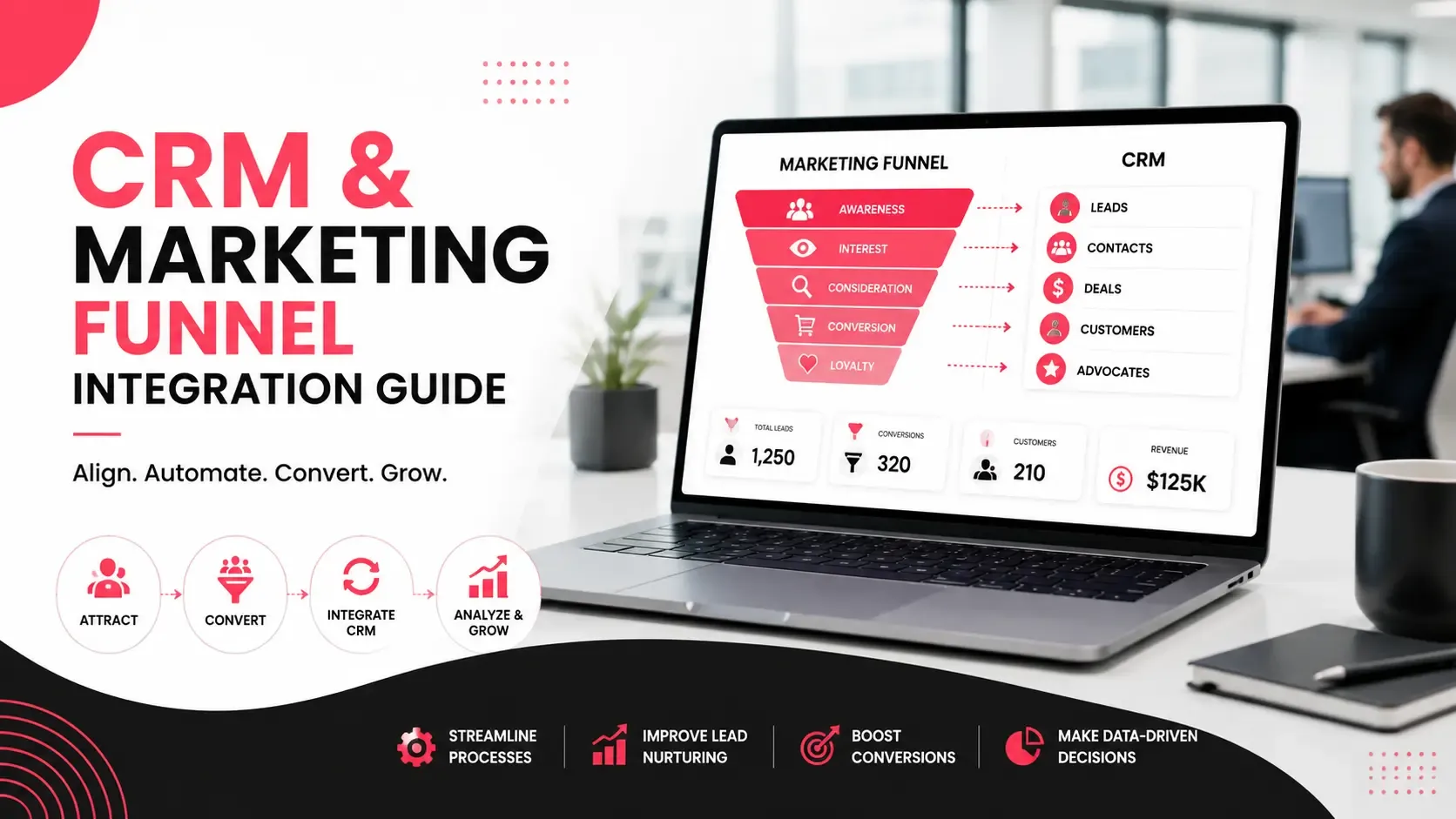
Many businesses invest in lead generation, advertising, SEO, content marketing, and social media campaigns but still struggle to convert leads into paying customers.
The problem is often not a lack of leads.
The problem is a disconnect between marketing activities and sales processes.
When marketing funnels and CRM systems operate independently, businesses frequently experience lost leads, delayed follow-ups, poor customer experiences, inaccurate reporting, and missed revenue opportunities.
Integrating your CRM with your marketing funnel creates a connected system where leads are tracked, nurtured, scored, and managed throughout the customer journey.
This guide explains how CRM and marketing funnel integration works, why it matters, and how businesses can use it to improve lead conversion rates, sales efficiency, and long-term growth.
Quick Answer
CRM and marketing funnel integration connects lead generation activities with customer relationship management systems.
This integration helps businesses:
- Capture leads automatically
- Track customer interactions
- Improve lead nurturing
- Automate follow-ups
- Increase conversion rates
- Improve sales efficiency
- Generate better reporting insights
- Reduce lead leakage
Businesses that align their CRM and marketing funnels typically achieve stronger lead management and better sales performance.
What Is CRM and Marketing Funnel Integration?
CRM integration connects customer relationship management software with marketing channels and sales processes.
Instead of managing leads manually, businesses create a centralized system where prospect data flows automatically through each stage of the customer journey.
Typical integrations include:
- Website forms
- Landing pages
- Email marketing systems
- Lead generation campaigns
- Social media advertising
- Marketing automation platforms
- Sales pipelines
This allows businesses to maintain visibility across every customer interaction.
Understanding the Modern Marketing Funnel
Before discussing integration, it is important to understand the funnel itself.
A marketing funnel represents the journey prospects take before becoming customers.
Awareness Stage
Potential customers discover your business through:
- SEO
- Social media
- Google Ads
- Content marketing
- Referrals
Consideration Stage
Prospects evaluate solutions and compare options.
They may:
- Read case studies
- Download resources
- Attend webinars
- Request information
Decision Stage
Prospects become sales opportunities.
They may:
- Request consultations
- Book demonstrations
- Request proposals
- Contact sales teams
The CRM acts as the central system that tracks and manages prospects throughout these stages.
Why CRM and Funnel Integration Matters
Without integration, businesses often encounter:
- Duplicate data
- Manual processes
- Inconsistent follow-ups
- Poor lead visibility
- Lost opportunities
An integrated system helps create a smoother experience for both customers and internal teams.
Benefits include:
- Faster response times
- Better lead qualification
- Improved customer experiences
- Stronger sales alignment
- More accurate reporting
The result is a more efficient revenue generation process.
How Lead Capture Becomes Automated
One of the biggest advantages of CRM integration is automatic lead capture.
When a visitor completes a:
- Contact form
- Consultation request
- Demo request
- Lead magnet download
their information can automatically enter the CRM.
This eliminates:
- Manual data entry
- Delayed follow-ups
- Missing records
Automation ensures every lead enters the system immediately.
Businesses focused on creating scalable acquisition systems can also explore Lead Generation services in Dubai to improve lead quality and conversion performance.
Lead Tracking Across the Customer Journey
Modern buyers interact with businesses through multiple touchpoints before making a decision.
An integrated CRM helps track:
- Website visits
- Email engagement
- Content downloads
- Advertising interactions
- Sales conversations
- Consultation requests
This provides valuable context for sales teams.
Instead of contacting a lead blindly, teams can understand how prospects have engaged with the business.
Improving Lead Qualification With Lead Scoring
Not every lead is equally valuable.
CRM and funnel integration allows businesses to implement lead scoring models.
Points may be assigned based on:
Prospect Action | Lead Score |
|---|---|
Website Visit | Low |
Resource Download | Medium |
Webinar Registration | High |
Consultation Request | Very High |
Lead scoring helps sales teams prioritize opportunities with the highest likelihood of conversion.
This improves efficiency and reduces wasted effort.
Marketing Automation and CRM Integration
CRM systems become significantly more powerful when combined with marketing automation.
Automation can trigger actions based on customer behavior.
Examples include:
New Lead Sequence
- Lead enters CRM
- Welcome email is sent
- Educational content is delivered
- Follow-up reminders are scheduled
Sales Opportunity Workflow
- Lead reaches scoring threshold
- Sales team receives notification
- Consultation invitation is triggered
Customer Onboarding Workflow
- Purchase completed
- Welcome sequence begins
- Educational resources are delivered
Automation ensures consistency while reducing manual work.
Businesses interested in intelligent workflow automation can also explore AI Automation Services in Dubai to streamline customer journeys and operational processes.
Improving Sales and Marketing Alignment
One of the most common challenges within growing businesses is misalignment between marketing and sales teams.
Marketing focuses on generating leads.
Sales focuses on closing deals.
Without shared systems, both teams often operate using different data.
CRM integration helps create:
- Shared visibility
- Unified reporting
- Clear lead ownership
- Consistent communication
This alignment improves accountability and performance.
Better Customer Experiences Through Personalization
Modern customers expect personalized experiences.
CRM integration helps businesses deliver more relevant communications based on:
- Previous interactions
- Interests
- Industry
- Purchase history
- Funnel stage
Personalized experiences often result in:
- Higher engagement
- Better conversion rates
- Improved customer satisfaction
Relevance is becoming increasingly important in competitive markets.
Reporting and Revenue Attribution
Many businesses struggle to determine which marketing efforts generate revenue.
Integrated CRM systems provide visibility into:
- Lead sources
- Conversion paths
- Sales outcomes
- Revenue attribution
This helps businesses answer critical questions such as:
- Which campaigns generate the best leads?
- Which channels produce customers?
- Which marketing activities deliver the highest ROI?
Better reporting leads to smarter investment decisions.
Common CRM Funnel Integration Mistakes
Many businesses fail to maximize results because they:
- Use incomplete customer data
- Ignore lead scoring
- Automate poor processes
- Fail to train teams
- Neglect reporting
- Create overly complex workflows
Technology alone cannot solve operational problems.
Success depends on strategy, implementation, and ongoing optimization.
Signs Your Business Needs CRM Integration
You may benefit from CRM and funnel integration if:
- Leads are frequently lost
- Follow-ups are inconsistent
- Reporting is unclear
- Sales cycles are lengthy
- Teams use disconnected systems
- Customer data is scattered
These issues often become more costly as businesses scale.
The Role of AI in CRM and Funnel Management
Artificial intelligence is transforming CRM systems.
Modern AI capabilities include:
- Predictive lead scoring
- Customer behavior analysis
- Automated recommendations
- Smart segmentation
- Sales forecasting
- Personalized customer journeys
AI-powered CRM platforms help businesses make faster and more informed decisions while improving customer experiences.
Key Takeaways
- CRM and marketing funnel integration improves lead management.
- Automated lead capture reduces missed opportunities.
- Lead scoring helps prioritize high-intent prospects.
- Marketing automation enhances efficiency.
- Sales and marketing alignment improves performance.
- Personalization increases engagement and conversions.
- Revenue attribution provides valuable business insights.
- AI is making CRM systems more intelligent and effective.
- Integration creates a scalable foundation for growth.
Creating a Connected Revenue Growth System
Successful businesses do not treat marketing, sales, and customer management as separate functions.
They create connected systems that guide prospects from initial awareness to long-term customer relationships.
CRM and marketing funnel integration provides the structure needed to track leads, automate processes, improve communication, and optimize every stage of the customer journey. Businesses that invest in integration often experience stronger conversion rates, better operational efficiency, and more predictable growth.
For a deeper understanding of automation-driven growth strategies, read our Marketing Automation for Business Growth guide.
Milaaj Brandset helps businesses build integrated digital ecosystems that connect lead generation, automation, CRM management, and customer experience optimization to support sustainable growth.
FAQs
What is CRM and marketing funnel integration?
CRM and marketing funnel integration connects lead generation activities with customer management systems to improve tracking, nurturing, and conversions.
Why is CRM integration important?
It improves visibility, automates processes, reduces lead leakage, and helps businesses manage customer relationships more effectively.
What are the benefits of lead scoring?
Lead scoring helps businesses identify high-intent prospects and prioritize sales efforts more efficiently.
Can CRM integration improve conversion rates?
Yes. Better lead management, personalization, and automation often lead to higher conversion rates.
How does marketing automation work with CRM systems?
Marketing automation triggers actions such as emails, follow-ups, and notifications based on customer behavior and funnel activity.
Which businesses benefit most from CRM integration?
Any business generating leads through websites, advertising, SEO, content marketing, or outbound sales can benefit from CRM integration.
How does CRM integration improve reporting?
It provides visibility into lead sources, customer journeys, conversion paths, and revenue attribution.
What role does AI play in CRM systems?
AI helps automate lead scoring, forecasting, segmentation, personalization, and customer journey optimization.
Ready to Elevate Your Brand?
Start Your Project Today