September 15, 2026
AWS vs Traditional Hosting: Which Should Your UAE Business Choose?
Milaaj Editorial / Research Insights
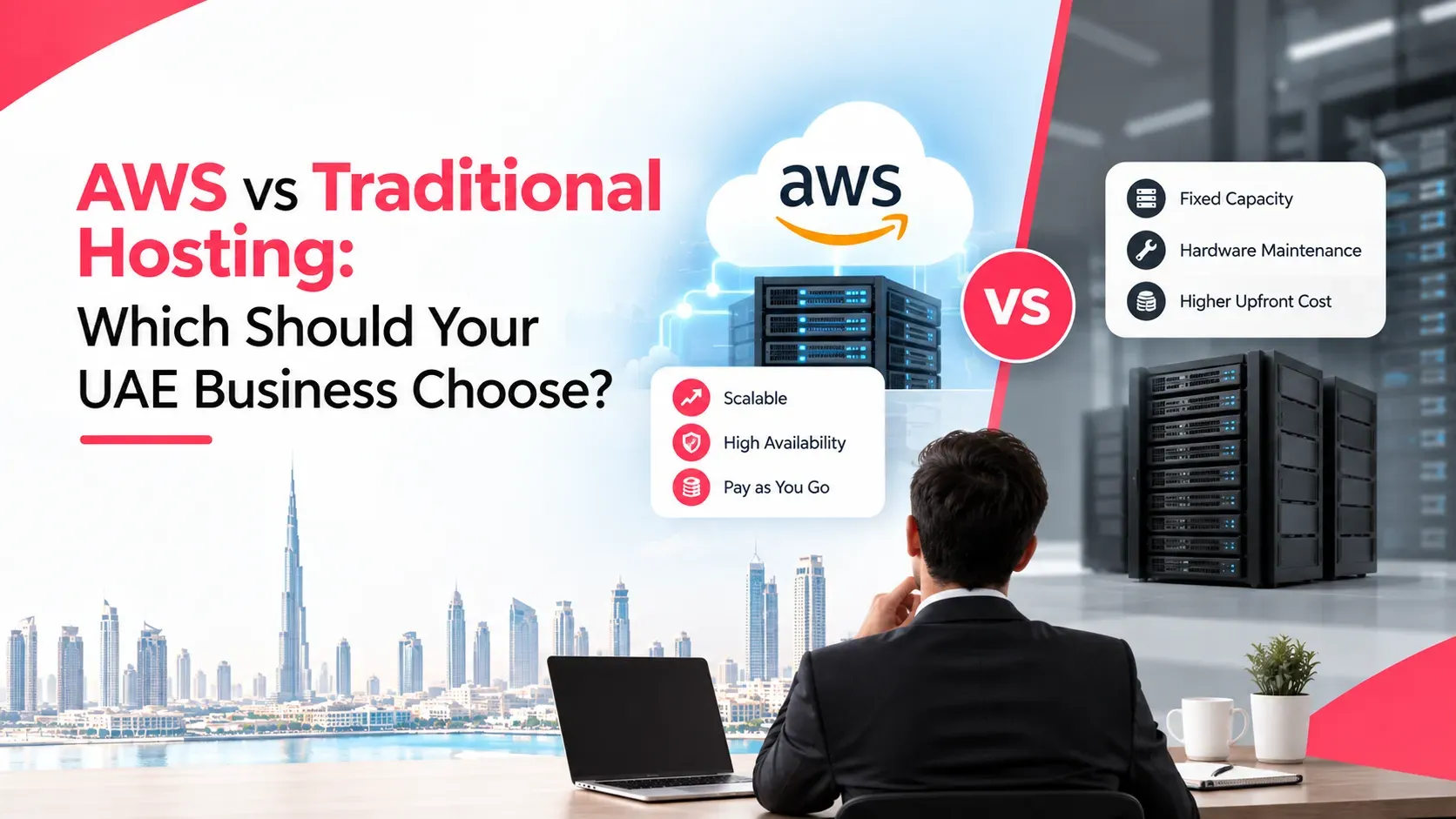
If your website slows to a crawl every time a Ramadan sale or a big campaign brings in extra visitors, you already know the feeling. Your host was fine for years, and now it's suddenly not.
That moment is when most UAE business owners start hearing the word "AWS" thrown around by developers, and start wondering if they need to rip out their hosting setup entirely.
You don't always need to. But you do need to understand what you're actually choosing between.
Quick Answer
Traditional hosting is a fixed server plan that's simple and affordable for small, steady-traffic sites. AWS is cloud hosting that scales resources up or down automatically, costs more to manage well, but handles growth, spikes, and complex applications far better. Most UAE businesses only need to make the switch once traffic, uptime demands, or app complexity outgrow a standard hosting plan.
Key Takeaways
- Traditional hosting is cheaper and simpler, but capped in how much traffic or load it can handle.
- AWS scales automatically and offers stronger uptime, but usually needs a developer or agency to manage it properly.
- Cost comparisons aren't apples to apples. AWS pricing is usage-based, so a quiet month costs less and a busy month costs more.
- Security responsibility shifts depending on your setup. AWS gives you more tools, but you (or your dev team) have to configure them correctly.
- The right choice depends on your traffic pattern, growth plans, and whether you have technical support in-house or through an agency.
What Is Traditional Hosting?
Traditional hosting means your website lives on a physical server, or a slice of one, that's set up in advance with a fixed amount of storage, bandwidth, and processing power.
Shared hosting, VPS (virtual private server) hosting, and dedicated servers all fall under this umbrella. You pay a flat monthly or annual fee, and your resources stay the same whether you get ten visitors a day or ten thousand.
This is the model most small business websites in the UAE were built on, and for a lot of them, it still works perfectly well.
What Is AWS Cloud Hosting?
Amazon Web Services (AWS) is a cloud computing platform. Instead of renting a fixed slice of one physical server, you rent computing power, storage, and services on demand, spread across a global network of data centers. This matches how AWS itself defines cloud computing: on-demand access to IT resources with pay-as-you-go pricing, instead of owning and maintaining the hardware yourself.
The key difference is elasticity. If your traffic spikes, AWS can automatically add more computing resources to keep your site running. When traffic drops, it scales back down, and your bill adjusts accordingly.
For businesses running more complex setups, like custom web applications, AI tools, or platforms that need to stay online no matter what, AWS also opens the door to services built specifically for that. If your business is heading in that direction, it's worth understanding what serverless architecture can do, since it removes the need to manage servers at all for certain workloads.
AWS vs Traditional Hosting: The Key Differences
Cost Structure
Traditional hosting is predictable. You pay a fixed amount, and you know exactly what's coming out of your account each month.
AWS uses pay-as-you-go pricing. You're billed for what you actually use, which can mean lower costs during quiet periods and higher costs during busy ones.
Scalability
This is where the two really diverge.
- Traditional hosting has a ceiling. Once you hit it, your site slows down or crashes until you manually upgrade your plan.
- AWS scales automatically, adding resources in real time as demand increases.
As IBM's overview of cloud computing puts it, organizations can allocate resources up or down quickly in response to changing business demand, which is exactly the flexibility a fixed traditional server can't offer.
Uptime and Reliability
AWS operates across multiple data centers and availability zones, so if one location has an issue, traffic can shift elsewhere without your site going down. Traditional hosting typically runs on a single server, which means a hardware failure can take your whole site offline until it's fixed.
Security and Compliance
Both models can be secure, but the responsibility looks different. Traditional hosting providers usually handle base-level server security for you. AWS gives you far more granular security controls, but you (or whoever manages your infrastructure) need to configure them correctly. Misconfigured cloud settings are one of the most common causes of data exposure, so this isn't a "set and forget" situation. If you haven't reviewed your site's overall security posture recently, it's worth running through basic website security best practices regardless of which hosting model you choose.
Maintenance and Technical Skill Required
Traditional hosting is largely managed for you, especially with shared or managed plans. AWS requires more hands-on setup and ongoing management, which usually means bringing in a developer or agency rather than handling it yourself through a simple control panel.
When Traditional Hosting Still Makes Sense
Traditional hosting isn't outdated. For a lot of UAE businesses, it's genuinely the smarter, simpler choice.
- Your website is informational or a small brochure site with steady, predictable traffic.
- You're not running complex applications, large e-commerce catalogs, or custom software.
- Budget predictability matters more to you than flexibility.
- You don't have a developer or agency on retainer to manage cloud infrastructure.
If your site also happens to load slowly, that's often a hosting-adjacent problem rather than a hosting-type problem. Before assuming you need AWS, it's worth ruling out simpler fixes first. A quick pass through a website speed optimization guide can sometimes solve the exact issue that made you start researching AWS in the first place.
When AWS Makes Sense for UAE Businesses
AWS starts to make sense once your traffic, complexity, or uptime requirements outgrow what a fixed server can reliably handle.
Common signals include:
- Your traffic is unpredictable or seasonal, with sharp spikes around campaigns, sales events, or holidays.
- You're running an e-commerce store, custom web app, or a platform with real-time features.
- Downtime directly costs you revenue or customer trust.
- You're planning to integrate AI tools, automation, or services that need serious backend processing power.
If any of that sounds like where your business is headed, it's usually worth having someone map out what your actual cloud services needs look like before you commit to a full migration, rather than guessing at the right AWS setup on your own.
What Does AWS Actually Cost in the UAE?
AWS pricing is usage-based, so costs vary by business. A small business site might run for $20 to $80 a month, while a higher-traffic e-commerce store or app could run several hundred dollars monthly. Setup and ongoing management, usually handled by a developer or agency, is typically a separate cost on top of AWS's own usage fees.
Switching from Traditional Hosting to AWS: What to Plan For
If you've decided AWS fits where your business is going, the switch itself needs some planning to avoid downtime or a messy migration.
- Audit your current site, including its database, media files, and any custom code.
- Choose the right AWS services for your needs (a basic EC2 setup looks very different from a fully managed application stack).
- Set up staging first and test thoroughly before pointing your domain to the new environment.
- Configure monitoring and backups from day one, not as an afterthought.
- Plan the DNS switch during low-traffic hours to minimize any disruption.
This is one of those changes that's genuinely easier with an experienced team behind it. If you'd rather not learn AWS configuration from scratch while also running your business, AWS cloud solutions for Dubai businesses is exactly the kind of migration and setup work worth outsourcing properly the first time.
Frequently Asked Questions
Is AWS more expensive than traditional hosting?
It depends on your traffic. For a small, low-traffic site, traditional hosting is usually cheaper. For a business with variable or growing traffic, AWS can actually work out more cost-effective because you're not paying for capacity you don't use most of the time.
Do small businesses in the UAE need AWS, or is regular hosting enough?
Most small businesses with steady, modest traffic do fine on traditional hosting. AWS becomes worth it once your traffic is unpredictable, your site handles complex functionality, or downtime has a real cost to your business.
What is the main difference between cloud hosting and traditional hosting?
Traditional hosting gives you a fixed amount of server resources. Cloud hosting like AWS scales those resources automatically based on real-time demand, and you pay based on what you actually use.
Can I switch from traditional hosting to AWS without downtime?
Yes, with proper planning. Setting up a staging environment, testing thoroughly, and timing the DNS switch during low-traffic hours all help avoid disruption during migration.
Is AWS hosting reliable for UAE-based websites?
Yes. AWS operates across multiple global data centers and availability zones, which gives it strong uptime. Latency for UAE visitors depends on which AWS region you deploy to, so choosing the right region matters for local site speed.
Final Thoughts
Neither option is universally "better." Traditional hosting is still the right call for plenty of steady, simple websites, and AWS is overkill until your business actually needs the flexibility it offers.
The real question isn't which one is more modern. It's which one matches where your business actually is right now, and where it's headed next. Getting that assessment right the first time is exactly the kind of problem Milaaj Brandset helps UAE businesses work through every day.
If you're still not sure which side of that line you're on, that's a completely normal place to be. Get an honest read on your traffic patterns and growth plans before you commit either way, and the right hosting setup usually becomes obvious.
Ready to Elevate Your Brand?
Start Your Project Today