August 11, 2026
Branding Mistakes Startups Should Avoid: 15 Common Errors
Milaaj Editorial / Research Insights
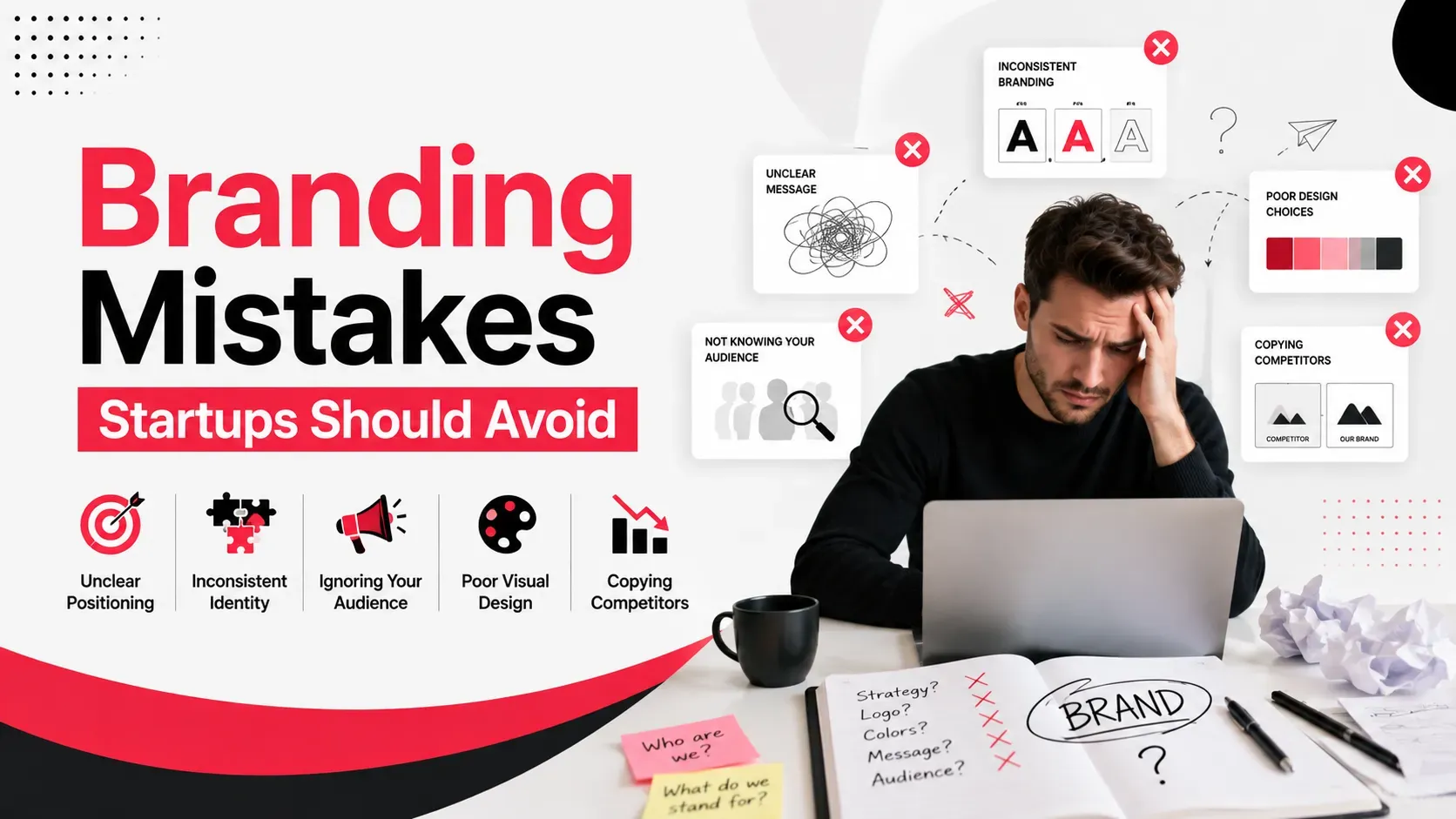
Branding mistakes can make it harder for startups to earn attention, build trust, and explain why customers should choose them. While early-stage companies often focus heavily on product development and customer acquisition, branding can get reduced to choosing a logo, colours, and a memorable name.
That approach misses the bigger picture.
A startup's brand influences how people understand its value, perceive its credibility, remember it, and decide whether to engage with it. A strong brand does not require a huge budget, but it does require clarity and consistency.
From unclear positioning to inconsistent messaging, here are the most common branding mistakes startups should avoid and what to do instead.
Quick Answer
The biggest branding mistakes startups make include trying to appeal to everyone, copying competitors, designing before defining their strategy, using generic messaging, constantly changing their identity, ignoring brand consistency, and focusing too much on visual trends.
A better approach is to first understand the target audience, define a clear position, establish a meaningful difference, create a recognizable identity, and then apply it consistently across every customer touchpoint.
Why Branding Matters for Startups
Established companies may already have recognition and customer familiarity working in their favour.
Startups usually don't.
A potential customer encountering a startup for the first time may have several unanswered questions:
- What does this company actually offer?
- Is it credible?
- Who is it for?
- Why should I choose it?
- What makes it different?
- Does it understand my problem?
Effective branding helps answer these questions quickly.
It gives the business a recognizable identity while making its value easier to understand. More importantly, good branding creates consistency between what a company promises and what customers experience.
1. Trying to Appeal to Everyone
One of the most common startup branding mistakes is attempting to make the brand relevant to everyone.
A message such as "innovative solutions for modern businesses" might sound broad and professional, but it doesn't tell a specific customer much.
A stronger position identifies a particular audience and problem.
For example, instead of saying:
a startup could position itself around a specific industry, company type, or customer challenge.
Specificity makes marketing easier because the brand has something concrete to say.
Better approach
Define:
- Who you serve
- What problem you solve
- What outcome you provide
- Why your approach is different
You can expand your audience later. Early clarity is usually more valuable than premature reach.
2. Designing the Logo Before Defining the Brand
A logo is an important visual asset, but it isn't the brand strategy.
Starting with the logo can lead founders to make visual decisions before answering fundamental questions about the business.
Before designing the identity, establish:
- Target audience
- Brand positioning
- Value proposition
- Personality
- Brand promise
- Competitive differentiation
- Communication style
Once these foundations are clear, the visual identity can reinforce them.
A modern technology startup, for instance, may require a very different visual language from a premium hospitality business, even if both want to appear "professional."
3. Copying Competitors Too Closely
Competitor research is useful, but imitation is not differentiation.
A startup may notice that competitors use similar colours, terminology, layouts, photography, or messaging and assume that copying those patterns will make the company look credible.
The problem is that the new brand can become difficult to distinguish.
Instead of asking:
"What does everyone else look like?"
ask:
"Where is there an opportunity to be more distinctive?"
Study competitors to understand the category, identify common patterns, and discover gaps.
Then build an identity that gives customers a reason to remember you.
4. Having an Unclear Value Proposition
Customers shouldn't need to study your website to understand what you do.
A strong value proposition communicates three things:
Who you help + what you solve + why your solution matters.
Avoid vague statements such as:
- Transforming the future
- Driving innovation
- Empowering businesses
- Creating better possibilities
These phrases may sound polished but could describe thousands of companies.
Specific messaging is stronger.
Explain the actual problem, audience, service, or outcome.
5. Using Generic Brand Messaging
A startup can have an attractive identity and still struggle if its messaging sounds like everyone else.
Words such as "premium," "innovative," "trusted," and "customer-focused" have limited value without supporting evidence.
Instead of simply claiming that your company is reliable, demonstrate it through:
- Customer results
- Case studies
- Reviews
- Experience
- Processes
- Guarantees
- Specific capabilities
Strong branding makes claims easier to believe because the rest of the customer experience supports them.
6. Chasing Every Branding Trend
Design trends can make a startup look contemporary, but trends have a short lifespan.
A visual identity built entirely around whatever is popular this year can quickly become dated.
This doesn't mean startups should ignore modern design.
It means trends should support the brand rather than define it.
Consider whether a visual choice contributes to:
- Recognition
- Readability
- Differentiation
- Audience relevance
- Long-term usability
A timeless foundation can incorporate contemporary elements without needing a complete redesign whenever design preferences change.
7. Inconsistent Branding Across Channels
A startup may have a polished website but completely different visuals on Instagram, LinkedIn, presentations, advertisements, and email communications.
This creates unnecessary fragmentation.
Brand consistency should cover:
- Logo usage
- Colours
- Typography
- Photography
- Graphics
- Tone of voice
- Messaging
- CTA language
Consistency doesn't mean every platform needs identical content.
The presentation should adapt to the channel while retaining recognizable brand characteristics.
8. Ignoring Brand Voice
Visual identity receives significant attention, but language is equally important.
Imagine a startup whose website sounds professional and authoritative while its social media posts use completely different language and personality.
The brand becomes difficult to recognize.
Define basic communication principles.
Should the brand sound:
- Expert but approachable?
- Premium and sophisticated?
- Friendly and conversational?
- Technical and precise?
- Bold and energetic?
The answer should reflect the audience and positioning rather than the founder's personal writing style.
9. Rebranding Too Frequently
Startups naturally evolve.
Their audience may change. Their products may expand. Their positioning may become clearer.
That doesn't mean every change requires a new logo.
Frequent rebranding can make it harder for customers to develop recognition.
Before changing the brand, determine whether the problem is actually:
- Poor positioning
- Weak messaging
- Inconsistent execution
- Outdated visuals
- A changed business model
Sometimes the solution is refinement rather than reinvention.
10. Designing for the Founder Instead of the Customer
Founders understandably have strong opinions about their company's identity.
They may prefer certain colours, fonts, styles, or visual concepts.
But branding should ultimately communicate with the customer.
A design can be personally appealing while failing to connect with the intended market.
Use customer research, competitor analysis, feedback, and market context to validate major branding decisions.
The key question isn't:
"Do I like this?"
It is:
"Does this communicate what the customer needs to understand?"
11. Making the Brand Too Complicated
More design elements don't automatically create a stronger identity.
A startup may use:
- Several font families
- Too many colours
- Multiple logo variations
- Complicated illustrations
- Long taglines
- Excessive visual effects
The result can be difficult to recognize and even harder to implement consistently.
A strong identity usually has a clear visual hierarchy.
Start with a small set of distinctive elements and establish rules for how they work together.
Simplicity can make a young brand easier to remember.
12. Neglecting the Brand Experience
Branding doesn't stop when someone sees your logo.
Customers experience the brand through every interaction.
That includes:
- Website navigation
- Sales calls
- Emails
- Customer support
- Product onboarding
- Packaging
- Invoices
- Social media
- Follow-up communication
If a startup presents itself as premium but delivers a confusing website and slow customer support, the experience contradicts the brand promise.
A strong brand is supported by consistent delivery.
13. Failing to Build Trust
New companies face an obvious challenge: customers may not know whether they can trust them.
Branding can help establish credibility, but it needs evidence.
Useful trust signals include:
- Customer testimonials
- Case studies
- Reviews
- Client logos where appropriate
- Founder expertise
- Industry certifications
- Transparent contact information
- Clear service information
- Original insights
For B2B startups especially, professional presentation combined with credible proof can reduce perceived risk during the buying process.
14. Ignoring Cultural and Market Context
A brand that works in one market may need adjustments in another.
This becomes particularly important when startups enter international markets.
Consider:
- Language
- Cultural expectations
- Local terminology
- Imagery
- Colour associations
- Pricing communication
- Regional customer priorities
For startups targeting the UAE or wider GCC, localisation should go beyond simply adding a location name to a website.
The brand should demonstrate that it understands the market it wants to serve.
15. Treating Branding as a One-Time Project
A startup's first brand identity is rarely its final form.
As the company gains customers, enters new markets, and understands its audience better, its positioning may become more refined.
That is normal.
The mistake is treating branding as something that is completed once and never evaluated again.
Instead, periodically review:
- Customer perception
- Competitive positioning
- Brand recognition
- Messaging performance
- Visual consistency
- Market relevance
The objective isn't constant change.
It is keeping the brand aligned with the business.
Common Branding Mistakes vs Better Approaches
Branding Mistake | Better Approach |
|---|---|
Trying to reach everyone | Define a specific audience |
Designing before strategy | Establish positioning first |
Copying competitors | Identify meaningful differentiation |
Using generic claims | Communicate specific value |
Chasing design trends | Build a durable visual foundation |
Inconsistent branding | Create clear brand guidelines |
Rebranding constantly | Refine when there is a genuine reason |
Founder-focused decisions | Consider customer perception |
Overcomplicating the identity | Keep the system clear |
Ignoring customer experience | Deliver the brand promise consistently |
How Startups Can Build a Stronger Brand
A practical branding process can follow eight stages:
Research → Position → Differentiate → Define → Design → Document → Deliver → Review
Research
Understand customers, competitors, market conditions, and existing perceptions.
Position
Decide where the brand belongs in the customer's mind.
Differentiate
Identify what makes the company meaningfully different.
Define
Establish the brand voice, personality, promise, and messaging.
Design
Create the visual identity around the strategic foundation.
Document
Develop guidelines for colours, typography, imagery, messaging, and usage.
Deliver
Apply the identity consistently across customer touchpoints.
Review
Use feedback and market changes to determine whether refinement is necessary.
This approach prevents branding from becoming a purely aesthetic exercise.
Key Takeaways
- Startups should define their audience before trying to reach everyone.
- A logo is only one component of a complete brand identity.
- Competitor research should reveal opportunities, not encourage imitation.
- Clear and specific messaging is more powerful than generic marketing language.
- Consistency across channels strengthens recognition.
- Branding should reflect customer needs rather than only founder preferences.
- A strong brand is reinforced by the actual customer experience.
- Trust signals are particularly important for new businesses.
- Startups should evolve their brands thoughtfully rather than constantly rebrand.
- Good branding creates a foundation for sustainable marketing and growth.
Conclusion
A startup doesn't need the biggest branding budget to create a memorable identity.
It needs clarity.
Customers should be able to understand who the company serves, what it offers, why it matters, and what makes it different. Once that foundation is established, visual identity, messaging, content, advertising, website design, and customer experience can reinforce the same idea.
The most successful startup brands are rarely built by following every trend. They are built by understanding the market, making deliberate choices, and delivering a consistent experience over time.
For startups that need professional guidance in turning their positioning into a cohesive visual system, Brand Identity Development can provide the strategic and creative foundation needed to build a recognizable brand.
A strong brand is not simply something a startup displays. It is something customers learn to recognize, understand, trust, and remember.
Frequently Asked Questions
What are the most common branding mistakes startups make?
Common mistakes include unclear positioning, generic messaging, copying competitors, inconsistent branding, excessive focus on visual trends, frequent rebranding, and failing to connect the brand with the customer experience.
Why is branding important for startups?
Branding helps startups communicate their value, establish credibility, differentiate themselves from competitors, and become more recognizable to their target audience.
Should startups invest in branding before launching?
Yes. Startups should establish their basic positioning, audience, messaging, and visual direction before launch. However, the identity can be refined as the business gathers real customer feedback.
How can startups create a consistent brand identity?
Create clear guidelines covering visual elements, tone of voice, messaging, imagery, logo usage, colours, and typography. Then apply those guidelines across the website, social media, advertising, sales materials, and customer communications.
Should startups rebrand frequently?
No. Rebranding should have a clear business reason, such as a major change in positioning, audience, product, or market. Minor problems often require refinement rather than a complete rebrand.
How can a startup differentiate itself from competitors?
Start by identifying what competitors consistently communicate and where customer needs remain underserved. Differentiation can come from positioning, customer experience, specialization, expertise, product advantages, service delivery, or a distinctive brand personality.
Ready to Elevate Your Brand?
Start Your Project Today