September 24, 2026
Dropshipping vs Custom E-commerce Store: What's Best for a UAE Business?
Milaaj Editorial / Research Insights
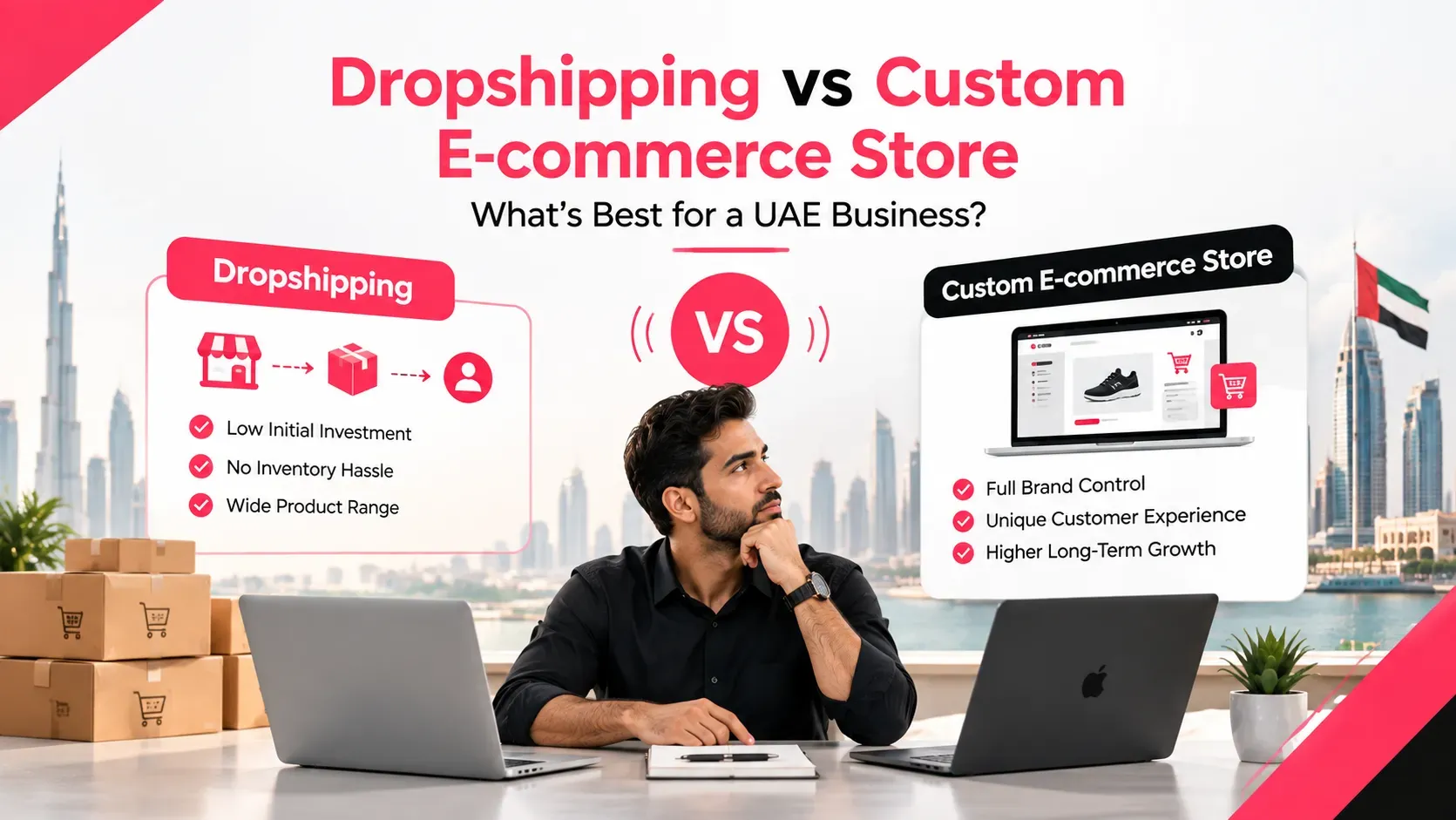
You've seen the ads. A young founder on a yacht in Dubai Marina explains how he built a "six-figure store" without ever touching a product. Start today: no inventory, no warehouse, no risk.
It's a tempting pitch, and dropshipping is a real, legal business model. But when you compare dropshipping vs custom ecommerce honestly, the right choice depends on your budget, your products, and one very UAE-specific factor: customers here expect their orders fast. This guide walks through costs, margins, delivery, licensing, and marketing so you can choose with clear eyes.
Quick Answer
Dropshipping suits testing products with little upfront capital, because a supplier holds the stock and ships each order. A custom e-commerce store, where you own your stock and brand, suits building a long-term business with better margins and control over delivery. In the UAE, fast-delivery expectations favour holding stock or using local suppliers. Many businesses test with dropshipping, then move winning products in-house.
Key Takeaways
- Dropshipping lowers startup risk but gives you thin margins and little control over delivery or quality.
- A custom store with your own stock costs more upfront but builds a brand, better margins, and repeat customers.
- Both models are legal in the UAE, and both need a proper licence that covers e-commerce activity.
- Slow overseas shipping is the biggest weakness of dropshipping in a market used to next-day delivery.
- A hybrid approach (test with dropshipping, then stock your winners) often gives you the best of both.
What Is Dropshipping?
Dropshipping is an online retail model where you sell products you don't keep in stock. When a customer orders from your store, you pass the order to a supplier, who ships it directly to the customer. You earn the difference between your selling price and the supplier's price, while the supplier handles storage, packing, and shipping.
What Is a Custom E-commerce Store?
In this guide, a custom e-commerce store means a business that owns or controls its own products (bought wholesale, made in-house, or produced under its own private label) and sells them through a store built around its brand. You manage the stock, or a fulfilment partner does it for you, and you control packaging, delivery speed, and the customer experience.
One important clarification: dropshipping can also run on a well-built, branded website. So the real choice isn't about the website itself. It's about who holds the stock and who controls what happens after a customer clicks "buy."
Dropshipping vs Custom E-commerce Store: Side-by-Side Comparison
Factor | Dropshipping | Custom store with your own stock |
|---|---|---|
Upfront cost | Low: licence, store, and ads | Higher: licence, store, stock, and storage |
Profit margin per sale | Usually thin | Usually healthier |
Delivery speed in the UAE | Often slow if the supplier is overseas | Same-day or next-day possible |
Control over quality | Limited, since you rely on the supplier | Full, since you inspect what you sell |
Branding and packaging | Minimal, often generic | Fully yours |
Returns handling | Complicated, often cross-border | Simple and local |
Risk of unsold stock | None | Real, so it needs planning |
Long-term brand value | Low | High |
The pattern is clear: dropshipping trades control for lower risk, while a custom store trades higher upfront risk for control.
Is Dropshipping Legal in the UAE?
Yes. Dropshipping is legal in the UAE, but you can't run it informally. According to the UAE government's official guidance on e-commerce, selling online on the mainland requires a commercial licence that includes e-commerce activity from your emirate's economic department, and every e-commerce licence also needs approval from the TDRA, the UAE's telecoms and digital regulator.
You also have a choice of setup:
- Mainland licence: lets you sell directly to customers across the UAE.
- Free zone licence: often cheaper and popular with online businesses, but free zone companies may need extra arrangements to sell directly into the mainland market.
The same licensing rules apply to a custom store, so this isn't a reason to choose one model over the other. For the complete setup process, from licence to payment gateway, see our step-by-step guide to launching an e-commerce store in the UAE.
Pros and Cons of Dropshipping for UAE Businesses
The Advantages
- Low startup cost: no stock to buy before you make your first sale.
- Fast product testing: you can try new products in days and drop the ones that don't sell.
- No warehouse: you can run the business from a laptop.
- Wide product range: you can list hundreds of items without storing any of them.
The Disadvantages
- Slow delivery: products shipped from overseas suppliers can take one to three weeks, while UAE shoppers are used to next-day delivery from the big marketplaces.
- Thin margins: the supplier takes most of the price, and ad costs eat much of the rest.
- Cash on delivery complications: many UAE shoppers still prefer paying on delivery, which is harder to manage when you don't control shipping.
- Quality and returns: you can't check products before they reach your customer, and cross-border returns are slow and costly.
Delivery pain shows up directly in your sales. Baymard Institute's checkout research found that 39 percent of shoppers abandon a checkout because of extra costs like delivery charges and taxes, exactly the kind of cost dropshippers struggle to absorb.
Pros and Cons of a Custom E-commerce Store
The Advantages
- Better margins: buying in bulk lowers your cost per unit.
- Fast, reliable delivery: with stock in the UAE, you can offer same-day or next-day delivery.
- A real brand: your packaging, product quality, and service become things customers remember.
- Repeat customers: people come back to brands they trust, which lowers your marketing cost over time.
The Disadvantages
- Higher upfront investment: you pay for stock before you sell it.
- Stock risk: products that don't sell tie up cash and storage space.
- More operations: storage, packing, and delivery need a team or a fulfilment partner.
The repeat-customer advantage is where a custom store really pulls ahead, and these practical ways to improve e-commerce customer retention show how to turn first orders into loyal buyers.
Dropshipping vs Custom E-commerce: Which Model Fits Your Business?
Choose Dropshipping If...
- You have a limited budget and want to test demand before investing
- You're exploring a niche and don't yet know which products will sell
- You can find suppliers with UAE or GCC warehouses to keep delivery fast
Choose a Custom Store If...
- You already have products, a supplier relationship, or a physical shop
- You want to build a brand that grows in value over time
- Your customers expect fast delivery, easy returns, or cash on delivery
Consider the Hybrid Route
Many successful UAE sellers combine both. They test products through dropshipping, then buy the best-sellers in bulk (or launch them under a private label) and ship them from local stock. You get low-risk testing plus strong margins on the products that prove themselves.
Both routes often start on a platform like Shopify, which handles dropshipping apps and stocked inventory equally well. If you want a store that can grow from one model to the other without a rebuild, Shopify development built for UAE sellers is a sensible place to start.
How Marketing Differs Under Each Model
Your business model shapes how you win customers.
Dropshipping stores usually depend almost entirely on paid ads. Because many sellers offer the same products, it's hard to stand out in search results, and when you stop paying for ads, sales often stop too.
Custom brand stores have more options. Unique products and original content can rank on Google, email marketing brings back past buyers, and word of mouth builds over time. Each channel reduces your reliance on ads and improves your margins.
Organic search is one of the biggest long-term advantages of owning a brand, and e-commerce SEO services in Dubai can help your product and category pages attract buyers without paying for every click.
Moving From Dropshipping to Your Own Brand
If you started with dropshipping and found products that sell consistently, switching to your own stock is a natural next step. It usually involves:
- Securing supply: negotiating bulk pricing or private-label production for your best-sellers.
- Setting up fulfilment: using your own space or a UAE fulfilment partner for storage and delivery.
- Upgrading the brand experience: adding branded packaging, better product photography, and faster delivery promises.
- Upgrading the store: improving product pages, checkout, and integrations with your inventory and delivery partners.
The store upgrade is where many sellers outgrow their original setup. Working with a team that offers custom e-commerce development for growing brands means your website is built around your products, operations, and customers, rather than a template designed for someone else's business.
Frequently Asked Questions
Is dropshipping legal in the UAE?
Yes, as long as you hold a valid licence that covers e-commerce activity. Running an online store without one can lead to fines, so sort out your licence before you start selling.
Do I need a trade licence to dropship from Dubai?
Yes. You'll need either a mainland licence with e-commerce activity from Dubai's Department of Economy and Tourism or a free zone e-commerce licence. The right option depends on whether you mainly sell to UAE customers or internationally.
Is dropshipping still profitable in the UAE in 2026?
It can be, but it's harder than the ads suggest. Margins are thin, ad costs keep rising, and customers expect fast delivery. Sellers who use local suppliers and choose niche products tend to do better than those shipping generic items from overseas.
Can I start with dropshipping and switch to my own stock later?
Yes, and many UAE businesses do exactly that. Use dropshipping to find products that sell, then buy those in bulk or create your own label to improve margins and delivery speed.
Which is cheaper to start: dropshipping or my own store?
Dropshipping is cheaper to start because you don't buy stock upfront. A custom store costs more at the beginning, but it usually earns more per sale and builds lasting brand value.
Final Thoughts
When you weigh dropshipping vs custom ecommerce, there's no universal winner, only the right fit for your budget, products, and ambitions. Dropshipping is a low-risk way to learn what sells. A custom store is how you build something that lasts.
Whichever path you choose, start with a clear plan and a store that can grow with you. If you'd like guidance from a team that knows the UAE market, Milaaj Brandset helps businesses build online stores that sell today and scale tomorrow.
Ready to Elevate Your Brand?
Start Your Project Today