September 5, 2026
Digital PR Strategies for SEO Growth: Build Authority, Links & Visibility
Milaaj Editorial / Research Insights
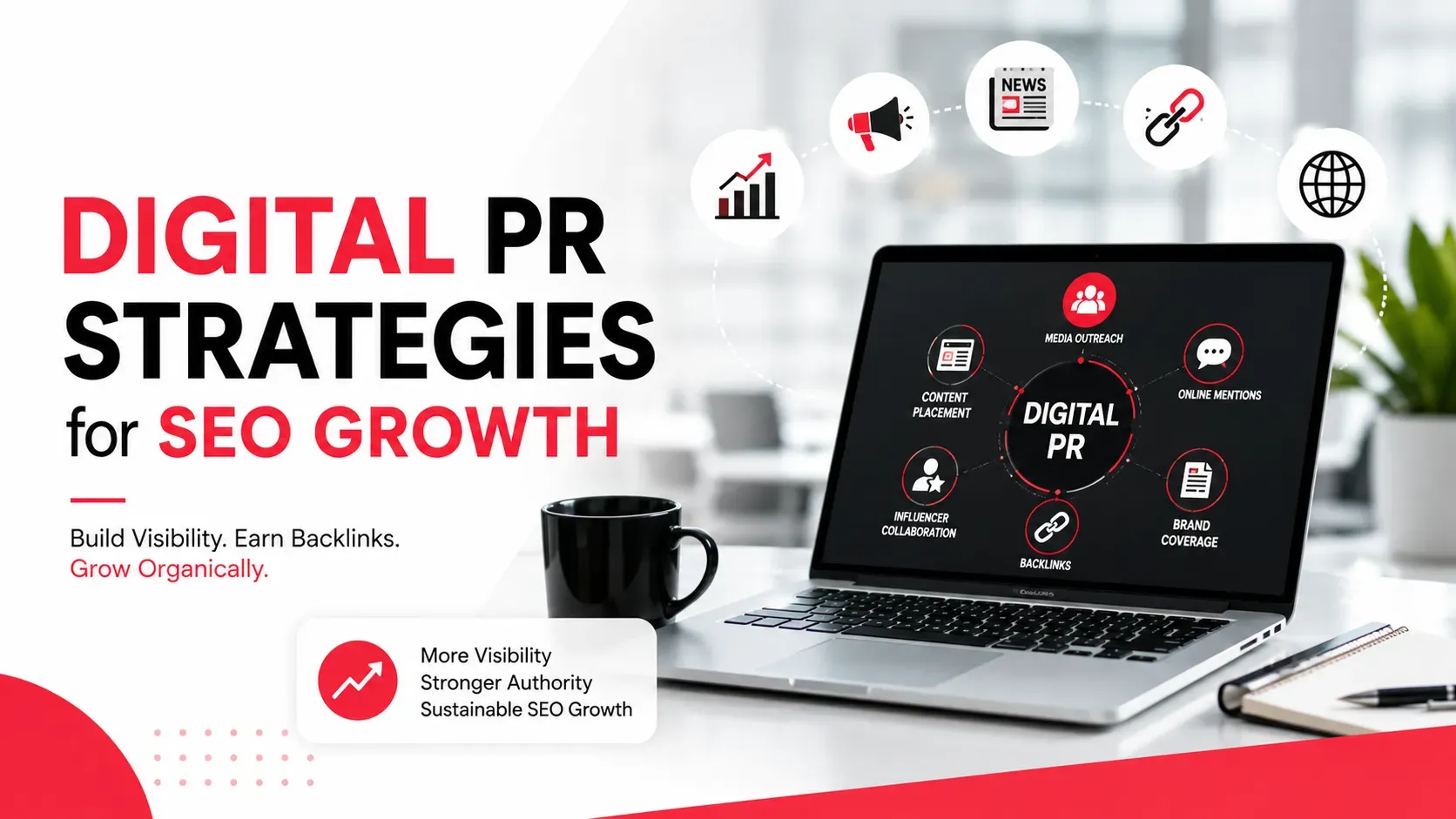
SEO and public relations used to be treated as separate marketing disciplines.
SEO teams focused on rankings, keywords and backlinks. PR teams focused on journalists, publications and brand reputation.
That distinction is becoming less useful.
A strong digital PR campaign can put a business in front of relevant audiences, generate editorial mentions, attract valuable backlinks, strengthen brand recognition and create content assets that continue generating search visibility long after the original story is published.
But digital PR is not simply another way to build backlinks.
The strongest campaigns give publications, journalists and audiences a reason to talk about the brand.
That is what makes digital PR valuable for long-term SEO growth.
Quick Answer: How Does Digital PR Help SEO?
Digital PR can support SEO by helping businesses:
- Earn relevant editorial backlinks
- Increase brand mentions and recognition
- Generate referral traffic
- Build relationships with authoritative publications
- Establish subject-matter expertise
- Create branded search demand
- Promote original research and useful data
- Strengthen content distribution
- Increase visibility beyond traditional search results
The key word is earned.
A successful digital PR campaign does not manufacture hundreds of links. It creates something sufficiently useful, interesting, timely or authoritative that independent publications have a reason to reference it.
That makes digital PR fundamentally different from buying or manipulating links.
Digital PR and Link Building Are Not the Same Thing
The two activities overlap, but they should not be treated as identical.
Traditional link building often starts with the question:
"How can we get a link to this page?"
Digital PR starts with a different question:
"What could we create or contribute that people would genuinely want to cover?"
That difference changes the entire process.
A company might conduct original research, publish new industry data, provide expert commentary on a developing story or create a useful visual resource.
The resulting article may include a backlink.
But the link is a consequence of the story—not the entire reason the story exists.
This is much closer to sustainable authority building.
For a broader look at building search visibility without manipulative tactics, see our guide to [White Hat SEO strategies for long-term growth].
1. Create Original Data Journalists Can Actually Use
One of the strongest digital PR assets is information that other publications cannot simply copy from another article.
Businesses often have access to useful data that they overlook.
For example:
- Search trends from internal research
- Customer survey results
- Industry pricing observations
- Product usage patterns
- Consumer preferences
- Market comparisons
- Annual performance data
- Geographic trends
The data does not need to be enormous.
It needs to answer a question people care about.
Imagine a UAE e-commerce company discovers from a customer survey that mobile shoppers in different age groups behave differently during checkout.
That finding could become:
- A research report
- A press release
- An infographic
- An expert article
- Social content
- A journalist pitch
One research project can therefore become an entire PR and SEO asset.
2. Turn Business Expertise Into Expert Commentary
Journalists frequently need specialists who can explain complicated subjects quickly.
Businesses should make their expertise easy to access.
For example, an SEO professional might comment on:
- A major Google Search development
- A change in consumer search behavior
- AI's impact on online discovery
- A new digital marketing trend
- E-commerce changes
- Website security developments
The important point is relevance.
Do not send generic statements simply because a story is trending.
Provide a genuinely useful explanation.
A strong expert quote might answer:
What happened? Why does it matter? Who is affected? What should businesses do next?
That is much more valuable than simply saying that a development is "important."
3. Use Newsjacking Carefully
Newsjacking involves responding quickly to a developing story with relevant expertise or analysis.
It can be powerful because journalists are actively looking for information while a story is receiving attention.
But speed should not replace relevance.
A digital agency does not need to comment on every trending topic.
The best opportunities are stories that naturally connect to the company's expertise.
For example, a cybersecurity company might respond to a major security incident.
An e-commerce specialist might comment on a significant change in online shopping behavior.
A financial consultancy might explain the implications of a new business regulation.
The closer the connection between the story and the company's expertise, the more credible the commentary becomes.
4. Build Digital PR Campaigns Around a Strong Story
A common mistake is starting with a promotional message.
Journalists generally do not need another advertisement for a company's services.
They need a story.
Instead of:
"Our company provides excellent digital marketing services."
consider:
"A survey of 1,000 UAE consumers reveals how online shoppers are changing their purchasing behavior."
The second statement contains a potential story.
A good PR campaign often has four components:
Interesting question → credible evidence → useful insight → clear story
The brand becomes part of the story naturally.
5. Make Content Worth Referencing
Not every article is a PR asset.
A 1,000-word article repeating information already available on dozens of websites gives journalists little reason to reference it.
Link-worthy content usually gives people something they cannot easily obtain elsewhere.
Examples include:
- Original statistics
- Industry reports
- Surveys
- Interactive tools
- Research studies
- Unique visualizations
- Detailed case studies
- Original frameworks
- Expert analysis
- Proprietary datasets
This also creates an SEO advantage.
When another publication references the resource, its audience can discover the original business.
That creates a pathway from PR exposure → referral traffic → brand discovery → potential search demand.
6. Pitch the Right Publication, Not Every Publication
More outreach does not necessarily mean better digital PR.
Sending the same email to hundreds of unrelated websites can produce poor results and damage relationships.
Instead, build a targeted publication list.
Consider:
- Industry relevance
- Audience overlap
- Geographic relevance
- Editorial quality
- Publication reputation
- Existing coverage of the topic
- Whether the journalist actually covers the subject
For a UAE business, a relevant regional publication may be more valuable than an unrelated website with a large global audience.
Relevance should be one of the first filters.
7. Build Relationships Before You Need Coverage
Digital PR works better when outreach is not always transactional.
Businesses can build relationships by:
- Following relevant journalists
- Reading their previous work
- Sharing genuinely useful information
- Responding to requests
- Providing concise expert commentary
- Respecting editorial deadlines
- Avoiding irrelevant pitches
A journalist who knows that a particular expert consistently provides useful information is more likely to remember that person when a relevant story appears.
This is relationship building—not link building.
8. Use Digital PR to Strengthen Brand Authority
This is where PR and SEO become particularly interesting.
A business can rank for a keyword without being widely recognized.
But repeated appearances across relevant publications can gradually increase familiarity.
People may encounter the brand through:
- Search
- Industry articles
- Expert interviews
- News stories
- Social media
- Podcasts
- Business publications
- Research reports
The brand becomes associated with particular subjects.
That broader recognition matters because customers increasingly investigate companies across multiple channels before making decisions.
Our guide on the importance of brand authority in SEO explores how expertise, recognition, mentions and reputation contribute to a stronger search presence.
9. Don't Measure Digital PR Only by Backlinks
Backlinks are useful, but they should not become the only success metric.
A campaign can be valuable even when an article does not contain a followed backlink.
For example, a PR placement might produce:
- Brand awareness
- Referral traffic
- Expert recognition
- New business enquiries
- Branded searches
- Social visibility
- Industry relationships
- Future media opportunities
These outcomes can be difficult to capture through a simple backlink report.
A stronger measurement framework includes:
PR exposure + search visibility + referral traffic + brand demand + conversions
This is particularly important for businesses investing in digital PR as part of a broader SEO strategy.
10. Repurpose One PR Story Across Multiple Channels
A successful PR campaign should not disappear after publication.
Suppose a company releases original research.
That single asset can become:
- A research article
- A media pitch
- A press release
- LinkedIn posts
- Short-form social content
- An infographic
- A presentation
- An email newsletter
- A sales resource
- A follow-up industry article
This creates a content flywheel.
The PR campaign generates attention.
The attention creates content opportunities.
The content supports SEO.
The SEO content continues attracting visitors.
And the strongest insights can generate another PR story later.
11. Combine Digital PR With Existing SEO Content
Digital PR works best when it supports pages that already have strategic value.
Suppose a company wants to rank for an important commercial topic.
Rather than sending PR traffic to a random blog post, it might create an authoritative research resource related to that subject.
The PR campaign then attracts attention and references.
The business can internally connect the research to:
- Service pages
- Supporting guides
- Comparison pages
- Product pages
- Related educational resources
This creates a stronger relationship between earned visibility and the rest of the website.
The objective is not to force every publication to link directly to a commercial landing page.
It is to build an ecosystem where valuable resources support the broader site.
12. Use Local Digital PR for UAE Visibility
Digital PR does not have to mean international publications.
For UAE businesses, local and regional coverage can be extremely relevant.
Potential opportunities include:
- UAE business publications
- Industry associations
- Local business communities
- Regional technology publications
- Dubai-focused media
- Industry events
- Local research initiatives
- Expert interviews
A business serving Dubai customers may benefit more from strong visibility among relevant UAE audiences than from an unrelated international mention.
Local PR can therefore complement local SEO and broader brand-building efforts.
What Digital PR Campaigns Should Avoid
Digital PR becomes less effective when businesses approach it like mass link building.
Avoid:
Mass email pitching
Generic pitches sent to hundreds of journalists are rarely persuasive.
Fake news
A manufactured "announcement" without genuine news value is unlikely to earn meaningful coverage.
Link-first thinking
If the entire campaign exists only to obtain a backlink, the underlying story may be weak.
Irrelevant publications
A large number of unrelated mentions does not automatically create authority.
Overly promotional content
Journalists need useful information, not marketing copy disguised as expert commentary.
Buying editorial coverage for SEO purposes
Paid placements can serve legitimate advertising purposes, but businesses should not confuse them with independent editorial endorsement.
The goal of digital PR should be earned attention.
A Practical Digital PR Workflow for SEO
Businesses can simplify the process into six stages.
1. Find the story
Identify a question, trend, data point or industry problem worth discussing.
2. Create the asset
Develop research, commentary, analysis, data, visuals or another genuinely useful resource.
3. Identify relevant media
Build a targeted list of journalists and publications that actually cover the subject.
4. Pitch the insight
Keep the outreach concise and explain why the information matters to that publication's audience.
5. Amplify the coverage
Share successful placements through appropriate brand and content channels.
6. Measure the business impact
Track links, mentions, referral traffic, branded searches, leads and conversions, not just publication count.
Businesses that want to combine earned authority with technical SEO and organic search growth can work with an experienced SEO partner to build a strategy around content, authority and sustainable visibility.
Key Takeaways
- Digital PR can support SEO through earned links, mentions, referral traffic and brand recognition.
- Digital PR should not be reduced to backlink acquisition.
- Original research and proprietary data can provide strong reasons for journalists to cover a business.
- Expert commentary can position a company as a credible source within its industry.
- Newsjacking works best when the developing story is genuinely relevant to the business.
- Relevance matters when choosing publications and journalists.
- Brand authority can grow when a business is repeatedly associated with useful expertise.
- Backlinks are only one measure of PR success.
- Strong PR assets can be repurposed across content, social and SEO channels.
- UAE businesses can use regional and local media to strengthen market-specific visibility.
- The best digital PR campaigns create something worth talking about before asking for coverage.
Conclusion
Digital PR can be one of the most effective ways to connect SEO with broader brand growth—but only when it is treated as more than a backlink strategy.
The strongest campaigns start with something genuinely interesting: original data, useful research, expert insight, a timely analysis or a story that matters to a particular audience.
Coverage and links then become outcomes of that value.
For businesses, this creates a more sustainable SEO ecosystem. A successful story can generate media coverage today, referral traffic tomorrow, branded searches over time and authoritative references that continue sending signals and visitors long after the original campaign has ended.
The goal is not to make a brand appear everywhere.
It is to make the brand worth mentioning in the places that matter.
That is where digital PR becomes a genuine SEO growth strategy rather than another link-building shortcut.
Milaaj Brandset combines sustainable SEO, content and authority-building principles to help businesses turn online visibility into long-term growth.
FAQ
What is digital PR in SEO?
Digital PR is the use of online public relations activities to increase a brand's visibility, reputation and authority. From an SEO perspective, successful campaigns can generate relevant editorial links, brand mentions, referral traffic and greater recognition.
Does digital PR improve Google rankings?
Digital PR does not guarantee higher rankings. However, successful campaigns can earn relevant links, increase brand exposure and create useful content assets that support a broader SEO strategy.
Is digital PR the same as link building?
No. Link building focuses primarily on acquiring links, while digital PR focuses on earning attention and coverage through stories, expertise, research and newsworthy information. Links can be one result of a successful PR campaign.
What makes content link-worthy?
Content is more likely to attract references when it provides something genuinely useful or difficult to reproduce, such as original research, statistics, expert analysis, unique data, tools, detailed studies or valuable visual resources.
Is digital PR useful for small businesses?
Yes. A small business does not need a huge PR budget to create a useful story. Proprietary customer insights, specialist expertise, local research and strong industry commentary can all create PR opportunities.
How long does digital PR take to produce SEO results?
There is no fixed timeline. Some campaigns can generate coverage quickly, particularly when responding to timely news. Others may take weeks or months to produce meaningful visibility. SEO benefits can also accumulate gradually as useful content, mentions and earned links continue to attract attention.
Should UAE businesses focus on local or international digital PR?
It depends on the target audience. A business serving primarily Dubai or UAE customers may gain more commercial value from relevant regional publications than from unrelated international coverage. International PR becomes more useful when the company's market and expertise support a broader audience.
Ready to Elevate Your Brand?
Start Your Project Today