August 19, 2026
Digital Transformation Strategies for UAE Businesses
Milaaj Editorial / Research Insights
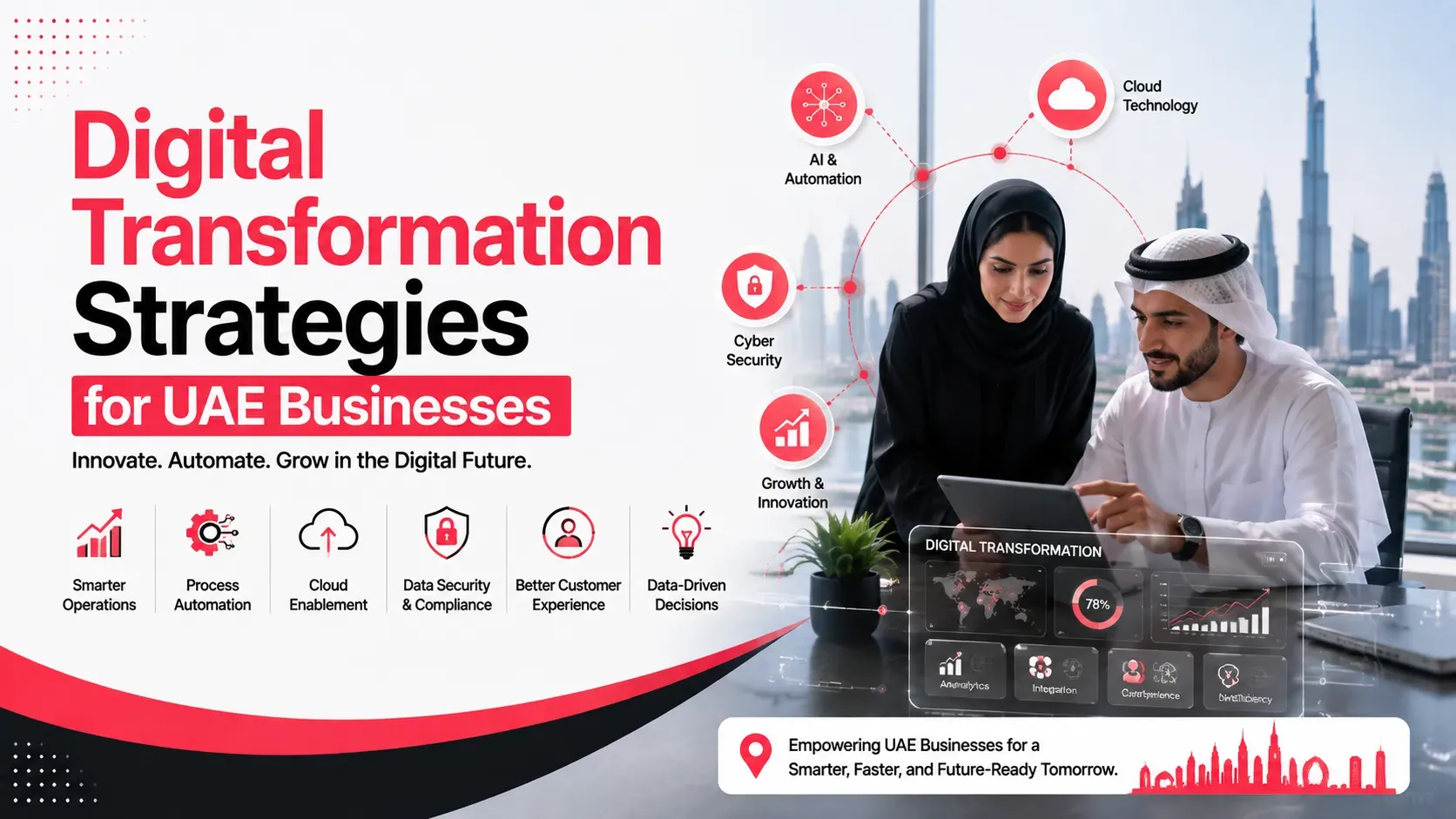
Digital transformation is no longer simply about moving paperwork online or purchasing new software. For UAE businesses, it increasingly means redesigning how the company operates, serves customers, manages information, and makes decisions using digital technology.
The UAE has made digitalization a major economic priority. Its Digital Economy Strategy aims to increase the digital economy's contribution to GDP from 9.7% in 2022 to 19.4% within ten years, supported by more than 30 initiatives and programmes.
For businesses, however, transformation shouldn't begin with the question, "Which technology should we buy?"
A better starting point is:
"Which business problem should technology solve?"
That shift creates a more practical transformation strategy, one focused on efficiency, customer experience, data, security, and measurable growth.
Quick Answer
The most effective digital transformation strategies for UAE businesses combine technology adoption with operational and organizational change.
Key priorities include:
- Setting business-led transformation goals
- Modernizing outdated systems
- Automating repetitive processes
- Connecting CRM, ERP, and business data
- Adopting AI where it creates measurable value
- Moving appropriate systems to the cloud
- Improving digital customer experiences
- Strengthening cybersecurity
- Training employees for new workflows
- Measuring ROI continuously
The strongest transformation programs don't attempt to digitize everything simultaneously. They prioritize the areas where technology can create the greatest operational or commercial impact.
What Digital Transformation Means for UAE Businesses
Digital transformation is the process of using digital technologies to fundamentally improve business operations, customer experiences, decision-making, and value creation.
It can involve relatively simple changes, such as replacing manual approval processes, or major projects such as implementing an ERP system across multiple departments.
A transformation program might include:
Manual spreadsheets → integrated ERP
Paper forms → digital workflows
Manual customer follow-ups → CRM automation
Disconnected data → centralized dashboards
Basic support → AI-assisted customer service
On-premise infrastructure → cloud-based systems
The important point is that technology should change how the business works, not merely add another software subscription.
Why UAE Businesses Need a Digital Transformation Strategy
The UAE's digital economy ambitions create a strong environment for technology-driven business growth. Government policy continues to emphasize digital infrastructure, innovation, data, cybersecurity, and smart services.
For private businesses, this creates both opportunity and pressure.
Customers increasingly expect:
- Fast digital communication
- Mobile-friendly services
- Convenient online transactions
- Personalized experiences
- Immediate access to information
- Connected customer support
At the same time, businesses face pressure to operate more efficiently and make better use of increasingly valuable data.
A structured digital transformation strategy allows companies to respond without adopting technology simply because it is fashionable.
Build a Digital Transformation Roadmap Around Business Goals
The first step is to identify business outcomes.
Instead of saying:
A company might identify a more useful objective:
That objective could eventually lead to AI-assisted customer service, workflow automation, CRM improvements, or a combination of technologies.
Common transformation goals include:
- Reducing operational costs
- Improving productivity
- Increasing sales
- Improving customer retention
- Reducing processing time
- Improving reporting
- Eliminating duplicate data entry
- Increasing operational visibility
Once goals are defined, businesses can prioritize the technology needed to achieve them.
Modernize Core Business Systems
Many companies don't have a technology shortage—they have a technology fragmentation problem.
Different departments may use different systems for:
- Sales
- Finance
- Inventory
- Customer service
- Marketing
- HR
- Procurement
If these systems don't communicate, employees may spend considerable time moving information manually.
Modernization can involve consolidating systems or integrating existing platforms.
For example:
CRM + ERP + Inventory + Accounting + Customer Support
can create a more connected operational environment.
For businesses with complex processes, Odoo implementation services can be particularly relevant when the transformation roadmap involves centralized ERP, CRM, inventory, accounting, automation, and system integration.
The objective isn't necessarily to replace every existing tool.
It's to create a system architecture where important information flows efficiently.
Use AI Where It Creates Measurable Value
AI is one of the most visible parts of digital transformation, but businesses should avoid treating it as a universal solution.
Useful applications include:
- Customer-service assistants
- Document processing
- Predictive analysis
- Content generation
- Sales assistance
- Recommendation systems
- Data classification
- Business intelligence
- Workflow decision support
For example, an AI system could summarize customer conversations and identify common complaints, while a human support representative handles the actual resolution.
Similarly, marketing teams can use AI to accelerate research, content production, and campaign analysis.
The strongest approach is to begin with a defined problem, then determine whether AI is actually the appropriate solution.
Automate Repetitive Business Processes
Automation is often one of the easiest areas in which businesses can achieve measurable transformation.
Look for tasks that are:
- Repetitive
- Rules-based
- High-volume
- Time-consuming
- Prone to manual errors
Examples include:
- Invoice processing
- Lead assignment
- Customer follow-ups
- Appointment reminders
- Report generation
- Internal approvals
- Inventory notifications
- Data synchronization
A useful transformation workflow might look like:
Customer enquiry → CRM record → automatic assignment → sales notification → follow-up → performance tracking
Instead of requiring employees to manage each step manually, the system handles predictable actions automatically.
The result can be faster processing without removing human oversight.
Connect Data, CRM and Business Operations
Data becomes much more valuable when it is connected.
Consider a company where marketing knows that a lead visited the website, sales knows that the lead requested a quotation, and finance knows whether the customer eventually purchased—but none of these teams can easily see the complete journey.
That's a data problem.
A transformation strategy should identify important information and determine:
- Where is it stored?
- Who needs access?
- How often does it change?
- Which systems need it?
- How should it be protected?
- What decisions depend on it?
CRM integration can help businesses create a more unified view of customers and marketing activity. A practical next step is understanding the benefits of CRM integration for marketing teams, particularly when marketing, sales, and customer data currently exist in separate systems.
Move the Right Workloads to the Cloud
Cloud technology can provide businesses with flexibility, scalability, and easier access to modern infrastructure.
But "move everything to the cloud" isn't necessarily a transformation strategy.
Businesses should evaluate workloads individually.
Consider:
- Security requirements
- Performance
- Scalability
- Integration needs
- Cost
- Compliance
- Availability
- Backup requirements
Cloud adoption can be particularly useful for businesses that need systems accessible across multiple offices, locations, or remote teams.
It can also support modern development, analytics, collaboration, and disaster-recovery strategies.
The important consideration is whether the cloud environment improves the business outcome.
Strengthen Cybersecurity During Digital Transformation
Every new digital system creates another potential point of exposure.
That makes cybersecurity a core transformation requirement rather than a separate IT concern.
The UAE's current cybersecurity framework includes policies addressing areas such as data exchange, cloud security, AI security, encryption, remote work, and third-party security.
Dubai's updated Cyber Security Strategy also identifies secure digital infrastructure and accelerated digital transformation among its objectives.
Businesses should therefore consider:
- Access controls
- Multi-factor authentication
- Data encryption
- Backup systems
- Vulnerability management
- Employee awareness
- Vendor security
- Incident response
- System monitoring
AI projects deserve particular attention. The UAE's National Cyber Security Policy for AI establishes requirements covering governance, infrastructure and application security, algorithm protection, operational safety, threat monitoring, and response.
Transformation without security can simply create faster ways to expose sensitive information.
Improve the Digital Customer Experience
Technology should ultimately make interactions easier for customers.
Businesses can improve digital experiences through:
- Faster websites
- Mobile-first interfaces
- Online booking
- Digital payments
- Self-service portals
- Personalized recommendations
- Automated updates
- Omnichannel support
- AI-assisted customer service
For example, a customer might discover a business through search, browse its website, contact the company through WhatsApp, complete a transaction online, and later receive automated support.
The systems behind these interactions should work together rather than forcing the customer to repeat information.
This is where digital transformation becomes visible from the customer's perspective.
Train Teams and Manage Organizational Change
Technology doesn't transform a company by itself.
Employees need to understand:
- Why the change is happening
- How their workflow will change
- Which systems they should use
- What information they are responsible for
- How success will be measured
Poor adoption can undermine even technically excellent systems.
A new CRM won't improve sales if employees continue maintaining separate spreadsheets.
An ERP won't improve operations if departments avoid using it.
An AI tool won't improve productivity if employees don't understand when its output needs verification.
Training and change management should therefore be included in the transformation roadmap from the beginning.
Measure Digital Transformation ROI
Transformation projects should have measurable outcomes.
Useful metrics can include:
Goal | Example KPI |
|---|---|
Improve productivity | Hours saved per process |
Reduce costs | Cost per transaction |
Improve sales | Conversion rate |
Improve customer service | Resolution time |
Reduce errors | Error rate |
Improve retention | Repeat purchase rate |
Improve operations | Processing time |
Improve decision-making | Reporting time |
A business doesn't need to measure everything.
Choose metrics connected directly to the original transformation objective.
If automation was introduced to reduce processing time, measure processing time.
If a CRM was introduced to improve lead management, measure lead response and conversion.
This creates a clear connection between technology investment and business value.
Common Digital Transformation Mistakes
Starting With Technology Instead of Problems
Buying software before understanding the business problem can create expensive complexity.
Trying to Transform Everything at Once
Large transformation programs are often easier to manage when delivered in stages.
Ignoring Existing Systems
Replacing systems unnecessarily can increase cost and disruption.
Treating Data as an Afterthought
Poor data quality can undermine automation, analytics, and AI.
Underestimating Cybersecurity
More connected systems require stronger security controls.
Forgetting Employees
Technology adoption depends on people using the systems correctly.
Measuring Activity Instead of Outcomes
The number of automated workflows or installed applications doesn't prove transformation success.
Key Takeaways
- Digital transformation should begin with business objectives, not technology.
- UAE businesses can use transformation to improve efficiency, customer experience, and scalability.
- Integrated CRM and ERP systems can reduce fragmented data.
- AI is most useful when applied to clearly defined business problems.
- Automation can eliminate repetitive manual processes.
- Cloud adoption should be based on business and security requirements.
- Cybersecurity must be built into transformation projects from the start.
- Employee training is essential for successful technology adoption.
- Digital customer experience should remain a central transformation goal.
- ROI should be measured using business outcomes rather than technology adoption alone.
Conclusion
Digital transformation is ultimately a business redesign exercise supported by technology.
The UAE's continued focus on digital economic growth, smart infrastructure, AI, and cybersecurity creates a strong environment for businesses willing to modernize.
But successful transformation doesn't require every company to adopt every emerging technology.
A more sustainable approach is to identify operational weaknesses, prioritize high-value opportunities, connect the right systems, protect business data, train employees, and measure the resulting improvement.
For businesses ready to modernize their operations and build connected digital systems, Odoo implementation services in Dubai can support ERP, CRM, automation, integration, and UAE-focused operational requirements. Milaaj Brandset brings digital capabilities together to help businesses build stronger, more scalable digital operations.
The companies that benefit most from digital transformation will not necessarily be those that adopt technology fastest. They will be the ones that understand where technology creates genuine business value—and implement it with the people, processes, data, and security needed to make that value sustainable.
Frequently Asked Questions
What is digital transformation for UAE businesses?
Digital transformation involves using technology to improve business processes, customer experiences, decision-making, data management, and operational efficiency.
What are the main digital transformation strategies?
Important strategies include system modernization, automation, AI adoption, CRM and ERP integration, cloud migration, cybersecurity, data management, and digital customer-experience improvements.
Why is AI important in digital transformation?
AI can automate analysis, support decision-making, personalize customer interactions, process information, and improve productivity when applied to suitable business problems.
Should small businesses invest in digital transformation?
Yes. Small businesses can begin with focused improvements such as CRM automation, cloud software, digital payments, workflow automation, or better customer communication rather than attempting a large transformation project immediately.
How long does digital transformation take?
There is no universal timeline. A focused workflow automation project may take weeks, while organization-wide ERP, data, infrastructure, and process transformation can take considerably longer.
How can businesses measure digital transformation success?
Businesses can measure improvements in productivity, processing time, costs, conversion rates, customer satisfaction, error rates, retention, and other KPIs directly connected to the transformation objectives.
Ready to Elevate Your Brand?
Start Your Project Today