October 3, 2026
Tabby and Tamara for UAE Online Stores: Is Buy Now Pay Later Worth It?
Milaaj Editorial / Research Insights
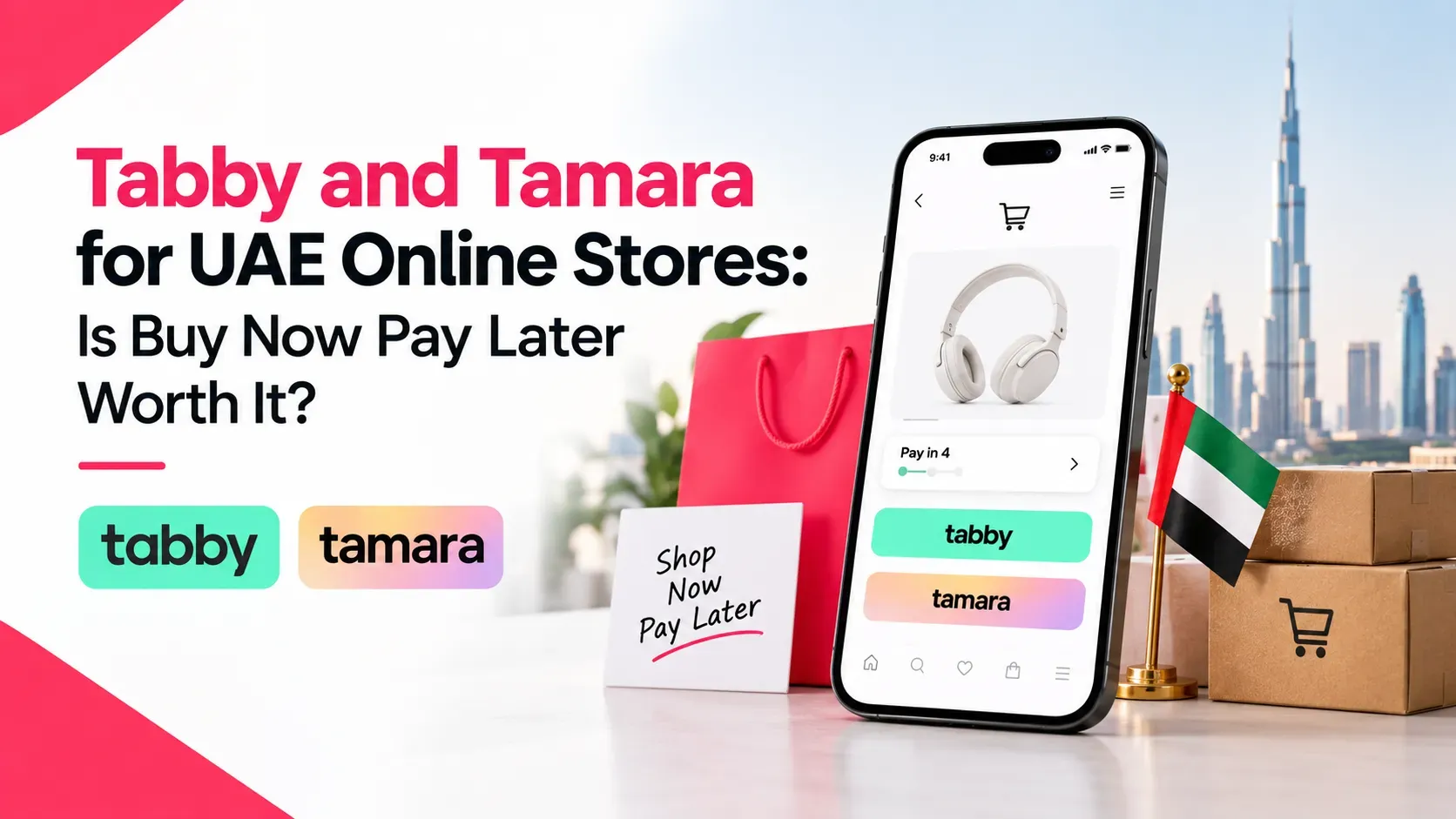
A shopper adds an AED 1,200 jacket to their cart, reaches checkout, and leaves. They wanted it, but not enough to pay the full amount today. If your store had offered "4 payments of AED 300," that sale might have happened.
That's the promise of Tabby and Tamara, and it's why "Pay in 4" badges now appear on so many UAE online stores. But BNPL isn't free, and it isn't right for every business. This guide explains how Tabby and Tamara work for UAE merchants, what they cost, the real pros and cons, and how to decide whether buy now pay later is worth it for your store.
Quick Answer
Buy now pay later (BNPL) lets customers split a purchase into interest-free instalments while you, the merchant, get paid up front. In the UAE, Tabby and Tamara are the leading providers. They typically charge merchants a higher fee than card payments, usually a percentage of each order plus a small fixed fee, so BNPL works best for stores with healthy margins and mid-to-high order values.
Key Takeaways
- You get paid up front. The BNPL provider pays you and collects instalments from the customer.
- The provider usually carries the risk. Under standard terms, missed customer payments are the provider's problem, not yours.
- Fees are higher than cards. You're paying for higher conversions and bigger baskets.
- It suits some stores more than others. Fashion, electronics, furniture, and beauty often benefit most.
- BNPL is regulated in the UAE. Providers must be licensed by the Central Bank and follow consumer protection rules.
What Is Buy Now Pay Later (BNPL)?
Buy now pay later is a payment method that lets shoppers split a purchase into smaller, interest-free instalments, usually paying the first part at checkout and the rest over the following weeks or months. The BNPL provider pays the merchant the full amount (minus fees) and then collects the instalments from the customer.
How BNPL Works for the Merchant
- A customer chooses Tabby or Tamara at checkout.
- The provider checks and approves the customer in seconds.
- The customer pays the first instalment.
- You receive the full order value, minus the provider's fee.
- The provider collects the remaining payments from the customer.
From your side, it behaves much like a card payment with a higher fee and a higher chance of the sale going through.
Tabby vs Tamara: How They Compare for UAE Merchants
Feature | Tabby | Tamara |
|---|---|---|
Core plan | Pay in 4 interest-free payments | Pay in 3 interest-free payments |
Longer plans | Up to 12 payments for selected merchants | Longer plans for selected merchants |
Merchant payout | Paid up front | Paid up front |
Platforms | Plugins for major e-commerce platforms, plus API | Plugins for major e-commerce platforms, plus API |
Markets | UAE and wider GCC | UAE and wider GCC |
Merchant fees | Negotiated per merchant | Negotiated per merchant |
In practice, both offer similar core experiences. Your choice often comes down to the fee you can negotiate, which brand your customers already use, and how well each integrates with your platform.
How Much Do Tabby and Tamara Cost Merchants?
Neither Tabby nor Tamara publishes a single fixed price for all merchants. Fees are usually a percentage of each order plus a small fixed fee per transaction, and are negotiated based on your category, volume, and average order value. Industry estimates commonly put the percentage at around 3% to 4%, which is noticeably higher than typical card processing.
Here's a simple way to think about it:
Example AED 800 order | Card payment | BNPL payment |
|---|---|---|
Typical fee (illustrative) | Around 2.5% (AED 20) | Around 3.5% + AED 1 (AED 29) |
Extra cost per order | About AED 9 |
The question isn't whether BNPL costs more. It does. The question is whether it brings in enough extra sales and bigger baskets to cover that difference. For current terms and onboarding details, start with Tabby's merchant information page and request quotes from both providers.
The Benefits of Offering BNPL in Your Online Store
- Higher conversion rates: customers who would hesitate at the full price can say yes to smaller payments.
- Bigger baskets: shoppers often add more to their cart when the payment is split.
- Up-front payment: you receive the full amount quickly, which helps cash flow.
- Reduced credit risk: under standard terms, the provider handles collections and missed payments.
- A marketing message: "Pay in 4" on product pages lowers the perceived price.
- Reach younger shoppers: many younger customers prefer BNPL to credit cards.
Tabby itself reports merchant results such as an 18% increase in conversion and a 33% increase in basket size. Treat these as the provider's own figures, and measure your results after launch. BNPL is also just one tool for rescuing hesitant buyers, alongside other ways to reduce cart abandonment.
The Downsides and Risks to Consider
BNPL isn't a free win. Before signing up, weigh these trade-offs:
- Higher fees: on low-margin products, a 3% to 4% fee can wipe out your profit.
- Margin pressure on discounts: combining BNPL with heavy sales can squeeze profit twice.
- Refund handling: returns need to flow correctly through the BNPL provider, which adds admin.
- Dependency: if customers get used to BNPL, removing it later may hurt sales.
- Brand fit: some luxury or B2B brands may feel BNPL doesn't match their positioning.
Is BNPL Worth It for Your Store? A Quick Decision Guide
Your situation | Is BNPL likely worth it? |
|---|---|
Average order value above roughly AED 300, healthy margins | Yes, strongly worth testing |
Fashion, electronics, furniture, beauty, fitness | Usually yes |
Average order value under AED 100 | Often not, the fee hurts more than it helps |
Very low margins (groceries, commodity products) | Usually no |
B2B or wholesale buyers | Rarely, invoice terms work better |
The smartest approach is to test. Run BNPL for two to three months, then compare conversion, average order value, and profit per order against your results before launch. That kind of evidence-based checkout planning is how Milaaj Brandset approaches payment decisions with UAE retailers.
Is Buy Now Pay Later Regulated in the UAE?
Yes. The Central Bank of the UAE regulates BNPL as a form of short-term credit under its Finance Companies Regulation, issued in September 2023. The key points:
- Only licensed providers can offer BNPL.
- Credit limits: a customer's total short-term credit can't exceed AED 20,000 or three months of verified income, whichever is lower.
- Fee caps: total fees charged to a customer can't exceed 30% of the original amount.
- Credit checks: providers must review credit reports for customers with limits above AED 5,000.
- Interest-free: BNPL credit must not charge interest.
- Transparency: fees and late payment terms must be disclosed clearly.
These rules apply to the provider, not your store. Your main responsibility is partnering with a licensed provider. For a fuller legal overview, see White & Case's summary of the Central Bank's BNPL rules.
How to Add Tabby or Tamara to Your Store
- Apply as a merchant on the provider's website.
- Pass business verification with your trade licence and company details.
- Agree your fees and terms, including refunds and payout timing.
- Install the integration, using the official app or plugin for your platform, or the API for custom stores.
- Add on-site messaging such as "4 payments of AED X" on product and cart pages.
- Test the full journey, including refunds, before going live.
For Shopify stores, installation is usually quick, but placing messages, testing refunds, and keeping the checkout fast still need care. Professional Shopify development in Dubai can make sure the integration looks native and doesn't slow your store down.
Promoting BNPL to Increase Conversions
Adding BNPL quietly at checkout leaves most of the benefit on the table. Make it visible:
- Show instalment amounts directly under product prices
- Mention BNPL in cart and checkout pages
- Include "Pay in 4" in email and WhatsApp reminders
- Highlight split payments in ads for higher-priced products
BNPL messaging is especially powerful for shoppers who already showed interest. Including it in remarketing campaigns reminds cart abandoners that the price is more manageable than they thought.
BNPL and Your Wider Payment Setup
BNPL works best alongside, not instead of, your other payment options. Most UAE shoppers still expect cards, Apple Pay, and in many categories cash on delivery. A well-balanced checkout gives every customer a payment method they're comfortable with.
If you're reviewing your full setup, compare BNPL against the best payment gateway options for UAE stores to decide what belongs at your checkout.
FAQs
How much do Tabby and Tamara charge merchants?
Both providers negotiate fees per merchant. Fees are typically a percentage of each order, often estimated at around 3% to 4%, plus a small fixed fee per transaction. Request quotes from both to compare.
Is Tabby or Tamara better for my online store?
Both offer similar core features. Compare the fees you're offered, which provider your customers already use, and how easily each integrates with your store platform.
Can I offer both Tabby and Tamara?
Yes, many UAE stores offer both, giving customers a choice. Just keep your checkout clean so too many options don't confuse shoppers.
Who carries the risk if a customer doesn't pay?
Under standard BNPL terms, the provider pays you up front and takes on the risk of missed customer payments. Always confirm this in your merchant agreement.
Is buy now pay later regulated in the UAE?
Yes. The Central Bank of the UAE regulates BNPL as short-term credit, requiring providers to be licensed and setting limits on credit amounts and fees.
Final Thoughts
Offering Tabby and Tamara in the UAE can be a smart move for online stores with healthy margins and mid-to-high order values. You get paid up front, shoppers get flexibility, and hesitant buyers have one less reason to walk away. The key is to treat BNPL as a business decision, not a trend: negotiate fees, test the results, and keep what works.
Start with a short trial, measure the impact on conversion and profit, and decide with real data. When you're ready, we can help you build a checkout that converts with our e-commerce team, from BNPL integration to a faster, smoother buying journey.
Ready to Elevate Your Brand?
Start Your Project Today