July 31, 2026
Marketing Analytics Guide for UAE Businesses
Milaaj Editorial / Research Insights
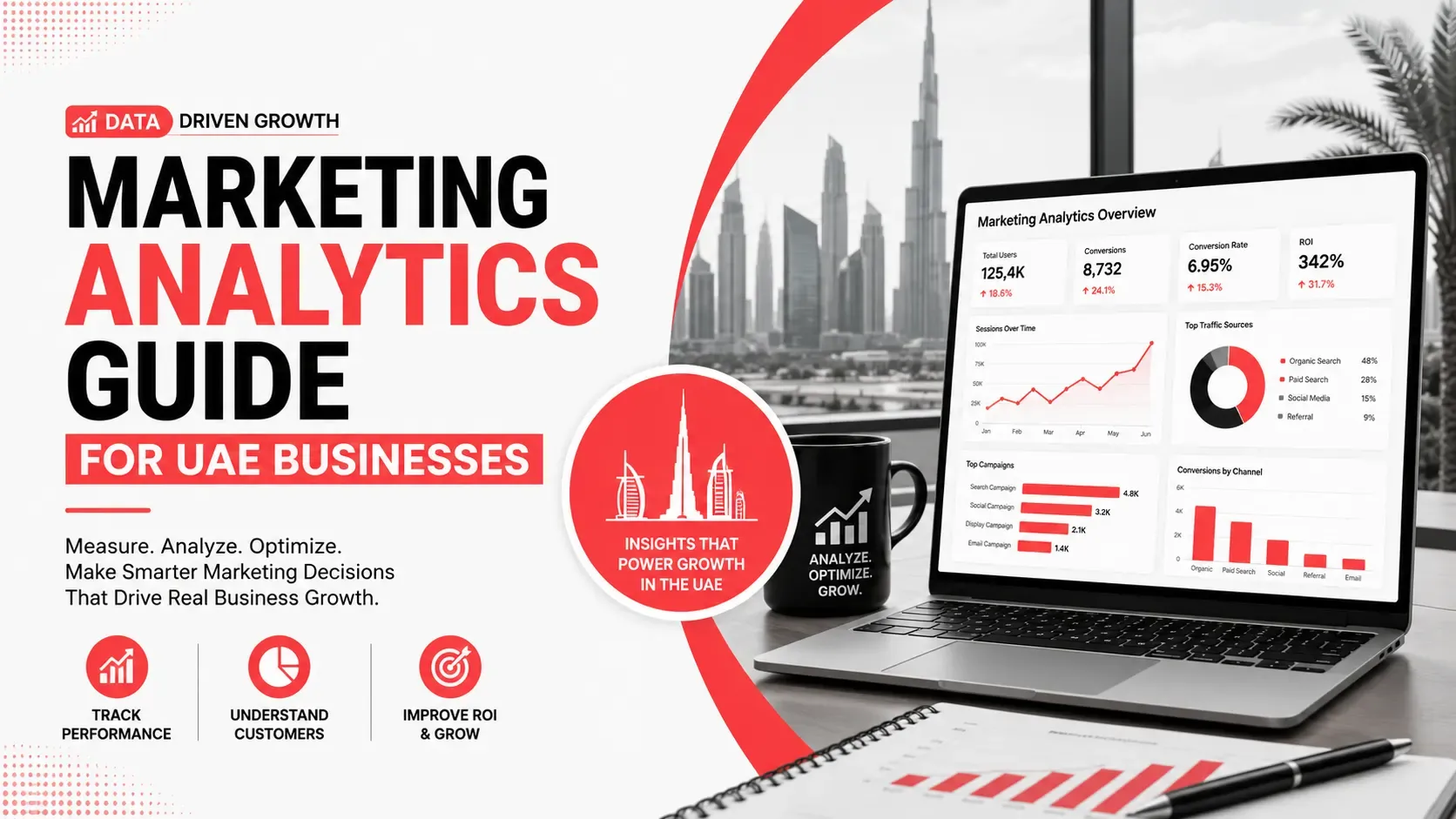
Marketing decisions based on assumptions often lead to wasted budgets and missed growth opportunities. As digital marketing channels become more competitive across the UAE, businesses need accurate data to understand what attracts customers, which campaigns generate results, and where marketing investments deliver the highest return.
Marketing analytics provides these insights by transforming website traffic, advertising performance, customer behaviour, and conversion data into actionable business intelligence. Instead of focusing only on impressions or clicks, businesses can evaluate the complete customer journey and identify the channels that contribute to revenue growth.
Whether you operate an ecommerce business, a professional service firm, a healthcare clinic, a real estate agency, or a local business, understanding marketing analytics helps you make informed decisions that improve campaign performance and maximize return on investment.
Quick Answer
Marketing analytics is the process of collecting, measuring, and analyzing marketing data to understand campaign performance and customer behaviour. UAE businesses can use analytics to identify high-performing marketing channels, improve customer acquisition, optimize conversions, and make data-driven decisions that increase marketing ROI.
What Is Marketing Analytics?
Marketing analytics involves measuring and interpreting data from various marketing channels to evaluate performance and improve future campaigns.
Instead of relying on assumptions, businesses use analytics to answer questions such as:
- Which marketing channels generate the most qualified leads?
- Which campaigns produce the highest return on investment?
- Where do visitors leave the website?
- Which content attracts the most engagement?
- Which traffic sources generate conversions rather than just visits?
Modern marketing analytics combines data from websites, search engines, advertising platforms, social media, CRM systems, and customer interactions to provide a comprehensive view of marketing performance.
Why Marketing Analytics Matters for UAE Businesses
The UAE's digital economy continues to expand rapidly, with businesses investing heavily in SEO, paid advertising, social media, email marketing, and content marketing to reach increasingly connected consumers. This competitive environment makes it essential to measure marketing performance accurately rather than relying on assumptions.
Marketing analytics helps businesses:
- Allocate budgets more effectively
- Identify profitable marketing channels
- Improve customer acquisition strategies
- Understand customer behaviour
- Optimize campaign performance
- Increase marketing return on investment
- Support long-term business growth
Rather than increasing marketing spend, analytics often reveals opportunities to improve the performance of existing campaigns.
Key Benefits of Marketing Analytics
Businesses that consistently measure performance gain several advantages.
Better Decision-Making
Reliable data helps marketing teams prioritize strategies based on measurable outcomes rather than opinions.
Improved Budget Allocation
Analytics identifies which campaigns generate revenue, allowing businesses to invest more confidently in high-performing channels.
Better Customer Understanding
Behavioural data reveals how visitors discover your business, what interests them, and where they encounter obstacles before converting.
Continuous Campaign Improvement
Regular performance analysis helps marketers refine campaigns over time instead of waiting until they underperform significantly.
Essential Marketing Metrics Every Business Should Track
Different businesses monitor different KPIs depending on their objectives, but several metrics are valuable across most industries.
Metric | Why It Matters |
|---|---|
Website Traffic | Indicates overall marketing reach |
Conversion Rate | Measures how effectively visitors become leads or customers |
Cost Per Acquisition (CPA) | Shows how much it costs to acquire a customer |
Customer Acquisition Cost (CAC) | Evaluates marketing efficiency |
Return on Ad Spend (ROAS) | Measures paid advertising profitability |
Click-Through Rate (CTR) | Indicates ad and content engagement |
Bounce Rate | Identifies potential website usability issues |
Customer Lifetime Value (CLV) | Measures long-term customer value |
Rather than monitoring every available metric, focus on those directly aligned with your business objectives.
Marketing Channels That Generate Valuable Analytics
Every digital marketing channel provides unique insights into customer behaviour.
Search Engine Optimization (SEO)
SEO analytics helps businesses understand:
- Organic traffic growth
- Keyword performance
- Landing page engagement
- User behaviour
- Conversion performance
These insights support long-term improvements in organic visibility and website performance.
Paid Advertising
Paid campaigns generate detailed performance metrics, including:
- Impressions
- Clicks
- Cost per click (CPC)
- Conversion rate
- Return on ad spend (ROAS)
Monitoring these metrics helps businesses improve campaign efficiency and reduce wasted advertising spend.
Social Media Marketing
Social media analytics measures:
- Audience growth
- Engagement rate
- Reach
- Video performance
- Website referrals
- Lead generation
These metrics help identify the types of content that resonate most with your audience.
Email Marketing
Email analytics tracks:
- Open rate
- Click-through rate
- Unsubscribe rate
- Conversion rate
- Campaign engagement
These insights support more personalized and effective communication with subscribers.
Essential Marketing Analytics Tools
Businesses do not need dozens of platforms to gain meaningful insights. A well-integrated analytics stack is often more effective than using numerous disconnected tools.
Some of the most widely used tools include:
- Google Analytics 4 (GA4) for website traffic and user behaviour
- Google Search Console for organic search performance
- Google Ads reporting for paid search campaigns
- Meta Ads Manager for Facebook and Instagram advertising analytics
- LinkedIn Campaign Manager for B2B advertising performance
- CRM platforms for lead tracking and customer lifecycle analysis
- Dashboard tools such as Looker Studio for unified reporting
Selecting tools that integrate with each other provides a more complete view of marketing performance.
Understand the Customer Journey
Customers rarely convert after a single interaction.
They may:
- Discover your business through Google Search.
- Read several blog articles.
- Visit your website multiple times.
- Engage with your social media content.
- Click a paid advertisement.
- Submit an enquiry days or weeks later.
Marketing analytics helps identify these touchpoints, allowing businesses to understand how different channels contribute to conversions instead of evaluating each channel in isolation.
If your analytics reveals that visitors frequently leave key landing pages without converting, read our guide on Conversion Rate Optimization for Beginners to learn practical strategies for improving website performance and increasing conversions.
Attribution Models and Why They Matter
One of the biggest challenges in marketing is identifying which channel deserves credit for a conversion. A customer may interact with multiple campaigns before becoming a lead or customer.
Common attribution models include:
Attribution Model | Best Used For |
|---|---|
First Click | Understanding which channel first introduced your brand |
Last Click | Measuring the final interaction before conversion |
Linear | Giving equal credit to every customer touchpoint |
Data-Driven | Using machine learning to assign credit based on actual customer behaviour |
Modern analytics platforms, including Google Analytics 4 (GA4), increasingly encourage data-driven attribution because it provides a more complete picture of how different marketing channels contribute to business outcomes.
Build Actionable Marketing Dashboards
A dashboard should help decision-makers understand performance quickly rather than overwhelm them with unnecessary data.
An effective marketing dashboard typically includes:
- Website traffic trends
- Lead generation performance
- Conversion rate
- Marketing channel performance
- Campaign ROI
- Customer acquisition cost
- Top-performing landing pages
- Revenue generated by marketing activities
Keep dashboards focused on business objectives instead of displaying every available metric.
Turn Data Into Better Marketing Decisions
Collecting data alone does not improve marketing performance. The real value comes from using insights to guide future decisions.
For example, analytics may reveal that:
- Organic search generates the highest-quality leads.
- One landing page has a significantly lower conversion rate than others.
- Mobile visitors leave a page much earlier than desktop users.
- Certain blog topics consistently generate qualified enquiries.
- A paid advertising campaign has a high click-through rate but a low conversion rate.
These findings help businesses decide where to invest more, what to improve, and which campaigns should be refined or discontinued.
Common Marketing Analytics Mistakes
Many businesses collect large amounts of data but fail to use it effectively.
Mistake | Better Approach |
|---|---|
Tracking too many metrics | Focus on KPIs linked to business goals. |
Measuring traffic without conversions | Evaluate lead quality and revenue, not just visitor numbers. |
Ignoring customer behaviour | Analyze how users navigate and interact with your website. |
Reviewing reports too infrequently | Monitor performance regularly and identify trends early. |
Making decisions based on assumptions | Use analytics to validate ideas before implementing major changes. |
Failing to connect marketing and sales data | Combine CRM and marketing insights to understand true campaign impact. |
Avoiding these mistakes helps businesses make more informed, evidence-based decisions.
Best Practices for Data-Driven Marketing
To build a strong analytics strategy:
- Define measurable marketing objectives.
- Track a small set of meaningful KPIs.
- Use consistent reporting periods.
- Compare performance over time rather than focusing on isolated results.
- Monitor the complete customer journey.
- Regularly review campaign performance and adjust strategies.
- Ensure marketing and sales teams share performance insights.
A disciplined approach to analytics helps businesses identify opportunities that might otherwise go unnoticed.
Marketing Analytics and Business Growth
Analytics should support strategic decision-making across your entire marketing operation.
For example:
- SEO analytics identifies opportunities to improve organic visibility.
- Paid advertising reports highlight campaigns delivering the strongest return on investment.
- Website analytics reveal pages that need optimization.
- CRM data shows which marketing channels generate the most valuable customers.
Combining these insights allows businesses to allocate resources more effectively while creating a better customer experience.
For a deeper understanding of improving paid campaign performance after analyzing your advertising data, explore our blog on How to Improve Google Ads Quality Score, where we explain practical optimization techniques that can reduce advertising costs and improve campaign efficiency.
Key Takeaways
- Marketing analytics transforms business data into actionable insights.
- Measuring the right KPIs helps businesses make informed marketing decisions.
- Understanding the customer journey provides a more complete view of campaign performance.
- Dashboards simplify reporting and support faster decision-making.
- Analytics should focus on business outcomes such as leads, conversions, revenue, and ROI rather than vanity metrics.
- Regular performance reviews help improve campaigns and maximize marketing investment.
Make Better Marketing Decisions With Data
Successful marketing is no longer based on intuition alone. Businesses that consistently measure performance, understand customer behaviour, and evaluate the impact of every marketing channel are better equipped to improve campaign efficiency and achieve sustainable growth.
Rather than treating analytics as a reporting exercise, use it as a decision-making framework that guides future marketing investments. Continuous measurement, testing, and optimization help businesses respond to changing customer behaviour while maximizing the value of every marketing dirham spent.
Milaaj Brandset helps businesses build data-driven marketing strategies by combining advanced analytics, performance reporting, and continuous optimization to improve campaign effectiveness and support long-term business growth.
FAQs
What is marketing analytics?
Marketing analytics is the process of collecting, measuring, and analyzing marketing data to evaluate campaign performance, understand customer behaviour, and improve business decisions.
Why is marketing analytics important for UAE businesses?
Marketing analytics helps businesses measure ROI, identify high-performing channels, improve customer acquisition, optimize campaigns, and make better use of marketing budgets in an increasingly competitive digital landscape.
Which metrics should businesses track?
Key metrics include website traffic, conversion rate, cost per acquisition (CPA), customer acquisition cost (CAC), return on ad spend (ROAS), click-through rate (CTR), customer lifetime value (CLV), and revenue generated from marketing activities.
What tools are commonly used for marketing analytics?
Popular tools include Google Analytics 4, Google Search Console, Google Ads, Meta Ads Manager, LinkedIn Campaign Manager, CRM platforms, and Looker Studio for unified reporting.
How often should marketing reports be reviewed?
Most businesses benefit from reviewing key performance indicators weekly while conducting more detailed monthly and quarterly performance analyses to identify trends and optimization opportunities.
What is the difference between marketing analytics and marketing reporting?
Marketing reporting presents performance data, while marketing analytics interprets that data to uncover patterns, explain results, and guide strategic marketing decisions.
Ready to Elevate Your Brand?
Start Your Project Today