August 28, 2026
Pillar Page Strategy for SEO Growth: A Complete Guide
Milaaj Editorial / Research Insights
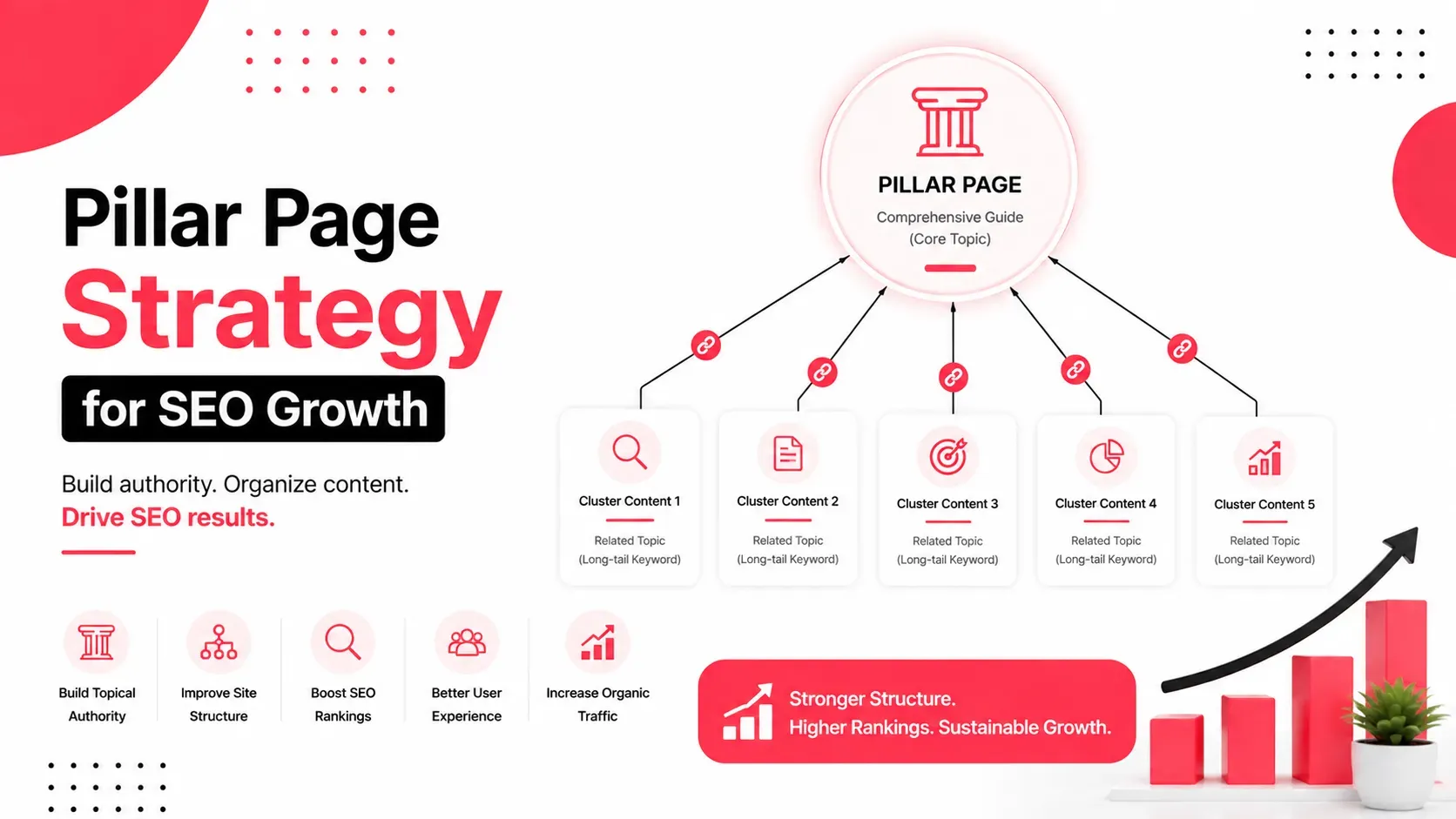
A pillar page can become one of the most valuable assets on a business website when it is built around a meaningful topic, comprehensive content, and a well-connected network of supporting pages.
Instead of publishing dozens of unrelated blog posts, a pillar page strategy for SEO organizes content around core topics and connects them through relevant internal links. This helps users find deeper information while giving search engines clearer signals about how different pages relate to one another.
However, a pillar page isn't simply a very long blog post.
A successful pillar page serves as the central resource for a broad topic, while supporting content answers narrower questions related to that subject.
Quick Answer
A pillar page is a comprehensive webpage that covers a broad topic and links to more detailed supporting content.
A strong pillar page strategy involves:
- Choosing a topic relevant to your business
- Researching the audience's search intent
- Mapping primary and secondary keywords
- Creating comprehensive but useful content
- Building supporting cluster pages
- Connecting related pages with contextual internal links
- Optimizing headings, URLs, metadata, and content structure
- Keeping the pillar page and supporting content updated
- Measuring organic traffic, rankings, engagement, and conversions
The objective isn't to create the longest page possible.
The objective is to create the most useful central resource for a specific topic and connect it to genuinely valuable supporting content.
What Is a Pillar Page and Why Does It Matter for SEO?
A pillar page is a comprehensive page designed to provide broad coverage of an important subject.
For example, a digital marketing website might create a pillar page targeting:
Digital Marketing for Small Businesses
That page could then connect to supporting articles about:
- SEO
- Social media marketing
- Email marketing
- Paid advertising
- Content marketing
- Conversion optimization
The pillar page provides the broader context, while the supporting pages explore specific subtopics in greater depth.
Pillar Pages vs Regular Blog Posts
A regular blog post usually addresses a specific question or topic.
For example:
"How Does Internal Linking Help SEO?"
A pillar page might cover the broader topic:
"Complete SEO Guide for Business Websites"
The difference isn't simply word count.
A pillar page is usually designed to become a central resource within a topic cluster, while a standard article may have a narrower search intent.
Pillar Pages vs Topic Clusters
A topic cluster consists of multiple related pages organized around a central subject.
A simplified structure could look like:
Pillar Page: SEO for Business Websites
↓
Technical SEO
↓
Internal Linking
↓
URL Structure
↓
On-Page SEO
The supporting pages link back to the pillar page where relevant, while the pillar page links to deeper resources.
This creates a connected content ecosystem.
A pillar page strategy therefore works closely with internal linking strategies to establish meaningful relationships between related pages.
How to Build a Pillar Page Strategy for SEO Growth
Creating a pillar page starts long before writing the first paragraph.
The topic, search intent, content structure, and supporting pages should all be planned together.
Choose the Right Core Topic
The best pillar topics are broad enough to support multiple subtopics but specific enough to serve a defined audience.
For example:
Weak pillar topic:
"Business"
Too broad.
Better:
"Digital Marketing for UAE Businesses"
This topic has a clear audience and can support multiple related subjects.
A good pillar topic should:
- Be relevant to your business
- Have meaningful audience demand
- Support multiple related subtopics
- Connect naturally to products or services
- Provide opportunities for long-term content development
Don't select a topic solely because a keyword has high search volume.
A topic that attracts traffic but has no relationship to your business may produce little commercial value.
Map Search Intent and Keywords
Keyword research should help you understand what people want to accomplish—not simply generate a list of phrases.
For a pillar page, identify:
Primary keyword:
The main topic the page is targeting.
Secondary keywords:
Closely related terms and variations.
Supporting topics:
Specific questions that deserve separate pages.
Commercial intent:
Topics that could eventually lead users toward your products or services.
For example, a pillar page about SEO might target:
Primary: SEO for businesses
Supporting topics could include:
- Technical SEO
- Internal linking
- Keyword research
- Local SEO
- On-page SEO
- SEO audits
Each topic can have a distinct search purpose.
Create Comprehensive Pillar Content
A pillar page should provide meaningful coverage of the subject.
That doesn't mean stuffing every possible keyword into one page.
Instead, cover the essential concepts users need to understand.
A strong pillar page should have:
- A clear introduction
- Logical sections
- Descriptive headings
- Useful examples
- Supporting evidence where appropriate
- Relevant internal links
- Clear next steps
Avoid making the page unnecessarily long just to reach an arbitrary word count.
If a detailed subject can be explained effectively in 2,000 words, there is no SEO advantage to turning it into 5,000 words of repetitive content.
The quality of coverage matters more than the number of words.
Build Supporting Cluster Content
Once your pillar topic is defined, identify the narrower questions that deserve their own pages.
For example:
Pillar: SEO for Business Websites
Supporting content:
- SEO-Friendly URL Structure
- Internal Linking Strategies
- How to Create SEO Silos
- Technical SEO Audit Guide
- Website Speed and SEO
- Local SEO Strategies
Each supporting article should satisfy a distinct search intent.
This approach prevents the pillar page from becoming overloaded while giving users access to deeper resources.
Connect Pages With Internal Links
Internal linking is what transforms separate pieces of content into a connected topic cluster.
The pillar page should link to important supporting pages.
Supporting pages should link back to the pillar page where appropriate.
Related supporting pages can also link to each other when there is a useful contextual connection.
For example, an article about SEO silos can naturally link to an article about internal linking because the two concepts overlap significantly.
Avoid adding links simply to increase the number of internal links.
Every link should have a reason.
How to Optimize a Pillar Page for Search and Users
A pillar page needs to work for both search engines and people.
Create a Clear Content Hierarchy
Use headings to make the page easy to scan.
A logical structure could be:
H1: SEO for Business Websites
H2: What Is Business SEO?
H2: How Business SEO Works
H3: Keyword Research
H3: Technical SEO
H3: Content Optimization
H2: How to Build an SEO Strategy
This structure helps readers find the information they need without reading every paragraph.
It can also make a long resource easier to understand.
Optimize Titles, Headings, and URLs
The page title should clearly communicate the subject.
Your primary keyword can appear naturally in the title, H1, URL, introduction, and relevant headings when appropriate.
For example:
example.com/blog/seo-for-business-websites/
is clearer than:
example.com/blog/page12345/
Don't force exact-match keywords into every heading.
A page should read naturally.
Your SEO-friendly URL structure should also remain consistent with the broader architecture of your website.
Add Relevant Internal and External Links
A pillar page should connect users to deeper resources.
Internal links can point toward:
- Supporting articles
- Service pages
- Product pages
- Related guides
- Relevant categories
External links can be useful when they support claims or direct readers toward authoritative resources.
Links should be relevant rather than added simply to meet a target.
Keep the Content Updated
A pillar page can become outdated as industries, search behavior, technologies, and business practices change.
Create a maintenance process.
Review:
- Statistics
- Examples
- Links
- Screenshots
- Recommendations
- Outdated terminology
- Search intent
- Supporting articles
You don't need to rewrite the entire page every month.
Update it when there is a meaningful reason.
Common Pillar Page Mistakes to Avoid
Choosing Topics That Are Too Broad
A pillar page about "Marketing" may be impossible to cover meaningfully.
Narrow the subject to a useful audience and purpose.
For example:
"Digital Marketing Strategies for UAE Businesses"
provides a much clearer scope.
Creating Thin Supporting Content
A pillar strategy doesn't work well if the supporting pages are created only to generate additional URLs.
Each cluster article should provide genuine value.
A short article that repeats information already covered on the pillar page may not deserve to exist separately.
Overusing Keywords and Internal Links
Don't turn your pillar page into a keyword checklist.
Repeated exact-match keywords can make content unnatural.
Likewise, adding dozens of internal links without considering relevance can make a page difficult to read.
Focus on meaningful relationships.
Ignoring Search Intent
A page can rank for a keyword but still fail to satisfy the person searching.
Before creating a pillar page, ask:
What does the visitor actually want to accomplish?
Someone searching for "SEO guide" may want an educational resource.
Someone searching for "SEO agency Dubai" has a much stronger commercial intent.
These searches require different types of pages.
How to Measure Pillar Page SEO Performance
Publishing a pillar page is only the beginning.
Measure whether it is achieving its intended purpose.
Useful metrics include:
- Organic impressions
- Organic clicks
- Keyword rankings
- Organic traffic
- Engagement
- Scroll depth
- Internal link clicks
- Supporting-page traffic
- Leads
- Conversions
Also monitor the supporting cluster.
If the pillar page attracts traffic but users never reach the supporting resources, your internal linking or page structure may need improvement.
Likewise, if supporting articles perform well but remain disconnected from the pillar page, there may be an opportunity to strengthen the cluster.
For businesses, the ultimate goal shouldn't be traffic alone.
Relevant organic traffic and business outcomes matter more than raw page views.
Key Takeaways
- A pillar page is a comprehensive central resource for a broad topic.
- Pillar pages work best when supported by related cluster content.
- Choose topics based on business relevance and audience needs.
- Use keyword research to understand search intent and identify supporting topics.
- Don't make a pillar page unnecessarily long just to increase word count.
- Build supporting pages around distinct search intents.
- Connect pillar and supporting pages with relevant internal links.
- Use clear headings and a logical content hierarchy.
- Keep URLs, titles, and metadata descriptive and natural.
- Avoid keyword stuffing and excessive internal links.
- Review pillar content regularly to keep it accurate.
- Measure both SEO performance and business outcomes.
Conclusion
A strong pillar page strategy can turn a collection of individual articles into a connected content system.
Instead of treating every blog post as an independent opportunity to rank, you can build a central resource around an important topic and create supporting content that answers the narrower questions your audience is asking.
Start with a topic that genuinely matters to your business. Research the audience's search intent. Map the primary and supporting keywords. Build comprehensive pillar content, then create useful cluster pages around specific subtopics.
Most importantly, connect everything logically.
The goal isn't to create a rigid SEO structure simply because a strategy says you should.
It's to create a website where users can move naturally from broad information to deeper answers and, when appropriate, toward a relevant business solution.
For businesses that want to build topic clusters, strengthen content architecture, and connect pillar pages with broader technical and on-page optimization, SEO services in Dubai can help develop a strategy aligned with both search visibility and business goals. Milaaj Brandset helps businesses connect content, SEO, and digital marketing into a more cohesive growth strategy.
A successful pillar page isn't simply a long article.
It's the central resource that gives an entire topic structure, context, and direction.
Frequently Asked Questions
What is a pillar page in SEO?
A pillar page is a comprehensive webpage that covers a broad topic and links to more detailed supporting content covering related subtopics.
How long should an SEO pillar page be?
There is no ideal universal word count. The page should be as comprehensive as necessary to satisfy the intended search intent without adding unnecessary repetition.
How many supporting articles should a pillar page have?
There is no fixed number. Start with the important subtopics your audience genuinely needs. A small cluster may have a handful of supporting pages, while a large topic can support many more.
Do pillar pages improve SEO rankings?
Pillar pages don't guarantee rankings. However, they can support a logical content structure, internal linking, topical coverage, content discovery, and user navigation when implemented effectively.
What is the difference between a pillar page and a cornerstone article?
The terms are sometimes used interchangeably. Both generally refer to important, comprehensive content designed to represent a core topic. A pillar page often specifically refers to the central page in a topic-cluster strategy.
Should a pillar page link to every supporting article?
It can link to relevant supporting articles, but it doesn't need to link to every page in the cluster. Prioritize the resources that genuinely help users understand the topic.
Should supporting articles link back to the pillar page?
When the pillar page provides broader context that is useful to the reader, linking back to it can create a stronger relationship between the pages. The link should be natural rather than forced.
Ready to Elevate Your Brand?
Start Your Project Today