August 10, 2026
SaaS SEO Strategies for B2B Startups
Milaaj Editorial / Research Insights
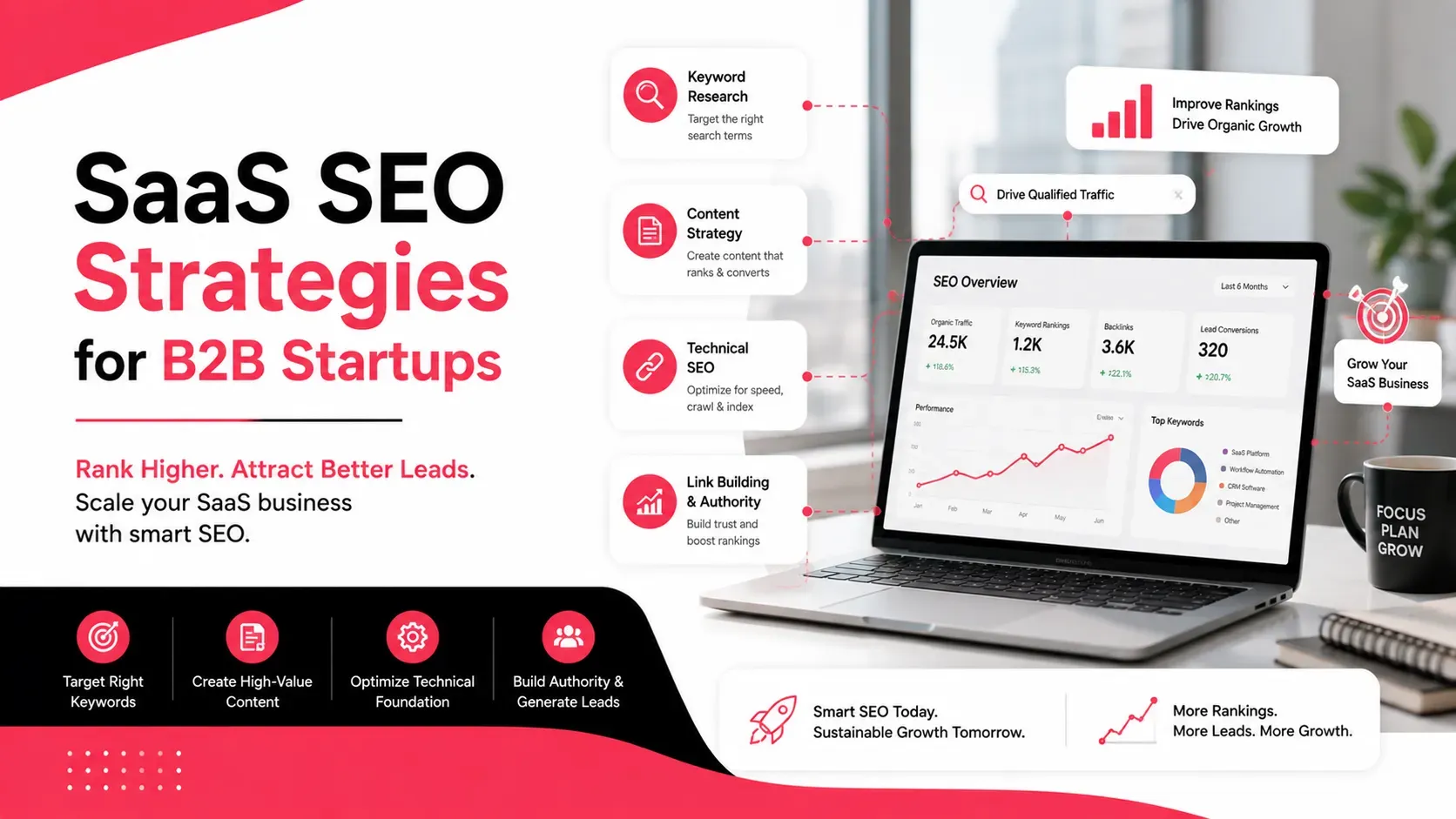
For a B2B SaaS startup, getting website visitors is not enough. The real objective is to attract people who have a genuine business problem, understand the value of a software solution, and may eventually become paying customers.
That makes search engine optimization particularly valuable for SaaS companies. A well-planned SEO strategy can help a startup appear when potential customers search for problems, solutions, software categories, integrations, alternatives, and product comparisons.
However, SaaS SEO is different from simply publishing blog posts around high-volume keywords. B2B software buyers often conduct research across multiple searches before contacting a company or starting a trial. A strong strategy therefore needs to cover the entire journey, from the first problem-related search to the final product evaluation.
Quick Answer
The most effective SaaS SEO strategy combines problem-focused keyword research, topic clusters, high-intent landing pages, technical SEO, product-led content, comparison pages, authoritative backlinks, and conversion optimization. Instead of measuring success only through organic traffic, B2B SaaS startups should connect SEO performance to demos, trials, qualified leads, pipeline, and revenue.
Why SEO Matters for B2B SaaS Startups
SaaS companies often operate in competitive markets where potential customers can compare dozens of products before making a decision.
Paid advertising can generate immediate visibility, but every click comes with a cost. SEO works differently. Content and landing pages that establish strong organic visibility can continue attracting relevant prospects after the initial investment in creating and optimizing them.
For startups, this can provide several advantages:
- Build visibility within a specific software category
- Capture customers researching solutions
- Reduce dependence on paid acquisition
- Establish authority in a niche
- Generate qualified organic leads
- Support product-led growth
- Create assets that compound over time
The important distinction is qualified visibility.
A SaaS company may receive thousands of visitors from an informational article but generate very few business opportunities. Another company might attract fewer visitors from highly specific comparison or solution keywords and generate substantially more qualified leads.
For this reason, SaaS SEO should be connected to business objectives from the beginning.
SaaS Keyword Research Requires a Different Approach
One of the biggest mistakes B2B SaaS startups make is building their SEO strategy around keywords with the highest search volume.
Search volume provides useful information, but it doesn't tell you whether the person searching is likely to become a customer.
A stronger approach is to organize keywords according to buyer intent.
Problem-Aware Keywords
At the beginning of the buying journey, prospects may not even know which type of software they need.
They search for the problem itself.
Examples might include:
- How to automate employee scheduling
- How to reduce invoice processing time
- How to manage remote sales teams
- How to track customer support requests
These searches can introduce potential customers to the problem your SaaS product solves.
Solution-Aware Keywords
The searcher understands that software could solve their problem.
Examples include:
- Employee scheduling software
- Automated invoice processing software
- Customer support management software
- Sales pipeline management software
These keywords are generally closer to commercial intent.
Product-Aware Keywords
At this stage, prospects are evaluating specific capabilities.
They might search for:
- CRM with WhatsApp integration
- Project management software for agencies
- Inventory software with accounting integration
- Customer support platform with AI automation
These searches provide opportunities to create highly targeted feature and use-case pages.
Bottom-of-Funnel Keywords
Some searches reveal particularly strong purchasing intent.
Examples include:
- Best [software category] for small businesses
- [Product] alternatives
- [Product A] vs [Product B]
- [Software category] pricing
- [Software category] demo
- [Product] integrations
These pages can attract prospects who are already comparing solutions.
The objective is not to target every possible keyword. It is to create a keyword portfolio that reflects how your ideal customer actually researches and evaluates software.
Build Topic Clusters Around Your SaaS Product
Once keyword research is complete, organize related searches into logical topic clusters.
Instead of publishing disconnected articles, build a content ecosystem around the problems your software solves.
For example, a SaaS company offering customer support software could build clusters around:
Core topic: Customer Support Software
Supporting topics:
- Customer support automation
- Help desk software
- Omnichannel customer support
- Customer service analytics
- Support ticket management
- AI customer service
- Customer support integrations
- Help desk software comparisons
This structure gives search engines and users clearer context about the company's expertise.
It also creates opportunities for strategic internal linking between educational content, commercial pages, and product pages.
For a broader explanation of building authority around connected topics, read our guide on how to build topical authority for SEO in Dubai.
Create High-Intent SaaS Landing Pages
Blog content alone is rarely enough for a competitive SaaS SEO strategy.
Startups also need dedicated landing pages designed around specific commercial searches.
Depending on the product, useful page types can include:
Industry Pages
Explain how the software helps a particular industry.
Examples:
- CRM software for real estate
- HR software for healthcare
- Project management software for construction companies
Use-Case Pages
Focus on a specific problem or outcome.
Examples:
- Software for automating lead follow-up
- Software for managing recurring invoices
- Platform for automating customer onboarding
Feature Pages
Target searches related to important product capabilities.
Examples:
- AI-powered reporting
- Automated workflow management
- Real-time inventory tracking
- Multi-channel customer support
Integration Pages
These can be especially valuable for SaaS businesses whose product connects with other platforms.
Examples might include:
- CRM + accounting software
- Project management + Slack
- Marketing automation + CRM
- Ecommerce + inventory management
Each page should provide genuine information rather than simply replacing a keyword in a template.
Optimize SaaS Product Pages for Search and Conversions
A SaaS product page has two jobs.
It needs to help search engines understand the page while convincing potential customers that the software is worth evaluating.
A strong product page should communicate:
- What the product does
- Who it is designed for
- Which problems it solves
- Key features
- Business benefits
- Integrations
- Pricing information where appropriate
- Customer evidence
- FAQs
- A clear next step
The value proposition should appear early on the page.
Instead of saying:
Explain the actual outcome.
For example:
Specificity makes the page more useful for both searchers and potential buyers.
Use Product-Led SEO
Product-led SEO goes beyond writing articles about a software category.
It uses the product itself, or resources closely connected to it, to attract organic search demand.
Depending on the SaaS model, this could include:
- Free tools
- Calculators
- Templates
- Generators
- Interactive resources
- Free versions of selected features
- Public databases
- Educational resources
For example, an accounting SaaS company could create a free invoice calculator that attracts people searching for invoice-related queries.
A project management platform might offer downloadable project templates.
These assets can generate organic visibility while allowing users to experience the company's expertise or product value.
The important point is usefulness. Creating hundreds of thin pages simply because a keyword exists is unlikely to produce the same value as a genuinely useful product-led resource.
Build Content for the B2B Buying Journey
B2B SaaS purchases rarely happen after a single search.
A potential customer may first search for a problem, investigate possible solutions, compare vendors, review features, check integrations, and then search for pricing or implementation information.
Your content strategy should reflect this journey.
Awareness Content
Help potential customers understand the problem.
Examples:
- Guides
- Educational articles
- Industry trends
- Problem explanations
Evaluation Content
Help prospects compare possible solutions.
Examples:
- Software comparisons
- Alternatives
- Feature comparisons
- Buying guides
Decision Content
Help prospects decide whether your product is appropriate.
Examples:
- Pricing pages
- Product pages
- Demo pages
- Case studies
- Implementation guides
- ROI content
This creates a more complete organic acquisition system rather than relying on a collection of unrelated blog posts.
Technical SEO for SaaS Websites
Technical SEO becomes especially important for SaaS websites because many products rely on JavaScript-heavy interfaces, dynamic content, integrations, and complex site structures.
A technically strong website should make it easy for search engines to:
- Discover important pages
- Crawl the website efficiently
- Understand page relationships
- Index the right URLs
- Render important content
- Access structured information
Pay attention to site speed, Core Web Vitals, mobile usability, canonical URLs, redirects, XML sitemaps, indexation, and internal linking.
For startups building complex SaaS platforms or marketing websites, custom web development can also help create a scalable technical foundation that supports both user experience and search performance.
Create Comparison and Alternative Pages
B2B software buyers frequently compare products before committing to a subscription. This makes comparison-based searches valuable opportunities for SaaS companies.
Useful page formats include:
- Product A vs Product B
- Product alternatives
- Best software for a specific use case
- Feature comparisons
- Platform comparisons
- Competitor alternatives
However, these pages should provide genuine value.
A weak comparison page simply lists two products and declares one the winner. A useful page examines factors such as features, pricing models, integrations, implementation requirements, ideal customer profiles, limitations, and use cases.
This type of content can attract prospects who are already close to making a purchasing decision.
Build a Strong Internal Linking Structure
Internal links help users discover related information while giving search engines additional context about your website.
A SaaS website might connect:
Blog article → Use-case page → Feature page → Product page → Demo or trial
For example, an article about sales automation could link to a relevant feature page, which then directs users toward the main product solution.
Use descriptive anchor text rather than repeatedly using generic phrases such as "click here."
The goal is to make navigation logical for both search engines and potential customers.
Develop SaaS Backlinks and Authority
Strong content can improve organic visibility, but competitive SaaS markets often require external authority as well.
Potential sources of relevant backlinks include:
- SaaS publications
- Industry websites
- Technology directories
- Integration partners
- Business associations
- Expert interviews
- Original research
- Digital PR
- Industry reports
A startup can also create link-worthy assets such as original research, benchmark reports, statistics, templates, and practical tools.
Quality matters more than quantity. Hundreds of irrelevant links are unlikely to provide the same value as a smaller number of authoritative, contextually relevant references.
Optimize for AI Search and Traditional Search
Search behavior is expanding beyond traditional results pages. Users increasingly ask AI-powered systems questions about products, software categories, vendors, and solutions.
SaaS companies should therefore make their content easy to understand and reference.
Useful practices include:
- Clearly explaining the product and its category
- Providing direct answers to important questions
- Demonstrating first-hand expertise
- Publishing original research and insights
- Maintaining consistent company information
- Creating detailed comparison and use-case content
- Using logical headings and structured content
This should complement traditional SEO rather than replace it.
The strongest approach is to create genuinely useful content that works for search engines, AI systems, and human buyers simultaneously.
Measure SaaS SEO by Pipeline, Not Traffic
Traffic is useful, but it should not be the primary definition of SEO success for a B2B SaaS company.
A page attracting 20,000 visitors may be less valuable than another page generating 30 highly qualified demo requests.
Important metrics include:
- Organic qualified leads
- Demo requests
- Free trials
- Lead-to-customer conversion rate
- Marketing-qualified leads
- Sales-qualified leads
- Organic-assisted revenue
- Customer acquisition cost
- Customer lifetime value
Tracking these metrics creates a clearer connection between SEO activity and business growth.
Common SaaS SEO Mistakes
Targeting Only High-Volume Keywords
Large keywords can attract significant traffic but may have little commercial value.
Focus on relevance and buying intent alongside search volume.
Publishing Generic AI Content
Producing large quantities of generic articles does not automatically create authority.
SaaS content should demonstrate product knowledge, industry expertise, original insights, and practical experience.
Ignoring Product and Use-Case Pages
A blog cannot replace pages designed specifically for commercial searches.
Important product, feature, integration, and use-case pages should be part of the SEO strategy.
Creating Thin Comparison Pages
Comparison content needs genuine research and useful differentiation. Repeating competitor names without providing meaningful information creates little value.
Measuring Traffic Instead of Revenue
Organic sessions are only one stage of the acquisition journey.
Track whether organic visitors become leads, opportunities, trials, and customers.
Neglecting Technical SEO
Excellent content cannot compensate for serious crawlability, indexation, performance, or site architecture problems.
Key Takeaways
- B2B SaaS SEO should focus on qualified prospects rather than traffic volume alone.
- Keyword research should cover problems, solutions, features, comparisons, alternatives, and buying-stage searches.
- Topic clusters help SaaS startups build authority around the problems their products solve.
- Product, use-case, feature, integration, and comparison pages can capture valuable commercial searches.
- Technical SEO provides the foundation for scalable organic growth.
- Product-led resources such as tools and templates can create additional search opportunities.
- SEO performance should ultimately be connected to leads, pipeline, customers, and revenue.
Build an SEO Strategy That Supports SaaS Growth
B2B SaaS SEO works best when it is treated as a growth channel rather than a publishing exercise. Startups that understand their buyers, target commercially meaningful searches, build useful product-focused content, and maintain a technically strong website can create a more sustainable source of qualified demand.
The goal is not to rank for everything. It is to become highly visible for the searches that matter to the people most likely to need your software.
A focused Search Engine Optimization strategy can help SaaS businesses build organic visibility, strengthen authority, and turn relevant search demand into measurable business opportunities. Milaaj Brandset helps businesses develop digital strategies that connect search visibility with broader growth objectives.
FAQs
Is SEO effective for B2B SaaS startups?
Yes. SEO can be particularly valuable for SaaS startups because potential customers often conduct extensive online research before choosing software. A strong strategy can capture prospects at multiple stages of that research process.
What keywords should SaaS companies target?
SaaS companies should target a combination of problem-aware, solution-aware, product-aware, feature, integration, comparison, alternative, and high-intent commercial keywords.
How long does SaaS SEO take to produce results?
Results vary based on competition, domain authority, content quality, technical condition, and search demand. New SaaS websites generally need consistent optimization and content development before organic visibility becomes substantial.
Should SaaS companies create comparison pages?
Yes, when comparisons reflect genuine customer research. Pages covering alternatives, competitors, features, pricing, and use cases can attract prospects who are already evaluating solutions.
How should SaaS SEO ROI be measured?
Look beyond rankings and traffic. Track qualified organic leads, demos, trials, sales opportunities, customers, customer acquisition cost, and revenue influenced by organic search.
Is technical SEO important for SaaS websites?
Yes. SaaS websites can have complex architectures, dynamic content, JavaScript applications, and multiple integrations. Technical SEO helps search engines discover, render, and index important content correctly.
Ready to Elevate Your Brand?
Start Your Project Today