July 18, 2026
Content Marketing Funnel Strategy for UAE Brands
Milaaj Editorial / Research Insights
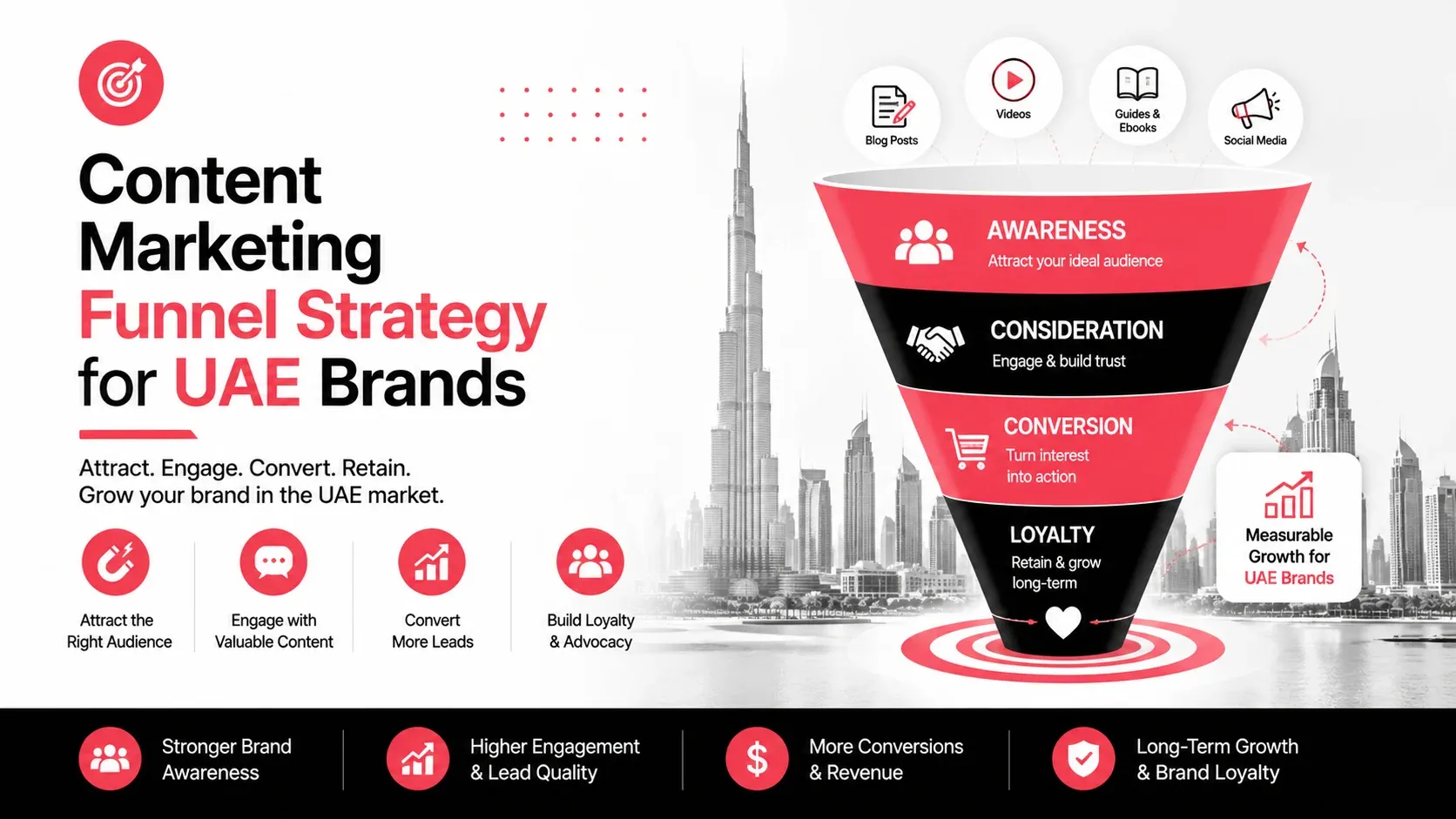
Creating valuable content is only one part of a successful marketing strategy. To consistently generate leads and customers, every piece of content should support a specific stage of the buying journey. This is where a content marketing funnel becomes essential.
A well-planned content funnel helps businesses attract new audiences, educate potential customers, build trust, and encourage conversions through relevant content at the right time. Instead of publishing isolated blog posts or social media updates, businesses can create connected content that guides prospects from their first interaction to becoming loyal customers.
For brands in the UAE, where digital competition continues to grow across industries, a structured content marketing funnel helps maximize the value of every content asset while supporting long-term business growth.
Quick Answer
A content marketing funnel is a structured strategy that delivers the right content at each stage of the customer journey. It uses awareness content to attract visitors, educational content to nurture interest, and conversion-focused content to encourage enquiries, purchases, or other business goals.
What Is a Content Marketing Funnel?
A content marketing funnel is the process of aligning your content with different stages of the buying journey.
Instead of expecting visitors to convert immediately, the funnel gradually builds trust by answering questions, solving problems, and providing valuable information.
Most content funnels are divided into three stages:
- Top of Funnel (TOFU)
- Middle of Funnel (MOFU)
- Bottom of Funnel (BOFU)
Each stage serves a different purpose and requires different types of content.
Why Every Business Needs a Content Funnel
Without a structured content strategy, businesses often publish content that attracts traffic but fails to generate meaningful results.
A content marketing funnel helps businesses:
- Attract qualified visitors
- Build brand awareness
- Educate potential customers
- Increase trust and credibility
- Support lead generation
- Improve conversion opportunities
- Strengthen long-term customer relationships
Rather than treating every visitor the same, a funnel delivers information based on where users are in their decision-making process.
The Three Stages of a Content Marketing Funnel
Each stage has a different objective and requires content that matches the audience's needs.
Funnel Stage | Content Goal | Content Examples |
|---|---|---|
TOFU | Build awareness | Blog posts, educational articles, videos |
MOFU | Educate and nurture | Guides, comparison pages, case studies |
BOFU | Encourage conversions | Service pages, consultations, testimonials |
Understanding these stages helps businesses create content that naturally moves prospects toward becoming customers.
Top of Funnel (TOFU): Build Awareness
The top of the funnel focuses on attracting people who are looking for information rather than actively searching for a specific business.
At this stage, users often ask questions such as:
- How does this work?
- What solution do I need?
- What are my options?
Useful TOFU content includes:
- Educational blog articles
- Industry insights
- Beginner guides
- Checklists
- Infographics
- Short videos
The goal is to provide helpful information without immediately promoting your products or services.
Well-optimized educational content also improves organic visibility and helps businesses reach new audiences through search engines.
Middle of Funnel (MOFU): Build Trust
Once visitors understand their problem, they begin evaluating possible solutions.
They want deeper information that helps them compare options and make informed decisions.
Effective MOFU content includes:
- Detailed guides
- Case studies
- Comparison articles
- FAQs
- Webinars
- Email sequences
This stage is an opportunity to demonstrate expertise while answering common objections and questions.
Businesses that invest in content strategy services can create structured content plans that guide prospects naturally from awareness to consideration without relying on overly promotional messaging.
Bottom of Funnel (BOFU): Encourage Conversions
At the bottom of the funnel, prospects are close to making a decision.
They already understand their needs and are evaluating which provider best meets their requirements.
Content at this stage should reduce uncertainty and encourage action.
Examples include:
- Service pages
- Customer success stories
- Testimonials
- Pricing information
- Consultation pages
- Product demonstrations
The objective is to provide the confidence visitors need to take the final step.
Create Content That Matches Search Intent
One of the biggest reasons content marketing funnels fail is that businesses create content without considering user intent.
For example:
- Someone searching for "What is content marketing?" needs educational information.
- Someone searching for "Content marketing agency" is likely evaluating service providers.
Creating the wrong type of content for a search query often results in lower engagement and fewer conversions.
Aligning content with user intent helps visitors find the information they need at the right stage of their journey.
Connect Content With Internal Links
A successful content funnel guides readers from one stage to the next.
For example:
- An educational blog can link to a detailed guide.
- A guide can link to a relevant service page.
- A service page can encourage users to request a consultation.
This approach creates a logical progression rather than expecting visitors to convert after reading a single article.
Businesses also benefit from pairing educational content with business website development, ensuring visitors move through a website that's easy to navigate and designed to support every stage of the content journey.
Balance Educational and Promotional Content
One of the most common content marketing mistakes is focusing too heavily on promotion.
Visitors in the awareness stage are looking for useful information, not sales messages. If every article immediately promotes your services, users may leave before building trust.
A healthier content mix includes:
- Educational blog posts
- Industry insights
- Practical guides
- Customer success stories
- Service-focused content
As prospects move further down the funnel, promotional content becomes more appropriate because they've already developed confidence in your expertise.
Repurpose Content Across Multiple Channels
Creating high-quality content requires time and resources, so maximize its value by adapting it for different platforms.
For example, a single blog article can become:
- Social media posts
- Email newsletters
- Short videos
- Infographics
- Presentation slides
- Downloadable resources
Repurposing content increases reach while maintaining consistent messaging throughout your marketing funnel.
Measure Funnel Performance
A content marketing funnel should be reviewed regularly to understand what's working and where improvements are needed.
Useful performance metrics include:
- Organic traffic
- Engagement time
- Pages per session
- Lead generation
- Conversion rate
- Email sign-ups
- Service enquiries
Instead of measuring content only by page views, evaluate how effectively it helps visitors progress through the funnel.
If educational articles attract significant traffic but generate few conversions, review whether your content naturally guides readers toward the next step.
Common Content Marketing Funnel Mistakes
Many businesses create content consistently but struggle to achieve meaningful business results because their funnel lacks structure.
Mistake | Better Approach |
|---|---|
Publishing random topics | Create content around a defined strategy |
Promoting services too early | Educate before selling |
Ignoring search intent | Match content to user needs |
Weak internal linking | Guide readers to relevant next steps |
No conversion opportunities | Include clear, relevant calls-to-action |
Measuring only traffic | Track leads and conversions as well |
Avoiding these mistakes helps create a funnel that supports both user experience and long-term business growth.
Key Takeaways
- A content marketing funnel guides prospects from awareness to conversion.
- Every stage requires content that matches the user's intent.
- Educational content builds trust before promotional content encourages action.
- Internal linking helps move visitors naturally through the funnel.
- Repurposing content increases visibility across multiple channels.
- Measuring conversions is just as important as measuring traffic.
- A structured content strategy produces stronger long-term marketing results.
Build a Content Funnel That Supports Sustainable Growth
Successful content marketing isn't about publishing more articles, it's about creating the right content for the right audience at the right time. A structured content marketing funnel ensures every blog, guide, service page, and resource works together to educate prospects, build trust, and support meaningful business outcomes.
As your audience grows and customer needs evolve, review your funnel regularly to identify content gaps, strengthen internal linking, and refine your strategy based on real performance data. Small improvements across each stage can significantly improve long-term results.
Milaaj Brandset helps businesses develop strategic content ecosystems that attract qualified audiences, strengthen brand authority, and generate sustainable organic growth.
FAQs
What is a content marketing funnel?
A content marketing funnel is a structured approach that delivers different types of content based on where potential customers are in their buying journey, from awareness to conversion.
What are the three stages of a content marketing funnel?
The three stages are Top of Funnel (TOFU), which builds awareness, Middle of Funnel (MOFU), which educates and nurtures prospects, and Bottom of Funnel (BOFU), which encourages conversions.
Why is a content marketing funnel important?
It helps businesses create purposeful content that attracts qualified visitors, builds trust, improves lead generation, and supports higher conversion rates.
What type of content works best at the top of the funnel?
Educational blog posts, beginner guides, videos, checklists, and industry insights are effective because they answer common questions and attract new audiences.
How do internal links support a content marketing funnel?
Internal links connect related content, helping visitors discover additional resources and move naturally from informational content to conversion-focused pages.
How can businesses measure the success of a content marketing funnel?
Key metrics include organic traffic, engagement time, pages per session, lead generation, conversion rate, email subscriptions, and service enquiries.
Ready to Elevate Your Brand?
Start Your Project Today