June 23, 2026
Google Ads vs Meta Ads for UAE Businesses
Milaaj Editorial / Research Insights
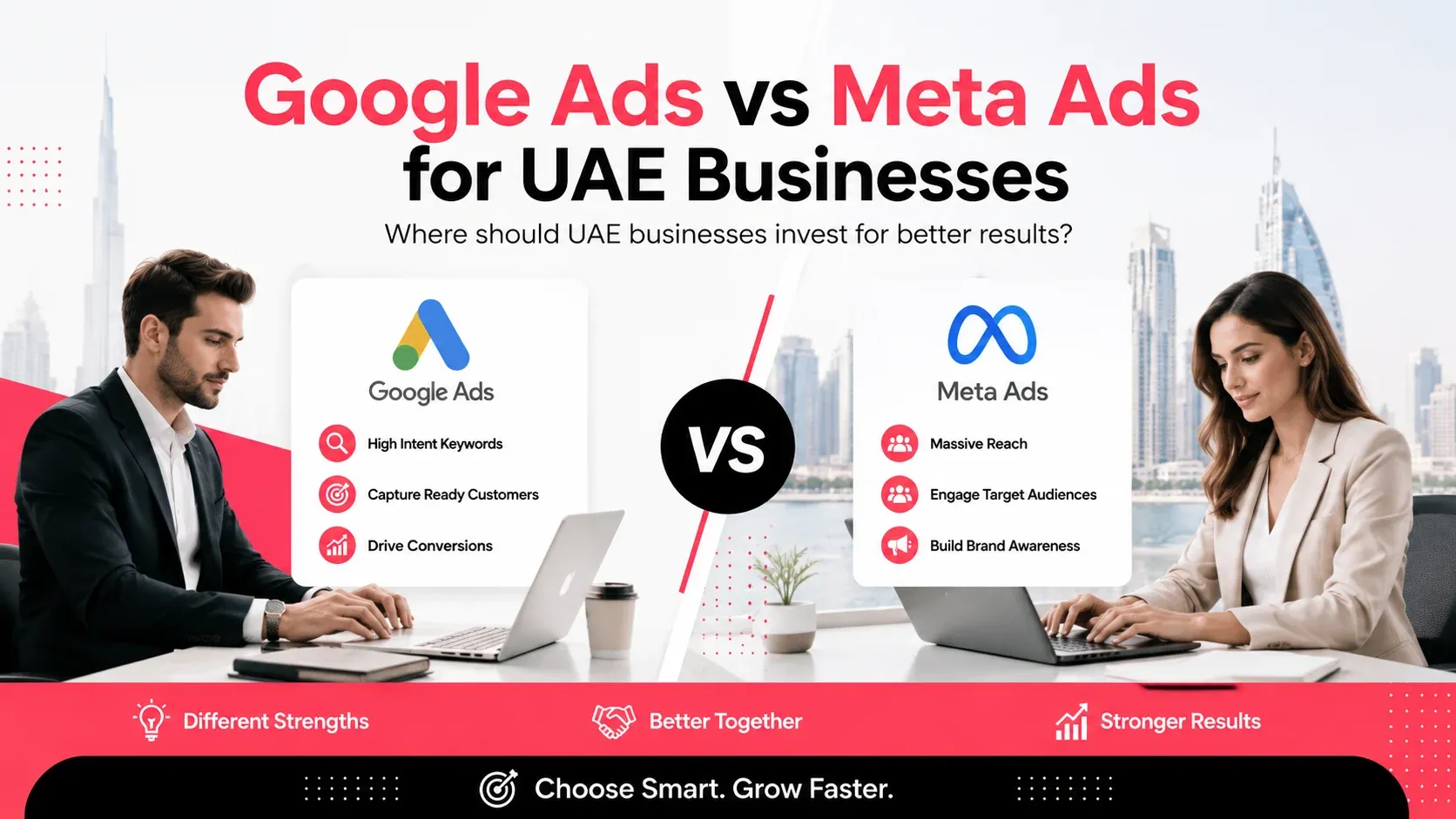
Businesses investing in digital advertising often face the same question:
Should we invest in Google Ads or Meta Ads?
Both platforms are powerful, but they serve different purposes within the customer journey.
Google Ads helps businesses capture existing demand from users actively searching for products or services. Meta Ads (Facebook and Instagram) helps businesses generate demand by reaching potential customers before they begin searching.
For UAE businesses, understanding the strengths, limitations, and ideal use cases of each platform is essential for maximizing advertising budgets and generating profitable results.
This guide compares Google Ads and Meta Ads across key areas including lead generation, targeting, customer intent, conversion potential, costs, and return on investment.
Quick Answer
Google Ads is typically better for capturing high-intent leads because users are actively searching for solutions.
Meta Ads is often better for building brand awareness, audience engagement, retargeting, and demand generation.
For most UAE businesses, the strongest results come from using both platforms strategically:
- Google Ads captures existing demand.
- Meta Ads creates and nurtures demand.
- Retargeting connects both channels.
- Conversion-focused landing pages maximize ROI.
The ideal platform depends on your industry, goals, budget, and customer journey.
Understanding the Fundamental Difference
The biggest difference between Google Ads and Meta Ads is user intent.
Google Ads
Users actively search for:
- Products
- Services
- Solutions
- Businesses
- Information
Examples:
- SEO Services Dubai
- Real Estate Agency Dubai
- Ecommerce Website Development UAE
The user already has intent.
Your goal is to appear when that demand exists.
Meta Ads
Users are browsing social platforms rather than searching.
Examples:
- Facebook
- Instagram
- Messenger
- Audience Network
Users may not be actively looking for your service.
Instead, advertisements interrupt their browsing experience and introduce opportunities they may not have considered.
This creates a fundamentally different advertising strategy.
Google Ads: Strengths for UAE Businesses
Google Ads excels when businesses need immediate visibility for high-intent searches.
Benefits include:
- Strong purchase intent
- Faster lead acquisition
- Local search visibility
- Measurable ROI
- High-quality leads
- Demand capture
For service-based businesses, Google Ads often generates some of the highest-converting traffic available.
Industries that frequently perform well include:
- Healthcare
- Legal services
- Home services
- Real estate
- Professional consulting
- Software solutions
Meta Ads: Strengths for UAE Businesses
Meta Ads provides powerful audience targeting capabilities.
Businesses can target users based on:
- Interests
- Behaviors
- Demographics
- Engagement history
- Online activity
- Custom audiences
Meta is particularly effective for:
- Brand awareness
- Audience building
- Product discovery
- Lead generation
- Retargeting
- Community growth
Businesses with visually appealing products often see strong results through Meta advertising.
Comparing User Intent
User intent significantly impacts campaign performance.
Factor | Google Ads | Meta Ads |
|---|---|---|
User Intent | High | Moderate |
Demand Type | Existing Demand | Demand Creation |
Purchase Readiness | Often Higher | Often Lower |
Customer Awareness | Usually Aware | May Be Unaware |
When users search on Google, they often have a specific need.
When users browse social media, they may not yet realize they need your solution.
This difference influences conversion rates, lead quality, and campaign structure.
Lead Generation Comparison
For lead generation campaigns, both platforms can be highly effective.
Google Ads Lead Generation
Advantages:
- Higher intent traffic
- Strong conversion potential
- Faster sales opportunities
- Better for urgent needs
Examples:
- Dentist appointments
- Legal consultations
- Business software
- Property inquiries
Meta Ads Lead Generation
Advantages:
- Lower audience acquisition costs
- Better awareness generation
- Larger audience reach
- Strong lead nurturing opportunities
Meta often works best when supported by strong follow-up systems.
Businesses focused on acquiring qualified inquiries can also explore Lead Generation services in Dubai to improve lead quality and conversion performance.
Audience Targeting Capabilities
Google and Meta approach targeting differently.
Google Targeting
- Keywords
- Search intent
- Location targeting
- Audience signals
- Remarketing lists
Meta Targeting
- Interests
- Behaviors
- Demographics
- Custom audiences
- Lookalike audiences
Meta generally offers broader audience-building capabilities, while Google offers stronger intent-based targeting.
Cost Comparison
Advertising costs vary significantly by industry.
Generally:
Google Ads
Can have:
- Higher CPCs
- Higher competition
- Higher lead quality
Meta Ads
Can have:
- Lower CPCs
- Lower CPMs
- Greater reach
However, lower advertising costs do not always mean better profitability.
The quality of leads often matters more than traffic volume.
Ecommerce: Which Platform Performs Better?
For ecommerce businesses, both platforms play important roles.
Google Ads for Ecommerce
Best for:
- Shopping campaigns
- Product searches
- Purchase-ready customers
Meta Ads for Ecommerce
Best for:
- Product discovery
- Retargeting
- Visual storytelling
- Repeat purchases
Many successful ecommerce brands use both platforms simultaneously.
Service-Based Businesses: Which Platform Wins?
For many UAE service providers, Google Ads often produces stronger lead quality because prospects are actively searching for solutions.
Examples include:
- Marketing agencies
- Law firms
- Medical clinics
- Consultants
- Contractors
However, Meta Ads can support growth by building awareness and generating future demand.
The combination often delivers stronger long-term results than relying on a single platform.
Retargeting Creates the Best Results
One of the most effective strategies combines both platforms.
Example:
- Prospect discovers your business through Meta Ads.
- Visits your website.
- Leaves without converting.
- Encounters retargeting ads.
- Returns later through Google search.
- Converts.
Modern customer journeys rarely involve a single interaction.
Retargeting helps businesses stay visible throughout the decision-making process.
For additional insights, read our Retargeting Strategies That Work in UAE Market guide.
When Should You Choose Google Ads?
Google Ads may be the better choice if:
- You need leads quickly.
- Your customers actively search online.
- Your service solves urgent problems.
- You have strong conversion tracking.
- You want intent-driven traffic.
Examples:
- Emergency services
- Healthcare providers
- Professional services
- SaaS companies
When Should You Choose Meta Ads?
Meta Ads may be the better choice if:
- You want brand awareness.
- Your product benefits from visual presentation.
- You need audience growth.
- You are launching a new brand.
- You want lower-cost reach.
Examples:
- Ecommerce brands
- Hospitality businesses
- Lifestyle brands
- Fashion retailers
- Consumer products
Why Most Businesses Need Both
The debate is often framed as Google Ads versus Meta Ads.
In reality, the highest-performing businesses typically use both.
Google captures demand.
Meta creates demand.
Together they create a more complete marketing ecosystem that supports every stage of the customer journey.
Key Takeaways
- Google Ads targets users actively searching for solutions.
- Meta Ads targets users based on interests and behaviors.
- Google often produces higher-intent traffic.
- Meta excels at awareness and audience building.
- Lead quality depends on strategy, targeting, and execution.
- Ecommerce businesses often benefit from both platforms.
- Service businesses frequently see strong results from Google Ads.
- Retargeting significantly improves overall performance.
- Combining both platforms usually delivers the strongest long-term ROI.
Choosing the Right Advertising Strategy for Growth
There is no universal winner between Google Ads and Meta Ads.
The best platform depends on your goals, industry, customer behavior, and sales process.
Businesses seeking immediate high-intent leads often prioritize Google Ads. Businesses looking to build awareness, expand reach, and nurture future customers often see strong results from Meta Ads.
The most successful UAE businesses typically integrate both platforms into a broader digital marketing strategy that captures demand, creates demand, and nurtures prospects throughout the buying journey.
For businesses evaluating broader paid advertising strategies, PPC Services Dubai can help align campaign objectives with measurable business outcomes.
Milaaj Brandset helps businesses develop performance-focused advertising strategies that combine search advertising, social media advertising, conversion optimization, and data-driven decision-making to support sustainable growth.
FAQs
Which is better for lead generation: Google Ads or Meta Ads?
Google Ads often generates higher-intent leads, while Meta Ads can generate larger volumes of leads at lower acquisition costs.
Are Meta Ads cheaper than Google Ads?
Meta Ads often have lower CPCs and CPMs, but overall profitability depends on lead quality and conversion rates.
Which platform is better for ecommerce?
Most ecommerce businesses benefit from using both Google Ads and Meta Ads together.
Can service businesses use Meta Ads successfully?
Yes. Meta Ads can support awareness, lead generation, and retargeting strategies for service businesses.
Is Google Ads better for local businesses?
Google Ads is often highly effective for local businesses because users actively search for nearby services.
What role does retargeting play?
Retargeting helps businesses reconnect with users who have previously interacted with the brand, improving conversion opportunities.
Should startups use Google Ads or Meta Ads?
The answer depends on the business model, customer journey, and budget. Many startups benefit from testing both platforms.
Can I run Google Ads and Meta Ads simultaneously?
Yes. Many successful businesses use both platforms together to maximize reach, lead generation, and conversions.
Ready to Elevate Your Brand?
Start Your Project Today