August 31, 2026
How Long-Form Content Improves SEO Rankings: Best Practices
Milaaj Editorial / Research Insights
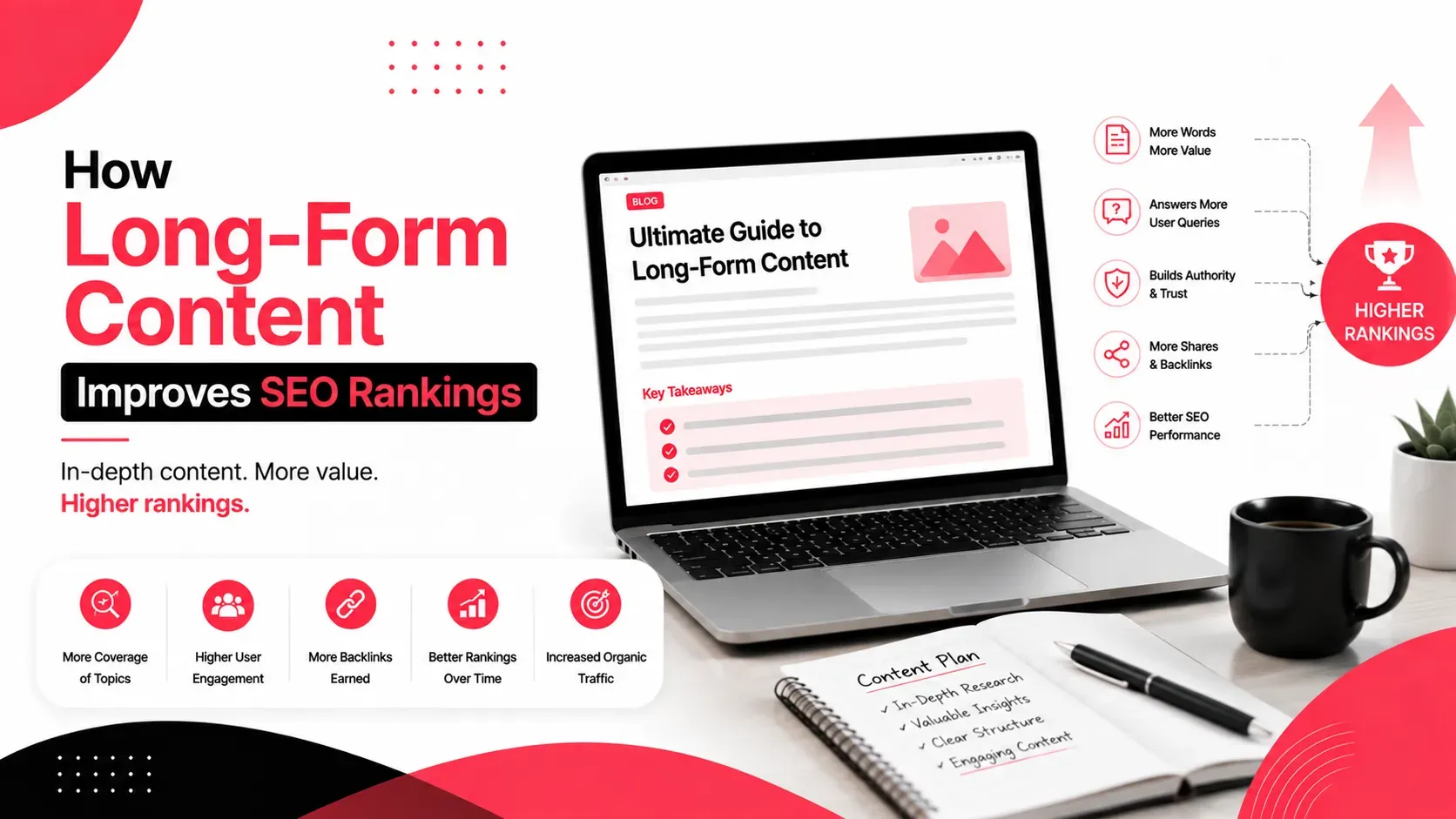
Long-form content has become a common part of many successful SEO strategies. Comprehensive articles can cover complex subjects in greater depth, answer multiple related questions, and provide useful resources for people researching a topic.
But there is an important distinction between long-form content and content that is simply long.
Writing 3,000 words instead of 1,000 doesn't automatically improve rankings. Search engines don't reward a page merely because it reaches a particular word count. The real value of long-form content comes from its ability to satisfy search intent, provide comprehensive information, establish topical relevance, and create a better path through related content.
When planned properly, long-form articles can become valuable SEO assets that attract organic traffic and support broader content strategies.
Quick Answer
Long-form content can support SEO rankings when it provides comprehensive, useful, and relevant information that satisfies the searcher's intent.
It can help by:
- Covering a topic in meaningful depth
- Answering related questions on one page
- Naturally including relevant terminology
- Supporting topical authority
- Creating opportunities for internal links
- Connecting readers with related resources
- Attracting backlinks when the content is genuinely valuable
- Providing a strong foundation for evergreen content
However, word count itself is not a ranking factor.
A 1,500-word article that completely answers a query can be more useful than a 4,000-word article filled with repetition.
The goal should always be useful depth, not unnecessary length.
Does Long-Form Content Improve SEO Rankings?
Long-form content can contribute to stronger SEO performance, but it isn't a guaranteed ranking advantage.
Search engines aim to provide useful results that satisfy users. Google has repeatedly emphasized creating helpful, reliable, people-first content rather than producing content primarily to manipulate search rankings.
This means businesses should think about long-form content as a way to provide better topic coverage, not as a way to hit an arbitrary word count.
What Counts as Long-Form Content?
There is no universal definition of long-form content.
Depending on the subject, long-form content might be:
- A detailed guide
- An industry report
- A comprehensive tutorial
- A pillar page
- An in-depth comparison
- A research-based article
- A complete resource covering a complex question
For one topic, 1,500 words may provide excellent coverage.
For another, 2,500 words may be necessary.
The appropriate length depends on:
- Topic complexity
- Search intent
- Audience expectations
- Existing search results
- Amount of useful information available
- Content format
Instead of asking "How many words should this article have?", ask:
"What information does the reader need to accomplish their goal?"
Why Content Depth Matters More Than Word Count
Content depth means addressing the important aspects of a subject rather than simply adding more paragraphs.
For example, an article about SEO for small businesses might need to explain:
- Keyword research
- On-page SEO
- Technical SEO
- Local SEO
- Content strategy
- Internal linking
- Measurement
If those topics are genuinely relevant to the reader, comprehensive coverage adds value.
But adding unrelated sections simply to increase length doesn't.
Good long-form content should be complete without being repetitive.
How Long-Form Content Supports SEO
Long-form content can provide several advantages when it is built around a clear search and content strategy.
Covers Search Intent More Comprehensively
Search intent describes what someone is trying to accomplish when they enter a query.
A broad informational search may involve several related questions.
For example, someone searching for "content marketing strategy" may want to understand:
- What content marketing is
- Why it matters
- How to create a strategy
- What content formats to use
- How to measure results
- Common mistakes
A comprehensive article can address many of these needs without forcing the reader to visit several unrelated pages.
This can improve the usefulness of the resource.
Targets Related Search Terms Naturally
A comprehensive article often discusses concepts that are semantically related to the main topic.
For an article about SEO audits, naturally relevant terms might include:
- Technical SEO
- Crawlability
- Indexing
- Broken links
- Metadata
- Internal links
- Core Web Vitals
- Structured data
You don't need to force these terms into the article.
If they're genuinely relevant to the topic, they will often appear naturally as part of a thorough explanation.
This is very different from keyword stuffing.
The objective is to demonstrate complete topical coverage, not repeat the same keyword dozens of times.
Builds Topical Authority
A single article rarely establishes strong expertise around an entire subject.
A broader content strategy can combine comprehensive resources with supporting articles.
For example:
Main topic: SEO Strategy
Supporting topics:
- Keyword research
- Technical SEO
- Internal linking
- SEO-friendly URLs
- Content optimization
- Local SEO
A comprehensive central resource can introduce these subjects while linking to more detailed pages.
This is where a pillar page strategy for SEO growth can become useful.
The objective is to create a network of genuinely useful resources rather than producing isolated articles.
Creates More Internal Linking Opportunities
Long-form articles often discuss multiple related concepts, creating natural opportunities to link to relevant pages.
For example, an article about content marketing could link to resources covering:
- SEO
- Internal linking
- Evergreen content
- Content clusters
- Conversion optimization
These links can help users discover additional information.
They can also help search engines understand relationships between pages.
A well-planned internal linking strategy should focus on relevance and usefulness rather than simply increasing the number of links.
Supports User Engagement and Content Discovery
A well-structured long-form article can keep users engaged by allowing them to find multiple answers in one place.
Useful elements include:
- Descriptive headings
- Short paragraphs
- Bullet points
- Examples
- Tables when appropriate
- Images or diagrams
- Jump links
- Relevant internal links
- Clear conclusions
The objective isn't to make visitors spend as much time as possible on a page.
The objective is to help them find what they need efficiently.
If the answer is provided quickly, that can be a positive user experience.
How to Create SEO-Friendly Long-Form Content
Creating a long article isn't enough. It needs a clear strategy from research through publication.
Start With Search Intent and Topic Research
Before writing, determine:
What does the searcher want?
Then research:
- Primary keyword
- Related queries
- Common questions
- Important subtopics
- Competitor content
- Customer pain points
Look at what existing search results cover, but don't simply reproduce them.
Identify information gaps and opportunities to provide a better explanation.
Build a Clear Content Structure
Long articles become difficult to read when they don't have a logical structure.
Use:
- One clear H1
- Relevant H2 sections
- H3 subsections where necessary
- Short paragraphs
- Lists
- Descriptive anchor text
- Clear transitions
For example:
H1: How Long-Form Content Improves SEO
H2: How Long-Form Content Supports SEO
H3: Search Intent
H3: Topical Authority
H3: Internal Linking
This gives both readers and search engines a clearer understanding of the page.
Cover the Topic Without Repetition
Before writing, create a content outline.
List the questions the article needs to answer.
Then remove sections that:
- Repeat another section
- Add no meaningful information
- Exist only for keyword targeting
- Are unrelated to the primary topic
This makes the final article more useful and easier to read.
Add Relevant Internal and External Links
Use internal links to guide readers toward useful related pages.
External links can also be appropriate when citing authoritative information or providing additional resources.
Anchor text should describe the destination accurately.
Avoid:
- Repeating the same anchor excessively
- Adding unrelated links
- Linking every keyword
- Creating unnatural link patterns
Links should support the reader's journey.
Optimize for Readability and User Experience
Long-form content can quickly become overwhelming.
Make it easier to scan.
Use:
- Short paragraphs
- Clear headings
- Bullet lists
- Visual breaks
- Simple language
- Examples
- Bold emphasis where useful
Avoid unnecessary jargon.
The best long-form content can explain complex subjects without making readers work unnecessarily hard.
Update Content Over Time
Some long-form articles can remain valuable for years, but that doesn't mean they should never be reviewed.
Update:
- Statistics
- Examples
- Links
- Screenshots
- Industry information
- Recommendations
This is particularly important for topics involving technology, marketing platforms, regulations, or rapidly changing practices.
Common Long-Form Content Mistakes to Avoid
Writing Mainly to Reach a Word Count
This is one of the biggest mistakes.
If an article answers the user's question in 1,400 useful words, don't add another 1,000 words simply to make it longer.
More content isn't automatically better content.
Adding Unnecessary Information
Every section should contribute to the reader's understanding.
If a paragraph doesn't answer a question, provide context, or help the reader take the next step, consider removing it.
Keyword Stuffing
Long-form articles naturally contain related keywords.
There is no need to repeatedly insert exact-match phrases.
Write for humans first.
Use keywords where they make sense in:
- Titles
- Headings
- Body copy
- URLs
- Metadata
- Anchor text
But keep the language natural.
Ignoring Search Intent
A long article can still fail if it doesn't answer what the searcher wants.
For example, someone searching for a quick definition may not need a 3,000-word history lesson.
Match the content depth to the actual query.
Neglecting Conversion Opportunities
Business content should support the customer journey.
If someone reads a detailed article and wants professional help, there should be an appropriate next step.
This might be:
- A relevant service page
- A consultation
- A downloadable resource
- Another useful guide
- A contact option
The CTA should fit the reader's intent rather than interrupting the educational experience.
How to Measure Long-Form Content SEO Performance
Don't judge long-form content solely by word count or page views.
Track metrics such as:
- Organic impressions
- Organic clicks
- Keyword rankings
- Organic traffic
- Engagement
- Internal link clicks
- Backlinks
- Leads
- Conversions
Google Search Console can help identify the queries generating impressions and clicks.
Analytics data can help determine what visitors do after reaching the article.
For example, if a long-form article attracts substantial organic traffic but produces no meaningful engagement or conversions, examine whether:
- The traffic matches the target audience
- The content satisfies search intent
- The CTA is relevant
- Internal links are useful
- The topic has commercial relevance
SEO success isn't simply about getting more visitors.
Relevant visibility and meaningful business outcomes matter more.
Key Takeaways
- Long-form content can support SEO when it provides meaningful depth.
- Word count itself doesn't guarantee better rankings.
- Search intent should determine how comprehensive an article needs to be.
- Thorough content can naturally cover related concepts and terminology.
- Topic clusters and pillar pages can strengthen broader content strategies.
- Internal links can connect long-form resources with relevant pages.
- Readability becomes especially important as content gets longer.
- Avoid adding unnecessary information just to increase word count.
- Keyword stuffing can make content unnatural and reduce quality.
- Update long-form content when information becomes outdated.
- Measure organic visibility, engagement, leads, and conversions.
- Focus on useful content rather than writing simply to satisfy an SEO word-count target.
Conclusion
Long-form content can be a powerful part of an SEO strategy, but its value doesn't come from being long.
Its value comes from being comprehensive enough to satisfy the searcher's needs.
A well-researched long-form article can answer related questions, demonstrate subject knowledge, connect readers with supporting resources, and create opportunities for internal linking. Over time, it can also become an important part of a broader content ecosystem.
The key is to start with search intent.
Understand what your audience wants. Build an outline around that need. Cover the important aspects of the subject without repetition. Use relevant internal links and clear headings. Then monitor performance and improve the content when necessary.
Businesses should also avoid treating every topic as a long-form opportunity.
Some searches need a short, direct answer.
Others require a comprehensive guide.
The right length is the length required to provide the best useful answer.
For businesses looking to combine comprehensive content with technical optimization, keyword strategy, internal linking, and sustainable organic growth, SEO services in Dubai can help create a more complete SEO framework. Milaaj Brandset helps businesses connect SEO and content marketing with broader digital growth objectives.
Ultimately, long-form content works best when you stop asking "How many words should this page contain?" and start asking:
"How can this page become the most useful resource for the person searching for this topic?"
Frequently Asked Questions
Does Google rank long-form content higher?
Not simply because it is long. Google evaluates many signals, and content should primarily be useful, relevant, and created to satisfy people. Long-form content can perform well when its additional depth genuinely helps the searcher.
What is the ideal word count for SEO content?
There is no universal ideal word count. The appropriate length depends on the topic, search intent, competition, and amount of information needed to provide a complete answer.
Is 2,000 words enough for SEO?
Yes, if 2,000 words provide sufficient coverage for the topic. A useful 2,000-word article can outperform a much longer article that contains unnecessary information.
Does long-form content generate more organic traffic?
It can, particularly when it comprehensively addresses topics with meaningful search demand. However, traffic depends on factors such as relevance, content quality, competition, authority, technical SEO, and search intent.
Does long-form content help build backlinks?
It can. Comprehensive original resources, research, guides, and useful reference material may be more likely to earn backlinks when other websites find them valuable enough to cite.
Should every blog post be long-form?
No. Content length should match the topic and search intent. Some questions are best answered briefly, while complex subjects benefit from comprehensive coverage.
How often should long-form content be updated?
There is no fixed schedule. Review content when information changes, performance declines, links become outdated, or new information significantly improves the resource.
Ready to Elevate Your Brand?
Start Your Project Today