August 12, 2026
How Startups Can Compete with Bigger Brands
Milaaj Editorial / Research Insights
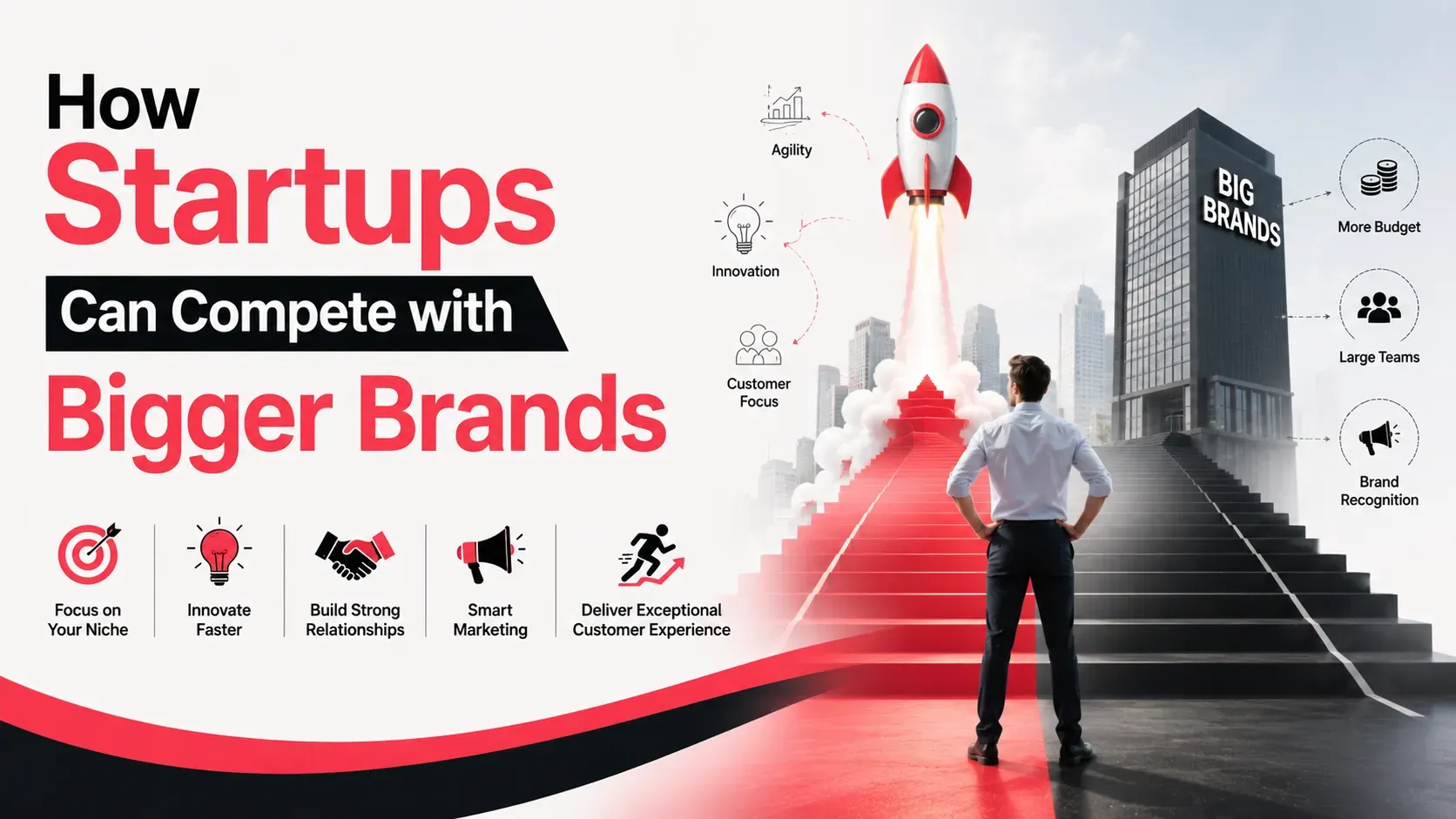
Competing with established brands can seem almost impossible for a startup. Larger companies often have bigger advertising budgets, stronger brand recognition, larger teams, and years of customer relationships behind them.
But startups do not need to beat big brands at everything.
They need to compete differently.
A startup can move faster, specialize more deeply, provide a more personal experience, and respond to customer needs without navigating layers of corporate decision-making. Those advantages can become powerful competitive tools when they are built into the company's strategy.
For startups, the goal isn't to look bigger than they are. It is to become more relevant, more agile, and more valuable to a specific audience.
Quick Answer
Startups can compete with bigger brands by focusing on a specific niche, creating a strong point of differentiation, responding to customers faster, delivering personalized experiences, building authority through content and SEO, developing partnerships, encouraging referrals, and experimenting more quickly.
Instead of trying to match a large company's advertising budget or product range, startups should identify areas where being smaller gives them an advantage.
Why Startups Can Compete With Bigger Brands
Large companies have obvious advantages.
They may have:
- Larger marketing budgets
- More employees
- Greater distribution
- Higher brand awareness
- More established customer bases
- Greater purchasing power
However, scale can also create limitations.
A large company may need several approval stages before changing a campaign. A startup might change it the same afternoon.
A multinational business may have standardized customer service processes. A startup can potentially speak directly with the founder or decision-maker.
A large brand may target an enormous market. A startup can focus intensely on one specific customer group.
This creates an important strategic principle:
1. Don't Try to Outspend Bigger Brands
One of the most expensive mistakes a startup can make is trying to win through advertising budget alone.
If an established competitor can spend ten times more on paid media, attempting to beat them by spending more may quickly drain your resources.
Instead, focus on efficiency.
Ask:
- Which customers are most valuable?
- Which channels reach them most effectively?
- Which content attracts qualified prospects?
- Which offers convert?
- Where is competition weaker?
- Which customers are currently underserved?
A smaller marketing budget can still produce strong results when it is concentrated on a clearly defined audience.
The objective isn't maximum exposure.
It is maximum relevance per marketing dollar.
2. Own a Smaller Niche
Big brands often need broad markets to justify their scale.
Startups can take the opposite approach.
Instead of trying to serve everyone, become exceptionally relevant to a smaller group.
For example, rather than positioning a software product as:
Business management software
a startup could specialize in:
Business management software for UAE property management companies.
The second positioning immediately creates a clearer market identity.
It also makes it easier to develop:
- Industry-specific content
- Relevant features
- Targeted landing pages
- Specialized messaging
- Customer case studies
- Partnerships
Once a startup becomes recognized within a niche, it can expand into adjacent markets.
3. Make Speed a Competitive Advantage
Large companies have resources, but they can also have complex decision-making structures.
Startups can often move much faster.
A startup can:
- Test a new offer quickly
- Change website messaging
- Launch a new landing page
- Respond to customer feedback
- Experiment with content
- Adjust pricing
- Introduce product improvements
Speed becomes particularly valuable when customer expectations change rapidly.
Instead of spending months deciding whether a new opportunity is worth pursuing, a startup can create a small experiment and learn from real market feedback.
The advantage isn't simply moving quickly.
It's learning quickly.
4. Know Your Customers Better
A startup doesn't need millions of customers to build meaningful customer intelligence.
It can start by speaking directly with the people already using its product or service.
Ask customers:
- Why did you choose us?
- What problem were you trying to solve?
- What alternatives did you consider?
- What nearly stopped you from buying?
- What do you like most about our solution?
- What would you change?
- What would make you recommend us?
These conversations can reveal positioning opportunities that competitors may have overlooked.
Customer knowledge can become a genuine competitive advantage.
5. Deliver a More Personal Experience
Personalization is one area where startups can compete effectively.
A large organization may have sophisticated automation, but that doesn't automatically make the customer experience feel personal.
A startup can differentiate itself through:
- Direct communication
- Personalized onboarding
- Faster responses
- Flexible solutions
- Founder involvement
- Customized recommendations
- Proactive follow-ups
For a small business customer, speaking with someone who understands their specific situation can be more valuable than interacting with a large but impersonal organization.
Technology can support this experience, but the relationship should remain at the center.
6. Become the Expert in One Problem
Instead of trying to establish authority around an entire industry, startups can become known for solving one particular problem exceptionally well.
For example, a startup could focus its content and expertise around:
- A specific business process
- One customer segment
- A particular technology
- A specialized industry challenge
- A geographic market
This approach makes content more focused and helps the brand build topical relevance.
Over time, customers may begin associating the startup with that particular problem.
That association is valuable.
7. Build Authority Through SEO
SEO can give startups an opportunity to compete for attention without relying entirely on advertising.
The key is to avoid immediately targeting the most competitive keywords.
Instead, build content around the questions and problems your target customers actually search for.
Useful opportunities include:
- Long-tail keywords
- Industry-specific searches
- Problem-based queries
- Comparison content
- How-to guides
- Original research
- Case studies
- Supporting resources
A startup can gradually establish authority by creating a connected collection of genuinely useful content.
For a deeper understanding of this approach, businesses can also explore how to build topical authority for SEO in Dubai.
The objective isn't simply to publish more articles than competitors.
It is to provide better answers for the people you want to become customers.
8. Compete Through Customer Experience
A startup may not be able to offer the biggest product catalogue, but it can often make the customer journey easier.
Look at every stage:
Discovery → Enquiry → Purchase → Onboarding → Support → Retention
Where is friction occurring?
Perhaps customers wait too long for responses.
Maybe the onboarding process is confusing.
Perhaps pricing isn't clear.
Maybe customers have to repeat information to different team members.
Fixing these issues can create a competitive advantage without requiring a huge marketing investment.
Sometimes the easiest way to compete with a bigger company is simply to make doing business with you easier.
9. Use Authenticity as an Advantage
Customers increasingly have access to enormous amounts of polished marketing content.
That makes genuine expertise valuable.
Startups can show the people and thinking behind the business through:
- Founder insights
- Behind-the-scenes content
- Product development stories
- Customer experiences
- Expert opinions
- Transparent explanations
- Lessons learned
This doesn't mean manufacturing an artificial personality.
The strongest founder-led branding usually comes from sharing knowledge and experiences that genuinely help the audience.
10. Build a Community, Not Just an Audience
A social media following is useful, but a community can be much more valuable.
A community creates repeated interaction between customers, prospects, experts, and the brand.
Depending on the business, this could involve:
- Customer groups
- Industry events
- Webinars
- Online communities
- Workshops
- Founder discussions
- User groups
A strong community can generate feedback, referrals, content ideas, partnerships, and customer loyalty.
Big brands can have enormous audiences.
Startups can create closer relationships.
11. Experiment More Frequently
Startups have an opportunity to treat uncertainty as something to investigate rather than something to fear.
Instead of assuming that one marketing strategy will work, test different possibilities.
For example, test:
- Two value propositions
- Different customer segments
- Different landing pages
- New content formats
- Alternative offers
- Partnership opportunities
- Different acquisition channels
The purpose of experimentation isn't to make every campaign successful.
It's to discover what deserves more investment.
A failed experiment that prevents a startup from wasting six months on the wrong strategy can still be extremely valuable.
12. Use Partnerships to Extend Your Reach
A startup doesn't always need to build its entire audience independently.
Partnerships can provide access to people who already trust another organization.
Potential partners include:
- Complementary businesses
- Consultants
- Industry associations
- Technology companies
- Agencies
- Professional communities
- Niche creators
Partnership opportunities could involve:
- Joint webinars
- Referral arrangements
- Co-created content
- Integration partnerships
- Events
- Cross-promotions
The best partnerships work because both businesses provide something useful to the same audience.
13. Turn Customers Into Advocates
Satisfied customers can become one of a startup's strongest competitive assets.
Encourage customers to share their experiences through:
- Reviews
- Testimonials
- Case studies
- Referrals
- User-generated content
- Recommendations
- Industry discussions
A potential customer may trust an existing customer's experience more than another advertisement.
Make advocacy easy.
Provide customers with simple ways to leave feedback or introduce others to your business.
14. Build a Distinctive Brand
A startup doesn't need to imitate the visual identity of an established competitor to look credible.
It needs an identity that is:
- Recognizable
- Relevant
- Consistent
- Appropriate for its audience
- Clearly differentiated
Branding should reinforce the company's positioning rather than exist separately from it.
This includes the visual identity, messaging, tone of voice, website, social presence, and customer experience.
For startups that need to turn their positioning into a cohesive and recognizable visual system, Brand Identity Development can provide an important strategic foundation.
The objective isn't to make the startup look bigger.
It is to make it easier to recognize and remember.
15. Use Technology Without Becoming Impersonal
Automation and AI can give startups capabilities that previously required large teams.
They can help with:
- Lead qualification
- Customer support
- Content research
- Personalization
- Analytics
- Marketing automation
- Customer segmentation
- Workflow management
But technology shouldn't become an excuse to remove human interaction.
A chatbot that gives customers irrelevant answers isn't a competitive advantage.
Automation should reduce repetitive work while allowing the team to spend more time on decisions and relationships that require human judgment.
Startup vs Big Brand: Where Each Has an Advantage
Big Brand Advantage | Startup Counter-Advantage |
|---|---|
Larger advertising budget | More focused spending |
Broad market reach | Niche specialization |
Large workforce | Faster decision-making |
Established reputation | Personal relationships |
Extensive product range | Specialized solutions |
Large customer base | Deeper customer knowledge |
Standardized processes | Greater flexibility |
Strong recognition | Distinctive positioning |
The point isn't that startups have more advantages than large companies.
They don't.
The point is that different strengths can produce competitive results.
A Practical Strategy for Startups
A startup competing against established brands can use a simple sequence:
Find a Niche
Identify a customer segment where the business can become highly relevant.
Understand It Deeply
Learn the customer's problems, buying behavior, objections, and expectations.
Differentiate
Find a reason customers should choose you beyond price.
Build Authority
Create useful content, demonstrate expertise, and publish evidence.
Deliver Better Experiences
Remove friction from sales, onboarding, service, and support.
Create Advocates
Turn satisfied customers into reviewers, referrers, and case studies.
Expand Carefully
Once the startup has established a strong position, move into adjacent audiences and markets.
This creates a more sustainable path than attempting to compete everywhere from day one.
Mistakes Startups Should Avoid When Competing With Big Brands
Copying Large Companies
A startup shouldn't replicate a big brand's strategy simply because it appears successful.
Competing Only on Price
A race to the bottom can destroy margins and make differentiation harder.
Trying to Serve Everyone
Broad positioning can make a startup less relevant to everyone.
Spending Before Validating
Large marketing campaigns should follow evidence that the product, audience, and message work.
Ignoring Customer Experience
Marketing can attract customers, but poor experiences will push them toward competitors.
Chasing Vanity Metrics
Followers, impressions, and website traffic don't automatically translate into revenue.
The focus should remain on meaningful business outcomes.
Key Takeaways
- Startups don't need to outspend larger competitors.
- Niche specialization can make a smaller company more relevant.
- Speed and experimentation can counterbalance the scale of established brands.
- Direct customer knowledge is a powerful competitive asset.
- Personalized service can differentiate a startup from larger organizations.
- SEO can help startups build long-term visibility around specific customer problems.
- Partnerships can provide access to established audiences.
- Customer advocacy can strengthen trust and generate referrals.
- A distinctive brand makes a startup easier to recognize and remember.
- Technology should improve efficiency without removing the human element.
Conclusion
A startup does not need to become a smaller version of a large corporation to compete successfully.
It needs to understand where it can be better.
That might mean knowing a niche customer group more deeply, responding faster, providing more personal service, becoming the authority on a specific problem, or creating an experience that feels significantly easier.
Large brands have scale.
Startups have agility, focus, and proximity to their customers.
The strongest competitive strategy is therefore not to fight established companies on every battlefield. It is to choose the right battlefield, build a clear advantage, and become exceptionally valuable to the people you serve.
Over time, that focused advantage can become the foundation for a much larger brand.
For startups looking to turn these principles into a practical growth strategy, Milaaj Brandset can help build the right combination of branding, digital marketing, and web solutions. Explore our digital marketing services to develop a strategy aligned with your business goals.
Frequently Asked Questions
Can startups really compete with large companies?
Yes. Startups can compete by focusing on areas where their smaller size provides an advantage, such as specialization, speed, personalization, customer relationships, and experimentation.
Should startups try to compete on price?
Usually not as their primary strategy. Competing only on price can reduce margins and make it difficult to build a sustainable advantage. Differentiation through expertise, service, convenience, or customer experience is often stronger.
How can a startup compete with a well-known brand?
Start by targeting a specific niche, developing a clear value proposition, demonstrating expertise, delivering excellent customer experiences, and building trust through reviews, case studies, and useful content.
Can SEO help startups compete with bigger companies?
Yes. Startups can target specific long-tail and industry-related searches where relevance matters more than overall brand size. Consistently useful content can help build organic visibility over time.
What is the biggest advantage startups have over large companies?
There isn't one universal advantage, but speed and flexibility are often significant. Startups can make decisions, test ideas, respond to customers, and adjust their strategies without the organizational complexity of large corporations.
How can startups build trust against established brands?
Startups can use customer reviews, testimonials, case studies, transparent communication, expert content, strong branding, and reliable customer experiences to reduce perceived risk and demonstrate credibility.
Ready to Elevate Your Brand?
Start Your Project Today