September 15, 2026
LLM Integration for Business: A Beginner's Guide for UAE Companies
Milaaj Editorial / Research Insights
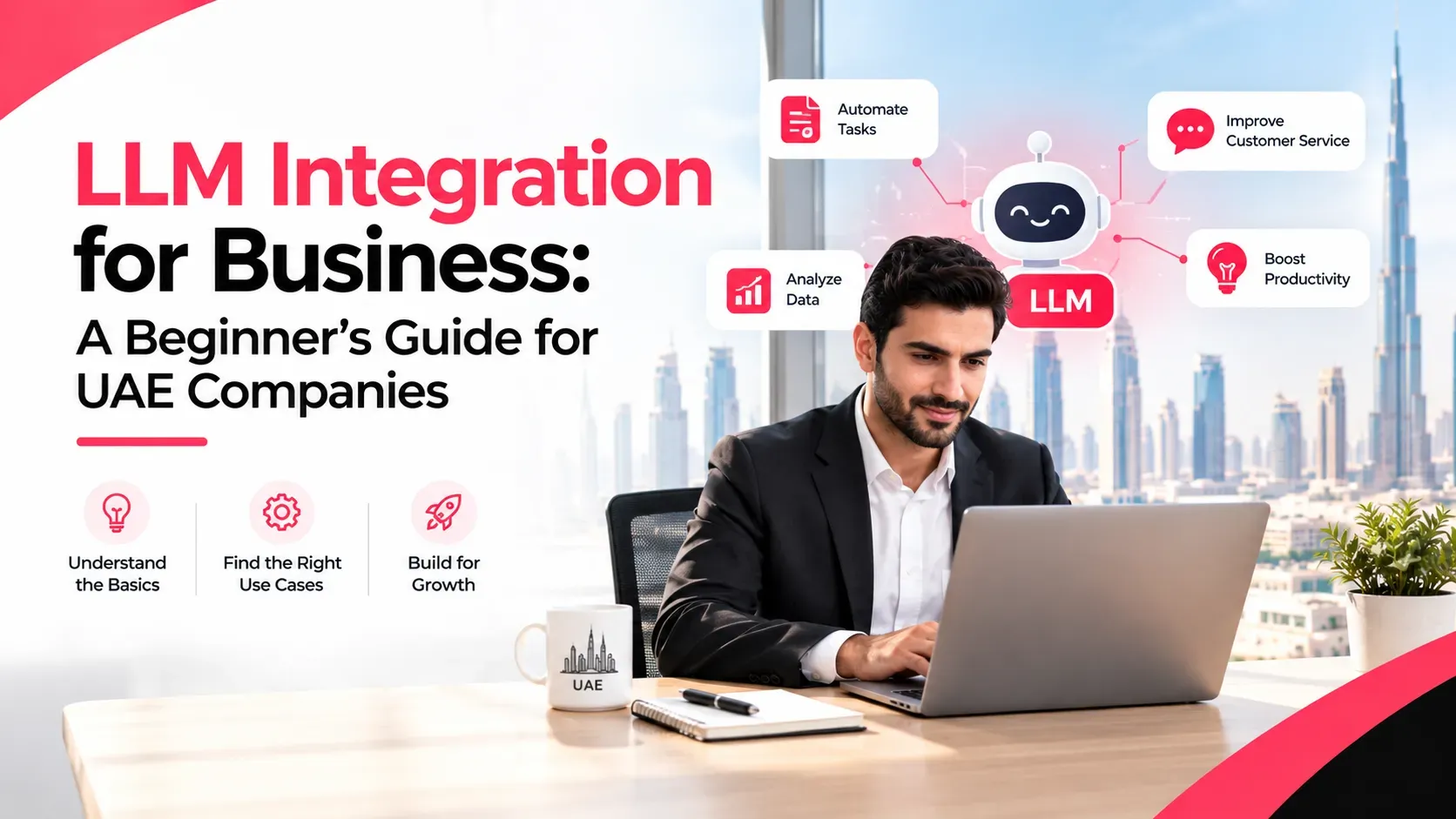
Maybe someone on your team mentioned "integrating an LLM" in a meeting, and you nodded along while quietly wondering what that actually means for your business.
You're not behind. Most business owners and marketing managers in the UAE are hearing this term for the first time this year, and the explanations online tend to swing between overly technical and vague marketing fluff.
Let's fix that. By the end of this guide, you'll know exactly what LLM integration is, what it can realistically do for your business, and how to start without needing an in-house AI team.
Quick Answer
An LLM (large language model) is the AI technology behind tools like ChatGPT. LLM integration means connecting that technology to your own business data, systems, or website so it can handle tasks like answering customer questions, searching your internal documents, or drafting content, using your actual information instead of generic public knowledge.
Key Takeaways
- An LLM is the AI model itself; integration is the process of connecting it to your business so it becomes genuinely useful for your specific operations.
- LLM integration goes beyond a basic chatbot. It can search your documents, analyze your data, and handle tasks across multiple systems.
- Common UAE business use cases include customer support, internal knowledge search, content drafting, and reporting.
- Data privacy matters here. UAE businesses need to think about where their data goes and how it's handled under local law.
- You don't need a full AI department to start. A focused pilot project with the right partner is usually the smarter first move.
What Is an LLM, in Plain English?
A large language model (LLM) is an AI system trained on enormous amounts of text so it can understand and generate human language. As IBM explains it, these models are capable of understanding and generating natural language to perform a wide range of tasks, from answering questions to writing code.
Think of an LLM as a very well-read assistant. It's read an enormous slice of the internet, so it can write, summarize, answer questions, and hold a conversation. But out of the box, it only knows what it was trained on. It has no idea what's inside your customer database, your pricing sheet, or last quarter's sales report.
That's where integration comes in.
What Does "LLM Integration" Actually Mean?
LLM integration is the process of connecting an AI model to your business's own data, tools, or workflows, so it can answer questions and complete tasks using your actual information rather than generic public knowledge. Instead of a generic chatbot, you get an assistant that knows your products, your policies, and your customers.
LLM Integration vs a Standard Chatbot: What's the Difference?
This is the confusion that trips up most beginners, so it's worth untangling clearly.
A standard chatbot, the kind businesses have used for years, usually follows a fixed script. You click a button, it gives you a pre-written answer, and if your question falls outside its rules, it hands you off to a human.
An LLM-integrated assistant works differently:
- It understands natural language, not just pre-set button clicks.
- It can pull real answers from your actual documents, product catalog, or database.
- It can handle open-ended questions it was never explicitly programmed to answer.
- It can be connected to multiple systems at once, not just a single script.
If you've ever been frustrated by an old-style chatbot that couldn't understand a slightly unusual question, that's the gap LLM integration closes. If your business already has a basic chatbot and you're wondering whether it's worth upgrading, it's worth exploring what custom AI chatbot development actually looks like before assuming your current setup is as good as it gets.
Real Business Use Cases for LLMs in the UAE
Customer Support and Query Handling
An LLM connected to your product information and FAQs can answer specific customer questions accurately, day or night, without a human needing to type out the same answer for the hundredth time.
Internal Knowledge Search
If your team spends time digging through old emails, shared drives, or PDFs to find one piece of information, an LLM can be pointed at that data and turned into a search tool that actually understands what you're asking.
Content and Communication Drafting
From first drafts of marketing copy to internal reports and customer replies, an LLM can speed up the writing process significantly, with a human reviewing and refining the output before it goes out.
Data Analysis and Reporting
LLMs can summarize large sets of data, spot patterns, and turn raw numbers into a plain-English summary a non-technical manager can actually use. Many UAE businesses are already using general AI tools for exactly this kind of task, and it's worth reading up on broader ChatGPT and AI tools for business marketing if you want a wider picture before narrowing in on a custom integration.
What to Consider Before You Integrate an LLM
Data Privacy and UAE Compliance
This is the part businesses most often overlook, and it's not optional.
If your LLM integration touches customer or employee data, you need to understand how that data is stored, processed, and protected under the UAE's Federal Decree-Law No. 45 of 2021 on data protection, commonly known as the PDPL. Where your data is hosted, and whether it stays within the UAE, is a decision that needs to be made deliberately, not as an afterthought. If this is new territory for you, it's worth reading through the basics of AI sovereignty and local data hosting in the UAE before committing to a specific setup.
Cost and Ongoing Maintenance
LLM integration isn't a one-time purchase. Costs typically include the initial setup and development, ongoing usage fees tied to how much the AI is used, and periodic updates as your business data changes. A small, focused integration (like a support assistant trained on your FAQs) costs far less than a company-wide AI system connected to every department.
How to Get Started with LLM Integration
You don't need to overhaul your entire business to get value from this. Most successful integrations start small and expand once they prove useful.
- Pick one clear, specific problem to solve first, such as slow customer response times or a hard-to-search knowledge base.
- Identify which data the LLM actually needs access to, and nowhere more than that.
- Decide on data hosting and privacy requirements before any development starts, not after.
- Build and test a focused pilot rather than a company-wide rollout on day one.
- Measure the actual impact (time saved, faster responses, fewer repetitive tickets) before deciding whether to expand it.
If step one already feels overwhelming, that's normal. This is exactly the kind of project where getting expert guidance early saves you from an expensive false start. LLM integration services for Dubai businesses can help you map out the right first project for your specific business, rather than guessing at what "AI integration" should even look like.
Frequently Asked Questions
What does LLM integration mean for a business?
It means connecting an AI language model to your own business data or systems, so it can answer questions, complete tasks, or generate content using your actual information rather than generic public knowledge.
Is LLM integration the same as building a chatbot?
Not quite. A basic chatbot usually follows a fixed script with pre-written answers. An LLM-integrated assistant understands natural language and can pull real answers from your own data, handling far more open-ended questions.
How much does it cost to integrate an LLM into a business?
Costs vary widely based on scope. A small, focused integration like a support assistant trained on your FAQs is far more affordable than a company-wide system connected across multiple departments. Ongoing usage and maintenance costs are typically separate from the initial setup.
Is it safe to use LLMs with sensitive UAE business data?
It can be, but only with the right setup. You need to understand where your data is hosted, how it's processed, and whether your approach complies with the UAE's data protection law before connecting any sensitive information.
What business tasks can an LLM actually handle?
Common tasks include answering customer support questions, searching internal documents, drafting content and communications, and summarizing data into plain-English reports. The right use case depends on where your business currently loses the most time.
Final Thoughts
LLM integration sounds complicated because most explanations make it sound complicated. In reality, it's a practical tool for solving a specific, everyday business problem, whether that's slow support responses, buried internal knowledge, or hours spent on repetitive writing.
You don't need to understand the technical details to make a smart decision here. You just need to know what problem you're solving and who can help you solve it properly. That's exactly where a partner like Milaaj Brandset comes in, helping UAE businesses turn "we should probably use AI for this" into something that actually works.
Start with one problem worth solving. The rest tends to follow once you see it working.
Ready to Elevate Your Brand?
Start Your Project Today