November 9, 2026
Do You Need a Mobile App or Just a Mobile-Friendly Website?
Milaaj Editorial / Research Insights
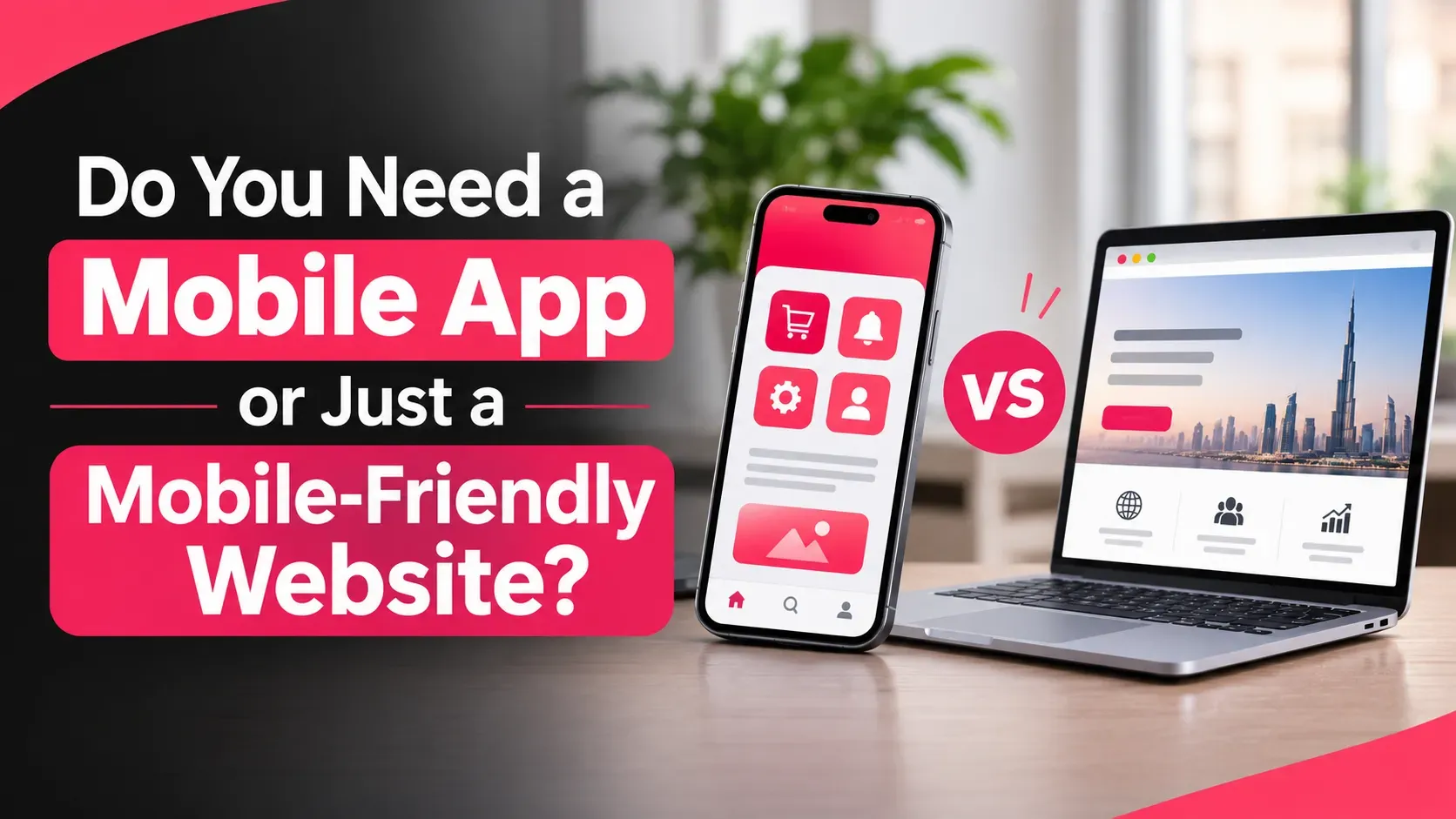
A vendor quotes you for an app. A competitor launches one. A relative asks, "Where is your app?" Suddenly it feels as though every serious business has one, and you are the odd one out.
Before you spend a dirham, ask a better question: do your customers need a mobile app or mobile-friendly website? For many UAE businesses the honest answer is the website, and for some it really is the app. This guide helps you work out which group you are in.
Quick Answer
A mobile-friendly website is enough when customers find you through search, read information, send enquiries or make occasional purchases. You need a mobile app when people use your service often, want loyalty features or notifications, or need device features such as the camera or offline access. A progressive web app sits between the two.
Key Takeaways
- Most customers meet your business through a browser, so a fast, mobile-friendly website comes first.
- Apps earn their cost when customers come back weekly or need device features.
- A progressive web app can cover some app needs, but iPhone support has limits.
- Decide with five questions about customer behaviour, not with what competitors launch.
- You can start with a website and build an app later, if you plan for it.
What Is the Difference Between a Mobile-Friendly Website and a Mobile App?
A mobile-friendly website runs in the browser and adjusts to any screen. A mobile app is installed from an app store and runs on the phone itself. A progressive web app is a website that behaves more like an app. Here is each in plain language.
Mobile-friendly (responsive) website
A responsive website uses one design that adapts to phones, tablets and desktops. Customers reach it by search or link, with nothing to install. This is the foundation for almost every business.
Progressive web app (PWA)
A PWA is a website with extra abilities. According to web.dev's progressive web app course, PWAs combine capabilities, reliability and installability, and service workers enable offline access. Once installed, a PWA gives a standalone experience, closer to an app.
Native app
A native app is built for iPhone or Android and sold through the App Store or Google Play. It can use device features more deeply, but it costs more to build and maintain, and customers must choose to download it.
Mobile App or Mobile-Friendly Website: Which One Does Your Business Need?
Choose a mobile-friendly website if your customers mainly search, browse, enquire or buy now and then. Choose an app if they return often and gain from notifications, saved accounts or device features. If you are unsure, start with the website, then add an app when customer behaviour proves the need.
Factor | Mobile-friendly website | PWA | Native app |
|---|---|---|---|
Reach | Anyone with a browser | Anyone with a browser | Only people who download it |
Found through search | Yes | Yes | Mostly through app stores |
Cost level | Lowest | Middle | Highest |
Time to launch | Shortest | Middle | Longest |
Works offline | Limited | Possible | Yes |
Push notifications | No | Possible, with limits on iPhone | Yes |
Deep device features | Limited | Some | Most |
Upkeep | One site | One site | Often two platforms |
Search matters here. Google says it indexes and ranks the mobile version of a site, and it recommends responsive design as the easiest pattern to maintain, as set out in Google's mobile-first indexing guide. An app does not replace that visibility.
When Is a Mobile-Friendly Website Enough?
A website is enough when customers do not need to come back daily. Think of someone looking for a clinic, a law firm, a fit-out company or a trade supplier. They search, compare, call or fill in a form, and they may not return for months.
A website usually covers your needs if:
- Customers find you through Google or social media.
- You mainly share information, prices, portfolios or contact details.
- Customers book, enquire or pay occasionally rather than weekly.
- You want the widest reach with the smallest budget.
- You do not need features that only a phone can provide.
Imagine a consultancy that spends a large sum on an app. Clients open it twice, then go back to email and WhatsApp. The money would have worked harder on a faster site, clearer pages and better search visibility.
If this sounds like you, invest in a site that loads quickly and reads well on a phone. A team like our web design team in Dubai can build that foundation.
When Does a Business Need a Mobile App?
An app makes sense when your product is used often or relies on the phone itself. Signs that you are in this group:
- Customers return weekly or daily, such as for ordering, rides, fitness or learning.
- You run a loyalty or rewards programme that customers check regularly.
- You need device features, such as the camera, location or biometric login.
- Customers have accounts, with histories, saved items or scheduled services.
- Your staff need a field tool, for tasks such as inspections, deliveries or stock counts.
- Notifications drive revenue, such as order updates or timed offers.
Picture a restaurant group with a loyalty scheme. Regulars order the same meal every week, collect points and expect alerts for new offers. That behaviour justifies an app. A single-location accountant does not have it.
Can a Progressive Web App Be the Middle Option?
Yes, for some businesses. A PWA lets you keep one website while adding installability and offline abilities. It avoids two separate store builds and can be a cheaper test of whether customers want an app-like experience.
There are limits, especially on iPhone. Apple's WebKit team explains that web push notifications work only for web apps added to the Home Screen, that the permission request must follow a direct user action, and that a site becomes an installable web app only if it has a suitable manifest. Otherwise it is saved as a bookmark. That was described when the feature launched on iOS 16.4, so check current behaviour before you promise notifications to customers.
For a deeper technical comparison, read our guide to PWA vs native apps.
How Much Does Each Option Cost?
A responsive website costs the least, a PWA sits in the middle and a native app costs the most. We will not print one number here, because the price depends on features, platforms, design and integrations, and quoted figures vary widely.
What matters is the total cost over time. An app needs updates for new phone versions, store review, bug fixes and often two platforms. A website needs hosting, security and content care, but usually less of each.
For a closer look at pricing, see our breakdown of what a mobile app costs in Dubai.
Mobile App or Mobile-Friendly Website: A Five-Question Checklist
Answer these honestly. If you say yes to three or more, an app deserves serious thought.
- Will customers use it at least weekly? Regular use justifies the install.
- Do you need device features? Camera, location, biometrics or offline use point to an app.
- Do customers already find you through search? If yes, protect that website first.
- Is there a loyalty, subscription or repeat-order model? Apps suit repeat behaviour.
- Can you maintain it? An app needs a budget for updates, not just for launch.
If your answers are mixed, begin with a strong website and track what customers ask for. If they are mostly yes, talk to a team that builds mobile app development in Dubai about scope and platforms.
Can You Start With a Website and Add an App Later?
Yes, and for many businesses it is the sensible order. A website gets you visible and gathers real data about what customers do. Then you build an app around the behaviour you can see.
To keep the path open:
- Build the website on a clean, flexible structure so content can feed an app later.
- Track key actions, such as repeat visits, bookings and logins.
- Start the app small, with only the features customers use most.
- Choose one platform first, or a cross-platform approach that covers both.
When you are ready, a cross-platform build is often the practical route. Our team can scope React Native app development for one codebase across iPhone and Android.
Frequently Asked Questions
Is a mobile-friendly website enough for my business?
For many businesses, yes. If customers find you through search, read information and enquire or buy occasionally, a fast responsive website covers the need. An app only adds value when customers use your service often.
When does a business actually need a mobile app?
When customers return weekly or daily, use loyalty or account features, or need device features such as the camera, location or offline access. Field tools for staff are another common reason.
Can a website send push notifications?
A progressive web app can, but support differs by device. On iPhone, Apple's WebKit team says web push works only for web apps added to the Home Screen, after a user action grants permission. A standard website in a browser tab cannot rely on it.
Is it cheaper to build a website or an app?
A responsive website is usually cheaper to build and maintain than a native app. An app often needs store review, regular updates and sometimes two platforms. Compare the cost over several years, not only at launch.
Can I start with a website and add an app later?
Yes. Many businesses launch a website first, watch how customers behave and then build a focused app. Plan your structure and tracking from the start, so the later build uses real data.
Final Thoughts
The right answer to mobile app or mobile-friendly website is rarely "both, right now." It is the option that matches how your customers actually behave. A strong website serves most businesses well, and an app earns its place when people return often or need the phone itself.
Run the five-question checklist, protect your search visibility and build in stages. Do that, and you will spend on what customers use. If you would like a partner to help you decide and build, that is the kind of conversation Milaaj Brandset has with UAE businesses every week.
Ready to Elevate Your Brand?
Start Your Project Today