July 27, 2026
How to Optimize Google Ads Landing Pages for Higher Conversions
Milaaj Editorial / Research Insights
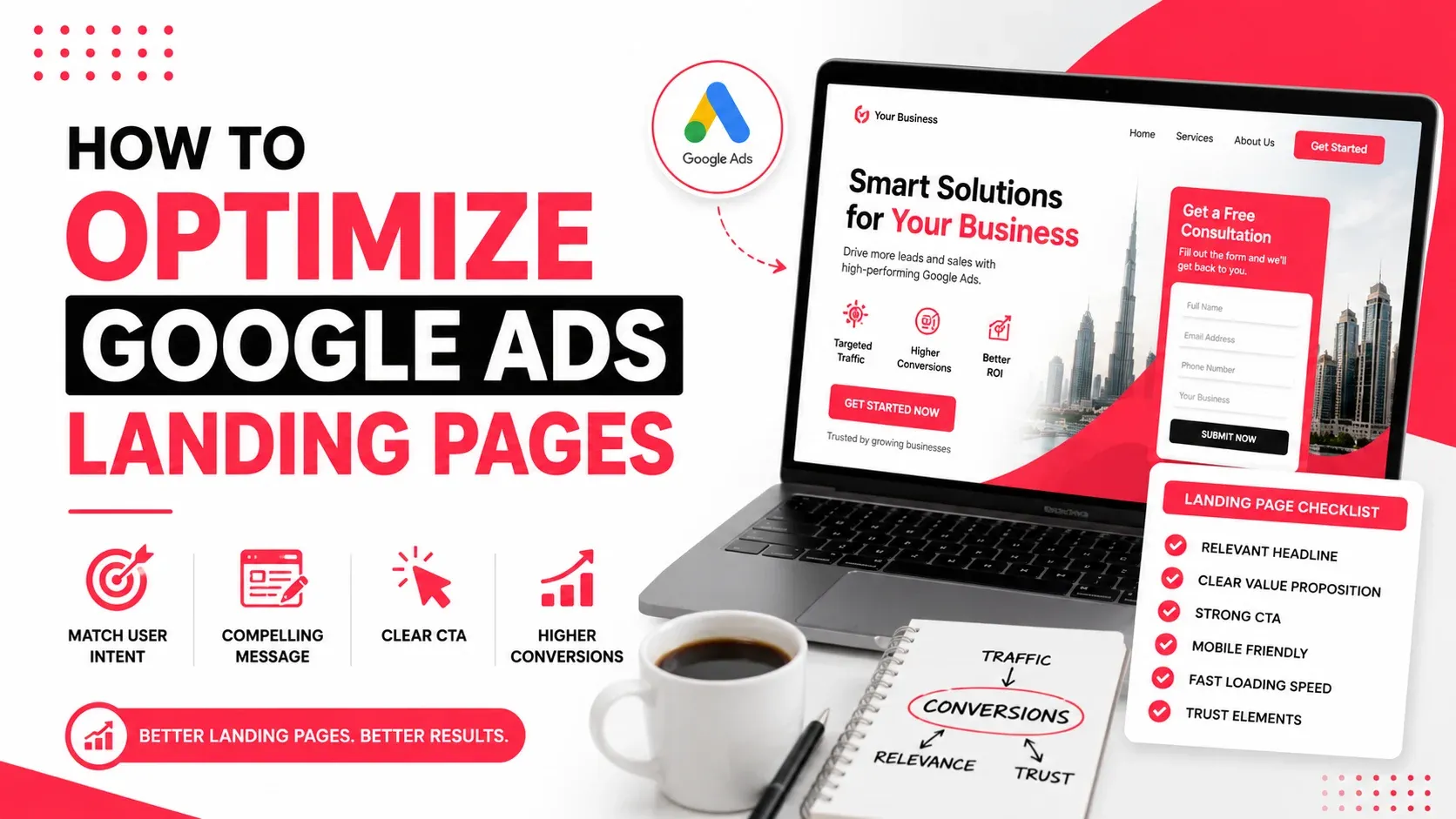
Driving traffic through Google Ads is only half the battle. Once users click your advertisement, the landing page becomes the deciding factor in whether they leave immediately or complete a valuable action. Even a well-managed advertising campaign can produce disappointing results if visitors arrive on a page that is slow, confusing, or unrelated to their search intent.
An optimized Google Ads landing page creates a seamless experience between the advertisement and the destination page. It reassures visitors that they have found exactly what they were searching for, presents information clearly, builds trust, and guides them toward a single conversion goal.
This guide explains how to optimize Google Ads landing pages to improve user experience, increase conversion rates, and maximize the return on your advertising investment.
Quick Answer
Google Ads landing pages perform best when they closely match the advertisement's message, load quickly, provide relevant information, build trust, and guide visitors toward one clear conversion goal. Regular testing and continuous optimization help improve campaign performance over time.
Why Landing Pages Matter in Google Ads
Every click generated through Google Ads represents an investment. If visitors leave without taking action, that investment delivers little value.
An optimized landing page helps businesses:
- Increase conversion rates
- Improve user experience
- Reduce bounce rates
- Generate higher-quality leads
- Strengthen advertising efficiency
- Support better campaign performance
Instead of sending paid traffic to a generic website page, businesses should create landing pages specifically designed for each advertising campaign.
Match the Landing Page to Your Advertisement
One of the most important principles of landing page optimization is message match.
Visitors should immediately recognize that the landing page reflects the promise made in the advertisement.
For example:
Advertisement
Landing Page
Consistent messaging reassures users that they have arrived at the correct destination and reduces the likelihood of them leaving the page.
Every advertisement should align with:
- Headlines
- Product descriptions
- Offers
- Visual elements
- Calls to action
The smoother the transition from ad to landing page, the better the overall user experience.
Focus on a Single Conversion Goal
Landing pages should guide visitors toward one primary objective.
Trying to encourage multiple actions often creates unnecessary distractions.
Examples of conversion goals include:
- Request a consultation
- Download a guide
- Book a demo
- Contact your team
- Purchase a product
- Register for an event
A focused landing page makes decision-making easier and improves conversion opportunities.
Write Headlines That Reinforce Search Intent
Your headline is often the first element visitors notice.
An effective headline should:
- Reflect the keyword or advertisement
- Clearly communicate value
- Explain what visitors can expect
- Use simple, direct language
Instead of creating clever or vague headlines, prioritize clarity and relevance.
Visitors should understand your offer within a few seconds of arriving on the page.
Keep Content Relevant and Easy to Scan
Online users rarely read every word on a page.
Improve readability by:
- Using short paragraphs
- Organizing information with headings
- Including bullet points
- Highlighting key benefits
- Using descriptive subheadings
A well-structured landing page helps visitors quickly locate the information they need before making a decision.
Highlight Benefits Before Features
Many businesses spend too much time describing product features while overlooking customer benefits.
Instead of simply listing capabilities, explain how those capabilities solve real problems.
For example:
Feature
- 24/7 customer support
Benefit
- Get assistance whenever you need it without delaying important business operations.
Benefits help visitors understand why your offer matters to them.
Use Strong Calls to Action
Every landing page should include a clear and visible call to action (CTA).
Effective CTAs typically:
- Use action-oriented language
- Explain what happens next
- Reduce uncertainty
- Stand out visually
- Appear multiple times throughout longer pages
Examples include:
- Get Your Free Quote
- Schedule a Consultation
- Request a Demo
- Download the Guide
- Start Your Free Trial
The CTA should remain consistent with the objective established in the advertisement.
Businesses offering landing page optimization services often improve conversion rates by simplifying CTA messaging and reducing unnecessary distractions throughout the page.
Build Trust With Social Proof
Visitors are more likely to convert when they feel confident in your credibility.
Useful trust-building elements include:
- Customer testimonials
- Verified reviews
- Case studies
- Industry certifications
- Awards
- Client logos
- Years of experience
- Success statistics
Place these elements near important decision points to reinforce confidence before visitors complete a form or make a purchase.
Optimize Forms for Higher Completion Rates
Long or complicated forms frequently reduce conversions.
Ask only for information that is genuinely necessary.
For example, instead of requesting:
- Full address
- Company size
- Industry
- Budget
- Phone number
- Job title
A lead generation form might initially require only:
- Name
- Email
- Business name
Reducing friction makes it easier for visitors to complete the desired action.
Improve Mobile Experience
A significant portion of Google Ads traffic comes from mobile devices.
Mobile-friendly landing pages should provide:
- Responsive layouts
- Easy-to-read text
- Large tap targets
- Fast loading speeds
- Simple navigation
- Short forms
Poor mobile usability often leads to abandoned visits even when advertisements successfully attract qualified traffic.
Increase Page Speed
Landing page speed directly influences both user experience and conversion performance.
Businesses can improve loading times by:
- Compressing images
- Minimizing unnecessary scripts
- Optimizing CSS and JavaScript
- Enabling browser caching
- Using high-performance hosting
- Improving Core Web Vitals
Even small improvements in page speed can reduce abandonment rates and encourage visitors to continue engaging with your content.
If you're working to improve campaign efficiency alongside landing page performance, read our guide on How to Improve Google Ads Quality Score to understand how ad relevance, expected click-through rate, and landing page experience work together to influence Google Ads performance.
Remove Distractions From the Page
Unlike a homepage, a Google Ads landing page should focus on one purpose.
Too many navigation links, promotional banners, or unrelated offers can distract visitors from completing the intended action.
To improve focus:
- Minimize unnecessary navigation menus.
- Avoid multiple competing offers.
- Limit outbound links.
- Keep the page centered on one conversion objective.
- Use whitespace to improve readability.
A streamlined page helps visitors concentrate on the information that matters most.
Use High-Quality Visuals
Images and videos should support your message rather than simply decorate the page.
Effective visuals may include:
- Product demonstrations
- Service illustrations
- Team photographs
- Customer success stories
- Before-and-after examples
- Short explainer videos
Ensure that all visuals are optimized for fast loading and accurately represent your products or services.
Maintain Consistency Between Keywords, Ads, and Landing Pages
Google rewards campaigns that provide a consistent user experience.
A visitor searching for "business website design services" should not land on a page discussing general digital marketing.
Maintain consistency by aligning:
Campaign Element | Best Practice |
|---|---|
Keywords | Match the user's search intent |
Advertisement | Clearly reflect the targeted keywords |
Landing Page Headline | Reinforce the advertisement's message |
Page Content | Deliver exactly what the ad promises |
Call to Action | Support the campaign objective |
This consistency improves user satisfaction while supporting stronger advertising performance.
Test Landing Pages Continuously
Landing page optimization is an ongoing process rather than a one-time task.
Regular A/B testing helps identify which changes improve conversions.
Consider testing:
- Headlines
- Hero images
- CTA button text
- Button placement
- Form length
- Trust badges
- Testimonials
- Page layouts
- Value propositions
Testing one element at a time provides clearer insights into what influences user behaviour.
Track the Right Performance Metrics
Effective optimization requires accurate measurement.
Monitor metrics such as:
- Conversion rate
- Bounce rate
- Average engagement time
- Form completion rate
- Click-through rate (CTR)
- Cost per conversion
- Return on ad spend (ROAS)
- Scroll depth
- Heatmaps and user recordings (where appropriate)
Looking beyond traffic numbers helps identify opportunities to improve the user experience and increase conversions.
Businesses investing in conversion rate optimization services often combine analytics data with user behaviour insights to make informed landing page improvements rather than relying on assumptions.
Common Landing Page Optimization Mistakes
Many landing pages fail because they overlook fundamental user experience principles.
Mistake | Better Approach |
|---|---|
Sending paid traffic to the homepage | Create dedicated landing pages for each campaign |
Weak or unclear headlines | Match the landing page headline to the advertisement |
Multiple competing CTAs | Focus on one primary conversion goal |
Slow page speed | Optimize performance and Core Web Vitals |
Long, complicated forms | Request only essential information |
Ignoring mobile users | Design mobile-first landing page experiences |
No trust signals | Add testimonials, reviews, certifications, or client logos |
Never testing changes | Continuously optimize using A/B testing and analytics |
Avoiding these issues helps create a smoother post-click experience and improves campaign performance over time.
Align Landing Pages With the Customer Journey
Different audiences require different landing page experiences.
For example:
- Awareness-stage visitors benefit from educational content and helpful resources.
- Consideration-stage visitors often look for comparisons, case studies, and customer testimonials.
- Decision-stage visitors want pricing, guarantees, consultation options, or clear purchase paths.
Matching the landing page to the visitor's stage in the buying journey increases relevance and supports higher conversion rates.
To better understand how user experience influences visitor behaviour after they click an ad, read our guide on How UX Design Impacts Lead Generation, which explores the relationship between usability, trust, and conversions.
Key Takeaways
- Dedicated landing pages generally outperform generic website pages for Google Ads campaigns.
- Strong message matching between keywords, advertisements, and landing pages improves relevance.
- Focus every landing page on one clear conversion goal.
- Fast loading speeds, mobile optimization, and simple forms reduce friction.
- Trust signals such as testimonials and certifications increase visitor confidence.
- Continuous testing and performance analysis are essential for long-term conversion improvements.
Turn More Clicks Into Conversions
Generating traffic through Google Ads is only the beginning of the customer journey. The real opportunity lies in providing visitors with a landing page that immediately addresses their search intent, communicates value clearly, and makes taking the next step simple.
By improving message consistency, reducing distractions, strengthening trust, optimizing mobile performance, and continuously testing new ideas, businesses can convert more advertising clicks into qualified leads and customers while making better use of their advertising budgets.
Milaaj Brandset helps businesses build high-performing Google Ads landing pages that combine conversion-focused design, user experience best practices, and data-driven optimization to maximize campaign performance and long-term business growth.
FAQs
Why should I use a dedicated landing page for Google Ads?
Dedicated landing pages are designed around a specific campaign objective and closely match the advertisement's message, making visitors more likely to complete the desired action than if they were sent to a general webpage.
How does landing page relevance affect Google Ads?
Relevant landing pages provide a better user experience, which can contribute to improved campaign performance, stronger engagement, and better alignment with Google's assessment of landing page experience.
What makes a high-converting landing page?
A high-converting landing page typically includes a clear headline, relevant content, a strong call to action, trust signals, fast loading speeds, mobile-friendly design, and a simple conversion process.
Should every Google Ads campaign have its own landing page?
Whenever practical, yes. Creating landing pages tailored to individual campaigns or closely related ad groups improves message consistency and helps address specific user intent.
How often should I test my landing pages?
Landing pages should be reviewed regularly. A/B testing headlines, CTAs, forms, layouts, and other elements helps identify opportunities to improve conversion rates over time.
Which metrics should I monitor?
Important metrics include conversion rate, bounce rate, average engagement time, form completion rate, cost per conversion, return on ad spend (ROAS), and overall lead quality.
Ready to Elevate Your Brand?
Start Your Project Today