July 27, 2026
PPC Keyword Research Strategy for UAE Campaigns
Milaaj Editorial / Research Insights
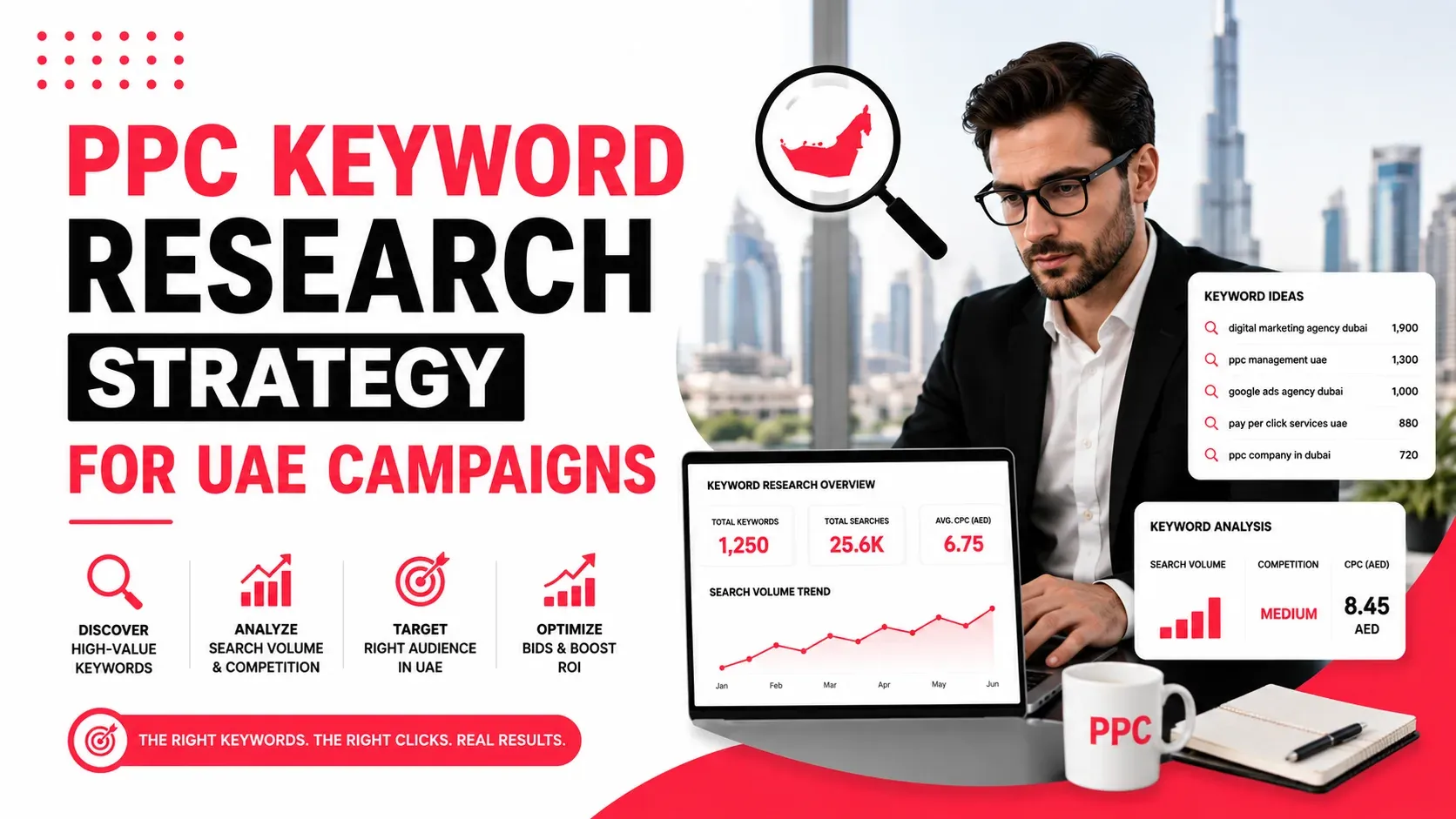
Keyword research forms the foundation of every successful pay-per-click (PPC) campaign. Even the most compelling ad copy and well-designed landing pages will struggle to deliver results if your ads target the wrong search terms. Choosing relevant keywords helps businesses reach potential customers at the right stage of their buying journey while making advertising budgets more efficient.
For businesses targeting audiences across the UAE, keyword research requires more than identifying high-volume search terms. User intent, regional language preferences, city-specific searches, and local purchasing behaviour all influence how people search for products and services.
This guide explains how to build a practical PPC keyword research strategy for UAE campaigns that attracts qualified traffic, improves campaign relevance, and supports stronger advertising performance.
Quick Answer
A successful PPC keyword research strategy for UAE campaigns combines search intent analysis, relevant core and long-tail keywords, location-specific targeting, keyword match types, and negative keywords. Regular optimization ensures campaigns reach the right audience while reducing wasted advertising spend.
Why Keyword Research Matters in PPC
Every keyword determines when and where your advertisements appear.
Effective keyword research helps businesses:
- Reach relevant audiences
- Improve click-through rates
- Increase conversion opportunities
- Reduce wasted advertising spend
- Improve campaign relevance
- Support better Quality Scores
Rather than selecting the highest-volume keywords, successful PPC campaigns prioritize search terms that closely match business objectives and customer intent.
Understand Search Intent Before Choosing Keywords
People search with different goals.
Understanding search intent allows businesses to choose keywords that align with customer expectations.
Informational Intent
Users want to learn or research.
Examples include:
- Best CRM software
- How to choose office furniture
- Benefits of cloud storage
These keywords work well for educational content and awareness campaigns.
Commercial Intent
Users are comparing options before making a decision.
Examples include:
- Best accounting software UAE
- Compare website design agencies
- CRM pricing Dubai
Commercial keywords often generate highly qualified traffic because users are actively evaluating solutions.
Transactional Intent
Users are ready to take action.
Examples include:
- Buy office chairs Dubai
- PPC agency Abu Dhabi
- Laptop repair near me
Transactional keywords usually deliver the highest conversion potential.
Navigational Intent
Users are searching for a specific business or brand.
Examples include:
- Google Ads login
- Adobe Creative Cloud
- Microsoft Azure pricing
Although navigational keywords may not always fit every campaign, they can be valuable for protecting branded searches.
Build a Balanced Keyword List
Successful PPC campaigns combine multiple keyword types instead of relying on a single category.
Keyword Type | Best Use |
|---|---|
Core keywords | High-volume searches |
Long-tail keywords | Higher purchase intent |
Location-based keywords | Geo-targeted campaigns |
Negative keywords | Prevent irrelevant clicks |
Competitor keywords | Market research and controlled testing |
A balanced keyword strategy improves campaign flexibility while helping businesses target users at different stages of the buying journey.
Start With Core Keywords
Core keywords describe your primary products or services.
Examples include:
- Website development
- Digital marketing
- Accounting software
- Property management
- Car rental
These keywords often generate higher search volume but also attract stronger competition.
Core keywords provide the foundation for campaign expansion.
Expand With Long-Tail Keywords
Long-tail keywords contain more specific search phrases that often indicate stronger purchase intent.
Examples include:
- Affordable Google Ads agency in Dubai
- ERP software for small businesses UAE
- Commercial office cleaning Abu Dhabi
Although search volume may be lower, long-tail keywords frequently produce:
- Higher conversion rates
- Better ad relevance
- Lower competition
- More qualified traffic
Long-tail searches also allow businesses to address highly specific customer needs.
Include Location-Based Keywords Naturally
Since this strategy targets UAE campaigns, location-based keywords play an important role.
Examples include:
- SEO agency Dubai
- Website development Abu Dhabi
- IT support Sharjah
- Interior design Ajman
- Logistics company Ras Al Khaimah
Businesses serving multiple Emirates should organize campaigns by geographic area rather than placing every city keyword into a single ad group.
This approach improves keyword relevance while making it easier to create localized advertisements and landing pages.
Consider English and Arabic Search Behaviour
The UAE has a multilingual audience, which influences keyword selection.
Some users search in English, while others search in Arabic or combine both languages depending on the service.
Examples include:
- English business keywords
- Arabic service searches
- Brand names written in English
- Mixed-language search queries
Reviewing search term reports regularly helps identify language patterns that may reveal additional keyword opportunities.
Research Competitor Keywords Carefully
Competitor research can reveal valuable insights into industry search behaviour.
Rather than copying competitor keyword lists, analyze:
- Common service terms
- Industry terminology
- High-intent phrases
- Frequently used modifiers
- Market gaps
Competitor research should inspire better keyword selection rather than duplicate another advertiser's strategy.
Businesses investing in Google Ads keyword research often combine competitor analysis with first-party search data to identify opportunities that align with their own products, services, and campaign objectives.
Build Keyword Clusters Around Search Intent
Grouping closely related keywords into dedicated ad groups improves campaign relevance.
For example:
Ad Group: Website Design
- Website design Dubai
- Business website design
- Website development company
- Corporate website design
Ad Group: E-commerce Development
- Shopify development UAE
- WooCommerce developers
- E-commerce website company
- Online store development
Smaller, tightly themed ad groups allow businesses to create highly relevant advertisements that better match user searches.
If you're working to improve campaign relevance after selecting your keywords, our guide on How to Improve Google Ads Quality Score explains how keyword organization, ad relevance, and landing page experience work together to improve advertising performance.
Use Negative Keywords to Reduce Wasted Spend
Choosing the right keywords is only part of an effective PPC strategy. Equally important is identifying searches that should not trigger your advertisements.
Negative keywords prevent ads from appearing for irrelevant searches, helping improve click quality and budget efficiency.
For example, a business selling premium software may exclude searches containing:
- Free
- Jobs
- Internship
- Tutorial
- PDF
- Crack
- Download
Regularly reviewing your Search Terms Report helps uncover new negative keywords based on actual user searches.
Benefits of negative keywords include:
- Higher-quality traffic
- Lower wasted advertising spend
- Better click-through rates
- Improved campaign relevance
- More efficient budget allocation
Understand Keyword Match Types
Google Ads offers different keyword match types that control how closely a user's search must match your selected keywords.
Choosing the appropriate match type helps balance reach and relevance.
Match Type | Best Use |
|---|---|
Broad Match | Discover new search opportunities |
Phrase Match | Reach users searching for similar intent while maintaining relevance |
Exact Match | Target highly specific, high-intent searches |
Many successful campaigns combine all three match types while continuously reviewing search queries to refine targeting.
Broad Match
Broad Match provides the widest reach.
It allows Google to display your ads for searches related to the meaning of your keyword rather than only exact wording.
Advantages include:
- Discovering new search terms
- Expanding reach
- Identifying additional keyword opportunities
However, Broad Match requires careful monitoring because it can also trigger irrelevant searches.
Phrase Match
Phrase Match provides a balance between flexibility and control.
Ads can appear for searches that include the meaning of your keyword while allowing variations in wording.
Phrase Match is often suitable for businesses that want broader reach without sacrificing too much relevance.
Exact Match
Exact Match offers the highest level of precision.
Although Google may still show ads for closely related searches, Exact Match generally targets users with the strongest purchase intent.
Businesses commonly use Exact Match for:
- High-converting keywords
- Brand terms
- High-value services
- Competitive commercial searches
Organize Campaigns Logically
Campaign organization directly affects ad relevance and ongoing optimization.
Instead of grouping unrelated keywords together, structure campaigns by factors such as:
- Product category
- Service type
- Customer intent
- Geographic location
- Brand vs. non-brand searches
A logical campaign structure makes it easier to:
- Write relevant ad copy
- Allocate budgets effectively
- Analyze performance
- Scale successful campaigns
Use Keyword Research Tools
Effective PPC keyword research combines multiple data sources rather than relying on a single tool.
Useful resources include:
- Google Keyword Planner
- Google Search Terms Report
- Google Trends
- Google Search Console
- Competitor research tools
- Internal website search data
Customer enquiries, sales conversations, and support requests can also reveal valuable keyword ideas that traditional tools may overlook.
Monitor Keyword Performance Regularly
Keyword research is not a one-time activity.
Search behaviour changes due to:
- Seasonal demand
- Industry developments
- New competitors
- Consumer trends
- Product updates
Regular campaign reviews help identify:
- High-performing keywords
- Low-performing keywords
- New search opportunities
- Additional negative keywords
- Emerging commercial search terms
Businesses using pay-per-click advertising services typically review keyword performance continuously to maintain campaign relevance and improve return on ad spend.
Common PPC Keyword Research Mistakes
Many campaigns underperform because of avoidable keyword selection errors.
Mistake | Better Approach |
|---|---|
Targeting only high-volume keywords | Balance volume with relevance and intent |
Ignoring search intent | Match keywords to the customer's buying stage |
Using large ad groups | Create tightly themed keyword clusters |
Overlooking negative keywords | Regularly exclude irrelevant searches |
Selecting keywords once and never reviewing them | Continuously optimize using performance data |
Ignoring regional search behaviour | Include location-specific and language-specific keyword variations where appropriate |
Avoiding these mistakes creates more focused campaigns that attract qualified visitors instead of simply increasing traffic.
Measure Keyword Success Beyond Clicks
Clicks indicate interest, but they don't always reflect business performance.
Evaluate keyword effectiveness using metrics such as:
- Click-through rate (CTR)
- Conversion rate
- Cost per click (CPC)
- Cost per acquisition (CPA)
- Return on ad spend (ROAS)
- Impression share
- Search impression share lost due to budget or rank
- Lead quality
- Revenue generated
Reviewing these metrics together provides a more complete understanding of how individual keywords contribute to campaign success.
If your PPC strategy includes geographically targeted campaigns, our blog on Difference Between Local SEO and Traditional SEO explains how local search intent differs from paid keyword targeting and why both approaches can complement one another.
Key Takeaways
- Keyword research is the foundation of every successful PPC campaign.
- Search intent should guide keyword selection more than search volume alone.
- A balanced keyword strategy includes core, long-tail, location-based, competitor, and negative keywords.
- English and Arabic search behaviour should be considered when targeting UAE audiences.
- Well-organized keyword clusters improve ad relevance and campaign management.
- Ongoing optimization is essential because search behaviour evolves over time.
Build Smarter PPC Campaigns With Better Keywords
Successful PPC campaigns begin with understanding how potential customers search for products and services. Rather than targeting every high-volume keyword, businesses achieve better results by selecting keywords that align with user intent, organizing campaigns logically, and continuously refining their strategy using real performance data.
For businesses advertising across the UAE, combining location-specific targeting, multilingual keyword research, and ongoing optimization creates more relevant campaigns that attract qualified traffic while making advertising budgets work harder.
Milaaj Brandset helps businesses build data-driven PPC strategies through comprehensive keyword research, campaign optimization, and continuous performance analysis to improve advertising efficiency and long-term business growth.
FAQs
Why is keyword research important for PPC campaigns?
Keyword research determines when and where your ads appear. Choosing relevant keywords helps attract qualified traffic, improve ad relevance, and make advertising budgets more efficient.
What types of keywords should a PPC campaign include?
A balanced campaign typically includes core keywords, long-tail keywords, location-based keywords, competitor keywords for research and testing, and negative keywords to prevent irrelevant clicks.
Why are long-tail keywords valuable?
Long-tail keywords often indicate stronger purchase intent, face less competition, and can generate higher conversion rates because they target more specific searches.
Should UAE businesses target both English and Arabic keywords?
Yes. Many users in the UAE search in English, Arabic, or a combination of both. Reviewing search term data helps businesses identify language preferences and optimize campaigns for different audience segments.
How often should PPC keyword research be updated?
Keyword research should be reviewed regularly. Search behaviour changes over time due to seasonality, market trends, competitor activity, and evolving customer needs.
What are negative keywords?
Negative keywords prevent advertisements from appearing for irrelevant searches, reducing wasted advertising spend and improving overall campaign efficiency.
Ready to Elevate Your Brand?
Start Your Project Today