September 1, 2026
Semantic SEO Strategies for Modern Websites: A Practical Guide
Milaaj Editorial / Research Insights
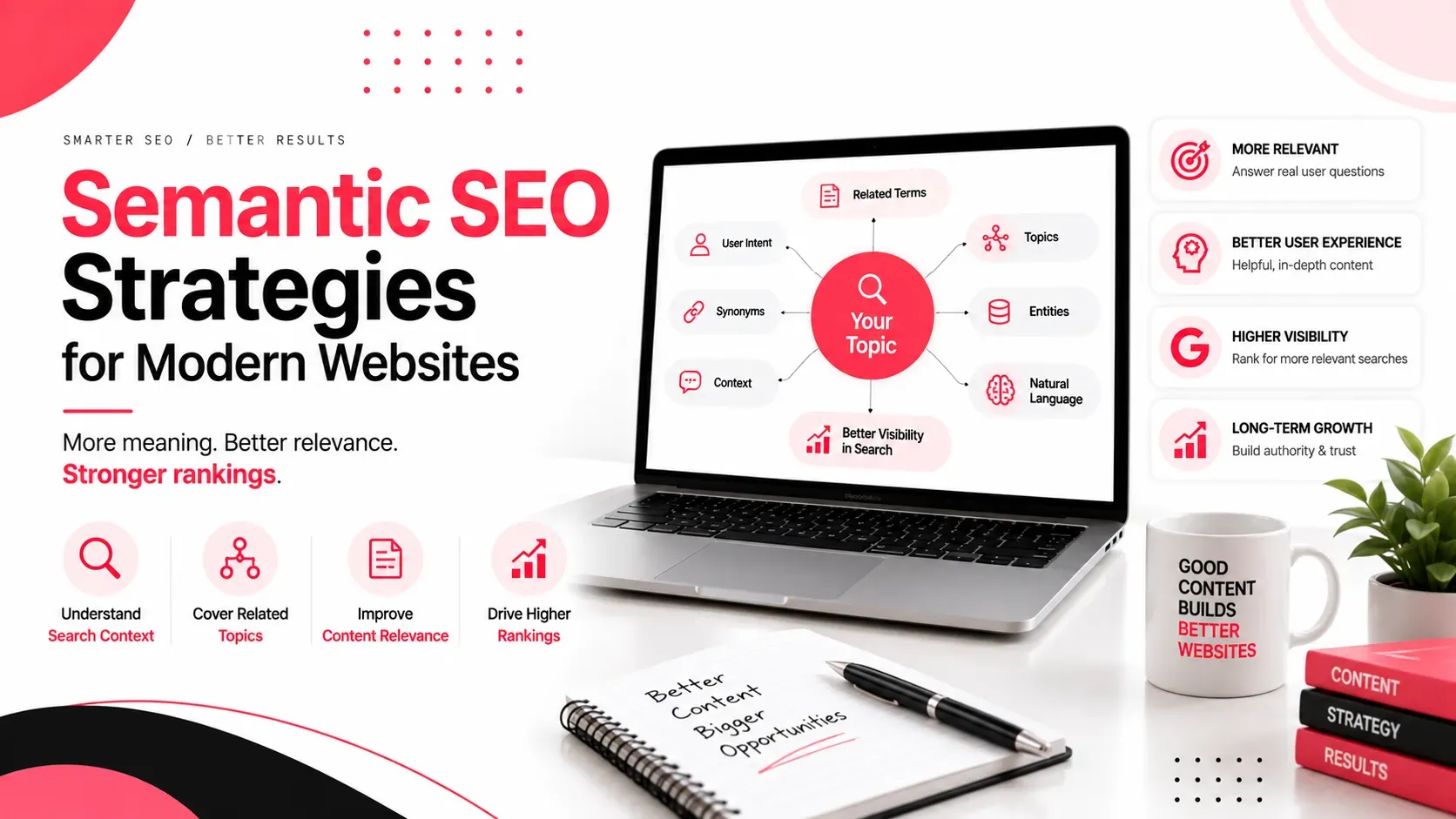
Search engines no longer rely on exact keyword matches alone to understand what a webpage is about. Modern search increasingly depends on meaning, context, entities, relationships, and search intent.
That shift makes semantic SEO important for businesses that want sustainable organic visibility.
Instead of creating separate pages for every keyword variation, semantic SEO helps websites build comprehensive topic coverage and clear relationships between related concepts. It can also support visibility across traditional search results, featured answers, and AI-powered search experiences.
For businesses, the opportunity is significant: create content that doesn't just contain the right keywords, but clearly demonstrates what a topic means, how its concepts are connected, and how the content satisfies the user's goal.
Quick Answer
Semantic SEO is the practice of optimizing website content and structure around the meaning and relationships behind search queries, rather than focusing only on exact-match keywords.
A strong semantic SEO strategy includes:
- Understanding search intent
- Covering a topic comprehensively
- Using relevant entities and concepts
- Connecting related pages through internal links
- Building topic clusters
- Creating logical website architecture
- Using natural language and related terminology
- Adding structured data where appropriate
- Removing overlapping or thin content
- Optimizing content for people as well as search systems
- Structuring information clearly for AEO and AI-powered search
The goal isn't to add as many related keywords as possible.
The goal is to create a website that clearly demonstrates topical relevance, expertise, and useful relationships between information.
What Is Semantic SEO?
Semantic SEO focuses on meaning and context.
Traditional keyword optimization might focus heavily on a phrase such as:
"SEO services in Dubai."
A semantic approach considers the broader concepts surrounding that topic, including:
- Search engine optimization
- Keyword research
- Technical SEO
- On-page SEO
- Local SEO
- Content strategy
- Search intent
- Link building
- Organic traffic
- Search rankings
- Dubai businesses
These concepts are related to the main subject and help create a more complete understanding of what the page covers.
Semantic SEO vs Traditional Keyword Optimization
Traditional SEO still uses keywords, and keywords remain useful.
The difference is how they are used.
An outdated approach might repeat one target phrase throughout an article.
A modern approach focuses on:
Keyword → topic → entities → context → search intent → user need
This doesn't mean keywords are no longer important.
Instead, keywords become one part of a broader understanding of relevance.
Why Search Engines Focus on Meaning and Context
People rarely search using perfectly structured language.
Users may ask the same question in many different ways.
For example:
- How can I improve my Google ranking?
- How do I rank higher on Google?
- How to increase organic search traffic?
- How can my website appear higher in search results?
These queries can express closely related needs.
Search systems increasingly need to understand the meaning behind language, rather than treating every wording variation as an entirely separate subject.
Why Semantic SEO Matters for Modern Search
Semantic SEO has become increasingly relevant as search becomes more conversational and context-driven.
Understanding Search Intent
A keyword doesn't tell the entire story.
Consider:
"Apple website."
The user could be looking for the official company website.
Now consider:
"Apple nutrition benefits."
The meaning is completely different.
Understanding intent helps determine what information belongs on a page and what content format is appropriate.
This connects directly with search intent optimization, because semantic relevance becomes much stronger when content addresses the actual purpose behind the search.
Building Topical Authority
A website becomes more useful when it demonstrates knowledge across the important aspects of a subject.
For example, a website targeting digital marketing could cover:
- SEO
- Content marketing
- Social media marketing
- Paid advertising
- Email marketing
- Conversion optimization
- Analytics
- Branding
Each area can contain supporting subtopics.
This creates a network of related information rather than isolated articles.
Connecting Entities and Concepts
An entity can be a person, organization, location, product, service, concept, or other identifiable thing.
Semantic SEO considers how these entities relate to one another.
For example:
SEO → Google Search → keywords → search intent → content → rankings → organic traffic
These relationships provide contextual information about the subject.
The objective isn't to artificially insert entities into content.
They should appear naturally when they're genuinely relevant.
Preparing Content for AI Search and AEO
Search is increasingly becoming conversational.
Users may ask AI-powered systems complete questions instead of typing short keywords.
This increases the importance of:
- Clear answers
- Logical organization
- Strong topical context
- Well-defined concepts
- Trustworthy information
- Useful supporting evidence
- Consistent entity relationships
Semantic SEO can therefore support Answer Engine Optimization (AEO) and broader AI-search visibility.
However, optimizing for AI shouldn't mean writing content exclusively for machines.
Content still needs to satisfy people first.
How to Build a Semantic SEO Strategy
Semantic SEO works best when implemented across the entire content ecosystem rather than treated as a keyword technique.
Map Topics, Entities, and Related Concepts
Start with the primary subject.
Then identify the concepts that naturally surround it.
For example, a website targeting website maintenance might cover:
Core topic: Website maintenance
Related concepts:
- Security updates
- Backups
- Performance
- Broken links
- Software updates
- Mobile usability
- SEO monitoring
- Content updates
- Uptime
- Website security
This creates a semantic map of the topic.
The purpose isn't to force every concept onto one page.
Instead, decide which concepts belong together and which deserve separate supporting pages.
Create Comprehensive Topic Coverage
A comprehensive article should answer the questions that matter to its intended audience.
For example, a guide about website maintenance might explain:
- What website maintenance involves
- Why it matters
- How often maintenance should happen
- What tasks are required
- How maintenance affects SEO
- Common maintenance problems
- When professional help is appropriate
This is more useful than repeating the phrase "website maintenance" throughout the page.
Build Topic Clusters
Topic clusters organize related content around a central subject.
A website might have:
Pillar: SEO
Supporting content:
- Keyword research
- Technical SEO
- Internal linking
- Search intent
- SEO-friendly URLs
- Long-form content
- Semantic SEO
Each supporting article explores a specific aspect while connecting back to relevant broader resources.
A well-designed pillar page strategy for SEO growth can help organize this information into a clearer topical structure.
Optimize Content Around Search Intent
Semantic SEO should never become an excuse to add unrelated information.
Start with the user's objective.
Ask:
- What does the user want to know?
- What problem are they trying to solve?
- What questions are likely to follow?
- What information would help them make a decision?
- What action might they take next?
Then build the content around those needs.
Use Natural Language and Related Terms
A semantically optimized article will naturally contain related terminology.
For example, an article about local SEO might naturally mention:
- Google Business Profile
- Local search
- NAP consistency
- Reviews
- Local citations
- Location pages
- Map results
- Local keywords
Don't force these terms into every paragraph.
Use them when they improve understanding.
Semantic SEO and Website Architecture
Semantic SEO isn't limited to individual articles.
Your website structure also communicates relationships between topics.
Create Logical Content Relationships
Imagine a website where an article about technical SEO links to pages about:
- Website speed
- Crawlability
- Indexing
- XML sitemaps
- Structured data
Those connections make sense because the topics are related.
A random collection of pages with no meaningful connections provides a weaker user experience.
Organize content so visitors can move naturally from broad topics to more specific information.
Strengthen Internal Linking
Internal links help users discover related content and can help search engines understand relationships between pages.
For example:
SEO guide → search intent → content optimization → SEO service
Each link should provide a meaningful next step.
Use descriptive anchor text rather than vague phrases such as "click here."
A strong internal linking strategy should prioritize topical relevance and user usefulness instead of simply maximizing the number of links.
Use Descriptive URLs and Headings
Clear URLs and headings provide additional context.
Compare:
example.com/page123
with:
example.com/semantic-seo-strategies
The second URL communicates what the page is about.
Similarly, headings should describe the actual subject of each section.
Avoid vague headings such as:
"Things to Know"
A clearer alternative is:
"How Semantic SEO Supports Topical Authority"
Implement Structured Data Where Appropriate
Structured data can provide search engines with additional information about eligible content.
Depending on the website, structured data may help describe:
- Products
- Organizations
- Articles
- Events
- Local businesses
- Breadcrumbs
- Other supported entities
Structured data should accurately represent the visible content.
It isn't a shortcut to rankings and shouldn't be used to misrepresent a page.
How to Optimize Existing Content for Semantic SEO
You don't always need to publish new content to improve topical coverage.
Existing pages may contain significant opportunities.
Identify Content Gaps
Review your existing pages and ask:
- What important questions are missing?
- Are related subtopics covered?
- Are definitions clear?
- Are important entities explained?
- Are relevant supporting pages linked?
- Does the content match current search intent?
Content gaps can reveal opportunities to improve existing pages.
Improve Topical Coverage
Look for areas where the article is technically correct but incomplete.
For example, an article about ecommerce SEO that only discusses keywords may benefit from sections covering:
- Product pages
- Technical SEO
- Site architecture
- Category pages
- Internal linking
- Structured data
- User experience
The goal is not to make the article longer for its own sake.
The additional information should make the resource more useful.
Consolidate Overlapping Pages
Semantic SEO can also reveal when several pages are competing for the same topic.
Suppose a website has five articles covering almost identical versions of:
- SEO content strategy
- Content strategy for SEO
- SEO content planning
- Content SEO strategy
- SEO content marketing
If they target essentially the same intent, maintaining all five may create unnecessary overlap.
Depending on the circumstances, consolidation, differentiation, or restructuring may provide a stronger solution.
Refresh Outdated Content
Search intent and industry information can change.
Review important pages periodically.
Update:
- Statistics
- Examples
- Links
- Recommendations
- Screenshots
- Definitions
- Industry developments
An article that accurately reflects the current topic is more useful than one based on outdated assumptions.
Strengthen Entity and Contextual Signals
Make important concepts clear.
For example, don't mention an unfamiliar organization or technology without explaining what it is when the explanation is relevant.
Use consistent terminology.
If the page is discussing a particular service, make the service, industry, audience, location, and related concepts clear where appropriate.
This strengthens contextual understanding without requiring keyword repetition.
Common Semantic SEO Mistakes
Keyword Stuffing With Related Terms
Adding dozens of semantically related keywords doesn't automatically make content better.
An article can be filled with relevant terms and still provide little value.
Use terminology naturally.
Creating Thin Content Around Every Entity
Not every related concept needs its own page.
Creating hundreds of short pages simply because they represent different entities can produce a fragmented website.
Create separate pages when the topic has a distinct purpose, audience, or search intent.
Confusing Semantic SEO With Adding More Keywords
Semantic SEO isn't simply LSI keyword insertion.
It involves understanding:
- Meaning
- Context
- Search intent
- Entities
- Relationships
- Topic coverage
- Website structure
The focus should be on relevance rather than keyword quantity.
Ignoring User Experience and Search Intent
A technically sophisticated semantic strategy won't help if the page is difficult to use.
Avoid:
- Huge blocks of text
- Unclear headings
- Unnecessary repetition
- Weak navigation
- Irrelevant internal links
- Excessive jargon
Semantic SEO should improve understanding, not make content more complicated.
How to Measure Semantic SEO Performance
Semantic SEO isn't represented by one specific metric.
Instead, evaluate several signals together.
Organic Visibility and Topic Coverage
Monitor whether pages begin appearing for a broader set of relevant queries.
Look beyond one exact keyword.
A strong page may rank for many variations and related searches.
Rankings Across Related Queries
Track clusters of related keywords rather than only one target phrase.
For example, an SEO guide may gain visibility for searches involving:
- SEO strategy
- SEO techniques
- SEO planning
- SEO best practices
- organic search strategy
This can provide a better indication of topical relevance.
Engagement and Conversion Signals
Traffic alone doesn't prove success.
Also consider:
- Engagement
- Internal link clicks
- Enquiries
- Leads
- Conversions
- Returning visitors
The most valuable semantic SEO strategy is one that attracts the right audience and supports business goals.
Content and Internal-Link Performance
Identify which pages attract organic visibility and which pages receive clicks from those resources.
This can reveal opportunities to strengthen content relationships and improve the user journey.
Key Takeaways
- Semantic SEO focuses on meaning, context, and relationships rather than exact keywords alone.
- Search intent should guide semantic content optimization.
- Entities help establish relationships between concepts, organizations, services, products, and topics.
- Comprehensive content can provide stronger topical coverage.
- Topic clusters help organize related information.
- Internal links connect semantically related pages and improve content discovery.
- Clear headings and URLs provide additional contextual signals.
- Structured data can help describe eligible content accurately.
- Existing content can often be improved through content-gap analysis and consolidation.
- Semantic SEO is not the same as adding more keywords.
- AI search and AEO make clear, structured, trustworthy information increasingly important.
- Measure semantic SEO through visibility, related queries, engagement, and business outcomes.
Conclusion
Semantic SEO represents a shift from thinking about search optimization as keyword placement to thinking about meaning, context, relationships, and user needs.
A modern website shouldn't simply create one page for every keyword variation. It should build a connected collection of useful resources that thoroughly covers the subjects its audience cares about.
Start by understanding search intent.
Then map the important topics and entities surrounding your core subjects. Build comprehensive resources where appropriate, create supporting content for narrower questions, and connect related pages with meaningful internal links.
At the same time, keep the user experience at the center.
Don't add related terms simply because an SEO tool suggests them. Don't create thin pages for every entity. Don't make an article longer when the additional information doesn't help the reader.
Instead, focus on depth, relevance, clarity, and useful relationships between information.
This approach also creates a stronger foundation for AEO and AI-powered search, where the ability to understand concepts and provide clear answers is increasingly important.
For businesses that want to turn these principles into a broader organic growth strategy, SEO services can combine technical SEO, content optimization, keyword research, website architecture, and topical strategy.
Milaaj Brandset helps businesses connect these digital marketing activities with their wider growth objectives.
Ultimately, semantic SEO isn't about trying to predict every word a search engine might understand.
It's about building a website that clearly understands its own subjects and provides genuinely useful information about them.
Frequently Asked Questions
What is semantic SEO?
Semantic SEO is an approach to search optimization that focuses on the meaning, context, entities, relationships, and search intent surrounding a topic rather than relying only on exact keyword matches.
Is semantic SEO still important?
Yes. Modern search increasingly relies on understanding language, context, entities, and user intent. Semantic optimization can help websites create more relevant and comprehensive content.
Is semantic SEO the same as LSI keywords?
No. LSI keywords are often used as a simplified description for related terms, but semantic SEO is much broader. It involves topics, entities, context, relationships, search intent, content structure, and website architecture.
How do I create semantic SEO content?
Start by identifying the primary topic and search intent. Research related questions and concepts, determine which entities are relevant, create comprehensive coverage, use natural terminology, and connect the page with related content through internal links.
Does semantic SEO improve Google rankings?
Semantic SEO can help improve relevance and topical coverage, but it doesn't guarantee rankings. Search performance depends on many factors, including content quality, technical SEO, authority, competition, relevance, and user satisfaction.
How does semantic SEO help AI search?
AI-powered search systems need to understand relationships between concepts and extract useful information. Clearly structured, context-rich, trustworthy content can make those relationships easier to interpret.
Should every related keyword have its own page?
No. Keywords with the same search intent can often be addressed on one strong page. Separate pages are more appropriate when topics have substantially different intents, audiences, or purposes.
How often should semantic SEO content be updated?
There is no universal schedule. Review important content when search intent changes, information becomes outdated, performance declines, or new developments significantly improve the resource.
Ready to Elevate Your Brand?
Start Your Project Today