September 4, 2026
SEO Trends UAE Businesses Should Watch in 2026–27
Milaaj Editorial / Research Insights
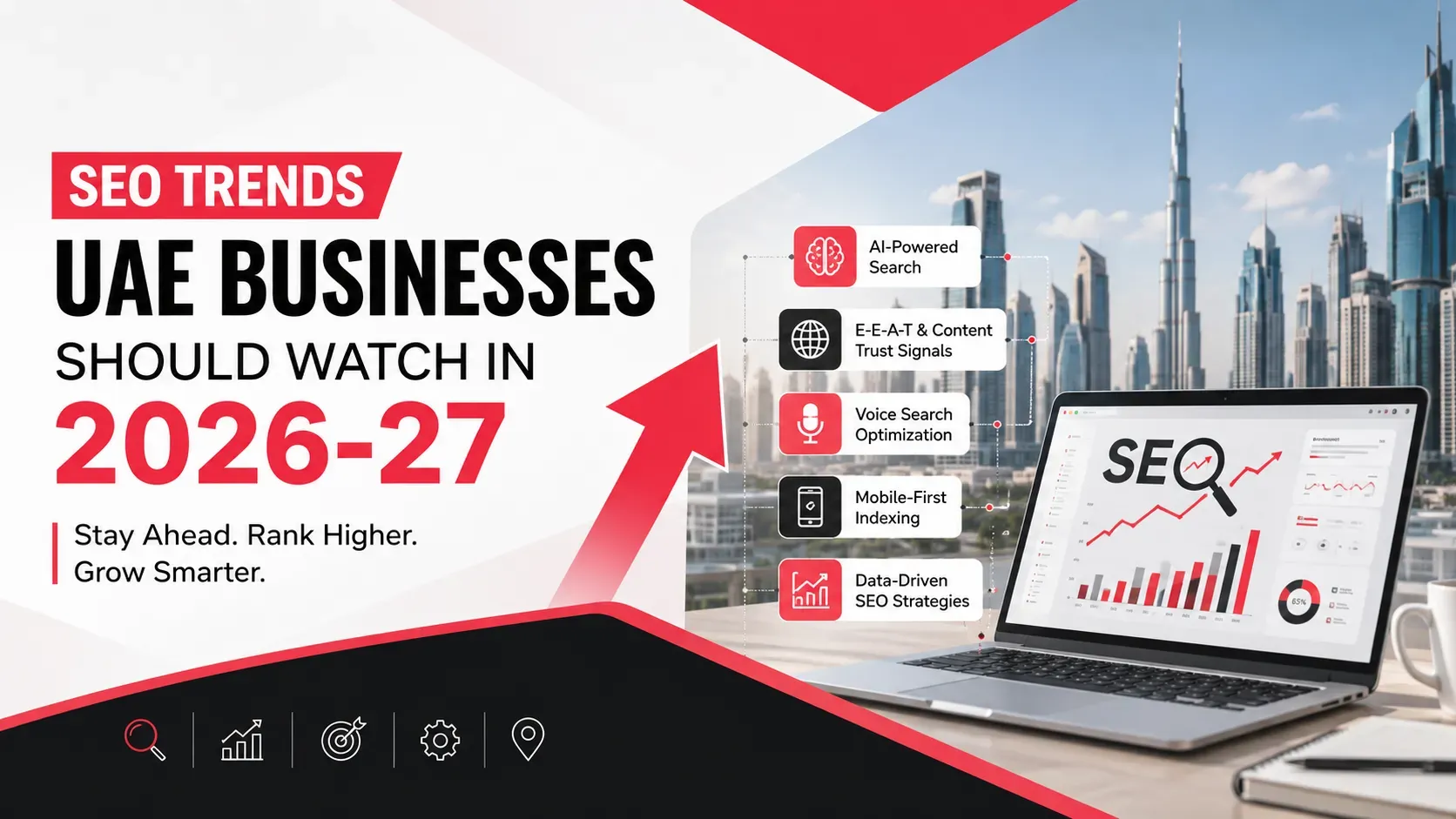
SEO in the UAE is entering a more complicated phase. Ranking on the first page of Google still matters, but the way people discover businesses is changing.
Searchers increasingly use longer, conversational queries, AI-assisted search experiences, local results, maps, reviews, social platforms and multiple digital touchpoints before deciding which business to trust.
For UAE businesses, the next stage of SEO is therefore less about chasing individual rankings and more about becoming visible, understandable and credible wherever customers search for answers.
Quick Answer: What SEO Trends Should UAE Businesses Watch in 2026–27?
The most important SEO trends for UAE businesses are:
- AI Overviews and AI Mode changing how search results are consumed
- Optimizing for conversational and follow-up searches
- Stronger emphasis on topical authority and first-hand expertise
- Local SEO becoming more important for location-based decisions
- Entity and brand visibility beyond individual keywords
- Faster, cleaner websites that are easy for users and search systems to access
- Content designed to answer specific customer problems rather than generate keyword traffic
- Greater importance of reviews, reputation and third-party signals
- Search visibility being measured beyond traditional blue-link rankings
- More integration between SEO, content, digital PR and other digital channels
These trends do not mean traditional SEO is disappearing. Google says its generative AI search experiences are built on core Search ranking and quality systems, meaning foundational SEO remains important.
1. AI Search Will Change What “Ranking” Means
One of the biggest SEO developments heading into 2026–27 is the growing presence of AI-generated search experiences.
Google's AI Overviews and AI Mode can synthesize information from multiple sources instead of simply presenting a list of links. Google now provides guidance specifically for website owners on appearing in these experiences.
This creates a different visibility question for businesses:
Is your website only ranking, or is your brand also being understood and referenced when an AI-generated answer is created?
That does not mean businesses need to abandon conventional SEO and chase a separate "AI algorithm."
Google explicitly states that there are no special technical requirements or separate optimization rules for its generative AI features. The same fundamentals like crawlable pages, useful content, strong technical foundations and quality signals remain important.
For UAE businesses, the practical opportunity is to make important information exceptionally clear:
- What the business offers
- Who it serves
- Where it operates
- What makes it different
- Which problems it solves
- What evidence supports its claims
The clearer the information, the easier it is for both users and search systems to interpret.
2. Conversational Search Will Become More Important
People do not always search the way they type keywords into an SEO tool.
Someone looking for accounting services in Dubai might search:
"accounting services Dubai"
But another person may ask:
"Which accounting service should a small business in Dubai use for monthly bookkeeping and VAT?"
The second query contains more context, intent and constraints.
AI-assisted search encourages this type of behavior because users can ask follow-up questions instead of starting a completely new search each time.
This means UAE businesses should create content around questions, situations and decisions, not just keyword variations.
Useful content could address:
- Which service is suitable for a particular business?
- What does a process involve?
- What does it cost?
- What documents are required?
- What mistakes should customers avoid?
- How do two options compare?
- What should a buyer check before choosing a provider?
The goal is not to predict every possible query. It is to understand the customer's decision-making process.
3. Topical Authority Will Matter More Than Isolated Keywords
Publishing one article for every keyword can create a fragmented website.
A stronger strategy is to build connected coverage around important business subjects.
For example, a UAE e-commerce company could build a content ecosystem around:
E-commerce SEO → product-page optimization → category-page SEO → technical SEO → conversion optimization → local search → payment experience
Each page addresses a different need while reinforcing the site's broader understanding of the subject.
This is where topical relevance becomes important.
Google's systems use relationships between words, concepts and passages to understand what pages are about. Businesses should therefore think in terms of topics and entities, not simply keyword repetition.
Our guide on how Google understands content relevance explores this principle in more detail.
For 2026–27, businesses should ask:
Then build useful coverage around that subject.
4. Local SEO Will Become More Strategic for UAE Businesses
Local SEO remains particularly important in a market where location can strongly influence purchasing decisions.
A customer searching for a service in Dubai, Abu Dhabi or Sharjah may care about more than whether a business mentions the city on its website.
They may want to know:
- Is the business actually serving my area?
- Where is it located?
- What areas does it cover?
- What do local customers say about it?
- Is the service available nearby?
- How quickly can I get help?
- Does the company understand the local market?
That makes local relevance much more than adding city names to landing pages.
Businesses should strengthen their Google Business Profile, maintain accurate business information, collect genuine customer reviews, build locally relevant content and ensure important location information is consistent across the web.
For service-area businesses, genuinely useful location pages can also help but only when those pages provide information that is meaningful for the particular area.
5. Brand and Entity Visibility Will Matter Alongside Keywords
Traditional SEO often asks:
"Which keywords does our website rank for?"
The broader question is:
"How is our business understood across the web?"
A business may appear through:
- Its website
- Google Business Profile
- Reviews
- Industry publications
- Social profiles
- Business directories
- News coverage
- Expert contributions
- Customer discussions
- Product or service references
This creates an entity-level view of visibility.
A strong business should be consistently represented across relevant sources, with accurate information about its name, services, location and expertise.
That is particularly important as search experiences increasingly combine information from multiple sources.
However, businesses should not try to manufacture mentions simply because they believe AI systems reward them. Google's AI-search guidance specifically cautions against pursuing inauthentic mentions; quality and relevance remain important.
6. First-Hand Expertise Will Become a Bigger Content Advantage
The internet already contains enormous amounts of generic information.
The competitive advantage is increasingly what your business knows that a generic article cannot easily reproduce.
Consider two articles about website development.
One summarizes information available across dozens of websites.
The other explains:
- Common problems encountered during real projects
- Technical decisions the team regularly makes
- Mistakes clients often make
- Examples from actual implementations
- Before-and-after observations
- Practical recommendations from experience
The second has a much stronger reason to exist.
Google's people-first guidance encourages original, substantial and useful content rather than content created primarily to attract search traffic.
For UAE businesses, this could mean turning internal expertise into:
- Case studies
- Original research
- Expert commentary
- Industry observations
- Data-driven articles
- Detailed guides
- Comparison resources
- Real project examples
In 2026–27, expertise itself can become a content asset.
7. Technical SEO Will Become More Closely Connected to AI Visibility
Technical SEO has never been only about rankings.
It determines whether search systems can efficiently access, understand and interpret a website.
That becomes even more relevant when AI-powered search systems need to retrieve information from websites.
Google continues to emphasize foundational requirements such as crawlability, indexability and technically accessible content for AI search experiences.
UAE businesses should therefore pay attention to:
- Mobile usability
- Page speed
- Core Web Vitals
- Crawlability
- Indexation
- Internal linking
- Structured data
- Canonicalization
- JavaScript rendering
- Image optimization
- Clear site architecture
A beautiful website that search engines cannot efficiently understand is still an SEO problem.
8. SEO Measurement Will Move Beyond Rankings
A ranking report can tell you where a page appears.
It cannot tell you the entire value of SEO.
This is becoming even more important as AI search changes how users interact with results.
In June 2026, Google introduced dedicated Search Console reporting for visibility from generative AI features, including AI Overviews and AI Mode, with the data also contributing to the broader Search performance picture.
This gives businesses another reason to rethink measurement.
Instead of tracking only:
"Are we position #3?"
also track:
- Organic impressions
- Qualified organic traffic
- Leads
- Sales
- Conversion rates
- Branded searches
- Local visibility
- Important query groups
- AI-search visibility where available
- Assisted conversions
The most valuable SEO traffic is not necessarily the largest traffic source. It is the traffic that reaches the right audience at the right stage of the buying journey.
9. Zero-Click Searches Will Make Brand Visibility More Valuable
A customer does not always need to click a website to learn something.
Search results can provide:
- Business information
- Reviews
- Maps
- Featured snippets
- AI-generated answers
- Direct answers
- Product information
This means fewer searches may result in a traditional website visit in some situations.
But that does not make SEO irrelevant.
It changes the value proposition.
A business can gain visibility by being:
- Mentioned
- Referenced
- Displayed
- Recommended
- Seen in local results
- Associated with an answer
- Recognized as a credible source
The website still matters because deeper research, comparisons and conversions often happen there.
The important shift is to treat SEO as visibility across the search journey, rather than only website clicks.
10. Search Reputation Will Become Part of SEO Strategy
Customers rarely evaluate a company using its website alone.
Before making a decision, they may check reviews, social profiles, news coverage, forums, directories or other independent sources.
That means a company can have technically excellent SEO while still losing customers because its broader online reputation is weak.
For UAE businesses, SEO strategy should increasingly connect with:
- Review management
- Digital PR
- Brand consistency
- Customer experience
- Reputation monitoring
- Expert visibility
This is not about manipulating every mention online.
It is about making sure the public information surrounding the business accurately reflects its actual quality and expertise.
What Should UAE Businesses Do Now?
Businesses do not need to completely rebuild their SEO strategy for 2026–27.
They should evolve it.
A practical roadmap is:
Audit the technical foundation
Check crawlability, indexation, site architecture, performance and mobile experience.
Identify the subjects worth owning
Choose important commercial topics and build genuinely useful topical coverage around them.
Upgrade existing content
Improve outdated pages with original insights, stronger examples, clearer answers and better internal connections.
Strengthen local relevance
Keep business information accurate and create useful location-specific resources where they genuinely help customers.
Build real expertise
Turn internal knowledge, customer questions and project experience into content competitors cannot easily copy.
Measure visibility and business impact
Track conversions and qualified visibility alongside rankings and traffic.
Businesses that need a more structured approach can develop an SEO strategy for UAE businesses that combines technical SEO, content, local search and long-term authority rather than treating each tactic separately.
Key Takeaways
- AI-powered search is changing how customers discover and evaluate information.
- Traditional SEO remains important because Google's AI search experiences rely on its existing Search systems.
- Conversational, problem-based searches require content that addresses real customer questions.
- Topical authority is more valuable than publishing disconnected keyword-focused pages.
- Local SEO should demonstrate genuine local relevance rather than simply repeating city names.
- Brand and entity visibility increasingly matter alongside individual keyword rankings.
- First-hand expertise can differentiate business content from generic AI-generated material.
- Technical SEO remains essential for both traditional and AI-powered search visibility.
- SEO measurement should increasingly focus on visibility, leads, conversions and business value.
Conclusion
The biggest SEO trend for UAE businesses in 2026–27 may not be a single algorithm update or optimization technique.
It is the gradual shift from ranking for keywords to becoming a trusted source of information across increasingly diverse search experiences.
Businesses that build strong technical foundations, demonstrate real expertise, understand local customers and create genuinely useful content will be better positioned as search becomes more conversational and AI-assisted.
The opportunity is not to chase every new SEO buzzword. It is to build a digital presence that search engines, AI systems and most importantly customers can understand and trust.
Milaaj Brandset helps businesses approach SEO as a long-term visibility strategy, combining technical foundations, relevant content and sustainable search growth rather than relying on short-term ranking tactics.
FAQ
Is SEO still important for UAE businesses in 2026–27?
Yes. Google states that its generative AI search experiences are rooted in its existing Search ranking and quality systems, so foundational SEO remains relevant.
Will AI replace traditional SEO?
No. AI is changing how search results are presented and how users interact with them, but websites still need to be crawlable, useful, relevant and technically accessible. Google describes optimizing for AI search as an extension of optimizing the overall search experience.
Should UAE businesses focus on AEO or GEO instead of SEO?
They should not treat them as completely separate disciplines. Google says that AEO and GEO are terms used to describe work around AI-search visibility, while its own systems continue to rely on core SEO and Search practices.
Is local SEO still important in Dubai and the UAE?
Yes. Local search remains important whenever customers choose businesses based on location, service area, proximity, reviews or local relevance. Businesses should focus on genuinely useful local information rather than simply creating pages filled with city names.
How should businesses measure SEO success in 2026–27?
Use a combination of rankings, impressions, qualified organic traffic, leads, conversions, revenue, branded visibility and—where available visibility in generative AI search features. Google introduced dedicated Search Console reporting for generative AI visibility in June 2026, including AI Overviews and AI Mode.
Ready to Elevate Your Brand?
Start Your Project Today