September 4, 2026
Black Hat SEO Mistakes Businesses Should Avoid
Milaaj Editorial / Research Insights
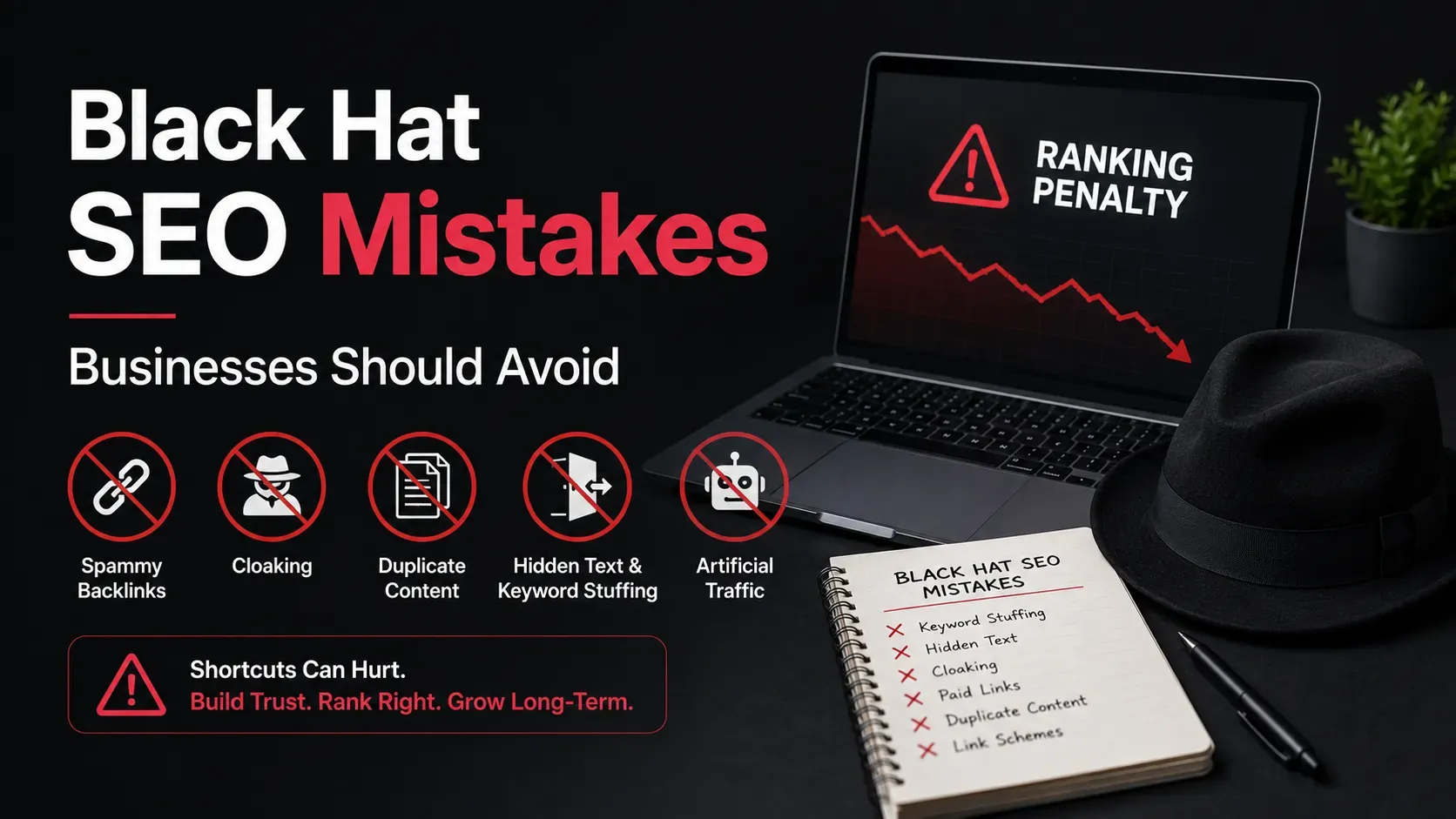
SEO can produce long-term organic visibility, qualified traffic, and valuable leads. But when businesses become too focused on rankings, they can fall into a dangerous trap: using tactics designed to manipulate search engines rather than improve the experience for users.
These tactics are commonly described as black hat SEO.
The problem is not simply that some techniques are outdated. Many deliberately attempt to deceive search engines, manufacture authority, or create pages that exist primarily to manipulate rankings. Google says sites that violate its spam policies may rank lower or disappear from Search altogether.
For a business, that can turn a shortcut into a much bigger problem.
Quick Answer: What Are the Biggest Black Hat SEO Mistakes?
The most serious black hat SEO mistakes include:
- Stuffing keywords into pages unnaturally
- Buying or manipulating backlinks for ranking purposes
- Hiding text or links from visitors
- Using cloaking to show different content to Google and users
- Creating doorway pages for multiple locations or search variations
- Publishing large amounts of low-value automated content
- Manipulating a trusted website's reputation with unrelated third-party content
- Using deceptive redirects or hacked-content injections
- Creating pages primarily to capture search traffic rather than help visitors
The common thread is manipulation. A tactic becomes particularly risky when its primary purpose is to influence search rankings instead of providing genuine value.
Why Black Hat SEO Is a Business Risk, Not Just an SEO Problem
A ranking drop may sound like a marketing problem, but its effects can spread much further.
Organic search may contribute to:
- Website enquiries
- Product discovery
- Lead generation
- Brand visibility
- Local customers
- Online sales
- Reputation
If manipulative SEO causes important pages to lose visibility, the business can lose opportunities that were previously coming from organic search.
There is also a trust issue.
Imagine a company ranking highly for an important service keyword but using hidden content, irrelevant location pages, or purchased links to get there. Even if the tactic produces temporary gains, it does not create a stronger brand.
Google's current guidance emphasizes helpful, reliable, people-first content rather than material created primarily to manipulate rankings.
That makes sustainable SEO fundamentally different from ranking at any cost.
1. Keyword Stuffing Makes Content Look Manipulated
One of the oldest black hat SEO mistakes is excessive keyword repetition.
A business might take a page targeting "SEO company Dubai" and repeatedly insert variations such as:
The page may technically contain the target phrase many times, but it becomes difficult to read.
Google specifically identifies keyword stuffing as filling a page with keywords or numbers in an attempt to manipulate rankings. Examples include unnatural repetition and blocks of location terms.
The better approach
Write around the topic rather than around a keyword count.
A useful page might naturally discuss:
- Search visibility
- Technical optimization
- Search intent
- Content quality
- Local relevance
- Organic traffic
- Conversion opportunities
The primary keyword still matters, but it should fit naturally into the page.
Google's Search Essentials recommends using words people would use to search for your content in prominent locations such as titles and headings. That is very different from repeating the same phrase everywhere.
2. Buying Backlinks Can Turn Authority Building Into Link Spam
Backlinks can help search engines discover and understand websites, but deliberately buying or exchanging links for ranking purposes creates a different situation.
Google's spam policies identify several forms of link spam, including buying or selling links for ranking purposes, excessive link exchanges, automated link creation, and optimized links distributed through certain guest posts or advertisements.
This creates an important distinction:
Earning a link because someone values your content is different from paying specifically for ranking credit.
What businesses should watch for
Be cautious if an SEO provider promises:
- Hundreds of backlinks within days
- Guaranteed high-authority links
- Large networks of websites
- Automated backlink packages
- Exact-match anchor text everywhere
- Links from unrelated websites purely because they have high metrics
A smaller number of genuinely relevant references can be far more useful than a huge artificial link profile.
3. Cloaking Creates Two Different Versions of a Page
Cloaking is particularly deceptive because the content presented to search engines can differ from what users see.
For example, a page could appear highly relevant to a particular service when crawled by a search engine but display something substantially different to visitors.
Google defines cloaking as presenting different content to users and search engines with the intention of manipulating rankings and misleading users.
Not every difference between rendered experiences is cloaking. Websites can legitimately use responsive layouts, JavaScript, accessibility features, and other technologies.
The problem is deliberate manipulation of what search engines see.
If a business needs search engines to understand dynamic content, the solution should be better technical implementation—not deception.
4. Hidden Text and Links Are Not a Secret Ranking Advantage
Some websites have historically attempted to add ranking signals without visibly adding content for users.
Examples include:
- White text on a white background
- Text positioned outside the visible screen
- Zero-sized text
- Hidden links
- Invisible keyword blocks
Google explicitly classifies hidden text and link abuse as spam when the purpose is to manipulate search engines rather than serve visitors.
There is an important distinction here.
Modern websites legitimately hide content inside:
- Accordions
- Tabs
- Tooltips
- Mobile interfaces
- Accessible components
Google says these types of user-experience elements are not automatically violations.
The issue is whether the content is being hidden for manipulation.
5. Doorway Pages Can Create a Website Full of Near-Duplicates
Businesses operating across multiple cities sometimes make another mistake: creating dozens of almost identical pages simply by changing the location name.
For example:
- SEO Company Dubai
- SEO Company Sharjah
- SEO Company Abu Dhabi
- SEO Company Ajman
If each page provides genuinely useful, locally relevant information, there may be a legitimate reason for separate pages.
But creating substantially similar pages simply to capture variations of search queries can become doorway abuse.
Google describes doorway abuse as creating pages designed to rank for specific similar searches while ultimately funneling users toward the same destination. It specifically includes pages targeting different cities or regions that funnel users toward one page.
A better local SEO model
Instead of changing only the city name, ask:
What is actually different for a customer in this location?
Useful local pages might include genuinely different:
- Services
- Customer needs
- Market conditions
- Areas served
- Case studies
- Business information
- FAQs
- Local examples
Local relevance should be meaningful, not cosmetic.
For a broader look at organizing related content without creating artificial structures, see our guide to SEO silo structure.
6. Publishing Hundreds of Low-Value Pages Is Not an SEO Strategy
Another increasingly important black hat SEO risk is scaled content abuse.
The technology used to create content does not automatically make it spam. The problem occurs when businesses produce large quantities of unoriginal, low-value pages primarily to manipulate search visibility.
Google's current spam documentation specifically includes generating many pages with AI or other automated tools without adding value, scraping content, combining material from multiple sources without meaningful improvement, and producing pages that contain keywords but little useful meaning.
This is particularly relevant when businesses think:
Search does not work that simply.
A smaller library of genuinely useful resources can create a stronger topical presence than hundreds of nearly interchangeable pages.
7. Using a Trusted Website to Rank Unrelated Content Can Backfire
Google's site reputation policy addresses another form of manipulation: publishing third-party content on an established, trusted website primarily to exploit that site's reputation and improve rankings.
This can happen when a website suddenly publishes large amounts of unrelated commercial content simply because its existing domain has authority.
Google updated its site reputation policy in August 2026 and continues to treat manipulation of established site reputation as a search-quality concern.
For businesses, the lesson is simple:
Domain authority should not become a license to publish anything that might rank.
Content should make sense for the site's audience, subject matter, and purpose.
8. Automated SEO Should Not Replace Human Judgment
Automation can be useful for research, analysis, reporting, content organization, and repetitive tasks.
The mistake is allowing automation to become the entire strategy.
Google's guidance does not say that using AI automatically violates its policies. Instead, it warns against using generative AI or other automated systems to produce large amounts of content without adding value, particularly when the purpose is to manipulate rankings.
A healthier workflow is:
Research → automation where useful → expert review → original insight → editing → publishing → measurement
The human contribution is what turns information into something genuinely useful.
9. Manipulative SEO Often Starts With the Wrong Question
One of the easiest ways for a business to drift toward black hat SEO is to ask:
A better question is:
That change in thinking affects everything.
Instead of asking how many keywords can be inserted, you ask whether the page answers the customer's question.
Instead of asking how many backlinks can be purchased, you ask what would make another website want to reference the business.
Instead of creating 50 location pages, you ask whether customers in those locations genuinely need different information.
This is the difference between search-engine-first SEO and people-first SEO.
Google's current helpful-content guidance encourages original, substantial, insightful content and warns against creating material primarily to attract search-engine visits.
What Should Businesses Do Instead?
Avoiding black hat SEO does not mean avoiding optimization.
It means putting effort into areas that create value for both users and search engines.
Focus on:
Build useful content
Create resources that answer real customer questions and add information beyond what is already obvious.
Improve technical foundations
Make important pages accessible, crawlable, fast, usable, and logically structured.
Earn relevant authority
Create research, insights, tools, data, case studies, or genuinely useful resources that others have a reason to reference.
Strengthen topical relevance
Connect related pages naturally so users and search engines can understand how subjects relate to one another.
For example, our guide on [how Google understands content relevance] explores why relationships between topics and concepts matter when building useful content.
Measure business outcomes
Do not judge SEO entirely by ranking position.
Look at:
- Qualified organic traffic
- Leads
- Conversions
- Revenue
- Engagement
- Relevant keyword visibility
- Returning visitors
A ranking that produces no meaningful business value is not necessarily a successful SEO result.
How to Spot a Black Hat SEO Provider Before Hiring One
Businesses should be especially cautious when an SEO provider promises results without explaining the process.
Warning signs include:
- Guaranteed first-page rankings
- Thousands of backlinks for a fixed low price
- Secret SEO techniques
- Immediate ranking promises
- No explanation of link sources
- Large quantities of automatically generated content
- Exact-match keywords everywhere
- Doorway pages for every city
- Refusal to provide reports
- Claims that Google penalties can simply be "bypassed"
A credible SEO strategy should be explainable.
If a provider cannot tell you what they are doing to your website, where links are coming from, what content is being created, or why a particular tactic is necessary, that lack of transparency is itself a warning sign.
What If Your Website Has Already Used Black Hat SEO?
Do not panic, but do not ignore it either.
Start with an audit.
Review:
- Existing backlinks
- Suspicious anchor-text patterns
- Duplicate or doorway pages
- Hidden content
- Unexpected redirects
- Automatically generated pages
- Thin or irrelevant content
- Unusual traffic and ranking changes
- Search Console notifications or manual actions
Then separate genuine problems from tactics that are simply misunderstood.
Not every ranking decline means a penalty, and not every unusual SEO implementation is spam.
The goal is to identify what is actually happening before making large-scale changes.
For businesses that need to replace risky tactics with a sustainable approach, an ethical SEO strategy for Dubai businesses can bring technical SEO, content, search intent, and long-term visibility into one structured plan.
Key Takeaways
- Black hat SEO focuses on manipulating search systems rather than improving user value.
- Keyword stuffing can make content unnatural and may violate Google's spam policies.
- Buying or manipulating backlinks can create link-spam risks.
- Cloaking and hidden content become problematic when used to deceive or manipulate search engines.
- Doorway pages can create large numbers of low-value, near-duplicate pages.
- Automated content becomes risky when it is produced at scale without meaningful originality or value.
- Established websites should not be exploited to rank unrelated third-party content.
- Sustainable SEO focuses on useful content, technical quality, relevance, authority, and business outcomes.
Conclusion
Black hat SEO mistakes are often attractive because they promise a shortcut. The problem is that shortcuts built around manipulation rarely create the kind of search visibility a business can depend on for years.
A stronger approach is to build content people genuinely want, make websites easy to understand and use, earn relevant authority, and continuously improve based on evidence.
That approach may not produce overnight results, but it creates an SEO foundation that is much easier to defend, improve, and connect to real business growth.
Milaaj Brandset takes a white-hat, sustainable approach to SEO, focusing on long-term search visibility rather than short-lived ranking tricks.
FAQ
Is black hat SEO illegal?
Black hat SEO is not automatically illegal. However, some tactics can violate search-engine policies, contractual requirements, advertising rules, or other laws depending on how they are used. The main SEO concern is whether the practice manipulates search results or deceives users.
Can black hat SEO permanently damage a website?
It can create serious and long-lasting problems, particularly when a website accumulates manipulative links, large amounts of low-value content, deceptive pages, or other spam signals. Recovery depends on what happened and how thoroughly the underlying problems are addressed.
Is buying backlinks always black hat SEO?
No. Paid links used for legitimate advertising or sponsorship are not necessarily a problem. Google specifically distinguishes normal advertising from links intended to manipulate ranking credit; paid links should be appropriately qualified when required.
Is AI-generated content black hat SEO?
Not automatically. Google focuses on the value and purpose of the content rather than simply whether AI was involved. Using AI to produce large amounts of unoriginal content primarily to manipulate rankings can fall under scaled content abuse.
What is the safest SEO approach for a business?
Build a people-first strategy around useful content, technically sound websites, relevant internal linking, genuine authority, clear search intent, and continuous measurement. SEO should support the customer's journey rather than attempt to trick search engines.
Ready to Elevate Your Brand?
Start Your Project Today