July 28, 2026
Display Advertising Strategies for UAE Businesses
Milaaj Editorial / Research Insights
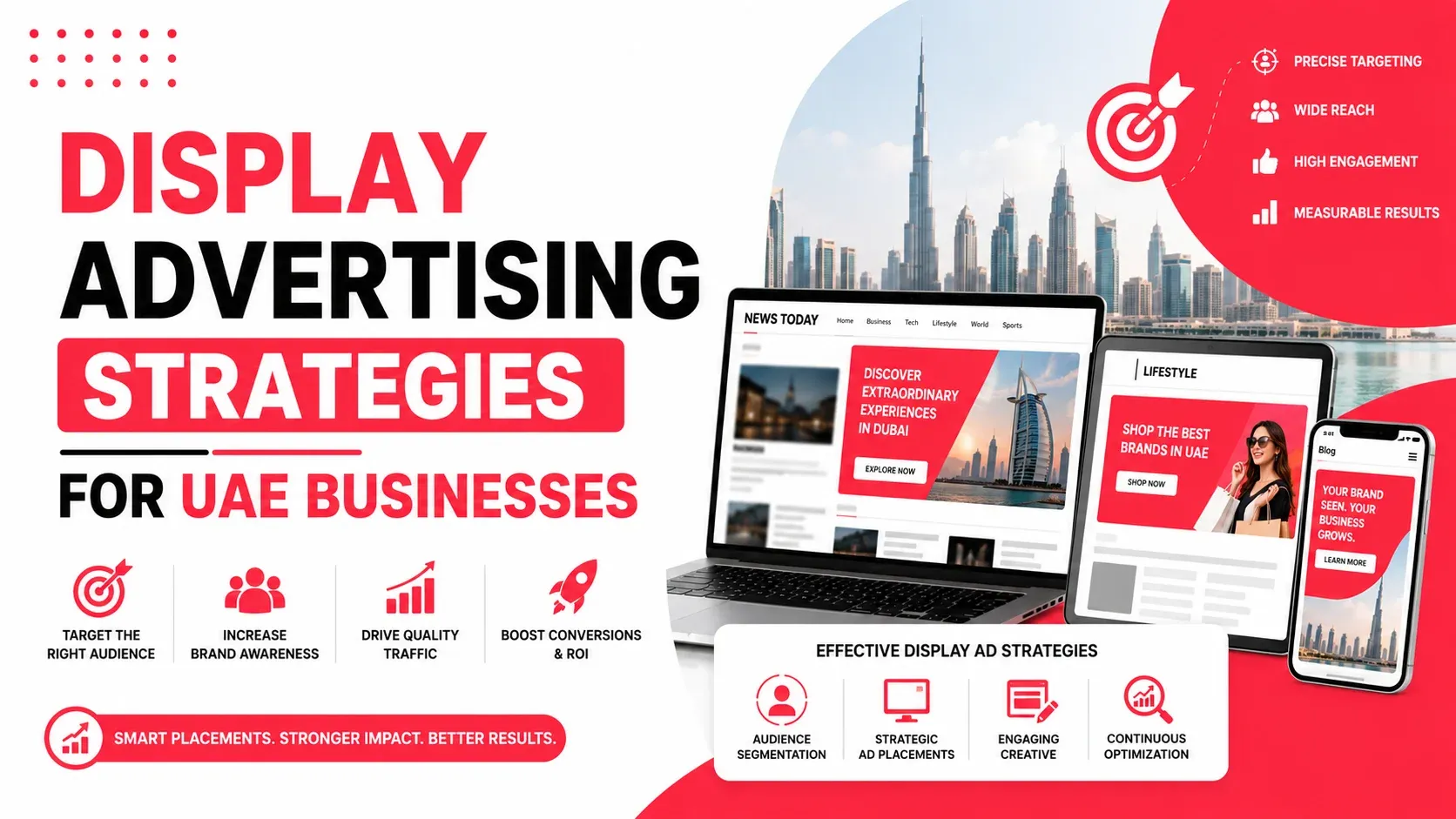
Display advertising has become an essential part of digital marketing for businesses looking to build brand awareness, stay visible throughout the customer journey, and reconnect with potential customers after they leave a website. Unlike search advertising, which targets users actively looking for a solution, display advertising reaches audiences while they browse websites, watch videos, use mobile apps, or check their email.
For businesses operating in the UAE, display advertising offers an opportunity to engage a highly connected, multilingual audience across multiple digital touchpoints. Success, however, depends on more than simply creating attractive banner ads. Effective campaigns require precise audience targeting, compelling creatives, strategic placements, and continuous optimization.
This guide explains how UAE businesses can develop a display advertising strategy that supports brand visibility, customer engagement, and measurable business growth.
Quick Answer
Display advertising works best when businesses combine audience segmentation, high-quality creative assets, location-specific targeting, remarketing, and ongoing performance optimization. Rather than targeting everyone, successful UAE campaigns deliver relevant visual advertisements to carefully selected audiences across websites, apps, YouTube, and Gmail. Google recommends using responsive display ads with multiple high-quality assets so its systems can optimize combinations for different placements.
What Is Display Advertising?
Display advertising refers to visually rich advertisements shown across websites, mobile applications, video platforms, and other digital properties.
Unlike traditional text-based search ads, display advertisements use elements such as:
- Images
- Graphics
- Logos
- Headlines
- Videos
- Interactive creative
Google Display campaigns can reach users across millions of websites, apps, YouTube, and Gmail, helping businesses expand beyond search-based advertising. Google continues to enhance these campaigns with AI-powered optimization and responsive creative formats.
Why Display Advertising Matters for UAE Businesses
The UAE has one of the world's most digitally connected populations, with consumers regularly using search engines, social media platforms, video streaming services, online news portals, and mobile applications.
Display advertising helps businesses:
- Increase brand awareness
- Stay visible during longer buying journeys
- Support product launches
- Reach new customer segments
- Re-engage previous website visitors
- Complement search advertising campaigns
Because many purchasing decisions involve multiple online interactions, display advertising helps keep businesses visible before customers are ready to convert.
Understand the Display Advertising Funnel
Display advertising supports different stages of the customer journey.
Customer Stage | Display Advertising Objective |
|---|---|
Awareness | Introduce the brand to new audiences |
Consideration | Educate and build trust |
Decision | Encourage enquiries or purchases |
Retention | Reconnect with previous customers |
Campaign objectives should align with the stage of the buying journey rather than using the same messaging for every audience.
Define Clear Campaign Goals
Before launching a display campaign, establish measurable objectives.
Common goals include:
- Brand awareness
- Website traffic
- Lead generation
- Product promotion
- Event registrations
- App downloads
- Customer retention
Clearly defined objectives influence every aspect of campaign planning, including audience targeting, bidding strategy, creative design, and performance measurement.
Identify Your Target Audience
One of the biggest advantages of display advertising is audience targeting.
Rather than displaying advertisements to everyone, businesses can reach people based on specific characteristics and behaviours.
Useful audience segments include:
Demographic Targeting
Reach audiences based on:
- Age
- Gender
- Household status
- Income (where available)
Interest-Based Targeting
Google identifies users who consistently engage with topics such as:
- Technology
- Finance
- Travel
- Healthcare
- Education
- Automotive
Interest targeting helps introduce brands to users who may not yet be actively searching.
In-Market Audiences
These audiences consist of users who are actively researching products or services and are considered closer to making a purchase.
Examples include:
- Home buyers
- Business software buyers
- Insurance shoppers
- Vehicle buyers
- Travel planners
For many businesses, in-market audiences generate more qualified traffic than broad awareness campaigns.
Custom Audience Segments
Businesses can build audiences using:
- Relevant keywords
- Competitor websites
- Industry-specific URLs
- Customer interests
- Search behaviour
Custom audiences provide greater control over campaign targeting.
Use Geographic Targeting Effectively
For UAE businesses, location targeting is essential.
Rather than targeting the entire country with identical messaging, campaigns can be tailored to individual Emirates or service areas.
Examples include:
- Dubai
- Abu Dhabi
- Sharjah
- Ajman
- Ras Al Khaimah
- Fujairah
Businesses serving specific locations can also adjust messaging, offers, or creative assets to reflect regional audiences. Localized targeting is particularly valuable in the UAE because consumer behaviour, language preferences, and service availability often vary between Emirates.
Consider Multilingual Audiences
The UAE serves a highly diverse population.
Many users browse in:
- English
- Arabic
Some users also switch between languages depending on the product or service.
Businesses should consider:
- Localized headlines
- Language-specific landing pages
- Regionally relevant imagery
- Culturally appropriate messaging
Rather than translating advertisements directly, adapt messaging to suit each audience segment.
Create High-Quality Display Ad Creatives
Creative quality is often the biggest factor influencing display campaign performance.
Strong display advertisements should:
- Focus on one clear message
- Use high-resolution images
- Include concise headlines
- Feature recognizable branding
- Highlight a clear value proposition
- Contain a strong call to action
Google also recommends avoiding excessive text overlays, low-quality images, cluttered layouts, and decorative elements that distract from the main product or service. Responsive display ads perform best when advertisers provide multiple headlines, descriptions, images, and logos, allowing Google's systems to assemble the most effective combinations for different placements.
Businesses using display advertising services often achieve better results by continuously refreshing creative assets instead of relying on the same banner designs for extended periods.
Use Responsive Display Ads
Responsive Display Ads automatically adjust their size, appearance, and format to fit available advertising placements.
Advertisers upload:
- Headlines
- Descriptions
- Images
- Logos
Google then tests different asset combinations to identify those most likely to achieve campaign objectives across websites, apps, Gmail, and YouTube. This approach also increases inventory eligibility and allows campaigns to adapt to a wide range of devices and placements.
If you're planning display campaigns alongside search advertising, read our guide on PPC Keyword Research Strategy for UAE Campaigns to understand how audience targeting and keyword strategy complement each other across paid advertising campaigns.
Strengthen Campaigns With Remarketing
Not every visitor converts during their first interaction with your business. Display advertising allows businesses to reconnect with users who have already shown interest through remarketing.
Remarketing helps businesses stay visible by showing relevant ads to audiences who have previously:
- Visited a website
- Viewed a product or service
- Started but did not complete a purchase
- Submitted part of a form
- Engaged with a mobile application
- Watched videos on YouTube
Since these users are already familiar with your business, remarketing campaigns often generate stronger engagement than campaigns targeting completely new audiences.
Google also supports dynamic remarketing for eligible businesses, allowing ads to automatically display products or services that users previously viewed, creating a more personalized experience.
Select the Right Bidding Strategy
Your bidding strategy should reflect your campaign objective.
Common options include:
Campaign Goal | Recommended Bidding Strategy |
|---|---|
Brand Awareness | Target CPM |
Website Traffic | Maximize Clicks |
Lead Generation | Maximize Conversions |
Sales | Target CPA or Maximize Conversion Value |
Revenue Growth | Target ROAS |
Rather than choosing a bidding strategy based solely on budget, select one that aligns with the results you want to achieve.
Design Landing Pages That Match Your Ads
A display advertisement creates expectations that the landing page should immediately fulfill.
Maintain consistency by ensuring:
- Headlines reflect the advertisement.
- Images match campaign visuals.
- Offers remain consistent.
- Calls to action are prominent.
- Navigation is simple.
- Pages load quickly on desktop and mobile devices.
A seamless transition from advertisement to landing page improves user experience and supports higher conversion rates.
Businesses offering Google Display Network management often create dedicated landing pages for individual campaigns instead of directing all traffic to a homepage, resulting in more relevant user experiences.
Optimize for Mobile Users
Most display advertising impressions occur on mobile devices.
To provide a better experience:
- Use responsive landing pages.
- Optimize image sizes.
- Ensure buttons are easy to tap.
- Keep forms short.
- Maintain readable font sizes.
- Reduce unnecessary pop-ups.
A mobile-first approach helps maximize engagement across smartphones and tablets.
Monitor Campaign Performance
Display campaigns should be reviewed regularly rather than left running without optimization.
Key metrics include:
- Impressions
- Reach
- Click-through rate (CTR)
- Conversion rate
- Cost per click (CPC)
- Cost per acquisition (CPA)
- Return on ad spend (ROAS)
- View-through conversions
- Frequency
- Audience engagement
Evaluating these metrics together provides a clearer understanding of campaign effectiveness than focusing on clicks alone.
Test and Refresh Creative Assets
Display advertising performance often declines when audiences repeatedly see the same creative.
To reduce ad fatigue:
- Rotate banner designs.
- Test different headlines.
- Experiment with new calls to action.
- Update imagery periodically.
- Introduce seasonal promotions.
- Refresh value propositions.
Continuous creative testing helps maintain audience interest while improving long-term campaign performance.
Common Display Advertising Mistakes
Many display campaigns fail because they overlook basic strategy and optimization principles.
Mistake | Better Approach |
|---|---|
Targeting overly broad audiences | Build segmented audiences based on intent and demographics |
Using generic banner designs | Create campaign-specific creatives with one clear message |
Ignoring remarketing opportunities | Re-engage previous website visitors with tailored ads |
Sending traffic to generic pages | Use dedicated landing pages aligned with the advertisement |
Running campaigns without testing | Continuously optimize creatives, audiences, and bidding |
Using one creative for every audience | Personalize messaging for different customer segments |
Ignoring mobile optimization | Design creatives and landing pages for mobile-first experiences |
Avoiding these mistakes improves campaign relevance and helps advertising budgets generate better results.
Integrate Display Advertising With Your Marketing Strategy
Display advertising delivers the strongest results when combined with other digital marketing channels.
For example:
- Search advertising captures users actively looking for solutions.
- Display advertising increases brand visibility before and after search.
- Content marketing educates potential customers.
- Email marketing nurtures leads.
- Social media reinforces brand recognition.
- Remarketing reconnects with interested visitors.
An integrated strategy ensures customers encounter consistent messaging throughout their buying journey.
To improve what happens after users click your display ads, read our guide on How to Optimize Google Ads Landing Pages for practical strategies on creating landing pages that encourage more enquiries and conversions.
Key Takeaways
- Display advertising helps businesses reach audiences beyond search engines.
- Audience segmentation is more effective than broad targeting.
- Geographic and multilingual targeting are especially valuable for UAE campaigns.
- Responsive Display Ads improve reach across multiple placements.
- Remarketing keeps businesses visible throughout longer buying journeys.
- Creative testing and performance optimization should be ongoing processes.
- Landing page relevance plays a significant role in campaign success.
Build Stronger Brand Visibility With Display Advertising
Display advertising is more than placing banners across websites—it is about reaching the right audience with the right message at the right time. By combining strategic audience targeting, compelling creative assets, localized messaging, remarketing, and continuous optimization, businesses can increase brand awareness while supporting measurable marketing objectives.
For UAE businesses, tailoring campaigns to regional audiences, maintaining consistent messaging, and using data to refine performance can transform display advertising into a valuable long-term growth channel.
Milaaj Brandset helps businesses develop performance-driven display advertising strategies that combine audience insights, creative excellence, and ongoing optimization to maximize brand visibility, customer engagement, and business growth.
FAQs
What is display advertising?
Display advertising uses visual advertisements such as banners, images, videos, and responsive ads to reach users across websites, mobile apps, YouTube, Gmail, and other digital platforms.
How is display advertising different from search advertising?
Search advertising targets users actively searching for specific products or services, while display advertising introduces your brand to audiences as they browse online content, helping build awareness and encourage future engagement.
Why is remarketing important?
Remarketing allows businesses to reconnect with users who have previously interacted with their website or advertisements, increasing the likelihood of conversion by keeping the brand visible during the decision-making process.
Should UAE businesses create separate campaigns for different Emirates?
In many cases, yes. Separate campaigns for locations such as Dubai, Abu Dhabi, or Sharjah allow businesses to tailor messaging, budgets, and audience targeting based on regional demand and service availability.
What are Responsive Display Ads?
Responsive Display Ads automatically combine uploaded headlines, descriptions, images, and logos to create advertisements that fit different placements across the Google Display Network, YouTube, Gmail, and mobile applications.
Which metrics are most important for display advertising?
Businesses should monitor impressions, reach, click-through rate (CTR), conversion rate, cost per acquisition (CPA), return on ad spend (ROAS), view-through conversions, and overall engagement to evaluate campaign performance.
Ready to Elevate Your Brand?
Start Your Project Today